 Verified reviewer
Pros & cons.
- +Glyceryl glucoside (Deep Moisture Technology) activates aquaporin-3 water channels for internal moisture transport
- +Classic emollient system with mineral oil, microcrystalline wax, glycerin, and sweet almond oil
- +Rich, nourishing texture that absorbs to a non-greasy satin finish
- +Excellent value in local markets (Europe, UK, Australia) at standard retail pricing
- +Over 110 years of Beiersdorf emollient formulation expertise behind the product
- +Made in Germany with 50% recycled plastic packaging
- −Six individually listed fragrance allergens per EU labeling — not suitable for fragrance-sensitive skin
- −Not readily available in the US — requires importing at 50-100% markup over domestic equivalent
- −US-market Essentially Enriched offers similar benefits at lower cost and easier availability
- −Mineral oil and microcrystalline wax are dealbreakers for clean beauty consumers
- −Thick texture takes 1-2 minutes to absorb — not ideal for people in a rush
The full review.
The global skincare market has a quiet irony: brands often sell different products in different countries under similar names without explaining why. Nivea’s Rich Nourishing Body Lotion and its US-market counterpart, Essentially Enriched, share a sweet almond oil and glycerin foundation, a white pump bottle, and a brand heritage from 1911. However, the formulations diverge in ways that matter for moisturizer performance.
The main difference is glyceryl glucoside—Nivea’s proprietary Deep Moisture Technology ingredient. It does not appear in the American version. Glyceryl glucoside is a plant-derived sugar compound that activates aquaporin-3 water channels in the epidermis. Aquaporins are proteins in cell membranes that act as molecular water pipes to move water between cells. By stimulating these channels, glyceryl glucoside helps the skin distribute moisture internally instead of relying only on topical humectants on the surface. This is a different approach: instead of just adding water, you help the skin move water where it needs to go.
Beiersdorf—Nivea’s parent company, founded in 1882 by a pharmacist working with a dermatologist—has published research on the glyceryl glucoside mechanism. The science is real, though the formula does not disclose the concentration. No head-to-head consumer study has established the clinical difference between using a product with glyceryl glucoside versus one with petrolatum and hyaluronic acid (like the US version). Both approaches work. The question is whether the aquaporin activation pathway provides superior deep hydration.
The rest of the formula uses classic Nivea emollient engineering. Mineral oil and microcrystalline wax form the occlusive barrier—the international version uses wax where the US version uses petrolatum. Glycerin provides surface-level humectant attraction. Sweet almond oil adds fatty acid nourishment and the product’s warm, nutty scent. The base ingredients overlap about 70% between the two versions; the hydration mechanism and the occlusive choice differentiate them.
On the skin, the Rich Nourishing version feels slightly thicker than the US Essentially Enriched—more like a body milk than a lotion. It spreads with a creamy texture that signals it is for serious dryness without feeling like a heavy ointment. Absorption takes one to two minutes, which is longer than lightweight lotions, but the result is a soft, satin finish without obvious greasiness. It seals in surface moisture effectively when applied to damp skin after a shower.
The fragrance situation shows the most visible divergence. Both have similar scent profiles, but EU regulations require disclosure of 26 known fragrance allergens if they exceed 0.001% in leave-on products. The Rich Nourishing ingredient list shows linalool, limonene, benzyl alcohol, geraniol, citronellol, and alpha-isomethyl ionone—six individual allergens that the US version hides behind the single word “Fragrance.” The actual fragrance content is likely similar; the European label is just more transparent. This transparency provides valuable information for consumers with known fragrance sensitivities. For others, comparing the two ingredient lists side by side can look alarming.
For US consumers, the practical question is whether importing this product at twelve to fifteen dollars for 400 mL beats buying the domestic Essentially Enriched at seven dollars for 500 mL. From a cost perspective, the answer is no. The US version provides more product for less money and includes sodium hyaluronate in its 2025 reformulation. The glyceryl glucoside in the international version is scientifically interesting, but whether it creates a noticeably different moisturizing experience on body skin is debatable.
For consumers in the UK, Europe, Australia, or other markets where this is the local version, the equation changes. At local pricing (roughly five to six euros for 400 mL), the Rich Nourishing lotion is an excellent value—a well-formulated dry skin treatment from a brand with over a century of emollient expertise and an innovative hydration ingredient.
Made in Germany at Beiersdorf’s facilities, the product has the manufacturing quality of one of Europe’s oldest personal care companies. The 50% recycled plastic packaging reflects current sustainability commitments. The dermatological testing—conducted by a company that employs its own dermatological researchers—is meaningful.
The bottom line depends on geography. In markets where this is the standard Nivea dry skin offering, it is an excellent, affordable body lotion with a genuine formulation differentiator in glyceryl glucoside. For US consumers, the domestic Essentially Enriched is more practical unless you specifically want the aquaporin-activating ingredient and will pay the import premium.
Formula
Ingredient analysis.
Full INCI list
Aqua, Paraffinum Liquidum, Isohexadecane, Glycerin, Isopropyl Palmitate, Cera Microcristallina, PEG-40 Sorbitan Perisostearate, Polyglyceryl-3 Diisostearate, Prunus Amygdalus Dulcis Oil, Glyceryl Glucoside, Maris Sal, Magnesium Sulfate, Sodium Citrate, Citric Acid, Potassium Sorbate, Linalool, Limonene, Benzyl Alcohol, Geraniol, Citronellol, Alpha-Isomethyl Ionone, Parfum
Skin match.
The science.
The Science
Glyceryl glucoside's mechanism of action is the formula's most distinctive scientific feature. Beiersdorf scientists published research showing glyceryl glucoside upregulates aquaporin-3 (AQP3) expression in keratinocytes. AQP3 is a membrane channel protein that transports water and glycerol across epidermal cell membranes. By increasing AQP3 activity, glyceryl glucoside improves internal moisture distribution — a different approach than applying humectants that attract water to the surface.
Studies in the Journal of Cosmetic Dermatology show formulations with glyceryl glucoside improve skin hydration metrics, reduce transepidermal water loss, and maintain these improvements longer than vehicles without the ingredient. The proposed mechanism is that enhanced AQP3 expression improves water movement from the deeper dermis into the stratum corneum, providing sustained hydration from within.
The occlusive system uses microcrystalline wax instead of the petrolatum found in the US counterpart. Both are hydrocarbon-based occlusives from mineral oil refining and have similar efficacy in reducing TEWL. Microcrystalline wax has a higher melting point and creates a more structured barrier film than softer petrolatum, which may cause the international formulation's thicker texture.
Sweet almond oil does more than provide emolliency. Research in Complementary Therapies in Clinical Practice shows topical almond oil application improves skin barrier function and reduces transepidermal water loss, as linoleic acid supports ceramide synthesis in the stratum corneum.
Dermatologist Perspective
Dermatologists recognize glyceryl glucoside as a scientifically credible hydration-boosting ingredient; Beiersdorf's dermatological research division has published research supporting the aquaporin-3 activation mechanism. Board-certified dermatologists note that while the humectant-occlusive approach of the US Essentially Enriched version works equally well for dry skin, the glyceryl glucoside pathway adds a hydration dimension that targets the skin's own moisture transport infrastructure. Dermatologists advise that either version is clinically appropriate for most patients with dry body skin — the choice depends more on ingredient philosophy and availability than a meaningful difference in outcomes.
Where it fits in your routine.
Apply a thick layer to damp skin right after showering or bathing. The glyceryl glucoside works best when skin has enough water for aquaporin channels to transport. Target dry areas like elbows, knees, shins, and hands. Use twice daily. Wait 1-2 minutes for the thick texture to absorb before dressing. Shake the pump dispenser if the product separates.
In its home markets (Europe, UK, Australia), this product costs about 5-6 EUR for 400 mL, matching or beating comparable body lotions. For US consumers importing it at $12-15 per 400 mL, the value drops because the domestic Essentially Enriched provides 500 mL for approximately $7. The glyceryl glucoside ingredient justifies the premium, but it is questionable if it moisturizes noticeably better than petrolatum + hyaluronic acid at nearly double the effective price for body-level skincare.
This works best for consumers in markets where this is the standard Nivea dry skin offering (Europe, UK, Australia) seeking effective, affordable body care with Nivea's proprietary Deep Moisture Technology. Ingredient enthusiasts interested in glyceryl glucoside's aquaporin-activating mechanism should also import this.
Skip this if the domestic Essentially Enriched is available in the US — it costs less, is easier to find, and works similarly. Avoid this if you are sensitive to fragrance allergens (linalool, limonene, geraniol, etc.) or prefer clean beauty formulations without mineral oil.
Product details.
Thick body milk sits between a standard lotion and a body cream. It spreads easily and absorbs to a soft, non-greasy satin finish within 1-2 minutes.
It has the warm, nutty, sweet almond fragrance typical of the Nivea nourishing range. It contains these EU-labeled fragrance allergens: linalool, limonene, benzyl alcohol, geraniol, citronellol, and alpha-isomethyl ionone.
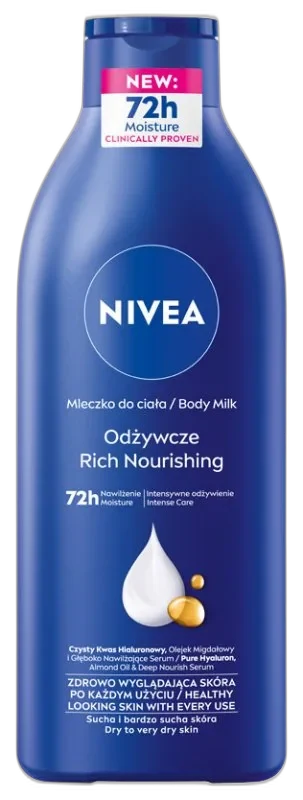
White plastic bottle with dark blue Nivea branding and cap. Sizes include 250 mL, 400 mL, and 625 mL. Larger sizes use pump dispensers. Bottles contain 50% recycled plastic per Nivea's sustainability commitments.
The lotion spreads with a thick texture on damp skin, denser than lightweight body lotions. The almond scent is immediate and pleasant. It absorbs within one to two minutes and leaves skin feeling nourished and smooth. Most users feel no tingling or irritation.
3-5 weeks with twice-daily full-body application for the 400 mL bottle
12 months
fall winter
The backstory.
The Rich Nourishing Body Lotion represents the international formulation of Nivea's premium dry skin body care line, sold across Europe, the UK, Australia, the Middle East, and other markets. While the US market receives the Essentially Enriched version with petrolatum as its key occlusive, the international version substitutes microcrystalline wax and adds Nivea's proprietary glyceryl glucoside — an ingredient the brand has invested significant research into for its ability to activate the skin's own moisture transport channels. The two formulations share a common almond oil and glycerin base but differ in their approach to deep hydration.
About Nivea
Legacy Brand (20+ years)Beiersdorf AG, founded in 1882 by pharmacist Paul Beiersdorf, introduced Nivea in 1911. This Rich Nourishing formula is the international version of the product line. It uses Nivea's proprietary Glyceryl Glucoside (Deep Moisture Technology), which the US-market Essentially Enriched equivalent lacks.
FAQ.
What's the difference between Nivea Rich Nourishing and Essentially Enriched?
These formulations differ by market. Rich Nourishing (international) contains glyceryl glucoside (Nivea's Deep Moisture Technology that activates aquaporin water channels) and microcrystalline wax. Essentially Enriched (US) uses petrolatum and sodium hyaluronate. Both use sweet almond oil and glycerin, but the hydration mechanisms differ.
Can I buy Nivea Rich Nourishing in the United States?
Standard US retailers like Target or Walmart do not sell it. You can buy it via Amazon, specialty beauty import sites like German Drugstore or CareToBeauty, and sometimes at international grocery stores. Import costs make the price higher than the domestic Essentially Enriched equivalent.
What is glyceryl glucoside and why does it matter?
Glyceryl glucoside is Nivea's proprietary ingredient. It stimulates aquaporin-3 water channels, which are proteins that transport water between cells. Rather than only applying topical moisture, this ingredient activates the skin's internal moisture distribution system for deeper, more sustained hydration. It is the core of Nivea's Deep Moisture Technology.
Why does the ingredient list show so many fragrance chemicals?
EU regulations require cosmetic products to list 26 known fragrance allergens if they exceed specific concentrations (0.001% for leave-on products). The US version likely uses similar fragrance compounds but lists them as 'Fragrance.' EU labeling shows more transparency, not more chemicals.
Is this lotion good for eczema-prone skin?
The emollient base (mineral oil, microcrystalline wax, glycerin) manages dry skin, but multiple fragrance allergens make this a poor choice for eczema-prone skin, which is typically reactive to fragrances. Use a fragrance-free body lotion instead if you have eczema.
Community
What the community says.
"Excellent long-lasting moisture for very dry skin that lasts through the day"
"Rich, nourishing texture that absorbs without excessive greasiness"
"Pleasant classic Nivea-like almond scent"
"Good value for the amount of product in international markets"
"Skin feels soft, smooth, and genuinely nourished after consistent use"
"Works especially well applied to damp skin after showering"
"Strong fragrance with multiple allergens may irritate sensitive skin"
"Thick texture requires a minute or two to absorb fully"
"Not readily available in the US — requires importing at higher prices"
"Contains mineral oil and microcrystalline wax — dealbreaker for clean beauty consumers"
"Multiple individual fragrance allergens listed under EU labeling requirements"