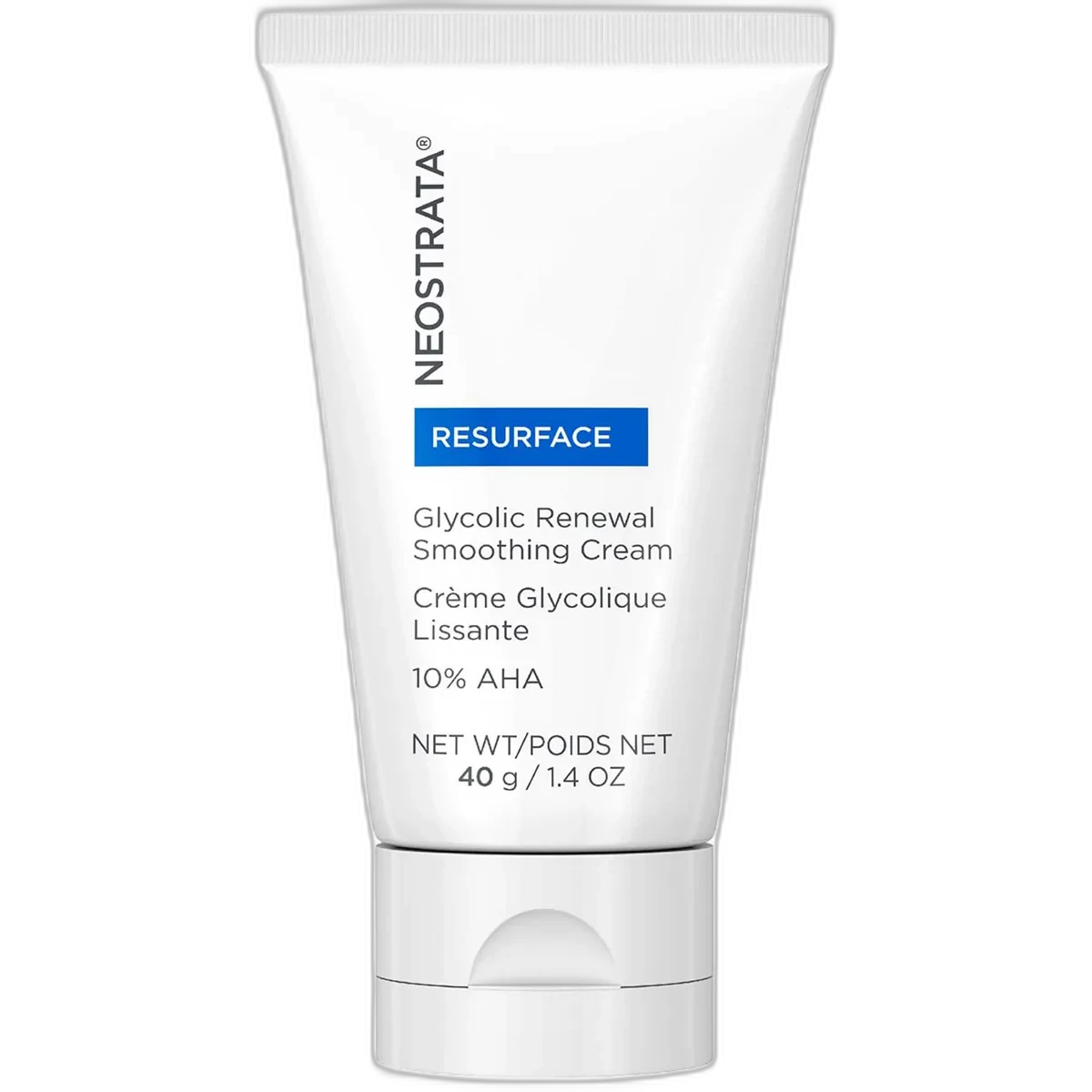
Glycolic Renewal Smoothing Cream 10% AHA
AHA Pioneer's Gold Standard
 Verified reviewer
Pros & cons.
- +Patented amphoteric delivery system makes 10% AHA significantly more tolerable than free-acid formulas
- +Rich, moisturizing cream texture that doubles as a night cream for most skin types
- +From the brand that invented AHA skincare — nearly 250 published clinical studies backing the science
- +Effective at smoothing texture, fading dark spots, and reducing fine lines over consistent use
- +Fragrance-free formulation suitable for those sensitive to added scents
- +Velvety dimethicone finish that feels elegant without greasiness
- −Small 1.4 oz jar at $55 makes this a premium-priced single product step
- −Contains methylparaben, which some consumers prefer to avoid
- −Isopropyl palmitate is moderately comedogenic and may trigger breakouts in acne-prone skin
- −Mild tingling and flaking during the first 1-2 weeks as skin adjusts
- −Not suitable for sensitive or barrier-compromised skin types
The full review.
Two people created every glycolic acid product you use. In 1974, dermatologist Dr. Eugene Van Scott and dermopharmacologist Dr. Ruey Yu published research showing alpha hydroxy acids renew skin, smooth texture, and address hyperpigmentation. They patented the technology in 1975 and founded NeoStrata in 1988. Nearly four decades later, the Glycolic Renewal Smoothing Cream uses their original insight: the right acid, delivered the right way, improves skin.
This history matters because the formulation reflects that understanding. The cream combines 8% glycolic acid with 2% citric acid for a total 10% AHA concentration. It is not a crude free-acid formula that dumps everything onto the skin at once. NeoStrata’s patented amphoteric complex, built around arginine, partially neutralizes the acid to create a time-release effect. The glycolic acid enters the skin gradually rather than all at once, providing sustained exfoliation over hours instead of a brief, intense assault that peaks and fades. It works like extended-release medication versus a single shot, improving both tolerability and efficacy.
The result is a product that feels different from a typical 10% acid. The cream texture is thick. Shea butter provides occlusive weight without greasiness. Dimethicone adds a velvety slip so the cream glides on and settles into a satin finish. Decyl oleate and isopropyl palmitate contribute emollience, though the latter sits on some comedogenicity watchlists and matters if you are breakout-prone. For most users, this cream works as a standalone night treatment with no additional moisturizer needed. For drier skin types, layering a heavier cream or oil over it works well.
Exfoliation is methodical rather than dramatic. You won’t see a new face after night one. In the first week, you will notice smoother texture where your fingers run over your cheek and the surface feels more uniform and less rough. Makeup sits better. Skin looks more reflective. By week four to six, the cumulative effect is visible to others: finer lines soften, dark spots fade, and the complexion takes on an even-toned clarity.
The formula has limitations. Methylparaben remains in the ingredient list; many consumers and brands avoid this preservative, though scientific consensus supports its safety at cosmetic concentrations. Isopropyl palmitate is moderately comedogenic and may trigger breakouts in acne-prone individuals, especially given its high position in the ingredient list. Propylene glycol is an effective humectant and penetration enhancer, but it is a known irritant for a small percentage of people.
The main complaint is size versus price. At $55 for 1.4 ounces, this is not a budget product. With nightly use on face and neck, the jar lasts roughly six to eight weeks, making the annual cost substantial for one routine step. The per-ounce cost is nearly $40, placing it in the premium category. You pay for the patented delivery system, legacy research, and clinical-grade formulation, but comparable glycolic acid products exist at lower price points.
Cheaper alternatives typically lack the amphoteric buffering that makes NeoStrata’s formula special. A $15 glycolic acid cream at 10% delivers its payload fast and harsh, often causing irritation, redness, and peeling. NeoStrata’s gradual-release approach achieves the same long-term results with better day-to-day tolerability. Whether the price premium is worth it depends on your skin’s sensitivity and budget, but for those who avoid glycolic acid due to irritation, this cream offers a different experience.
The brand earns its trust. It has over 110 patents, nearly 250 published studies, and the Discovery Award from The Dermatology Foundation. NeoStrata does not use influencer partnerships or viral TikTok moments to sell product; it relies on the fact that it wrote the textbook on AHA skincare. When the founders proved this entire ingredient category works, they built credibility into the DNA.
For anyone serious about chemical exfoliation as a long-term anti-aging strategy, this cream is a benchmark. It is not the cheapest or the flashiest, and it won’t photograph well for a skincare shelfie. It is exactly what it claims to be: serious glycolic acid, delivered with the intelligence of a brand that has refined this science since before most competitors existed.
Formula
About NeoStrata
The brand earns its trust. It has over 110 patents, nearly 250 published studies, and the Discovery Award from The Dermatology Foundation. NeoStrata does not use influencer partnerships or viral TikTok moments to sell product; it relies on the fact that it wrote the textbook on AHA skincare. When the founders proved this entire ingredient category works, they built credibility into the DNA.
Texture
The cream texture is thick. Shea butter provides occlusive weight without greasiness. Dimethicone adds a velvety slip so the cream glides on and settles into a satin finish.
Scent
Not mentioned in the text.
Common Praise
By week four to six, the cumulative effect is visible to others: finer lines soften, dark spots fade, and the complexion takes on an even-toned clarity.
Common Complaints
The main complaint is size versus price. At $55 for 1.4 ounces, this is not a budget product. With nightly use on face and neck, the jar lasts roughly six to eight weeks, making the annual cost substantial for one routine step. The per-ounce cost is nearly $40, placing it in the premium category. You pay for the patented delivery system, legacy research, and clinical-grade formulation, but comparable glycolic acid products exist at lower price points.
Works for
For anyone serious about chemical exfoliation as a long-term anti-aging strategy, this cream is a benchmark.
Not ideal for
Not explicitly mentioned, but implied for those sensitive to isopropyl palmitate or propylene glycol.
AM routine
Not mentioned in the text.
PM routine
For most users, this cream works as a standalone night treatment with no additional moisturizer needed. For drier skin types, layering a heavier cream or oil over it works well.
Ingredient analysis.
Full INCI list
Aqua (Water), Glycolic Acid, Cetearyl Alcohol, Ceteareth-20, Decyl Oleate, Isopropyl Palmitate, Citric Acid, Propylene Glycol, Isocetyl Stearate, Ammonium Hydroxide, Arginine, Isostearic Acid, Dimethicone, Magnesium Aluminum Silicate, Dicetyl Phosphate, Ceteth-10 Phosphate, Butyrospermum Parkii (Shea Butter), Phenoxyethanol, Butylene Glycol, Glycerin, Xanthan Gum, Disodium EDTA, Chlorphenesin, Methylparaben
Skin match.
The science.
The Science
Glycolic acid is the most studied alpha hydroxy acid in dermatology. Research spans over five decades, much of it from NeoStrata's founders. Its small size (76 g/mol) lets it penetrate the stratum corneum better than larger AHAs like lactic or mandelic acid by disrupting ionic bonds between corneocytes to speed up desquamation. A 1984 Van Scott and Yu study in the Journal of the American Academy of Dermatology showed that 5-15% glycolic acid concentrations improve photodamaged skin, including fine wrinkles, surface roughness, and mottled hyperpigmentation.
NeoStrata's formulation uses an amphoteric delivery system instead of simple glycolic acid. Pairing glycolic acid with arginine — a basic amino acid — creates a partially neutralized acid complex. This complex releases free glycolic acid gradually as it meets the skin's natural pH. NeoStrata's clinical studies show these amphoteric glycolic formulations exfoliate like free-acid formulas but have lower irritation scores.
The 2% citric acid has two roles. As an AHA, it adds keratolytic activity, but citric acid also acts as a chelating agent to stabilize the formula and provide antioxidant effects. Research in Dermatologic Surgery shows combination AHA formulations address multiple photoaging signs at once — including wrinkles, tactile roughness, and dyspigmentation — with improvements visible in clinical grading and instrumental analysis.
Shea butter serves a functional purpose. Studies show Butyrospermum parkii butter contains triterpene esters with anti-inflammatory activity, which helps mitigate the low-grade inflammation from glycolic acid exfoliation. This anti-inflammatory cushion and the gradual acid release let a 10% AHA cream work nightly without the barrier disruption typical of that concentration.
References
- Alpha hydroxy acids and superficial chemical peeling — Journal of the American Academy of Dermatology (1984)
Dermatologist Perspective
Board-certified dermatologists often recommend NeoStrata's glycolic acid products to patients wanting evidence-based chemical exfoliation without in-office peels. Clinicians value the amphoteric delivery system because it lets dermatologists prescribe meaningful glycolic acid concentrations to patients who previously had irritation from over-the-counter AHA products. Dermatologists say the gradual-release mechanism makes this cream an effective bridge between basic skincare and professional treatments. It is a common nightly recommendation for photodamage, melasma maintenance, and general anti-aging.
Where it fits in your routine.
Apply a thin, even layer to clean, dry skin at night. Use it every other night for the first two weeks so skin acclimates, then use nightly as tolerated. Avoid the immediate eye area. Normal to oily skin types do not need more moisturizer — the cream is thick enough for a night treatment. Drier skin types can layer a heavier moisturizer or facial oil over it. Always apply broad-spectrum SPF 30+ the next morning, because glycolic acid increases photosensitivity.
At $55 for 1.4 ounces, this is a premium product. The $39 per-ounce cost exceeds most drugstore and mid-range glycolic acid options. The patented amphoteric delivery system justifies the price. This technology differentiates the formula from cheaper alternatives by making the same acid concentration more tolerable. For users who can afford it, less irritation and sustained efficacy may remove the need for extra soothing products or recovery days, offsetting the cost. Budget-conscious users can find effective glycolic acid products at lower prices, but they lack the buffered delivery technology.
Adults with normal to combination skin want a serious glycolic acid treatment that works as a night cream. The amphoteric delivery system improves tolerability for users who found cheaper AHA products too irritating. This targets photoaging, dullness, uneven tone, and fine lines.
Avoid this 10% AHA formula if you have sensitive, rosacea-prone, or barrier-compromised skin. Acne-prone users should patch-test first because of the isopropyl palmitate. At $55 for 1.4 ounces, the price is high compared to cheaper glycolic acid options.
Product details.
Fragrance-free. It has a mild, slightly acidic scent that fades fast.
A small jar with a screw-top lid. The 40 g / 1.4 oz size feels high-end but finishes fast with nightly use.
Expect mild tingling or stinging on first application. This is normal with 10% AHA and usually stops within a few minutes. The cream feels thick and moisturizing despite the acid. During the first 1-2 weeks, some users see mild flaking as accelerated cell turnover removes dead skin. This resolves as the skin adjusts. ***
6-8 weeks with nightly facial application ***
12 months ***
fall winter ***
The backstory.
NeoStrata exists because Drs. Van Scott and Yu spent the 1970s proving that alpha hydroxy acids could renew skin — a discovery that birthed an entire category of skincare. The Glycolic Renewal Smoothing Cream, part of the Resurface line, represents the core of their philosophy: serious exfoliation made tolerable through smart chemistry. The amphoteric delivery system they patented is what separates NeoStrata's approach from the dozens of glycolic acid products that followed.
About NeoStrata
Legacy Brand (20+ years)NeoStrata was founded in 1988 by dermatologist Dr. Eugene Van Scott and dermopharmacologist Dr. Ruey Yu — the scientists who first published the skin-renewing benefits of alpha hydroxy acids in 1974 and received the U.S. patent in 1975. The brand holds over 110 patents and has published nearly 250 clinical studies and journal papers.
Common myths.
Higher glycolic acid percentages do not always yield better results.
NeoStrata's formula uses 8% glycolic acid and 2% citric acid with an amphoteric buffering system for gradual acid delivery. This method matches or exceeds the efficacy of higher-percentage unbuffered formulas but causes less irritation — the delivery system matters as much as the concentration.
You can't use glycolic acid if you have dry skin.
This formula provides enough moisture for dry skin. The shea butter, dimethicone, and emollient base offset the drying effect of the glycolic acid. This makes it one of the few AHA treatments that works as a night cream for drier skin types.
FAQ.
What percentage of glycolic acid is in NeoStrata Smoothing Cream?
The formula has 8% glycolic acid and 2% citric acid, totaling 10% AHA. NeoStrata's patented amphoteric complex uses arginine to buffer the acids for gradual release. This makes the formula more tolerable than an unbuffered 10% glycolic acid product but keeps the efficacy.
Can I use NeoStrata Glycolic Renewal Cream with retinol?
Yes, but not on the same night. The 10% AHA concentration in this cream is potent. Layering it with retinoids risks over-exfoliation, redness, peeling, and barrier damage. Alternate nights — glycolic cream one evening, retinoid the next — for the safest, most effective combination.
Is NeoStrata Glycolic Renewal Cream safe during pregnancy?
Most dermatologists consider glycolic acid safe during pregnancy because it lacks deep penetration for systemic risk. Consult your healthcare provider before starting any new active treatment during pregnancy. This formula lacks retinoids or salicylic acid.
How long does it take to see results from NeoStrata Glycolic Cream?
Most users see smoother skin texture and a brighter complexion within 1-2 weeks. Fine lines, dark spots, and skin tone show visible improvement at 4-6 weeks. Full anti-aging benefits develop over 8-12 weeks of consistent nightly use.
Why does my skin tingle when I apply this cream?
A 10% AHA formula causes mild tingling when glycolic acid contacts your skin. This sensation subsides within a few minutes. NeoStrata's amphoteric buffering system reduces tingling compared to unbuffered formulas. If tingling persists or becomes painful, rinse it off and use it less often.
Can I use this cream in the morning?
NeoStrata recommends evening use. Glycolic acid increases photosensitivity, making skin more vulnerable to UV damage while using this product. If you use it during the day, apply SPF 30 or higher; nighttime use is safer and more effective.
What the community says.
"Noticeably smoother skin texture within weeks"
"Effective at reducing fine lines and uneven tone"
"Rich, moisturizing cream texture despite the acid content"
"Good for long-term anti-aging maintenance"
"86% of users reported improved smoothness after 4 weeks"
"Small jar for the price — 1.4 oz goes quickly"
"Contains methylparaben, which some users prefer to avoid"
"Initial tingling or stinging during the adjustment period"
"Can cause flaking during the first 1-2 weeks"
Featured in.
People also looked at.