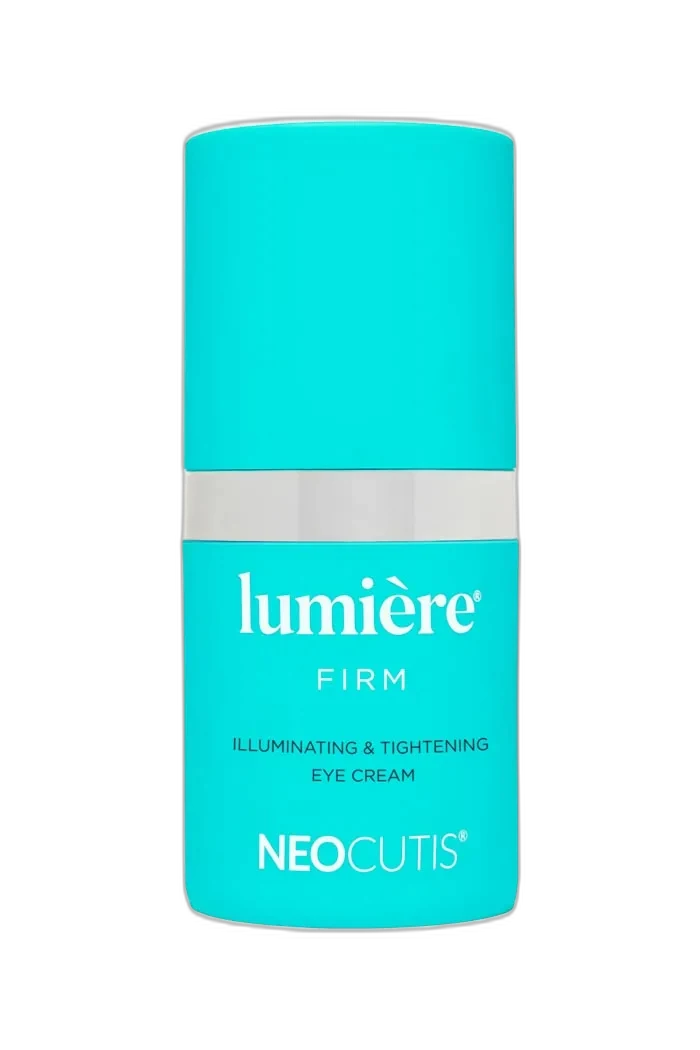
Lumière Bio-Restorative Eye Cream
Derm Office Staple
 Verified reviewer
Pros & cons.
- +PSP growth factor technology with genuine clinical origin story
- +Multi-mechanism approach to dark circles and puffiness
- +Caffeine delivers visible morning depuffing effect
- +Stable oil-soluble vitamin C suited to the eye area
- +Two signal peptides reinforce the collagen-stimulation story
- +Fragrance-free, soothing supporting ingredients
- +Airless tube protects growth factor stability
- −$115 for 15ml is a premium commitment
- −Won't eliminate hereditary structural dark circles
- −Firming benefits build gradually over 12+ weeks
- −Not pregnancy-advised due to growth factor content
- −Contains palm oil and petrolatum — not for strict clean-beauty shoppers
The full review.
Most eye creams come from a formulation brief that reads something like ‘luxury consumer product that addresses dark circles and puffiness.’ Lumière came from a different direction. Its hero ingredient, PSP (Processed Skin Cell Proteins), was developed out of Swiss research into skin cell therapies for burn patients at the University of Lausanne — a research program focused on the real, measurable problem of wound healing and collagen regeneration in damaged skin. When Neocutis was founded in 2003 to commercialize the technology for cosmetic use, the eye area was one of the natural first targets: it’s thin, it shows aging early, it’s where even subtle improvements in collagen and vascular support translate into visible results. Lumière became one of Neocutis’s first eye products and has been a quiet fixture in dermatology practice and medspa channels for over a decade.
What you get in the tube is a lightweight, silky white cream that sits in a 15ml airless dispenser and applies like a serum-cream hybrid. The formulation is more considered than most consumer eye creams admit to. Under-eye concerns are genuinely complex — dark circles come from vascular congestion, post-inflammatory pigmentation, thin skin, oxidative damage, and structural anatomy, and puffiness comes from lymphatic and fluid dynamics — so a formula that only addresses one of those causes will only ever partially help. Lumière’s approach is to stack multiple mechanisms. Caffeine handles the vasoconstriction and morning depuffing. Tetrahexyldecyl ascorbate — an oil-soluble vitamin C ester that penetrates lipid-rich periorbital skin better than L-ascorbic acid — handles the oxidative damage piece. Glycyrrhetinic acid from licorice handles the post-inflammatory pigmentation piece. Bisabolol soothes the delicate eye area so the other actives don’t cause micro-irritation. And PSP plus two peptides (tetrapeptide-21 and palmitoyl tripeptide-1 acetate) handle the long-game collagen signalling story that slowly firms the thin eye skin over months.
The application experience is what you’d expect from a well-formulated clinical eye cream. Cool, silky, absorbs in seconds, plays fine under concealer, no stinging or warmth. Most users report visible puffiness reduction within the first week — that’s the caffeine doing its fast work. The brightening and texture improvements arrive gradually, usually around weeks 4 to 6. The PSP and peptide firming benefits are the slowest, typically assessed at the 12-week mark or beyond. This is a product that rewards consistency rather than instant gratification, and the marketing, unlike some of its competitors, is honest about that.
Now the honest limits. The biggest thing users need to understand is that no eye cream, no matter how well-formulated, will eliminate hereditary dark circles caused by structural anatomy. If your dark circles come from thin skin over a deep tear trough, you’re looking at under-eye filler or laser treatment territory — this cream can soften the appearance at the margins but cannot fundamentally change the underlying architecture. The same goes for genetic hyperpigmentation. Neocutis is more careful about these claims than many competitors, but it’s worth being clear as a buyer: this is a tool in a larger strategy, not a solution to every under-eye complaint.
The price is the other conversation. At $115 for 15ml, this is priced in the clinical-channel eye cream tier — roughly the same range as SkinCeuticals, Revision Skincare, and Obagi equivalents, and well above the drugstore and mid-market options. The growth factor and peptide ingredients are genuinely more expensive to formulate than their simpler counterparts, so the price isn’t pure brand markup, but it’s also not a budget-friendly purchase. A 15ml tube lasts roughly 3 to 4 months with twice-daily use, which works out to about $30-35 a month — manageable for some skincare budgets, completely out of reach for others.
Who this product serves well is specific. If you’re a dermatologist-referred patient, if you’re in a clinical skincare routine already spending $200+ on a serum, if your under-eye concerns are a mix of mild puffiness, early crepiness, and oxidative-damage-driven dullness — this is a credible option with one of the more considered formulas in its price bracket. If you’re budget-shopping, if your under-eye issue is strongly hereditary dark circles, or if you haven’t yet added a retinoid and daily SPF to your routine (both of which will do more for eye-area aging than any eye cream), you should not be spending $115 here. The formulation deserves respect. The math has to work for your wallet and your expectations.
Ingredient analysis.
Full INCI list · pH 5.5
Water (Aqua), C12-20 Acid PEG-8 Ester, Petrolatum, Caprylic/Capric Triglyceride, Hydrogenated Polyisobutene, Glycerin, Butylene Glycol, Saccharide Isomerate, Hydroxyethyl Acrylate/Sodium Acryloyldimethyl Taurate Copolymer, Bisabolol, Caffeine, Tetrahexyldecyl Ascorbate, Fagus Sylvatica (Beech Tree) Bud Extract, Lecithin, PSP (Cutaneous Lysate), Tetrapeptide-21, Sodium Hyaluronate, Glycyrrhetinic Acid, Citric Acid, Dioscorea Villosa (Wild Yam) Root Extract, Tocotrienols, Elaeis Guineensis (Palm) Oil, Capryloyl Carnosine, Tocopherol, Benzoic Acid, Squalene, Palmitoyl Tripeptide-1 Acetate, Phytosterols, Sodium Citrate, Isohexadecane, Ethylhexylglycerin, Potassium Cetyl Phosphate, Acrylates/C10-30 Alkyl Acrylate Crosspolymer, Chlorphenesin, Polysorbate 60, Sodium Hydroxide, Disodium EDTA, Sorbitan Isostearate, Phenoxyethanol, Benzyl Alcohol
Skin match.
The science.
The Science
The eye area is a unique formulation challenge. It combines thin, delicate skin with concurrent aging and vascular concerns. This formula addresses several issues through different mechanisms. Caffeine works as a topical vasoconstrictor to temporarily reduce under-eye puffiness and the bluish appearance of dilated vessels; controlled studies show measurable circumference changes after application. Tetrahexyldecyl ascorbate is a stable, lipid-soluble vitamin C ester. In vitro studies show it penetrates the stratum corneum more effectively than water-soluble ascorbic acid derivatives, and it stimulates collagen once converted to ascorbic acid. Using it in eye area formulations targets the lipid-rich periorbital skin. Glycyrrhetinic acid, from licorice root, has anti-inflammatory activity by inhibiting 11-beta-HSD and a tyrosinase-modulating effect that helps with melanin-driven hyperpigmentation—a mechanism relevant for post-inflammatory dark circles. PSP and the growth factor category are newer, so peer-reviewed consumer RCT data remains limited, but in vitro and wound healing research support the collagen-signalling rationale. Tetrapeptide-21 and palmitoyl tripeptide-1 acetate are signal peptides with in vitro evidence for fibroblast activation and matrix protein synthesis. The formulation strategy uses a multi-pathway approach rather than a single hero mechanism to address under-eye complexity. This is the correct philosophy for the eye area, even if isolating each ingredient's individual contribution in real-world performance is difficult.
Dermatologist Perspective
Dermatologists often recommend multi-mechanism eye creams like Lumière for patients with complex concerns, such as early fine lines, mild puffiness, and pigmentation. Board-certified dermatologists typically use eye creams as supporting tools alongside a facial retinoid, daily broad-spectrum sunscreen, and procedural interventions for structural concerns. For dark circles caused by tear trough anatomy, dermatologists note that topical products have ceiling effects and that under-eye filler or laser treatments work faster. For post-inflammatory hyperpigmentation or oxidative dullness, dermatologists consider PSP and caffeine-based creams appropriate supporting tools. Neocutis's clinical-channel distribution and Swiss research heritage provide more credibility in dermatology practice conversations than most growth factor eye creams.
Guidance
Where it fits in your routine.
Use a tiny amount — about a grain of rice per eye. Tap the ring finger gently around the orbital bone, moving from the inner corner outward. Apply twice daily, morning and night. In the morning, wait 30-60 seconds for absorption before applying sunscreen or concealer. Refrigerating the tube increases the caffeine depuffing effect for puffiness. For best results, use daily SPF on the eye area and consistent retinoid use on the rest of the face. A small amount lasts a long time — a 15ml tube typically lasts 3-4 months.
At $115 for 15ml, this eye cream sits in the upper-mid clinical tier with SkinCeuticals, Revision, and Obagi peers. The case for the price is formulation depth: PSP growth factors, two peptides, a stable vitamin C, caffeine, and licorice-derived brightening create a more complex ingredient list than a $40 drugstore eye cream. The case against is that user results depend on baseline under-eye concerns, and the most expensive ingredients (growth factors, peptides) have the thinnest independent RCT data. Clinical-channel buyers with the budget wanting a credibly-formulated multi-mechanism option will find this a reasonable purchase. Budget-sensitive buyers can achieve similar results for less by using a caffeine-and-peptide drugstore eye cream plus a dedicated vitamin C.
Buy this if you use clinical-channel skincare and want a multi-mechanism eye cream with deep formulation. It works for early under-eye aging, mild puffiness, pigmentation, and texture concerns — the mixed profile common in people aged 30s to 50s.
Skip this if hereditary structural dark circles dominate your under-eye concerns (filler or laser works better), if you have a tight budget (drugstore caffeine eye creams provide most of the puffiness benefit), or if you are pregnant or nursing and avoid growth factor products.
Product details.
Lightweight, silky cream with a slight glide — not heavy, not tacky.
Fragrance-free, very mild base scent.
15ml white airless tube with an applicator nozzle — protects the growth factor actives and doses efficiently.
The first application feels cool, smooth, and slightly depuffing within minutes. It does not sting or feel warm. Using it every morning often reduces visible puffiness within days.
About 3-4 months with twice-daily use.
6 months
All Year
The backstory.
Lumière was one of Neocutis's first eye care products and has been a quiet fixture in dermatology and medspa channels for over a decade. It predates most of the current wave of growth factor eye creams, built on the same PSP (Processed Skin Cell Proteins) technology the brand spun out from its University of Lausanne wound-healing research. The formula has been periodically updated but the core PSP and caffeine combination has remained stable through the product's history.
About Neocutis
Established Brand (5–20 years)Neocutis launched in 2003 as a University of Lausanne spin-off. It uses PSP (Processed Skin Cell Proteins) technology, which comes from Swiss fetal skin cell research for burn and wound healing. Lumière was an early eye care entry for the brand. It has sold through dermatology practice channels for over a decade and has a longer clinical track record than most growth-factor eye creams.
Common myths.
Eye creams can eliminate hereditary dark circles.
Dark circles stem from several causes: thin skin exposing vasculature, post-inflammatory pigmentation, structural tear troughs, and oxidative damage. This cream targets pigmentation and vascular components, but hereditary structural dark circles respond better to under-eye filler or brightening procedures than to topical products.
FAQ.
Does Neocutis Lumière Bio-Restorative actually work on dark circles?
It helps dark circles caused by vascular congestion (caffeine constricts dilated vessels), oxidative damage (tetrahexyldecyl ascorbate), or post-inflammatory pigmentation (glycyrrhetinic acid). Topical products only support treatment for hereditary structural dark circles from thin skin or tear trough anatomy; procedural interventions work better.
How long does it take to see results?
Caffeine reduces puffiness within days. Brightening and texture improvements show in 4-6 weeks. PSP growth factor and peptide firming results build over 8-12 weeks and show at the 3-month mark.
Can I use this eye cream with retinol?
Yes. It works with retinol routines — apply Lumière after cleansing and before or after retinoid based on your preference. Eye skin is delicate, so many users apply the eye cream first as a buffer, let it absorb, and then apply retinol to the face while avoiding the orbital area.
Is it safe during pregnancy?
Neocutis advises against using PSP-based growth factor products during pregnancy because specific pregnancy safety data is missing. Consult your OB or dermatologist before using any growth factor product while pregnant or nursing.
How does Lumière compare to Lumière Firm?
Lumière Firm updates the formula with more peptides and tightening ingredients at a similar price. The original Bio-Restorative Eye Cream focuses on traditional PSP-plus-caffeine depuffing and brightening. Choose Lumière Firm for firmness; choose the Bio-Restorative formulation for dark circles and puffiness.
Does the 15ml tube last a long time?
Use twice daily for 3-4 months. A pea-sized amount covers both eyes, so each application uses very little.
What the community says.
"Visibly reduces morning puffiness"
"Non-greasy and layers under concealer"
"Gradual firmness improvement over months"
"No irritation on delicate eye skin"
"$115 price tag for 15ml is steep"
"Won't eliminate hereditary dark circles"
"Results are gradual, not dramatic"
"Small tube disappears within 3-4 months"
People also looked at.