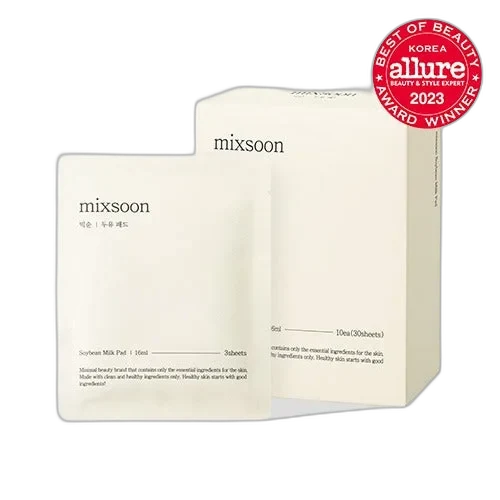
Soybean Milk Pad
Fermented Rescue Pad
 Verified reviewer
Pros & cons.
- +Comprehensive 33-ingredient formula with ceramides, triple HA, centella complex, and fermented soybean
- +Five-botanical calming complex makes it ideal for post-exfoliation and reactive skin recovery
- +Fragrance-free, alcohol-free, silicone-free — safe for sensitive and compromised skin
- +Ceramide NP and phytosphingosine provide genuine barrier repair during masking
- +Convenient pad format is travel-friendly and less wasteful than sheet masks
- +Immediately visible plumping, hydration, and calming effects after each use
- −$1.60 per pad is premium pricing for a consumable product
- −Only 10 pads per pack limits value compared to bulk toner pad options
- −Very limited review data — only 7 reviews on the brand site
- −Smaller pad size may not cover the entire face for some users
- −Effects are most noticeable as temporary boost rather than permanent change
The full review.
The pad mask sits in an awkward middle ground in K-beauty. It lacks the speed of a toner pad, where you just swipe and go. It also lacks the indulgence of a sheet mask, without an Instagram-worthy face-covering moment. Most brands fill these pads with watered-down toner for convenience. mixsoon’s Soybean Milk Pad uses the pad as a legitimate delivery system for a comprehensive treatment formula.
The ingredient list condenses K-beauty hits onto a cotton disc. Fermented soybean extract—the Bean line’s signature—leads the actives. It delivers the same bioavailable amino acids, isoflavones, and peptides found in the Bean Essence and Bean Cream. While the Bean Essence uses only 7 ingredients, the Soybean Milk Pad is maximalist with 33. It adds ceramide NP and phytosphingosine for barrier repair, three forms of hyaluronic acid for multi-depth hydration, and a five-botanical calming complex from traditional Korean herbal medicine.
That calming complex is notable. Centella asiatica extract and its isolated active compound madecassoside provide the wound-healing and anti-inflammatory benefits that make centella a staple for sensitive skin. Houttuynia cordata—the ‘chameleon plant’ in Korea used in traditional medicine for centuries—adds antimicrobial and anti-inflammatory activity. Artemisia capillaris, another Korean botanical staple, provides antioxidant protection. Tea tree leaf extract completes the complex with broad-spectrum antimicrobial properties. These five ingredients create a soothing system that works well after exfoliation, on reactive skin, or during seasonal transitions.
The triple hyaluronic acid system provides functional hydration. Sodium hyaluronate hydrates the skin’s surface. Hydrolyzed hyaluronic acid penetrates deeper layers. Sodium acetylated hyaluronate has a modified structure that provides longer-lasting hydration through better skin adhesion. During the 10-15 minute contact time, these three forms work at their respective depths, which a quickly-absorbed serum cannot do.
The ceramide NP and phytosphingosine pairing distinguishes this from simple hydrating pads. Ceramide NP is a key lipid in the skin’s natural barrier; replenishing it helps repair damage from environmental stress, over-cleansing, or aggressive treatments. Phytosphingosine—a ceramide precursor—stimulates the skin’s own ceramide production. This inside-out approach to barrier repair is smart formulation.
The pads are soaked in a milky, lightweight essence that feels cooling and calming. There is no fragrance, no stinging, and no adjustment period. After 10-15 minutes, the skin looks and feels plumper, dewier, calmer, and subtly brighter. The remaining essence pats into the skin without stickiness, and the effects last into the next day when sealed with a moisturizer.
The format has practical advantages over sheet masks. The pads are compact, travel-friendly, and do not slide off the face. They produce less waste—no plastic backing or dripping excess—and you can position them precisely on specific areas.
The drawback is cost. At sixteen dollars for ten pads, each use costs a dollar sixty. Using them twice weekly means a box lasts three to five weeks, costing roughly thirteen to twenty dollars monthly to supplement your routine. This is premium pricing for a pad mask, reflecting the formula quality, but it is not a casual product. Each pad is an investment, which is the formula’s strength and its barrier to entry.
The review count is limited—only seven reviews on the brand’s US site, plus scattered feedback from K-beauty retailers. This is a new product from an emerging brand. While the ingredient list is impressive, it lacks the real-world validation of thousands of users over years. The individual ingredients are well-studied, but this specific combination and delivery format lacks independent evaluation.
For those using the mixsoon Bean line, the Soybean Milk Pad is the deepest dive into the brand’s philosophy. It delivers fermented soybean benefits through a contact-intensive format with a comprehensive ingredient roster. It is a treatment pad that punches above its weight class. If the price and limited data do not deter you, it is one of the most formula-rich pad masks in K-beauty.
Ingredient analysis.
Full INCI list
Water/Aqua, Glycerin, Dipropylene Glycol, Cetyl Ethylhexanoate, 1,2-Hexanediol, Betaine, Hydroxyacetophenone, Panthenol, Polyglyceryl-3 Methylglucose Distearate, Trehalose, Butylene Glycol, Glyceryl Stearate, Sorbitan Stearate, Arginine, Carbomer, Xanthan Gum, Sorbitan Sesquioleate, Ethylhexylglycerin, Lactobacillus/Soybean Ferment Extract, Butyrospermum Parkii (Shea) Butter, Disodium EDTA, Sucrose Cocoate, Ceramide NP, Phytosphingosine, Cyclodextrin, Madecassoside, Artemisia Capillaris Extract, Melaleuca Alternifolia (Tea Tree) Leaf Extract, Sodium Hyaluronate, Houttuynia Cordata Extract, Centella Asiatica Extract, Hydrolyzed Hyaluronic Acid, Sodium Acetylated Hyaluronate
Skin match.
The science.
The Science
The Soybean Milk Pad uses well-documented active ingredient systems in a sustained-contact delivery format. The fermented soybean extract (Lactobacillus/Soybean Ferment Extract) provides bioavailable isoflavones — genistein and daidzein — that modulate sebum production via estrogen receptor beta interaction and offer antioxidant protection through free radical scavenging.
The triple hyaluronic acid system uses molecular weight to control skin penetration depth. Standard sodium hyaluronate (molecular weight ~1,000-1,500 kDa) hydrates the skin surface and forms a moisture-retaining film. Hydrolyzed hyaluronic acid (typically 10-50 kDa) penetrates deeper into the epidermis. Sodium acetylated hyaluronate has an acetyl group that increases lipophilicity, which improves its binding affinity to the stratum corneum and provides longer hydration than standard hyaluronate. A 2012 study in the Journal of Cosmetic Dermatology shows that multi-weight hyaluronic acid systems provide better hydration than single-weight formulations.
Madecassoside, a triterpenoid glycoside isolated from Centella asiatica, has extensive research on its wound-healing and anti-inflammatory properties. Research in the Journal of Ethnopharmacology shows that madecassoside promotes collagen synthesis and inhibits the inflammatory mediators TNF-alpha and IL-1beta. Pairing it with whole centella extract provides the isolated active compound plus the broader spectrum of centella's other bioactives (asiaticoside, asiatic acid, madecassic acid).
Ceramide NP is one of the most abundant ceramides in healthy skin and is critical for the lamellar lipid structure of the stratum corneum. Phytosphingosine works as a ceramide precursor and an antimicrobial agent; studies show it upregulates ceramide synthesis in keratinocytes.
Dermatologist Perspective
Dermatologists see pad masks as a practical delivery format for treatment ingredients, especially for patients who find sheet masks impractical for regular use. Board-certified dermatologists note that the Soybean Milk Pad's combination of ceramide NP and phytosphingosine matches evidence-based approaches to barrier repair, and the triple hyaluronic acid system offers better hydration than single-form HA products. The calming botanical complex — centella, madecassoside, houttuynia cordata, artemisia, and tea tree — works well for post-procedure recovery or skin sensitivity. Dermatologists may recommend these pads for patients recovering from chemical peels, laser treatments, or seasonal barrier disruption, as the sustained contact time maximizes active ingredient delivery to compromised skin.
Guidance
Where it fits in your routine.
Cleanse and tone, then open a pad sachet and leave the pad on your face for 10-15 minutes. Cut the pad or use multiple pads to cover your full face. After removal, pat the remaining essence into your skin; do not rinse. Apply your moisturizer immediately to seal in hydration. Use 2-3 times per week for maintenance, or daily for intensive treatment (post-exfoliation recovery, seasonal transition, or pre-event prep).
At $16.00 for 10 pads ($1.60 per use), the Soybean Milk Pad is a premium-priced consumable product. The value must be judged against the formula quality — ceramides, triple hyaluronic acid, centella complex, phytosphingosine, and fermented soybean in a single pad is genuinely more comprehensive than most sheet masks at similar price points. With 2-3 weekly uses, a pack lasts 3-5 weeks at roughly $13-20 per month. For targeted use — post-exfoliation recovery, pre-event plumping, or reactive skin rescue — the per-use value is reasonable. For daily use, the economics become challenging, and the Bean Essence at $35 for 2-3 months of daily use is a more cost-effective way to get the fermented soybean benefits.
Skincare enthusiasts want a formula-rich pad mask that does more than hydrate. This works for sensitive or reactive skin needing calming and barrier repair, people recovering from chemical peels or aggressive treatments, and mixsoon fans wanting the deepest dive into mixsoon fermented soybean technology.
Budget-conscious buyers may find $1.60 per pad hard to justify daily. Users who prefer the minimalism of the Bean Essence for fermented soybean may skip this. This is a treatment, not a convenience step, because it requires 10-15 minutes of contact time.
Product details.
Pre-soaked cotton pads hold a milky, lightweight essence. The soft, flexible pad material conforms to facial contours without irritation.
It is fragrance-free. The fermented soybean extract has a barely perceptible scent.
Individual sachets hold pads inside a clean, minimalist box. This travel-friendly format fits easily in a bag for on-the-go skincare.
The pad is soaked in a milky essence that feels cooling and soothing. It has no fragrance and causes no stinging or irritation. Removing the pad after 10-15 minutes reveals visibly plumper, more radiant skin. The remaining essence pats in easily and is not sticky.
3-5 weeks with 2-3 uses per week
24 months
All Year
The backstory.
The Soybean Milk Pad extends mixsoon's Bean line philosophy into a convenient pad format, designed for the same fermented soybean benefits as the Bean Essence but delivered through sustained skin contact. The addition of five calming Korean botanical extracts reflects the brand's roots in traditional Korean herbal skincare, bridging the gap between fermentation science and centuries-old botanical wisdom.
About mixsoon
Emerging Brand (2–5 years)Jooup Hwang founded mixsoon in Seoul in July 2020. The brand uses fermentation technology and Korean botanical ingredients for clean, minimalist formulations. mixsoon is an emerging brand, but K-beauty communities recognize it.
Common myths.
Pad masks work less effectively than sheet masks because they are smaller.
Mask effectiveness depends on formula saturation, not pad size. These pads soak in a concentrated essence containing ceramides, triple hyaluronic acid, and fermented extracts. The smaller format is more practical for regular use than full sheet masks. You can pat the remaining essence into the face and neck for additional coverage.
You need to use masks every day for them to work.
The ingredients in these pads — ceramides, centella, hyaluronic acid — provide immediate benefits per use and cumulative benefits with 2-3 weekly applications. Daily use works but is not necessary. The barrier-repair ingredients work after you remove the pad, and the effects compound with your regular skincare routine.
FAQ.
Are mixsoon Soybean Milk Pads good for sensitive skin?
Yes — the formula is fragrance-free, alcohol-free, silicone-free, and has five calming ingredients (centella asiatica, madecassoside, houttuynia cordata, artemisia, and tea tree). The ceramide NP and phytosphingosine also repair the barrier. Because the formula lacks common allergens or irritants, these pads are among the safest mask options for sensitive and reactive skin.
Can I use the Soybean Milk Pad after exfoliating?
Yes — the calming, barrier-repair formula makes these pads ideal for post-exfoliation recovery. The centella and madecassoside soothe irritation, the ceramides rebuild the barrier that exfoliation temporarily disrupts, and the triple hyaluronic acid system restores hydration. Using a pad after chemical exfoliation reduces redness and sensitivity.
How many pads come in a pack and how long does it last?
Each pack contains 10 pads. Using them 2-3 times per week makes a pack last 3-5 weeks. At $16 per pack ($1.60 per pad), this costs more than bulk toner pads. However, the concentrated treatment formula with ceramides, triple HA, and fermented soybean is more potent than basic toner pads.
What's the difference between the Soybean Milk Pad and Bean Essence?
The Bean Essence uses a minimalist 7-ingredient formula for daily use, focusing on four fermented extracts. The Soybean Milk Pad is a weekly treatment with 33 ingredients, including ceramides, triple hyaluronic acid, centella complex, and tea tree. This pad works through sustained contact instead of quick-absorbing drops. The Soybean Milk Pad provides deeper treatment, while the Bean Essence is your daily foundation.
What the community says.
"Intensely hydrating and soothing — skin feels plump and calm after use"
"Fragrance-free and gentle enough for very sensitive skin"
"Convenient pad format is easy to use and less messy than sheet masks"
"Noticeable brightening effect immediately after removal"
"Good ingredient list with ceramides, centella, and hyaluronic acid"
"Only 10 pads per pack makes it an expensive per-use product"
"Limited availability compared to other mixsoon products"
"Some users wish the pads were larger for full-face coverage"
"Effects are temporary without consistent regular use"
People also looked at.