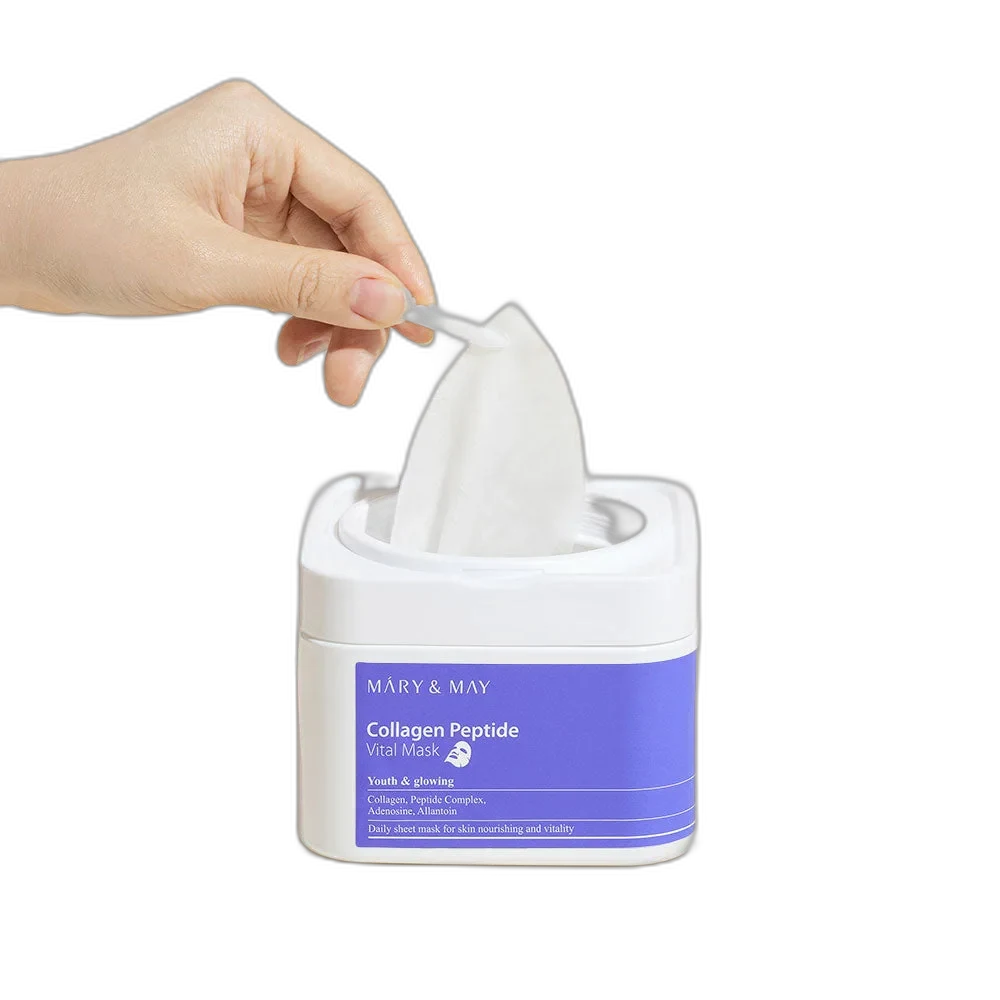
Collagen Peptide Vital Mask
K-Beauty Daily-Mask Value Pick
 Verified reviewer
Pros & cons.
- +Six-peptide stack unusually complex for a $22 tub mask
- +Includes Korean MFDS-approved adenosine for anti-aging claims
- +Thin fitted sheet conforms well to most face shapes
- +Pull-out tub with included tweezer keeps remaining sheets hygienic
- +Immediate visible plumping and dewy finish
- +Vegan and cruelty-free formulation
- +Under a dollar per mask — genuinely affordable daily option
- −Noticeable floral-aquatic fragrance not ideal for reactive skin
- −Peptide concentrations are modest despite the variety
- −Hydrolyzed collagen claim is partially marketing-forward
- −Essence drips when first removed from the tub
- −Not as pure-hydration-focused as some competitors
The full review.
Korean beauty has a quiet packaging revolution Western media missed. This explains how a sheet mask packs six peptides, adenosine, and GHK-Cu for under $1.00 per mask. The shift is the pull-out tub. For twenty years, sheet masks came in individual foil pouches as $3 to $8 weekend treats for skin emergencies. Around 2019, Korean brands began testing 30-sheet tubs: a large cellulose stack presoaked in essence inside a resealable plastic cylinder, using an included tweezer to prevent contamination. This change turned a $3 mask into a $0.75 daily ritual. Lower packaging costs per mask let Korean indie brands with small margins afford six peptides in the essence and still sell the tub profitably. Mary & May has mastered this format since 2018. The brand uses ingredient transparency and vegan formulations to deliver complex essences via the daily-mask tub. The Collagen Peptide Vital Mask is their anti-aging option and shows what this format enables. The formula uses 10,000 ppm hydrolyzed collagen—a 1% humectant load—plus a multi-peptide stack: copper tripeptide-1 (GHK-Cu), hexapeptide-11, hexapeptide-9, palmitoyl pentapeptide-4 (Matrixyl), palmitoyl tripeptide-1, and tripeptide-1. Adenosine appears mid-list; it is one of only two ingredients the Korean MFDS approves as an anti-wrinkle functional cosmetic. Glycerin, dipropylene glycol, butylene glycol, allantoin, and arginine provide hydration and soothing. The thin, fitted cellulose sheet drapes well without the heavy-wet-towel feel of older masks. Use is simple: pull a sheet with the included tweezer to maintain tub hygiene, unfold it on a cleansed, toned face, and leave it for 10 to 15 minutes. The essence has a soft floral-aquatic fragrance that K-beauty fans know, though some Western users may find it intrusive. After removal, the essence pats in easily, leaving skin visibly plumper and dewier within seconds. Makeup sits well over it. This mask is not transformative—you won’t look like a different person after 15 minutes—but the peptide and adenosine stack provides immediate plumping and real cumulative effects over four to eight weeks of consistent use. There are two honest limitations. First is the fragrance. People with sensitive skin, rosacea, or fragrance allergies should avoid this perfumed essence; Mary & May’s fragrance-free alternatives (the Idebenone daily mask, the Niacinamide daily mask) are better choices. Second, while the peptide stack is varied, individual peptide concentrations are modest at the tail of the INCI. This mask does not replace a dedicated peptide serum. Instead, it adds a meaningful peptide layer to a routine that lacks one in a pleasant daily format. That is the correct way to evaluate the product. For pure hydration, it competes with other Korean daily masks at this price but is not dominant—Abib’s Heartleaf and Mixsoon’s Bean masks are more hydrating. The Mary & May mask wins on anti-aging positioning. It is a top pick if you want a daily mask that adds peptides and adenosine without a separate serum. The math: 30 sheets at around $22.50 is $0.75 per mask, compared to $3-$8 for individually packaged masks from most Western and prestige Korean brands. At three or four uses per week, a tub lasts about two months, making it a cheap way to add peptides. For daily users, a tub lasts a month. The cumulative peptide exposure from using a multi-peptide essence every morning or evening is where the product earns its place.
Ingredient analysis.
Full INCI list
Water, Glycerin, Dipropylene Glycol, Hydrolyzed Collagen, Hydroxyacetophenone, Polyglyceryl-10 Laurate, Arginine, Carbomer, Polyglyceryl-4 Laurate, Allantoin, Adenosine, Caprylyl/Capryl Glucoside, Butylene Glycol, Fragrance, Hydroxyethylcellulose, Caprylyl Glycol, 1,2-Hexanediol, Collagen Extract, Soluble Collagen, Disodium EDTA, Ethylhexylglycerin, Copper Tripeptide-1, Hexapeptide-11, Hexapeptide-9, Palmitoyl Pentapeptide-4, Palmitoyl Tripeptide-1, Tripeptide-1.
Skin match.
The science.
The Science
This mask's anti-aging claim relies on three mechanisms. First, humectant hydration: hydrolyzed collagen at approximately 1%, glycerin, dipropylene glycol, and butylene glycol create a multi-layer humectant load. This binds water to the stratum corneum during the 10-15 minute wear time. The immediate plumping effect is real and documented in cosmetic chemistry literature—this is standard hydration mechanics. Second, adenosine: the Korean MFDS approves this as a functional cosmetic anti-wrinkle ingredient. Published trials show small, measurable reductions in fine line depth over 8-12 weeks of twice-daily use at concentrations around 0.04%. The adenosine in this mask sits mid-INCI, so the concentration is likely in that range. Third, the peptide stack. Palmitoyl pentapeptide-4 (Matrixyl) has the most published evidence—a 2005 study in the International Journal of Cosmetic Science showed increased type I collagen synthesis in fibroblast cultures and visible wrinkle reduction in small human panel studies. GHK-Cu (copper tripeptide-1) has an evidence base dating to the 1970s-80s for wound healing, and recent cosmetic literature suggests effects on skin firmness and elasticity. Hexapeptide-11 (which may refer to a different molecule than the one patented as Argireline) and palmitoyl tripeptide-1 (Matrixyl 3000 component) have supporting in vitro data. The caveat: the peptides in this formula sit at the tail of the INCI, so individual concentrations are modest. This provides a peptide exposure layer rather than a treatment dose. Over 4-8 weeks of cumulative daily use, that exposure is meaningful, but it does not substitute for a dedicated peptide serum at higher concentrations. This formulation is specific because of its variety—most masks at this price point use one or two peptides, while this one stacks six. This allows the essence to support multiple mechanisms in a single daily application.
Dermatologist Perspective
Dermatologists generally view daily sheet masks as a pleasant hydration delivery vehicle rather than a primary anti-aging tool. Board-certified dermatologists note the immediate plumping effect after a sheet mask is a genuine, measurable hydration benefit—it just fades within a few hours without moisturizer to seal it in. Regarding the peptide and adenosine claims, clinicians note that sheet mask concentrations are typically too modest to rival a dedicated serum, but cumulative daily exposure is still meaningful for patients who enjoy the ritual and stick with it. A dermatologist's recommended use case is this: a sheet mask like this one should complement, not replace, a routine built around sunscreen, retinoids, and targeted peptide or antioxidant serums. For patients with sensitive skin, rosacea, or a history of fragrance allergy, clinicians typically recommend unfragranced alternatives.
Guidance
Where it fits in your routine.
Apply after cleansing and toning as an essence or treatment. Use the included tweezer to pull out one sheet, unfold it, and apply to a clean, damp face. Leave on for 10-15 minutes. Do not exceed this time, or a drying sheet pulls moisture out of the skin. Remove the sheet and pat the remaining essence into the face and neck. Follow with serums, moisturizer, and SPF in the morning or your usual night cream in the evening. Reseal the tub tightly so the remaining sheets do not dry out.
At $22.50 for 30 sheets, each mask costs about $0.75. This is one of the best per-mask prices for a peptide-forward daily sheet mask globally. Individually packaged sheet masks from Western and prestige Korean brands usually cost $3 to $8 each. The value is high. The multi-peptide stack and adenosine inclusion make this well-appointed for the price; most sub-$25 daily mask tubs use only one hero ingredient. You only bypass this for value if you need fragrance-free, or if you want a dedicated peptide serum at a higher concentration. A $15-$25 serum delivers more per application but lacks the ritual element.
Daily-mask ritualists wanting peptides without a separate serum, K-beauty fans on a sheet-mask budget, buyers seeking an immediate plumping effect for events, and anyone wanting an affordable multi-peptide stack fit this. Normal to dry skin types get the most benefit.
If you have sensitive skin, rosacea, or a fragrance allergy, use Mary & May's Idebenone or Niacinamide unfragranced daily masks. Skip these if you want a dedicated treatment-level peptide concentration; a standalone peptide serum delivers more per application.
Product details.
A thin, fitted cellulose sheet holds a lightly viscous water-gel essence. The essence is wet enough that the sheet drips slightly when first removed from the tub.
It has a noticeable floral-aquatic fragrance typical of K-beauty daily masks. The scent is present but not overpowering once on the skin.
A pull-out cylindrical tub has a hinged lid and includes plastic tweezers. The 30-sheet format is the brand's signature and costs less per-mask than individually packaged options.
First use: a cool, wet cellulose sheet conforms well to the face and feels soothing. The fragrance lasts one to two minutes, then fades. After 10-15 minutes, the skin looks plumper and dewier. The remaining essence pats in easily without stickiness. There is no adjustment period — this comfort-first mask works for daily use.
30 sheets — lasts about 1 month with daily use, or 2-3 months if used 3-4 times a week.
12 months
All Year
The backstory.
Mary & May was founded in 2018 by a small Korean indie skincare team focused on ingredient transparency and vegan formulations. The brand gained an international following on YesStyle and Amazon during the K-beauty daily mask trend of 2020-2022, when the 30-sheet pull-out tub format became the default way to integrate sheet masks into a daily routine rather than as an occasional treat. The Collagen Peptide Vital Mask was developed as the brand's anti-aging daily option and has consistently been one of their top-three SKUs since launch.
About Mary & May
Emerging Brand (2–5 years)Mary & May is a Korean indie skincare brand founded in 2018. It focuses on vegan formulations and ingredient transparency. The brand has a global following through daily sheet mask sets sold on YesStyle, Amazon, and MOIDA. It is known for affordable multi-peptide and vitamin-based formulations for the Korean daily-mask ritual.
Common myths.
Hydrolyzed collagen in a sheet mask enters the skin and builds new collagen.
Hydrolyzed collagen molecules are too large to penetrate the stratum corneum in any meaningful quantity. In this mask, they act as a large-molecule humectant—they bind water to the surface for a temporarily plumper finish. The peptide stack, not the collagen, drives the collagen-building claim.
Leave a sheet mask on as long as possible to increase benefits.
Leaving a sheet mask on after the essence dries pulls moisture from the skin. The dry sheet acts like a reverse sponge. Mary & May recommends 10-15 minutes for this mask; leaving it on longer provides no benefit.
FAQ.
How often should I use the Mary & May Collagen Peptide Vital Mask?
This formula works for daily use. Most users get the best results and budget balance by using it 3-5 times a week, alternating with other serums or treatments on off-days. Daily use works for normal to dry skin, but fragrance-sensitive or reactive skin should use it 2-3 times a week to avoid cumulative irritation.
Is there real collagen in this sheet mask?
Yes, it has roughly 10,000 ppm or 1% hydrolyzed collagen, plus trace collagen extract and soluble collagen. The caveat is that hydrolyzed collagen molecules are too large to penetrate deeply. It works as a large-molecule humectant on the surface to provide a temporary plumping effect. The adenosine and the six-peptide stack further down the list do the actual anti-aging work.
What peptides are in this mask?
Six: copper tripeptide-1 (GHK-Cu), hexapeptide-11, hexapeptide-9, palmitoyl pentapeptide-4 (Matrixyl), palmitoyl tripeptide-1, and tripeptide-1. This sheet mask has an unusually varied peptide stack for its price, using signal peptides for collagen synthesis and GHK-Cu for wound healing and elasticity support.
Is this mask good for sensitive skin?
Most users tolerate it well, but the added fragrance makes it a cautious pick for sensitive or reactive skin. If you have rosacea or a fragrance allergy, Mary & May makes fragrance-free daily mask options like the Idebenone or the Niacinamide versions that fit better.
Can I use this mask in my morning routine?
Yes. Use it after cleansing and toning, before sunscreen. Leave it on for 10-15 minutes, pat in the remaining essence, and apply a light moisturizer and your usual SPF. The dewy finish works under most makeup, but let it absorb for a few minutes to prevent pilling.
Is this mask worth it compared to other K-beauty daily masks?
At this price, few daily sheet mask tubs provide six peptides plus adenosine for under $25 per 30 sheets. If you want fragrance-free options, or if barrier repair matters more than anti-aging, Abib or Mixsoon daily masks work better.
---
What the community says.
"excellent value for 30 sheets"
"thin fitting sheet"
"plumps skin immediately"
"dewy finish"
"pull-out case is convenient"
"strong fragrance"
"essence is quite wet"
"not as hydrating as some other daily masks"
"collagen claim is marketing-forward"
"sheet can tear if not handled gently"
People also looked at.