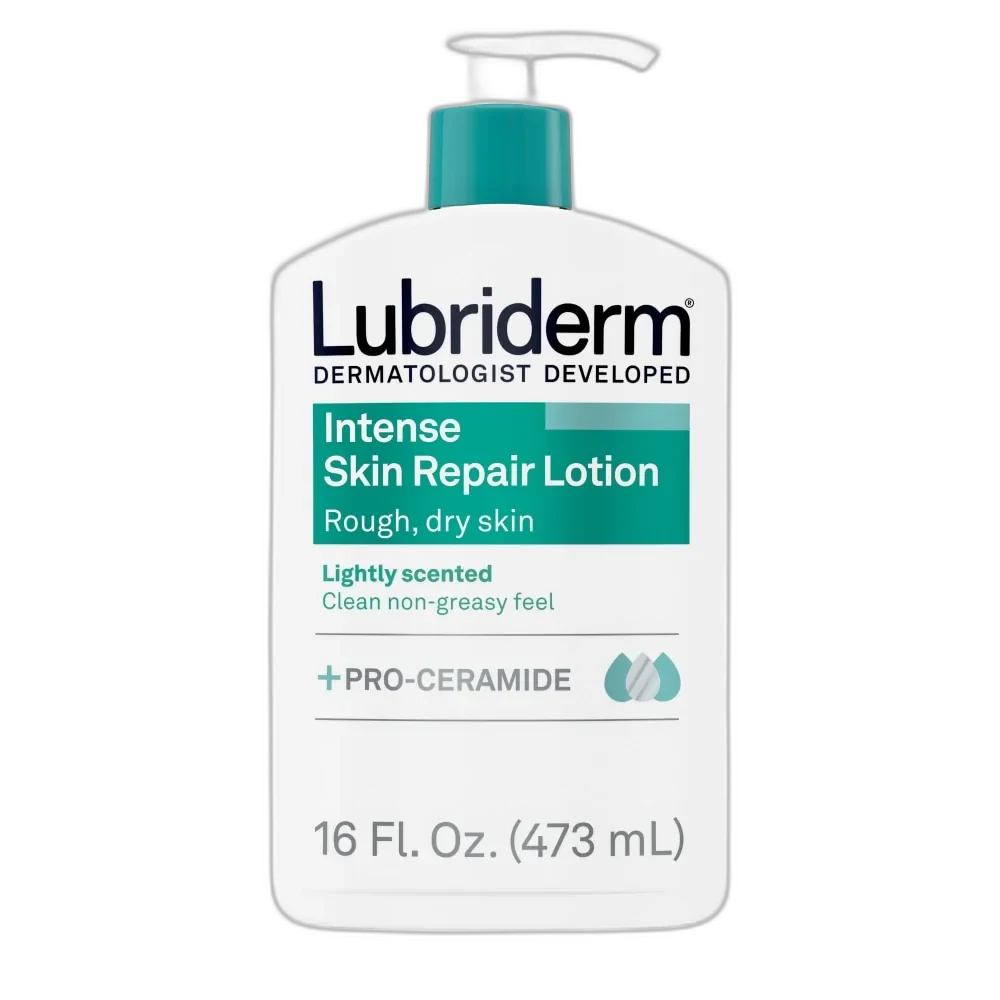
Intense Dry Skin Repair Ointment
Intensive Repair Workhorse
 Verified reviewer
Pros & cons.
- +Petrolatum-glycerin-cholesterol base represents dermatologically ideal barrier repair formulation
- +Completely fragrance-free and 91% top-allergen-free — safe for severely compromised skin
- +Visibly heals cracked heels and rough patches within days, not weeks
- +Cholesterol provides genuine lipid barrier replenishment beyond simple occlusion
- +Small tube format is convenient for targeted application and travel
- +Gentle enough for eczema patches and post-procedure skin
- −Very greasy, thick texture that does not absorb — requires bedtime use with protective clothing
- −Small 1.75 oz tube runs out quickly when treating multiple problem areas
- −Not widely available in stores compared to Lubriderm's lotion products
- −Not suitable for full-body use or daytime application due to heavy, occlusive texture
- −Can stain clothing and bedsheets without protective layers
The full review.
Skincare contains a certain irony: the most effective ingredient for repairing damaged skin is also the least glamorous. Petrolatum — pharmaceutical-grade petroleum jelly — has been the dermatology gold standard for wound healing and barrier repair for over a century. It reduces transepidermal water loss more effectively than any other topical ingredient, creating the moisture-rich environment skin needs to rebuild. Yet marketing departments avoid it, because telling users to apply petroleum jelly lacks the aspirational appeal of botanical extracts and proprietary complexes.
Lubriderm’s Intense Dry Skin Repair Ointment uses its petrolatum base without apology. The formula uses exactly what dermatological science says damaged skin needs: petrolatum for maximum occlusion, glycerin for humectant moisture-drawing, mineral oil for additional emolliency, and cholesterol — a thoughtful addition — for lipid barrier repair. Cholesterol is one of the three essential lipids in the stratum corneum’s intercellular mortar, alongside ceramides and free fatty acids. Including it means the formula does more than seal damaged skin; it provides raw materials for the skin to rebuild its barrier.
Texture
The texture is unambiguously an ointment. This is not a lotion marketed as an ointment. It is thick, semi-translucent, and greasy. It does not absorb fully — which is the point. An ointment sits on the skin as a protective occlusive layer, creating a sealed environment where the humectants beneath work undisturbed for hours. This delivery format works best for cracked heels, raw cuticles, winter-ravaged knuckles, and eczema patches.
The 1.75-ounce tube is small by design. This is not a full-body product. Squeeze out a small amount, apply it to the specific area that needs rescue, and let it work. For heels, applying a generous layer at night and wearing cotton socks produces softer, more comfortable skin by morning. Multiple reviewers report that cracked heels nearly healed within a week — a timeline no lotion can match, because no lotion provides the same degree of occlusive protection.
Scent
The fragrance-free formulation is critical for this product’s use case. Severely dry and cracked skin has lost barrier integrity, so everything applied has easier access to the living cell layers beneath. Fragrance on compromised skin causes stinging, irritation, and potential sensitization. Lubriderm gets this right: the ointment contains zero fragrance, zero common allergens, and is 91% top-allergen free according to SkinSAFE’s database. You can apply this to raw, broken skin without flinching.
The dimethicone and cyclopentasiloxane add practical value beyond the petrolatum. These silicones improve the ointment’s spreadability — as petrolatum alone can be sticky and difficult to apply evenly — and create an additional breathable protective layer. The combination of petroleum-based and silicone-based occlusives provides multi-mechanism barrier protection that covers the skin more completely than either system alone.
The honest limitations involve expectation-setting. This is a rescue product, not an everyday moisturizer. It feels greasy. It can stain fabric. It requires planning — applying it at bedtime with protective clothing over the treated areas is the practical way to use it. The 1.75-ounce tube is small and runs out within a few weeks if treating multiple areas, which can feel expensive per ounce despite the low absolute price. Also, it is less widely stocked than Lubriderm’s lotions and is not on every pharmacy shelf.
But for the specific situation it targets — skin that has gone beyond dry into damaged — this ointment earns its place. It is the product dermatology would design if it had a product design department: evidence-based ingredients, minimal irritant risk, maximum barrier protection, and no concessions to sensory elegance that might compromise therapeutic efficacy. Sometimes the best skincare product in your bathroom is the one that would never make it onto Instagram.
Ingredient analysis.
Full INCI list
Water, Glycerin, Ethylhexyl Isononanoate, Mineral Oil, Petrolatum, Cetyl Alcohol, Sorbitan Stearate, Hydrogenated Polydecene, Sodium Behenoyl Lactylate, Synthetic Wax, Dimethicone, Cholesterol, Cyclopentasiloxane, Cyclohexasiloxane, Cetearyl Alcohol, Caprylyl Glycol, Phenoxyethanol, Carbomer, Sodium Hydroxide, Disodium EDTA, Tocopheryl Acetate
Skin match.
The science.
The Science
Dermatological literature extensively documents petrolatum's occlusive efficacy. A 1992 Ghadially et al. study in the Journal of Clinical Investigation shows petrolatum reduces transepidermal water loss by approximately 98%, outperforming every other tested topical ingredient. The same study shows petrolatum does more than trap moisture; it creates an environment that lets the skin's natural barrier repair mechanisms work optimally, speeding up stratum corneum lipid architecture recovery.
Research shows the stratum corneum's barrier function depends on a specific ratio of ceramides, cholesterol, and free fatty acids. Feingold and Elias published a study in the Journal of Investigative Dermatology (2001) finding that exogenous cholesterol accelerates barrier recovery in barrier-compromised skin, especially with occlusive protection. In this ointment, cholesterol works under the petrolatum seal to support lipid barrier reconstruction directly.
Glycerin works effectively as a humectant in occlusive formulations. Research in Acta Dermato-Venereologica (2000) shows glycerin attracts water into the stratum corneum and modifies skin lipid phase behavior, improving barrier structural organization. Petrolatum occlusion amplifies glycerin's hydrating effects because the petrolatum prevents the drawn-in moisture from evaporating.
References
- Petrolatum accelerates barrier recovery and lipid synthesis after acute perturbation — Journal of Clinical Investigation (1992)
- Role of cholesterol sulfate in epidermal structure and function — Journal of Investigative Dermatology (2001)
- Glycerol's impact on stratum corneum hydration and lipid organization — Acta Dermato-Venereologica (2000)
Dermatologist Perspective
Board-certified dermatologists view petrolatum-based ointments as the gold standard for severely dry, cracked, and eczema-prone skin. Dermatologists note petrolatum's occlusive properties create the ideal healing environment for compromised barriers. Adding cholesterol to this formula aligns with evidence that barrier repair requires replenishing the three essential stratum corneum lipids. Dermatologists commonly recommend this product for overnight treatment of cracked heels, hand eczema, and post-procedure skin; its fragrance-free formulation is safe for reactive patients.
Where it fits in your routine.
Apply a thick layer to problem areas at bedtime — cracked heels, rough elbows, dry knuckles, or eczema patches. Cover heels with cotton socks after application. Wear thin cotton gloves for hands. Let the ointment warm and settle on the skin for a few minutes before covering. Use nightly until the area heals, then switch to a maintenance lotion. For ongoing eczema management, apply after moisturizing lotion as a final occlusive seal.
At about $8 for 1.75 oz, the per-ounce price exceeds Lubriderm's lotions, but this comparison is misleading. This is a targeted treatment product, not a daily full-body moisturizer. The small tube lasts 2-4 weeks for specific problem areas, making the per-treatment cost roughly $0.30-0.60. The price is reasonable for the therapeutic value—effective barrier repair using dermatologically validated ingredients. Comparable petrolatum-based ointments from clinical brands cost the same or more. You may still need a separate daily lotion for general body moisturization.
Use this for severely dry, cracked, or fissured skin that lotions fail to fix. It works well for cracked heels, winter hand dryness, eczema patches, and post-procedure skin. It suits people seeking a fragrance-free, allergen-minimal intensive treatment based on dermatological science instead of marketing claims.
This is too heavy and greasy for everyday body moisturizer use. It works for people with oily or acne-prone skin on specific treatment areas. It suits those who cannot tolerate the greasy texture or need protective clothing during overnight use. Lubriderm's lotions are more appropriate for mild to moderate dryness.
Product details.
Completely fragrance-free with no detectable odor.
A small 1.75 oz squeeze tube fits in a medicine cabinet or travel bag. The tube format lets you dispense controlled, targeted amounts for specific problem areas. Finish non-greasy satin
The ointment provides immediate comfort on cracked or severely dry skin. It does not sting or irritate; it forms a thick, protective layer that seals moisture in. The texture is heavy and feels greasy compared to lotions. Using it overnight with socks on feet or cotton gloves on hands produces softer skin by morning.
2-4 weeks with nightly targeted application to problem areas
24 months
fall winter
The backstory.
The Intense Skin Repair Ointment extends Lubriderm's therapeutic heritage into the most severe dry skin territory. Where the brand's lotions address everyday and moderate dryness, this ointment is built for cracked heels, raw cuticles, eczema patches, and skin that has lost its barrier integrity. It represents Lubriderm returning to its clinical roots — the kind of product that would have been at home in the dermatologist offices where the brand spent its first three decades.
About Lubriderm
Legacy Brand (20+ years)Lubriderm was developed by pharmacist Louis Schleuse in 1945 and used exclusively in dermatological settings for thirty years before public release in 1975. Now under Kenvue, the brand has over 80 years of heritage in therapeutic moisturization. The Intense Skin Repair Ointment is the brand's most occlusive offering.
Common myths.
Petroleum-based products suffocate the skin and stop it from breathing.
Petrolatum does not suffocate skin. It forms a semi-occlusive barrier that reduces transepidermal water loss but allows oxygen and carbon dioxide exchange. This occlusion provides what severely dry and cracked skin needs — a moisture-rich environment for the skin's natural repair processes to work. Dermatologists call petrolatum a gold-standard ingredient for barrier repair.
FAQ.
What is the difference between Lubriderm Intense Skin Repair Ointment and the Lotion?
The ointment is thicker and more occlusive than the lotion. It uses a petrolatum base for severely dry and cracked skin. The lotion is lighter for broader daily application. The ointment is fragrance-free, but the lotion has a light scent. Use the ointment for targeted treatment of cracked heels, raw patches, and severely compromised skin; use the lotion for general body moisturization.
Can I use the Lubriderm ointment on my face?
The formula is gentle and fragrance-free for the face, but the thick, petrolatum-based texture is too occlusive for most facial skin, especially for acne-prone skin. On the face, the cholesterol and petrolatum base can cause congestion. Use it on body skin, specifically for problem areas like heels, elbows, and cracked hands.
Is the Lubriderm Intense Skin Repair Ointment good for eczema?
Yes, the fragrance-free, petrolatum-based formula works for eczema-prone skin. Dermatologists recommend petrolatum as a top occlusive for eczema management. It provides maximum barrier protection and reduces the transepidermal water loss that drives eczema flares. The cholesterol in the formula also supports lipid barrier repair.
How do I use the Lubriderm ointment without staining my sheets?
Apply the ointment to targeted areas at bedtime. Wait a few minutes for initial absorption. Wear cotton socks on feet. Wear thin cotton gloves on hands. Wear long sleeves or pajama pants over elbows or knees. The ointment does not absorb fully like a lotion; this residual layer provides intentional overnight barrier protection.
Is the Lubriderm ointment fragrance-free?
Yes, the Intense Skin Repair Ointment is fragrance-free, whereas the Intense Skin Repair Lotion has a light scent. The Intense Skin Repair Ointment also lacks common allergens like lanolin, gluten, coconut, and nickel. This makes it one of the gentlest options for severely compromised skin.
What the community says.
"Heals cracked heels and severely dry skin patches remarkably quickly"
"Fragrance-free and gentle — does not sting on cracked or broken skin"
"Thick, protective ointment texture provides real occlusive barrier"
"Small tube is convenient for travel and targeted application"
"Very thick and greasy — not suitable for daytime or full-body use"
"Small 1.75 oz tube runs out quickly for those treating multiple dry areas"
"Can stain clothing and bedsheets if not given time to absorb"
"Difficult to find in stores — not as widely stocked as the lotion"