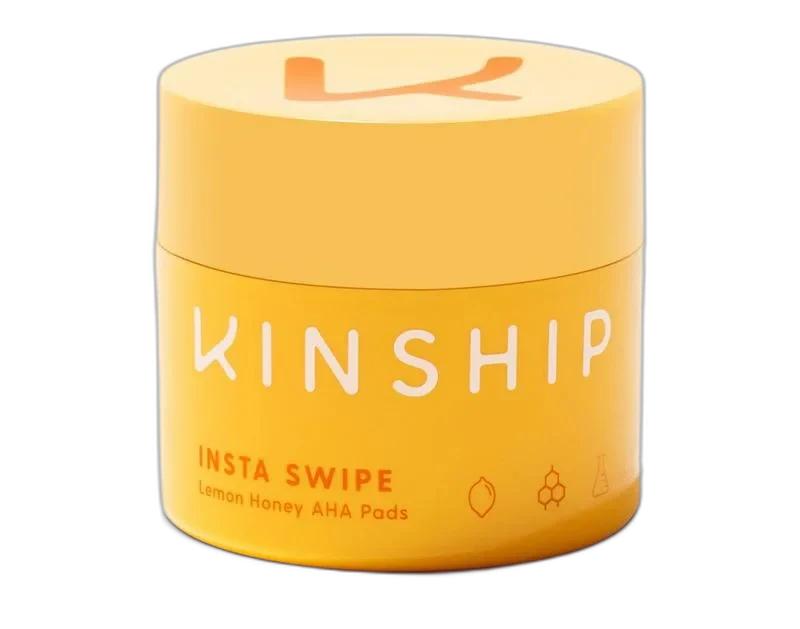
Insta Swipe Lemon Honey AHA Pads
Gen Z Glow Pad
 Verified reviewer
Pros & cons.
- +Effective glycolic and malic acid stack at a friendly price
- +Visible glow the morning after first use
- +Convenient pre-soaked pad format for busy evenings
- +Leaping Bunny certified and free of synthetic fragrance
- +Willow bark contributes mild oil-soluble clearing
- +Pleasant clean lemon-honey scent from botanical sources
- +Clean-beauty aesthetic without sacrificing active strength
- −Lemon peel oil is a known photosensitizer and an unforced error in a leave-on acid product
- −Jar packaging exposes the solution to air with every use
- −Last few pads in the jar often feel drier than the first
- −Not appropriate for sensitive or rosacea-prone skin
- −Contains honey so is not vegan despite clean-beauty framing
The full review.
About Kinship
The pre-soaked acid pad is one of the oldest formats in modern skincare, and for most of the 2000s it lived in drugstore aisles with jar labels that felt clinical at best and slightly scary at worst. When Kinship launched in 2019, Insta Swipe was the founders’ attempt to take that format and give it to a younger audience that grew up on cleaner-looking packaging and a softer marketing voice. The pads sit in a wide, round jar that looks more like a vintage cosmetic tin than an acid treatment, the solution smells like lemon and honey, and the whole product reads like something you would keep next to your makeup rather than hide in the medicine cabinet. It is a genuinely good-looking piece of work, and the interesting question is whether the formulation lives up to the rebrand.
Reality
The short answer is mostly yes. The liquid the pads are soaked in is a glycolic acid and malic acid stack sitting at a low enough pH to do real exfoliation work, rounded out with willow bark as a natural salicin source and lactobacillus ferment for a modest postbiotic cushion. You use one pad, swept once across the face and neck after cleansing, and by the next morning the skin looks visibly brighter in a way that a plain hydrating toner cannot fake. Over two or three weeks of twice-weekly use, texture on the forehead and around the nose starts to smooth, clogged pores in the T-zone empty out, and the general dullness that afflicts combination skin in its twenties lifts measurably. If your goal is a reliable, next-morning glow step and you have been bouncing off harsher drugstore pads, this one is the cleaner, gentler-leaning cousin you are looking for.
Common Complaints
That said, there are two honest drawbacks worth naming, and the first one is chemical. The formula includes both lemon peel oil and lemon fruit extract, which carry furanocoumarins, a class of compounds well-documented to sensitize skin to sunlight when applied and then exposed to UV. The inclusion level here is low and the product is marketed for evening use, so the real-world risk for most users is small, but it is not zero, and on a leave-on acid product that is already lowering surface pH, the lemon oil is an unforced error from a clean beauty brand that should know better. It is a small enough issue that it does not disqualify the product, but it should be part of how you think about using it. Always at night, always paired with daily broad-spectrum sunscreen, and always skip it before a beach day.
The second drawback is packaging. The wide-mouth jar is adorable, and sustainable in the sense that it is recyclable, but every time you open it you expose every remaining pad to air, and by the time you get to the last ten pads in the jar, the solution has noticeably thinned out as it absorbs and evaporates. A foil-sealed pull-pack or a smaller individual sachet format would preserve the formula better, though it would undercut the countertop aesthetic the brand clearly prioritized. Neither flaw is fatal. They are the kinds of trade-offs you notice after a few jars, not the kind that would make you stop using the product.
Who Should Buy
The person this product is best for is someone in their twenties or thirties with combination or oily skin who wants an effective at-home glycolic step that does not feel or smell clinical, who uses sunscreen daily anyway, and who is willing to treat the pads as a two-to-three-times-a-week luxury rather than a daily ritual. At twenty-four dollars for a jar that lasts three to four months at that pace, the per-use cost is almost trivial, and the format is genuinely convenient on nights when you want to speed-run your routine. It is not the most technically sophisticated acid product on the market, and it is not the right choice for sensitive or rosacea-prone skin, but within the slice of the category it is trying to occupy, it is a well-targeted and honestly pleasurable thing to use.
Ingredient analysis.
Full INCI list · pH 3.8
Water (Aqua), Glycolic Acid, Glycerin, Malic Acid, Aloe Barbadensis Leaf Juice, Salix Alba (Willow) Bark Extract, Lactobacillus Ferment, Ananas Sativus (Pineapple) Fruit Extract, Caprylic/Capric Triglyceride, Citrus Limon (Lemon) Peel Oil, Citrus Limon (Lemon) Fruit Extract, Honey Extract, Rose Extract, Theobroma Cacao (Cocoa) Extract, Vitis Vinifera (Grape) Fruit Extract, Sodium Hydroxide, Caprylyl/Capryl Glucoside, Phenoxyethanol, Ethylhexylglycerin.
Skin match.
The science.
The Science
Glycolic acid and malic acid drive this product's exfoliation. Glycolic acid has over two decades of research showing it reduces corneocyte cohesion and improves surface texture, pigmentation, and photoaging markers when applied at a low enough pH for the free acid to dominate. Research in the Journal of the American Academy of Dermatology and other literature shows that 5 to 10 percent AHA concentrations in leave-on toners or pads improve skin smoothness and brightness. Malic acid acts as a secondary AHA to widen the exfoliation profile at the molecular level, though it has less independent research. Willow bark extract contains salicin, which converts to salicylic acid in small amounts, but typical cosmetic levels are lower than an OTC BHA product. The postbiotic lactobacillus ferment shows emerging evidence for supporting stratum corneum recovery after acid exposure. Lemon peel oil is the formulation's weakest scientific link. Bergapten and other furanocoumarins in citrus peel oils are documented photosensitizers; while the risk at this low dose is modest, the ingredient adds no function to an AHA product and makes the label harder to defend on strict dermatological grounds.
Dermatologist Perspective
Dermatologists see pre-soaked AHA pads as a reasonable option for patients who struggle to use liquid toners consistently, as the pad delivers a controlled dose in one sweep. Board-certified dermatologists note that glycolic-plus-malic pads like this one fit the treatment step of an evening routine, suggesting two to three nights per week as the safest starting cadence. The dermatologic community cautions against layering: do not combine these pads with retinoids, benzoyl peroxide, or additional acids on the same evening. Dermatologists also flag citrus peel oils as unnecessary in leave-on products; patients with melasma or hyperpigmentation concerns are often advised to choose an AHA without added lemon or bergamot oils.
Where it fits in your routine.
Apply at night to dry skin after cleansing. Take one pad from the jar and sweep it across the face and neck once. Avoid the eye area, the corners of the mouth, and active irritation. Do not rinse. Use a hydrating serum and a ceramide moisturizer next. Start once or twice a week to test tolerance, then increase to two or three times per week. Do not use with retinoids, other AHA or BHA products, or vitamin C on the same night. Use daily broad-spectrum SPF 30 or higher during use, and reseal the jar tightly after each pass to stop solution evaporation.
At $24 for 45 pads, the per-use cost is just over fifty cents at the recommended 2 to 3 nights a week cadence. This offers excellent value for a functional AHA treatment. This product sits at the accessible end of the category compared to a $35 glycolic toner bottle or a $60 professional acid serum. The formula is not the most sophisticated glycolic treatment on the market, but you do not pay for that. For a Gen Z or millennial buyer wanting a clean-beauty aesthetic and a real AHA effect for a few dollars a week, the math works in the buyer's favor.
People with combination, oily, or normal skin in their twenties through forties want a convenient at-home AHA step that gives a next-morning glow without a clinical feel. This works well for clean-beauty fans who prefer a pad format over a liquid toner, and for travelers who find jar-and-cotton routines impractical.
Sensitive, rosacea-prone, or eczema-prone skin reacts to the lemon peel oil and the acid load. Pregnant or breastfeeding users should avoid it. Lemon oil complicates pigmentation management for anyone with melasma or stubborn hyperpigmentation. Budget shoppers can buy an acid toner bottle without lemon oil for less.
Product details.
Thin, soft, dimpled pads soak in a watery acid solution. They glide across the face without shedding.
Fresh lemon scent with a faint honey sweetness. It smells pleasant but is strong for an exfoliating product.
A wide-mouth recyclable jar uses a screw-top lid. It looks on-brand, but opening it exposes every pad to air. The last few pads in a jar are drier than the first.
Expect a mild tingle and a distinct lemon scent on the first pass. Skin feels smooth and slightly glowy within an hour. Some users report a short initial purge of small clogged bumps in week 1 to 2 that resolves by week 3.
About 3 to 4 months with 2 to 3 uses per week from a 45-count jar.
6 months
All Year
The backstory.
Kinship was founded in 2019 by a husband-wife team with a background in sustainable packaging, and Insta Swipe was one of its launch products. It was pitched as a post-workout or pre-makeup glow step aimed at a younger audience that associated acid toners with harsher 1990s formulas and wanted a cleaner, friendlier version.
About Kinship
Emerging Brand (2–5 years)Kinship launched in 2019 as a Gen Z-focused clean beauty brand. It uses sustainable packaging and has Leaping Bunny certification. The brand has growing retail distribution at Ulta and Anthropologie, but lacks long-term independent clinical validation beyond ingredient-level research.
FAQ.
How often should I use these pads?
Most people use this two to three nights per week. Daily use is too aggressive. People with drier or more reactive skin use it less often.
Does the lemon oil make my skin photosensitive?
Lemon peel oil contains furanocoumarins that sensitize skin to sunlight. This low inclusion level carries a small but non-zero risk. Use these pads at night only and wear daily broad-spectrum sunscreen.
Are these pads safe during pregnancy?
Not generally recommended. The glycolic concentration is high, and the product contains willow bark, a natural salicylic source. Most obstetricians advise pausing leave-on AHA and BHA products during pregnancy.
Can I use these with retinol?
Not on the same night. Alternate a retinol night with a pad night, and use a hydrating routine on the off-nights to prevent cumulative irritation.
Do they help with acne?
Yes, modestly. The glycolic and willow bark combination improves surface texture and clogged pores, but salicylic or benzoyl peroxide products work better for active inflammatory acne.
How long does a jar last?
A 45-count jar lasts most users three to four months at two to three uses per week. The last few pads in the jar feel drier because the solution evaporates when the lid opens.
Is this product vegan?
No. Honey extract makes it non-vegan, even though Kinship is Leaping Bunny certified cruelty-free.
What the community says.
"Noticeable glow the next morning"
"Convenient pre-soaked pad format"
"Smells fresh and citrusy"
"Clears dull, bumpy skin fairly quickly"
"Lemon oil burns sensitive skin"
"Pads can feel drying if used too often"
"Strong citrus scent is not for everyone"
"Jar packaging dries out pads near the end"
People also looked at.