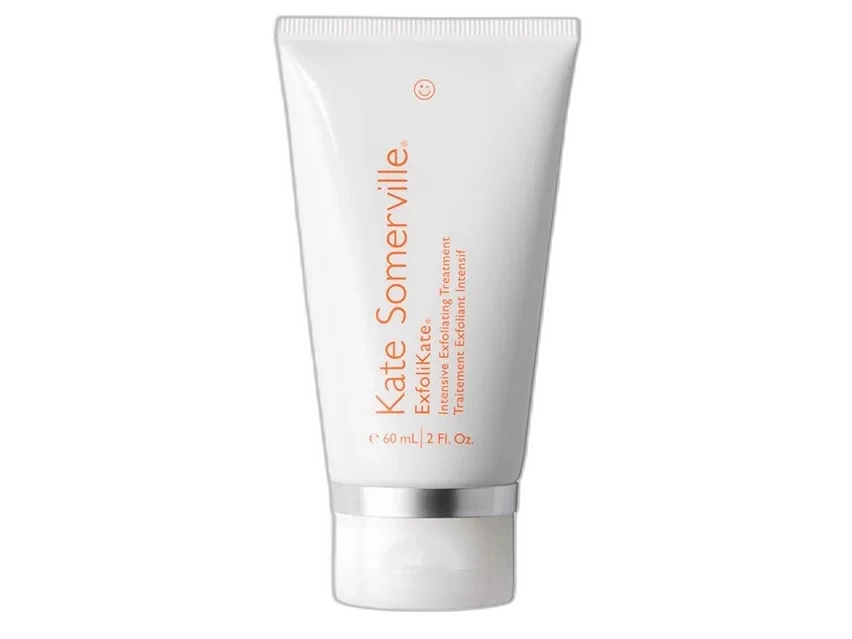
ExfoliKate Intensive Exfoliating Treatment
Cult Classic Exfoliant
 Verified reviewer
Pros & cons.
- +Dramatically smoother, more radiant skin visible immediately after a single 2-minute treatment
- +Quad-pathway exfoliation combines AHAs, BHA, physical silica, and fruit enzymes uniquely
- +Clinically proven pore refinement and texture improvement with twice-weekly use
- +Allure Best of Beauty Award winner with 15+ years of sustained cult-classic status
- +Salicylic acid provides pore-clearing benefits that pure AHA exfoliants cannot match
- +Available in a $19 mini size for low-commitment trial before investing in full size
- −Premium $85 price for 2 oz, though longevity with twice-weekly use softens the cost
- −Heavy essential oil blend introduces multiple allergens with no exfoliating benefit
- −Too intense for sensitive, rosacea-prone, or barrier-compromised skin types
- −Contains denatured alcohol which can contribute to dryness and irritation
- −Strong cinnamon-forward scent is polarizing and can cause reactions in some users
The full review.
Some products create hype, while others sustain it. The ExfoliKate Intensive Exfoliating Treatment has done both for over fifteen years—an eternity in the fast-moving beauty industry. Kate Somerville originally formulated this as a take-home product for her Melrose Place clinic to maintain results between professional facials. Instead, many users find it more effective than the facials themselves.
The formula uses quad-pathway exfoliation. Most exfoliants use one method: chemical acids, physical scrubs, or enzymes. ExfoliKate uses all four at once, creating the immediate transformation that drives its cult status.
Lactic acid is second on the ingredient list, indicating a high concentration that provides aggressive, hydrating chemical exfoliation. While some call lactic acid a gentler version of glycolic acid, high concentrations work as a powerful exfoliant. It dissolves the desmosomes holding dead corneocytes together while drawing moisture into the new skin. Salicylic acid appears further down the list to provide oil-soluble pore penetration that lactic acid lacks. Together, they target both surface texture and deep pore congestion.
Silica provides the physical component. These fine, spherical particles mechanically buff the skin as you massage the paste. Unlike jagged walnut shell fragments that cause micro-tears, silica particles are rounded and uniform. They polish the skin and sweep away cells loosened by the acids without damaging healthy tissue. It is the difference between sandpaper and a chamois cloth.
The third pathway is enzymatic. Bromelain from pineapple and papain from papaya are proteolytic enzymes that digest keratin, the protein in dead skin cells. They break down the actual structure of dead cells through a different mechanism than acids. Finally, a pumpkin ferment extract adds natural enzymes and lactic acid from the fermentation process.
The treatment is a sensory experience. You squeeze out a thick, green paste that smells like a spice market near a lavender field; the cinnamon, bergamot, and lavender essential oils are unmistakable and polarizing. You apply it to clean skin. Within seconds, the lactic acid creates a spreading warmth that ranges from a gentle tingle to a firm sensation. The two-minute wait feels long. When you rinse, the transformation is startling. Your face feels professionally resurfaced—not raw, but impossibly smooth, with a clarity and glow that converts skeptics into repeat buyers.
Using it twice weekly yields impressive cumulative effects. Pores visibly tighten as salicylic acid clears dead-cell buildup. Skin tone evens as accelerated turnover fades minor hyperpigmentation. Fine lines, especially dehydration-related lines around the eyes and mouth, soften as smoother, hydrated skin replaces the dull surface. This is one of the few products where the clinical claim of ninety-four percent improvement in texture matches real-world use.
The drawbacks are significant. This is not a gentle product. The high lactic acid concentration, salicylic acid, alcohol denat, and essential oils like cinnamon leaf oil create a long list of potential irritants. The essential oil blend—bergamot, lavender, cinnamon, patchouli, geranium, rosewood, and orange peel—functions more like a perfume than a skincare necessity. These ingredients contribute known allergens (linalool, limonene, eugenol, cinnamal) that do not aid exfoliation.
This product is not for sensitive skin, rosacea-prone skin, or compromised barriers. Cinnamon oil alone can trigger contact dermatitis, and using it with high-concentration acids on freshly exfoliated skin can cause reactions. Even robust skin types sometimes report tingling that turns into discomfort.
The price is also a factor. At eighty-five dollars for two ounces, this is a major investment. The cost per use drops if twice-weekly use lasts three or four months, and the 0.5 oz mini at nineteen dollars allows for a trial. However, you must ask: can you get similar results more cheaply using separate acid and enzyme products? Probably. But few products are as satisfying, transformative, or integrated into a single two-minute step. That is why ExfoliKate costs this much.
Formula
Ingredient analysis.
Full INCI list
Aqua/Water/Eau, Lactic Acid, Silica, Glycine Soja (Soybean) Oil, Pectin, Cetearyl Alcohol, Carica Papaya (Papaya) Fruit, Ceteareth-20, Cetyl Alcohol, Phenoxyethanol, Dehydroxanthan Gum, Glyceryl Stearate, PEG-100 Stearate, Salicylic Acid, Lactobacillus/Pumpkin Ferment Extract, Alcohol Denat, Sorbic Acid, Cinnamal, Mel/Honey/Miel, Citrus Aurantium Bergamia (Bergamot) Fruit Oil, Eugenol, Potassium Sorbate, Limonene, Linalool, Lavandula Angustifolia (Lavender) Oil, Beta-Carotene, Aloe Barbadensis Leaf Juice Powder, Bromelain, Papain, Retinyl Palmitate, Tocopheryl Acetate, Cinnamomum Cassia Leaf Oil, Acetic Acid, Pogostemon Cablin Oil, Pelargonium Graveolens Flower Oil, Aniba Rosaeodora (Rosewood) Wood Extract, Citrus Aurantium Dulcis (Orange) Peel Oil, CI 75810 (Chlorophyllin-Copper Complex)
Skin match.
The science.
The Science
The ExfoliKate Intensive Treatment uses a four-pathway exfoliation approach based on complementary dermatological mechanisms. Lactic acid, an alpha-hydroxy acid with a molecular weight of 90 Da, exfoliates by disrupting calcium-dependent desmosomes—the protein bridges between adjacent corneocytes. At the concentrations indicated by its second-position listing, lactic acid provides rapid keratolysis and acts as a humectant to draw water into the stratum corneum. A 1996 study by Smith in the Journal of the American Academy of Dermatology showed that AHAs at concentrations above 5% with pH below 3.5 produce clinically significant exfoliation.
Salicylic acid uses a different exfoliation pathway as a lipophilic beta-hydroxy acid. Research in the Journal of Cosmetic Dermatology shows that salicylic acid's oil-solubility lets it penetrate the sebaceous follicle and dissolve the lipid-rich plugs that dilate pores and cause comedone formation. Combining a water-soluble AHA (lactic acid) and a lipid-soluble BHA (salicylic acid) treats both the skin surface and the pore interior—a dual-compartment approach neither acid achieves alone.
The enzymatic component uses bromelain (from Ananas comosus) and papain (from Carica papaya)—cysteine proteases that cleave peptide bonds in keratin through a mechanism independent of pH-dependent acid exfoliation. A 2014 study in Clinical, Cosmetic and Investigational Dermatology showed that topical enzyme application improves skin surface smoothness. The Lactobacillus/Pumpkin Ferment Extract adds metabolic byproducts from probiotic fermentation—extra lactic acid and partially hydrolyzed enzymes—to supplement the chemical and enzymatic pathways.
The physical silica component mechanically debrides the chemically loosened corneocyte layer. While irregular physical exfoliant particles can cause micro-epidermal abrasions, amorphous silica particles are spherical and uniform, distributing pressure evenly across the skin surface during application.
References
- Cosmetic and clinical applications of alpha hydroxy acids — Journal of the American Academy of Dermatology (1996)
Dermatologist Perspective
Board-certified dermatologists view the ExfoliKate Intensive Treatment as a highly effective over-the-counter exfoliating product, noting its multi-mechanism approach matches professional-grade exfoliation protocols. Dermatologists who recommend it usually advise using it 1-2 times weekly and always applying sunscreen the next morning, because the AHA-BHA combination increases photosensitivity. However, dermatologists often flag the high essential oil content as an unnecessary irritation risk, especially for patients with atopic tendencies. Dermatologists generally do not recommend the product for patients with rosacea, active eczema, or those using prescription retinoids.
Where it fits in your routine.
Apply a thin, even layer to a clean, dry face and neck, avoiding the eye area. Leave it on for exactly 2 minutes — set a timer. A warming or tingling sensation is normal. If it hurts, rinse immediately. After 2 minutes, massage in gentle circular motions for 15-30 seconds to activate the physical exfoliation, then rinse thoroughly with lukewarm water. Follow with a hydrating serum and moisturizer. Use 1-2 times per week, but never on consecutive days. Always wear SPF 30+ the next morning.
At $85 for 2 fl oz, the upfront cost is high. But using it twice weekly makes one tube last 3-4 months — about $21-28 per month for exfoliation. The $19 mini (0.5 oz) offers 4-6 uses for a trial. A 5 oz jumbo at $175 ($35/oz vs $42.50/oz for the standard) gives better value for regular users. Compared to professional chemical peels ($100-300 per session), twice-weekly at-home use gives similar surface-level results for less money. The formulation works as promised — you just decide if convenience and immediate visible results justify the premium over buying separate acid products.
Skincare enthusiasts with normal, combination, or oily skin want the strongest single-step over-the-counter exfoliation. This works for anyone with persistent texture, dull skin, visible pores, or fine lines who has the skin resilience for intensive treatment.
This works for sensitive, rosacea-prone, eczema-prone, or barrier-compromised skin. Pregnant or nursing individuals should avoid the salicylic acid. Avoid this if you react to essential oils — specifically cinnamon, bergamot, or lavender. Adding this to a routine with prescription retinoids may overwhelm your skin.
Product details.
Cinnamon, bergamot, and lavender essential oils create a warm, complex herbal-spicy fragrance. It is distinctive and recognizable; most users either love it or find it overpowering.
Squeeze tube with a flip-top cap. Sizes include 0.5 oz, 2 oz, and 5 oz. The tube format allows precise dispensing and protects product integrity better than a jar.
The first use is intense. The green paste is thick. Within seconds, a warm tingling — sometimes a mild burning — shows the acids working. The sensation peaks and stabilizes during the 2-minute wait. Skin looks smoother, brighter, and more refined immediately after rinsing. Many users call this first-use experience a revelation.
3-4 months with twice-weekly use on face only
12 months
All Year
Common myths.
Burning means it works — more intense tingling means better results.
The lactic acid concentration in this product causes a mild warming sensation. Actual burning or pain means you exceeded your skin's tolerance. Rinse immediately if the sensation becomes uncomfortable. More tingle does not mean more exfoliation; it means more irritation.
Physical exfoliants cause micro-tears and damage skin.
Micro-tears come from harsh, irregular particles like ground nut shells. The silica in this formula is finely milled and rounded. It provides gentle physical buffing without the abrasive damage from jagged scrub particles. Many dermatologists endorse this combination of chemical and physical exfoliation.
FAQ.
How often should I use ExfoliKate Intensive Exfoliating Treatment?
Kate Somerville recommends this treatment 2 times per week. If you have not used intensive exfoliants before, start with once a week, then increase to twice weekly as your skin builds tolerance. Use this no more than 2-3 times per week and never on consecutive days; over-exfoliation damages your skin barrier.
Is ExfoliKate Intensive safe during pregnancy?
This product contains salicylic acid, which is generally advised against during pregnancy. Consult your OB-GYN or dermatologist before using any products with salicylic acid while pregnant or nursing.
Why does ExfoliKate tingle or burn when applied?
The high concentration of lactic acid (listed as the second ingredient) and salicylic acid causes the tingling sensation. A mild warmth is normal during the 2-minute application. If you feel actual pain or burning, rinse immediately — your skin may not tolerate this acid concentration.
What is the difference between ExfoliKate Intensive and the Daily Cleanser?
The Intensive Treatment is a concentrated, leave-on exfoliant used 1-2 times per week with significantly higher acid concentrations and physical silica particles for dramatic results. The Daily Cleanser is a gentler, rinse-off formula designed for everyday use. They are complementary products — use the Daily Cleanser for maintenance between Intensive Treatment sessions.
Can I use ExfoliKate Intensive with retinol?
Don't use them on the same night. High-concentration AHAs, BHA, and retinol together cause irritation and barrier damage. Use ExfoliKate on nights without your retinol treatment, and always follow with a hydrating moisturizer.
Is the $85 price worth it for ExfoliKate Intensive?
Using the 2 oz tube twice weekly lasts about 3-4 months, costing roughly $20-28 per month. The results — smoother skin, refined pores, and more radiance — show after the first use and justify the cost for many. A $19 0.5 oz mini lets you trial the product before committing.
Community
What the community says.
"Dramatically smoother skin after a single 2-minute treatment"
"Visible pore refinement that improves with each use"
"Glowing, radiant complexion immediately after rinsing"
"The best exfoliating treatment many users have ever tried"
"Very expensive at $85 for 2 oz"
"Intense tingling or burning sensation during the 2-minute wait"
"Too harsh for sensitive or easily irritated skin"
"Essential oils and cinnamon can cause reactions in some users"
People also looked at.