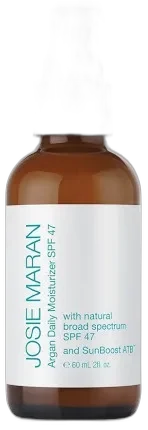
Argan Daily Moisturizer SPF 47
Clean Mineral SPF MVP
 Verified reviewer
Pros & cons.
- +SPF 47 achieved entirely with mineral filters — no chemical UV absorbers needed
- +Minimal white cast for a mineral formula, blending within 60-90 seconds
- +Moisturizing enough to replace a separate morning moisturizer for most skin types
- +Reef-friendly formula using only zinc oxide and titanium dioxide
- +B Corp certified brand with verified sustainable sourcing and environmental practices
- +Pregnancy-safe mineral-only UV protection at a meaningful SPF level
- +Green tea and vitamin E antioxidants supplement the physical UV filtration
- −Contains added fragrance despite the brand's clean beauty positioning
- −Not vegan due to beeswax — limits appeal for ethically motivated consumers
- −At $36 for 2 oz, the product runs out in about 5-6 weeks with daily use
- −Some visible white cast on deeper skin tones even after thorough blending
- −Can feel slightly heavy on oily skin in humid conditions
The full review.
For years, the mineral sunscreen category had an image problem. If you wanted reef-safe, pregnancy-safe, clean-ingredient sun protection, you accepted the trade-off: thick, white, paste-like formulas that sat on the skin like spackle and made you look like you’d just emerged from a mime workshop. Josie Maran’s Argan Daily Moisturizer SPF 47 was among the first prestige products to demonstrate that this trade-off was a formulation failure, not an inevitability.
The SPF 47 rating is achieved entirely through mineral filters: zinc oxide at 6.4% and titanium dioxide at 5.1%. This is worth emphasizing because most SPF products above 40 rely on chemical filters — the organic UV absorbers that are more cosmetically elegant but come with concerns about reef safety, hormonal activity, and photostability. Getting to SPF 47 with minerals alone requires formulation expertise that wasn’t widely available when this product first appeared. The zinc oxide provides broad UVA/UVB coverage, while the titanium dioxide reinforces UVB protection, and together they deliver a protection level that exceeds the dermatologist-recommended minimum of SPF 30 by a comfortable margin.
Texture
The texture is where the formulation earns its reputation. A blend of cyclopentasiloxane, polysilicone-11, and dimethicone creates a smooth vehicle that disperses the mineral particles evenly and prevents the chalky aggregation that plagues lesser mineral formulas. The argan and jojoba oils provide genuine moisturizing depth — this isn’t a sunscreen with token emollience, it’s a moisturizer with serious SPF. The oils sink into the skin while the silicone matrix holds the mineral filters in a uniform, transparent-ish layer. The result is a product that applies more like a serum-moisturizer hybrid than a sunscreen.
White cast
White cast, the perpetual complaint of mineral sunscreen users, is present but manageable. On fair to medium skin tones, the initial white tinge blends within sixty to ninety seconds of massaging the formula in. On deeper skin tones, some residual cast may persist — the brand offers a tinted version that addresses this more effectively, and it’s worth considering if universal transparency is important to you.
Moisturizing component
The moisturizing component is substantial enough that many users can skip a separate morning moisturizer entirely. Argan oil’s fatty acid profile — approximately 45% oleic acid and 35% linoleic acid — provides a balanced emollience that conditions without congesting. Jojoba oil, chemically more of a liquid wax ester than a true oil, mimics the skin’s own sebum and helps the formula feel natural rather than layered. Glycerin and aloe vera juice add humectant hydration. Green tea extract rounds out the formula with EGCG antioxidants that provide supplementary UV defense at the molecular level.
Honest criticism
The honest criticism centers on two ingredients that seem incongruous with the brand’s clean beauty positioning. First, parfum (fragrance) — an undisclosed blend of aromatic compounds that’s a legitimate concern for sensitive skin and a strange choice for a brand that built its reputation on ingredient transparency. It doesn’t overpower the product experience — the scent is light and dissipates quickly — but its inclusion invites the question of why a clean beauty pioneer would add an ingredient that serves no functional purpose and carries known sensitization risk.
Second, beeswax — which makes the formula non-vegan. For a B Corp certified brand with strong environmental messaging, the inclusion of an animal-derived ingredient limits the product’s appeal among ethically motivated consumers who might otherwise be the target audience.
Performance
Performance through a typical day is reliable. The mineral filters don’t degrade with UV exposure the way chemical filters can, so protection remains consistent as long as the product hasn’t been physically removed by sweating, touching, or wiping. Reapplication every two hours during sustained sun exposure is still necessary, but the formula’s moisturizer-like character makes this less of a chore than reapplying a dedicated sunscreen over makeup.
Value equation
The value equation is reasonable but not exceptional. At $36 for 2 ounces, this is a premium product that will last roughly five to six weeks with daily face and neck application — the minimum for adequate sun protection. That’s roughly $6-7 per week for combined moisturizer and SPF, which is competitive with buying the two products separately but not significantly cheaper. The formulation quality justifies the price; the per-ounce cost is where it feels steep compared to larger-format mineral sunscreens.
Josie Maran’s Argan Daily Moisturizer SPF 47 represents what clean mineral sunscreen can achieve when formulation science is taken as seriously as ingredient philosophy. It’s not perfect — the fragrance is unnecessary, the beeswax limits its vegan credentials, and the price-per-ounce is high — but it delivers daily mineral protection at a level that most people will actually enjoy wearing. In a category where compliance is everything, that enjoyability factor makes it one of the more practically effective SPF products available.
Ingredient analysis.
Full INCI list
Active Ingredients: Zinc Oxide 6.4%, Titanium Dioxide 5.1%. Inactive Ingredients: Aqua (Water), Ethylhexyl Palmitate, Caprylic/Capric Triglyceride, Aloe Barbadensis Leaf Juice, Polyglyceryl-6 Polyricinoleate, Cyclopentasiloxane, Polysilicone-11, Argania Spinosa (Argan) Kernel Oil, Glycerin, Cera Alba (Beeswax), Coco-Caprylate/Caprate, Phenoxyethanol, Polyhydroxystearic Acid, Methicone, Alumina, Tocopheryl Acetate, Sodium Chloride, Triethoxycaprylylsilane, Polyglyceryl-10 Laurate, Parfum (Fragrance), Bisabolol, Dimethicone, Simmondsia Chinensis (Jojoba) Seed Oil, Laureth-12, Ethylhexylglycerin, Camellia Sinensis (Green Tea) Leaf Extract, Citric Acid, Potassium Sorbate, Sodium Benzoate
Skin match.
The science.
The Science
The FDA classifies zinc oxide and titanium dioxide as Category I safe and effective sunscreen actives — the only two UV filters with this designation. A 2019 review in the Journal of the American Academy of Dermatology confirmed mineral UV filters have negligible systemic absorption. Less than 0.01% of applied zinc oxide enters the bloodstream, whereas chemical filters like oxybenzone and avobenzone show significant absorption.
The 6.4% zinc oxide and 5.1% titanium dioxide create an SPF 47 optimized dual-mineral system. Zinc oxide covers UVA I (340-400 nm), UVA II (320-340 nm), and UVB (290-320 nm). Titanium dioxide absorbs most strongly in the UVB and short-wave UVA II range. Together, they provide more uniform spectral coverage than either mineral alone, allowing the dual-filter approach to reach higher SPF at lower concentrations.
The formula uses triethoxycaprylylsilane-coated mineral particles to improve efficacy. A 2016 study in the International Journal of Cosmetic Science shows that hydrophobic surface treatment of zinc oxide and titanium dioxide particles improves photostability, reduces photocatalytic activity (which can generate free radicals), and increases water resistance. These coated particles also disperse more evenly in the silicone vehicle, improving both SPF performance and cosmetic elegance.
Clinical evidence supports argan oil's benefits beyond emollience. A 2015 study in Clinical Interventions in Aging found that topical argan oil application increased the gross elasticity parameter R2, improving skin elasticity over 60 days. The oil's high tocopherol content (620-820 mg/kg, primarily gamma-tocopherol) provides antioxidant activity that complements the physical UV barrier.
References
- Safety of mineral sunscreen filters: systemic absorption review — Journal of the American Academy of Dermatology (2019)
- Surface treatment effects on mineral UV filter performance — International Journal of Cosmetic Science (2016)
- Topical argan oil and skin elasticity improvement — Clinical Interventions in Aging (2015)
Dermatologist Perspective
Board-certified dermatologists call mineral sunscreens the gold standard for patients with sensitive skin, rosacea, melasma, pregnancy, or breastfeeding. Dermatologists note the dual zinc oxide-titanium dioxide system in this formula provides more complete spectral coverage than zinc oxide alone, which some minimalist mineral sunscreens use exclusively. The SPF 47 rating provides a meaningful safety margin above the minimum SPF 30 recommendation, since most consumers under-apply sunscreen by 50-75%. Dermatologists typically recommend patients apply a full quarter-teaspoon (about 1.25 mL) to the face and neck for adequate coverage.
Where it fits in your routine.
Apply a quarter-teaspoon to your face and neck as the final morning skincare step, after serums and before makeup. Smooth it evenly using gentle upward strokes and wait 1-2 minutes for the formula to set. Reapply every two hours during extended sun exposure. Use it over a lightweight serum or alone as a moisturizer-sunscreen combination. Pat gently over makeup for touch-ups instead of rubbing to avoid disturbing underlying products.
At $36 for 2 ounces, the price is premium but competitive for clean mineral SPF moisturizers. Daily application to face and neck lasts about 5-6 weeks, costing $6-7 per week for combined moisturizer and SPF 47 protection. A larger size from the brand improves per-ounce value. The price covers the formulation technology that makes SPF 47 mineral sunscreen wearable daily: the coated particles, the silicone dispersion system, and the argan oil integration that turns a clinical product into a pleasant daily moisturizer. For consumers seeking mineral-only, reef-safe SPF, few options offer this protection level and texture quality, which justifies the cost.
Use this for high-SPF mineral sun protection that also works as a moisturizer. It suits pregnant or breastfeeding individuals, people with chemical sunscreen sensitivities, reef-safe consumers, and dry to normal skin types wanting a streamlined morning routine.
Very oily skin types may find this too emollient for daily use. Those with fragrance sensitivities should note the added parfum. Deeper skin tones may prefer the tinted version to avoid white cast. Strict vegans should look elsewhere because it contains beeswax.
Product details.
This lightweight, creamy lotion absorbs fast for a mineral formula. The silicone and plant oil combination creates a smooth, serum-like application and avoids the typical chalky texture of mineral sunscreens.
Light floral-herbal fragrance. It is subtle but present—unlike unscented mineral sunscreens.
A squeeze tube with a flip cap uses the brand's signature clean, minimal design. The 2 oz tube is travel-friendly but runs out fast with daily use.
This mineral sunscreen applies smoothly. The white cast is minimal on fair to medium skin tones and blends within one minute. Skin feels moisturized but not heavy. The light fragrance is noticeable during application but fades quickly.
5-6 weeks with daily face and neck application
12 months
All Year
The backstory.
Josie Maran developed this SPF moisturizer to solve a problem she experienced personally — as a model, she needed daily sun protection but found conventional mineral sunscreens too heavy and white for on-camera use. The SPF 47 rating was deliberately chosen to exceed the dermatologist-recommended SPF 30 minimum while avoiding the texture challenges that come with pushing to SPF 50 in an all-mineral formula.
About Josie Maran
Established Brand (5–20 years)Josie Maran launched in 2007 as an early prestige clean beauty brand. The brand has a B Corp score of 96.3, makes about $150 million in annual revenue, and is 100% founder-owned. This SPF moisturizer has been on the market since 2014 and uses reformulations to improve its mineral sunscreen technology.
Common myths.
Mineral sunscreens require a thick, white cast to reach high SPF.
Modern mineral sunscreen advances—coated zinc oxide particles, silicone-based dispersants, and optimized particle size distribution—let formulas like this reach SPF 47 while staying transparent. White cast depends on formulation skill, not SPF level.
Chemical-free sunscreens work better for sensitive skin.
Mineral filters usually tolerate better, but this formula has added fragrance and beeswax. Both can trigger reactions in sensitive individuals. 'Mineral' doesn't mean 'gentle for everyone.'
FAQ.
Is Josie Maran SPF 47 reef-safe?
Yes — this formula uses only mineral UV filters (zinc oxide and titanium dioxide). It excludes oxybenzone and octinoxate, the two chemical filters most linked to coral reef damage. It meets Hawaii's sunscreen regulations, and the brand calls it reef-friendly.
Does this mineral sunscreen leave a white cast?
The white cast is minimal on fair to medium skin tones and blends in 1-2 minutes. Deeper skin tones may show some residual cast; the brand offers a tinted version to fix this.
Can I skip a separate moisturizer and just use this SPF?
The argan oil, jojoba oil, glycerin, and aloe content hydrate most normal to dry skin types. Very dry skin works well with a lightweight serum underneath. For oily skin, this alone feels too heavy.
Is Josie Maran SPF 47 safe during pregnancy?
Yes — dermatologists consider mineral sunscreens with zinc oxide and titanium dioxide the safest option during pregnancy. These filters sit on the skin's surface and have negligible systemic absorption. This formula has no chemical UV filters, retinoids, or other pregnancy-concerning ingredients.
Why does a clean beauty product contain fragrance?
This concern is valid. The formula follows clean beauty principles but includes parfum (fragrance), which adds undisclosed aromatic compounds. Users with fragrance sensitivities may prefer the brand's unscented products or the tinted SPF version.
What the community says.
"Impressively minimal white cast for a mineral sunscreen at SPF 47"
"Hydrating enough to replace a separate moisturizer for most skin types"
"Reef-friendly formula aligns with environmental values"
"Sits well under makeup without pilling or separating"
"Argan oil makes the formula feel luxurious rather than clinical"
"Contains added fragrance despite clean beauty positioning"
"Can feel slightly greasy on oily skin types in humid weather"
"Price is steep for a 2 oz product that needs daily reapplication"
"Some users detect a subtle white cast on deeper skin tones"
"Not vegan due to beeswax content"
People also looked at.