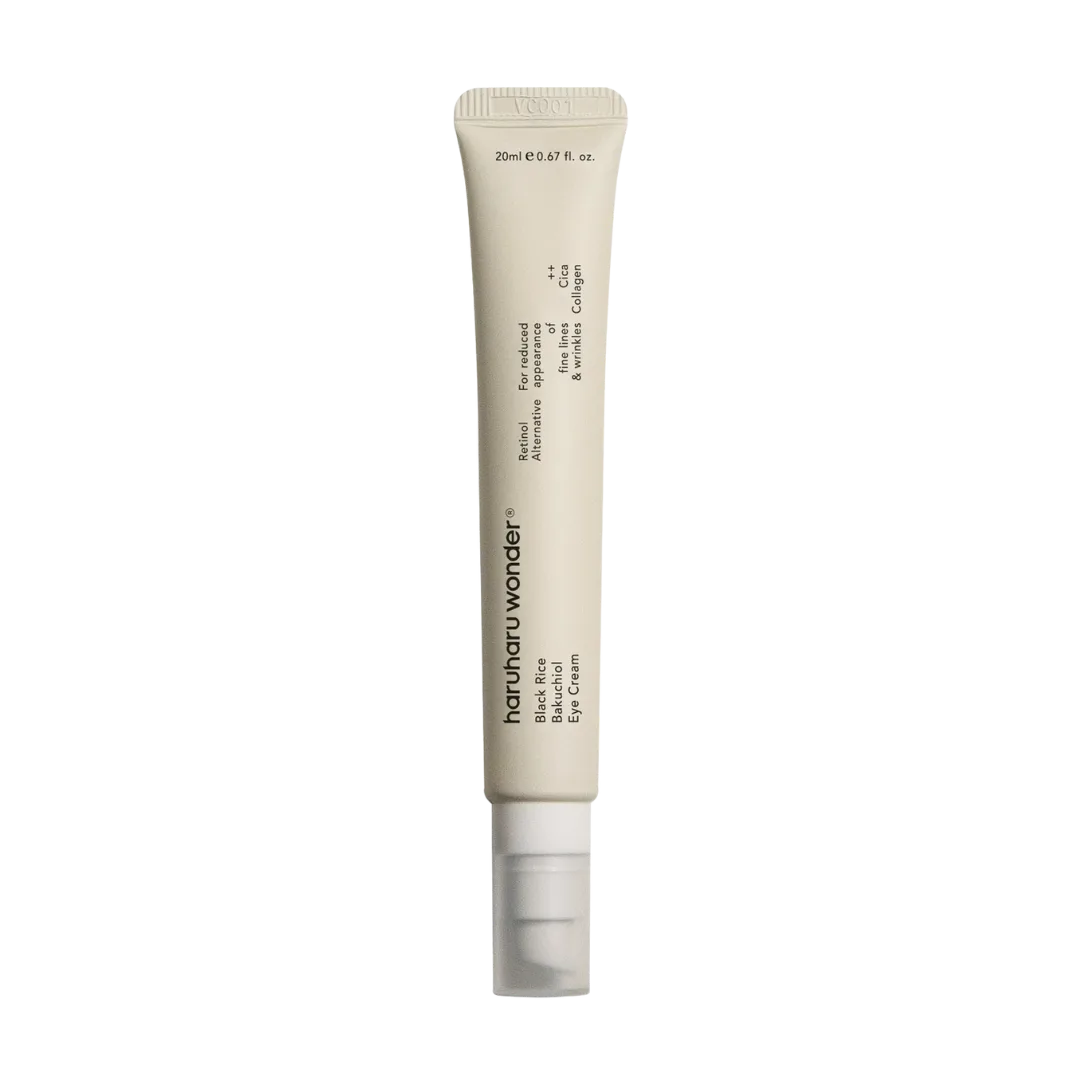
Black Rice Bakuchiol Eye Cream
Gentle Bakuchiol Eye Cream
 Verified reviewer
Pros & cons.
- +Bakuchiol dosed at a functional 5,000ppm, not a marketing trace
- +Pairs bakuchiol with niacinamide, adenosine, and madecassoside for multi-active action
- +Gentle enough for daily use on sensitive eye-area skin
- +Fragrance-free — important for reducing eyelid dermatitis risk
- +Absorbs cleanly without pilling under concealer or makeup
- +Reasonably priced for a K-beauty eye cream with functional actives
- −Small 20ml jar lasts only 3-4 months at twice-daily use
- −Results are subtle and accumulate slowly — not a dramatic transformation
- −Bakuchiol evidence base is smaller than retinol's clinical literature
- −Jar packaging isn't ideal for hygiene even with good preservation
- −Not fungal-acne safe due to sunflower oil and fatty alcohols
The full review.
Retinol often fails the eye area. The skin there is thinner, the barrier is more reactive, and the eyelid fold traps product poorly. Users who tolerate retinol on their forehead and cheeks often face crepey irritation around their eyes. For years, K-beauty addressed this with “eye creams” that were mostly humectant fluff with trace peptides—products that avoided irritation because they lacked efficacy. Haruharu Wonder’s Black Rice Bakuchiol Eye Cream uses a different approach.
Bakuchiol is the headline active. It is a meroterpene from Psoralea corylifolia seeds, a plant used in Ayurvedic medicine for centuries. Studies over the last decade suggest it works as a retinol alternative. A 2018 paper in the British Journal of Dermatology reported that bakuchiol improves wrinkles and hyperpigmentation similarly to retinol but with less irritation. Bakuchiol is not a vitamin A derivative; it is a structurally unrelated compound. It modulates similar downstream pathways without the dryness, flaking, and redness of the retinization cascade. This matters for the eye area.
Dosing sets Haruharu Wonder’s Black Rice Bakuchiol Eye Cream apart. Many bakuchiol products use the ingredient for marketing, placing it at trace levels near the end of the INCI. This eye cream places bakuchiol at roughly position 10 in the ingredient list. It contains 5,000ppm—about 0.5%—which matches the concentration used in most clinical work. While not the highest dose on the market, it is functional. In a 20ml package, you get a real active, not just a suggestion.
The formulation is well-built. Niacinamide sits high on the INCI list to provide vitamin B3 for brightening, barrier support, and tone improvement. Adenosine, a Korean-notified functional anti-wrinkle ingredient, is present at the regulatory dose to help fine lines. Madecassoside, a purified centella asiatica triterpene, adds calming and barrier support. Sodium hyaluronate and glycerin provide hydration. Sunflower seed oil acts as a light emollient base. The formula uses 1,2-hexanediol and pentylene glycol for preservation. It is fragrance-free and paraben-free, which is vital since fragrance causes eyelid dermatitis.
Texture determines if an eye cream stays in a routine. This one works. It is a lightweight milky cream that spreads easily, absorbs in under a minute, and leaves no tacky film or white residue. It works under concealer without pilling or moving color correctors and eye makeup. It has no sting, no fragrance, and requires no adjustment period. You can use it twice daily from day one without building tolerance, a key advantage of bakuchiol over retinol.
Limitations: this is a subtle product. Bakuchiol evidence is promising but lacks the decades of clinical literature supporting retinol. Improvements are slow and gentle: slightly firmer skin after eight to twelve weeks, smoother crow’s feet, and modest brightening for pigmentation-based dark circles. It will not provide the dramatic crepe-reversal seen with heavy prescription-retinoids. If dark circles are structural—caused by hollowing or vascular shadows—no topical eye cream, including this one, will fix them.
The 20ml size matters. At $29, it is reasonably priced for K-beauty, but a 20ml jar used twice daily lasts only three to four months. This costs roughly $0.25 per day. While fine for a daily anti-aging investment, the per-milliliter price is a premium compared to a full-face bakuchiol serum that also covers the eyes.
For sensitive skin users wanting real anti-aging actives without a retinization flare, this is one of the better-dosed options available. It is a thoughtfully built product that uses a genuine active concentration. In a category of overpriced humectant fluff, this restraint works.
Formula
PM routine
Ingredient analysis.
Full INCI list
Water, Glycerin, Helianthus Annuus (Sunflower) Seed Oil, Caprylic/Capric Triglyceride, Niacinamide, 1,2-Hexanediol, Cetyl Alcohol, Cetearyl Alcohol, C14-22 Alcohols, Bakuchiol, Stearyl Alcohol, Carbomer, Cetearyl Glucoside, Tromethamine, Butylene Glycol, Oryza Sativa (Rice) Extract, Cetyl Palmitate, C12-20 Alkyl Glucoside, Sodium Acrylate/Sodium Acryloyldimethyl Taurate Copolymer, Sorbitan Palmitate, Sorbitan Olivate, Polyisobutene, Myristyl Alcohol, Phyllostachys Pubescens Shoot Bark Extract, Zanthoxylum Piperitum Fruit Extract, Usnea Barbata (Lichen) Extract, Pulsatilla Koreana Extract, Aspergillus Ferment, Ethylhexylglycerin, Panax Ginseng Root Extract, Cyclodextrin, Adenosine, Lauryl Alcohol, Sodium Hyaluronate, Disodium EDTA, Caprylyl/Capryl Glucoside, Sorbitan Oleate, Glucose, Wheat Amino Acids, Natto Gum, Pentylene Glycol, Madecassoside
Skin match.
The science.
The Science
Peer-reviewed studies investigate Bakuchiol as a retinol alternative. The most cited study, a randomized, double-blind comparison in the British Journal of Dermatology in 2018 by Dhaliwal and colleagues, compared 0.5% bakuchiol cream to 0.5% retinol cream over 12 weeks. Both showed statistically similar improvements in wrinkle surface area and hyperpigmentation, but the bakuchiol group had significantly less scaling and stinging. In vitro, Bakuchiol modulates gene expression patterns that overlap with retinol signaling without binding retinoic acid receptors directly, which explains the lower irritation.
Niacinamide is one of the most studied cosmetic actives in dermatological literature. Multiple randomized trials show it improves barrier function, reduces erythema, and mildly improves hyperpigmentation at 2-5% concentrations. In an eye cream, niacinamide's barrier-supportive and anti-inflammatory profile helps the thin, reactive periocular skin.
Adenosine is a Korean Ministry of Food and Drug Safety-notified functional anti-wrinkle ingredient. It is permitted for wrinkle-improvement claims at regulatory concentrations, typically around 0.04%. It works by activating G-protein coupled receptors on fibroblasts, which increases collagen synthesis in vitro. The clinical evidence base is smaller than niacinamide's but meets Korean regulatory standards.
Madecassoside is a purified triterpene active extracted from Centella asiatica. Published evidence supports its wound-healing and anti-inflammatory activity. Its inclusion supports the formula's gentle design; Centella asiatica actives are common in sensitive-skin K-beauty formulations because they soothe skin.
References
- Prospective randomized double-blind assessment of topical bakuchiol and retinol for facial photoaging — British Journal of Dermatology (2019)
Dermatologist Perspective
Dermatologists note that true retinol is the gold-standard anti-aging active for the eye area, but many patients cannot tolerate retinol near the eyes even at low concentrations. For those patients, Bakuchiol is a clinically supported alternative that improves appearance without the retinization response. Board-certified dermatologists emphasize that eye creams must be used consistently without irritation. Gentle formulations like this one—using functional Bakuchiol concentrations, fragrance-free preservation, and supportive actives like niacinamide and adenosine—meet that requirement. Dermatologists also remind patients that no topical eye cream fixes structural dark circles or true volume loss; those require filler or surgery.
Where it fits in your routine.
Apply morning and night after cleansing, toning, and facial serums. Use a rice-grain-sized amount per eye on your ring finger. Tap it across the orbital bone, brow bone, and outer corners. Avoid the inner water line and upper eyelid crease. Apply your regular moisturizer next. In the morning, always use sunscreen. bakuchiol isn't photosensitizing like retinol, but daily UV protection is necessary for eye-area anti-aging. This works with all other active ingredients in your routine.
At $29 for 20ml, this eye cream costs $1.45 per milliliter—high for a per-milliliter price, but typical for an eye cream. Using it twice daily costs about $0.25 per day or $8-10 per month. This price is fair for a formula with a functional bakuchiol dose, niacinamide, adenosine, and madecassoside. A full-face bakuchiol serum offers more product for a similar price, but lacks the targeted eye-area texture and dedicated product convenience. For shoppers wanting an eye cream format with real actives, the value is reasonable.
People with sensitive eye-area skin want anti-aging actives without retinol irritation. It works for pregnant or breastfeeding users avoiding retinoids, and for anyone who finds retinol eye creams too harsh.
Skip this if you tolerate prescription retinoids well and want maximum anti-aging performance — a retinoid has more evidence than bakuchiol. Skip this if your dark circles are structural instead of pigmentation-based, and skip this if you avoid fungal-acne.
Product details.
Lightweight milky cream that spreads easily and absorbs quickly without tack.
Fragrance-free.
Small white jar with a pump-free neck lacks hygiene for some users, but the pentylene glycol and 1,2-hexanediol preservation system works.
It applies smoothly without tingling from the first use. No adjustment period is required; use it twice daily immediately. Most users see softer, slightly brighter under-eye skin within the first week.
Approximately 3-4 months with twice-daily eye-area application.
12 months
All Year
The backstory.
Haruharu Wonder was founded in 2019 as a Korean clean-beauty brand built entirely around fermented black rice, an ingredient borrowed from traditional Korean cooking where it's valued for its antioxidant anthocyanin content. The eye cream was added to the lineup in 2022 as the brand's anti-aging entry point, with bakuchiol selected to honor the brand's gentle positioning.
About Haruharu Wonder
Emerging Brand (2–5 years)Haruharu Wonder launched in 2019 as a Korean clean-beauty brand using fermented black rice as its hero. It has a loyal K-beauty following and has EWG Green grades across its lineup, though it lacks the long clinical track record of legacy Korean dermatology brands.
Common myths.
Bakuchiol is as effective as retinol for anti-aging.
Studies show bakuchiol produces similar appearance-level improvements, but the research base is smaller than retinol's. Use bakuchiol as a gentler option for sensitive eye-area skin, not a one-to-one retinol replacement.
You need a dedicated eye cream to address under-eye aging.
Most of the actives in eye creams also work in face moisturizers. Eye creams exist because the texture, pH, and concentration can be fine-tuned for the thinner, more reactive skin — not because the eye area has unique ingredient needs.
FAQ.
How is bakuchiol different from retinol for the eye area?
Bakuchiol is a plant-derived compound. Some studies show it improves appearance like retinol but without classic retinization irritation. This formula pairs Bakuchiol with niacinamide and adenosine for a gentle, well-rounded anti-aging effect for delicate eye-area skin.
Can I use this eye cream with a retinol serum elsewhere on my face?
Yes. Bakuchiol does not conflict with retinol. Many people use bakuchiol on the eye area to avoid the irritation retinol causes, while they use retinol on the rest of the face.
Is this eye cream safe during pregnancy?
Bakuchiol is pregnancy-compatible because it is not a vitamin A derivative. Still, always confirm with your OB, especially if you have specific concerns.
How long will the 20ml jar last?
Apply a rice-grain-sized amount to each eye twice daily. One jar lasts three to four months. This costs about $0.25 per day.
Does this eye cream help with dark circles?
The niacinamide content helps mild pigmentation-based dark circles. However, topical treatments won't fix structural dark circles from hollowing or vascular shadows. Set realistic expectations.
Can I use it as a full-face cream?
Technically yes, but the 20ml size is impractical. Haruharu Wonder and other brands offer larger serum formats for full-face bakuchiol treatment that cost less.
Is it fungal-acne safe?
Not strictly — the sunflower seed oil and cetyl/cetearyl alcohol content violate Malassezia avoidance protocols. Most eye-area fungal acne is rare, but worth noting.
What the community says.
"Gentle enough for daily use"
"No tingling or irritation"
"Absorbs quickly without pilling"
"Plays well under concealer"
"Small 20ml size disappears quickly"
"Results are subtle — not a dramatic transformation"
"Texture may feel too light for very dry skin"
People also looked at.