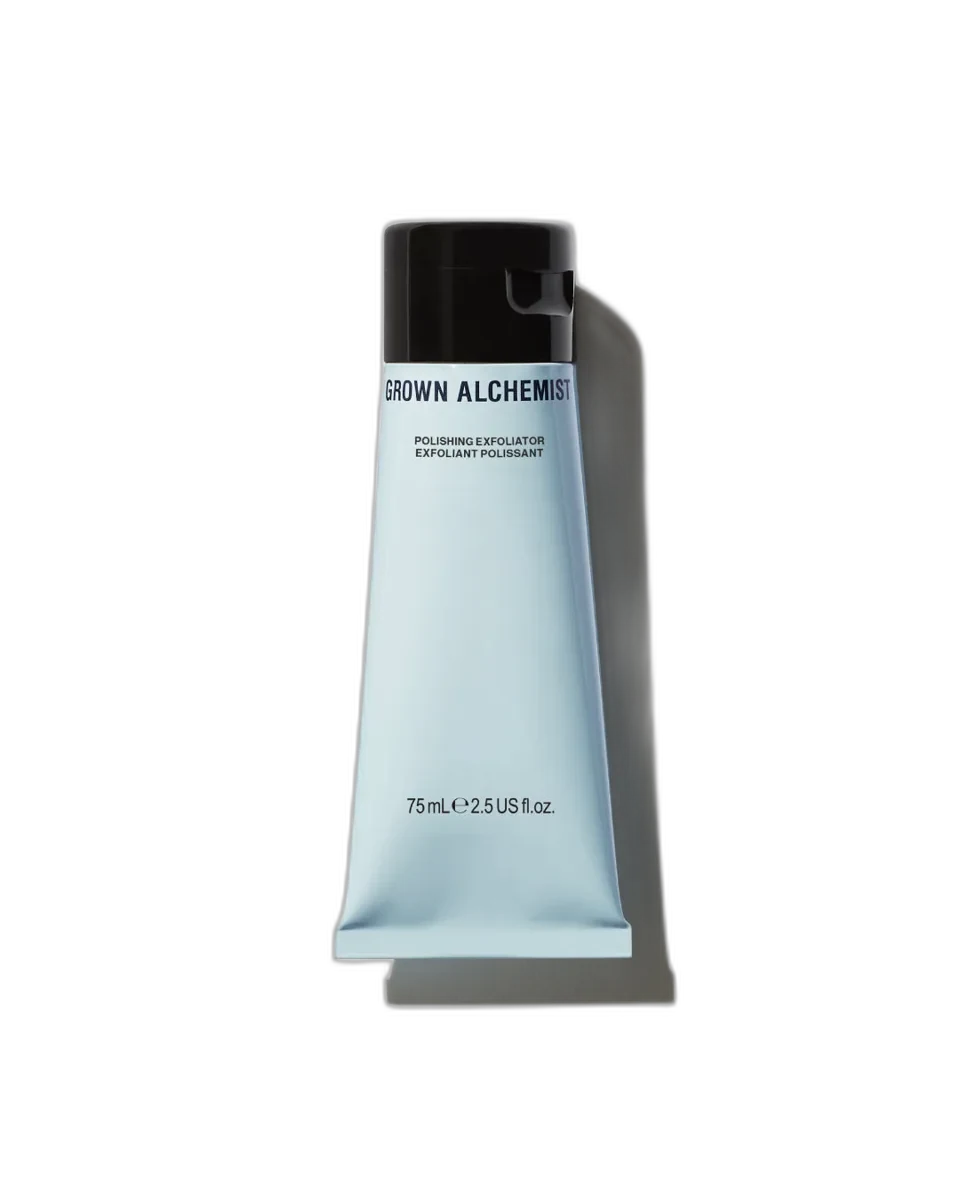
Polishing Facial Exfoliant
Luxury Green-Chemistry Scrub
 Verified reviewer
Pros & cons.
- +Biodegradable polylactic acid spheres provide gentle, rounded physical exfoliation
- +Cushioned aloe and camellia oil base prevents over-abrasion of the barrier
- +Konjac glucomannan adds a soft secondary exfoliating mesh
- +Leaves skin noticeably polished and soft without a tight feel
- +Vegan, cruelty-free, and green-chemistry formulated
- +Luxurious sensory experience that makes weekly exfoliation feel intentional
- −Heavy essential oil load makes it unsuitable for reactive or sensitive skin
- −At $42 for 75ml, priced well above equivalent drugstore physical scrubs
- −Lactic acid content too low to deliver meaningful chemical exfoliation
- −Not fungal-acne safe due to camellia oil and emollient base
- −Strong scent is polarizing and won't work for fragrance-averse users
The full review.
For the last decade, the skincare internet has been running an extended campaign against physical scrubs. The argument went like this: walnut shells create microtears, apricot pits are too jagged, and anyone who still uses a scrub after discovering glycolic acid is behind the times. Chemical exfoliation won the debate so decisively that it became unfashionable to even admit enjoying a face scrub. Then Grown Alchemist’s Polishing Facial Exfoliant quietly kept selling — for over a decade — to people who found the derm-Twitter consensus a bit absolute, and who wanted to know whether a well-built physical exfoliant could still earn a place in a grown-up routine.
The answer, if you read the INCI list carefully, is yes. The abrasive isn’t crushed anything; it’s polylactic acid, a plant-derived, biodegradable polymer that can be manufactured into spheres of uniform size and rounded edges. Those spheres sit inside a cushioned emulsion of aloe leaf, camellia seed oil, and konjac-derived glucomannan — a soft plant fiber that hydrates into a secondary, gentler mesh. The result is a scrub that doesn’t feel like a scrub at all on contact. It feels like a cleansing cream with a gentle buff mixed in. Used in circular motions on damp skin for thirty to sixty seconds, it sweeps away dead surface cells without the stinging or red-patch aftermath that cheaper physical exfoliants leave behind.
The rest of the formula reads like a Grown Alchemist signature. Rosehip oil contributes trace essential fatty acids. Evening primrose oil adds gamma-linolenic acid. A small amount of lactic acid sits lower on the INCI — not at a concentration that drives real chemical exfoliation, but enough to help loosen surface cellular debris so the physical particles can do cleaner work. Tocopherol (vitamin E) guards the oils against oxidation. The whole thing is preserved with sodium dehydroacetate and benzyl alcohol — clean-beauty-acceptable preservation that works but isn’t particularly robust, hence the 12-month open-jar shelf life.
Where this product invites debate is its essential oil signature. The fragrance isn’t added separately; it comes from a stack of peel and flower oils — sweet orange, grapefruit, patchouli, mandarin, ylang ylang, sandalwood, rose geranium, peppermint, and Peru balsam. On the one hand, this is the sensory identity of Grown Alchemist: a brand built around the idea that skincare should smell like an aromatherapy room and feel like a ritual. On the other hand, that stack is a genuine reactivity risk for sensitive skin. Peppermint oil can tingle on contact. Citrus peel oils are phototoxic in high concentration, though used at wash-off levels here that concern is largely theoretical. Peru balsam is a documented contact sensitizer. For a reactive-skin reader, the honest move is to either patch test seriously or pick a different scrub.
For everyone else, the experience is genuinely pleasant. Skin feels polished afterward — that specific velvety softness you get when surface texture is gently buffed — and the cushioned base means there’s no rough, over-exfoliated aftermath the way a harsh scrub can leave you. The aromatherapy element either works for you or it doesn’t, and if it works, it becomes part of the reason you reach for it once or twice a week.
Where the product is vulnerable is value. At $42 for 75ml, you’re paying a real premium for the packaging, the brand positioning, and the essential oil signature. A drugstore gentle jojoba bead scrub will cost a fifth as much and do a similar physical job. A bottle of BHA exfoliant will do more actual pore work for less money. Grown Alchemist’s answer to that is sensory: you’re not just paying for a scrub, you’re paying for a ritual. That answer is honest, and whether it holds up depends entirely on how much you value the ritual.
One last framing note. This is a polishing product, not a treatment. It won’t fade dark spots, won’t clear stubborn blackheads, won’t replace a chemical exfoliant. Treat it as a cosmetic complement — the once-a-week gentle buff that keeps skin surface-smooth between your active treatment nights — and it earns its place. Treat it as a primary exfoliating strategy and you’ll be disappointed. The smart routine uses both: this scrub when you want a polished sensory reset, and a proper AHA or BHA on the nights when you want actual cellular turnover. Used that way, the Polishing Facial Exfoliant is a small, reliable pleasure in a routine that otherwise runs on hard-science actives.
Formula
Best for
- Polishing the skin.
Works for
- Most skin types, but especially those who enjoy a gentle physical exfoliation.
Not ideal for
- Those with sensitive skin due to the essential oil blend.
- Those looking for a treatment to address specific skin concerns like dark spots or blackheads.
Texture
- Creamy with gentle, rounded particles.
Scent
- A blend of essential oils including sweet orange, grapefruit, patchouli, mandarin, ylang ylang, sandalwood, rose geranium, peppermint, and Peru balsam.
Common Praise
- Leaves skin feeling polished and smooth.
- Gentle and non-irritating.
- Pleasant sensory experience.
Common Complaints
- Pricey compared to other physical exfoliants.
- Potential for irritation due to essential oils.
Pairs Well With
- AHA or BHA exfoliants for a comprehensive exfoliating routine.
Conflicts With
- Potentially other products containing essential oils, especially for sensitive skin.
How to Use
- Use in circular motions on damp skin for 30-60 seconds, once or twice a week.
AM routine
- Not specified.
PM routine
- Not specified.
Ingredient analysis.
Full INCI list
Aloe Barbadensis (Aloe Vera) Leaf Extract, Aqua (Purified Water), Camellia Oleifera (Camellia) Seed Oil, Polylactic Acid (Plant), Cetearyl Olivate, Sorbitan Olivate (Plant), Cetyl Alcohol (Plant), Glucomannan (Konjac Root) Extract, Benzyl Alcohol (Plant), Citrus Sinensis (Sweet Orange) Peel Oil Expressed, Xanthan Gum (Polysaccharide), Pogostemon Cablin (Patchouli) Leaf Oil, Citrus Reticulata (Mandarin) Peel Oil, Sodium Dehydroacetate, Lactic Acid (Plant), Myroxylon Pereirae (Peru Balsam) Oil, Tocopherol (Plant), Cananga Odorata (Ylang Ylang) Flower Oil, Santalum Spicata (Sandalwood) Wood Oil, Citrus Paradisi (Grapefruit) Peel Oil, Pelargonium Graveolens (Rose Geranium) Flower Oil, Oenothera Biennis (Evening Primrose) Oil, Rosa Canina (Rosehip) Fruit Oil, Mentha Piperita (Peppermint) Oil, Linalool, Limonene
Skin match.
The science.
The Science
Polylactic acid (PLA) is a biodegradable polyester made from plant-derived lactic acid monomers, usually from corn or sugarcane. Cosmetic chemists use it to replace the plastic microbeads phased out by environmental regulations. It is a clean-beauty standard because manufacturers can make it into smooth, size-controlled spherical particles. Unlike crushed nut shells or fruit pits, PLA spheres have a rounded profile. This reduces the microtear risk found in older, harsh physical scrubs.
Glucomannan is a water-soluble dietary fiber from konjac root used in East Asian skincare for centuries. It forms a soft hydrogel network when hydrated and swells to many times its dry volume. In a cream exfoliant matrix, this swelling creates a gentle, secondary buffing action that complements the PLA spheres without adding abrasion. Konjac-derived ingredients also act as humectants and soothe skin, creating the product's known cushioned after-feel.
Lactic acid is a well-studied alpha hydroxy acid in dermatological literature that affects corneocyte cohesion and acts as a mild humectant. At this concentration—minor based on its INCI position—it works as a supporting ingredient rather than a primary exfoliator. It gently loosens the stratum corneum instead of providing the meaningful resurfacing seen in 5-10% lactic acid serums.
The supporting oils—camellia seed, rosehip fruit, and evening primrose—provide oleic, linoleic, and gamma-linolenic acids. These fatty acids are established barrier-supporting emollients. Including them in a physical exfoliant makes sense: they cushion the abrasive action and offset transient lipid disturbance from scrubbing.
Dermatologist Perspective
Dermatologists usually favor chemical over physical exfoliation for clinical goals like acne, hyperpigmentation, or actinic damage, because hydroxy acids produce more consistent, measurable outcomes than scrubs. However, board-certified dermatologists acknowledge that well-designed physical exfoliants with smooth, rounded particles work as useful adjuncts for people who prefer the tactile experience or want a quick surface polish before an event. Dermatologists consistently raise concerns about essential oil content in products used weekly on the face: fragrance oils, especially citrus peel and peppermint oils, drive contact dermatitis in sensitive skin. Consequently, dermatologists more commonly recommend this product for people with normal to resilient skin who enjoy the ritual, while steering reactive, rosacea-prone, or eczema-prone patients toward fragrance-free alternatives.
Where it fits in your routine.
Apply one to two times per week in the evening on cleansed, damp skin. Warm a pea-sized amount between fingertips and massage in small circular motions across the face for 30-60 seconds, avoiding the eye area. Rinse thoroughly with lukewarm water and pat dry. Follow with a hydrating toner, a calming serum, and a ceramide or barrier moisturizer. Do not use on the same day as retinoids, chemical exfoliants, or benzoyl peroxide — separate active nights from scrub nights. Do not use on broken or inflamed skin, active acne, sunburn, or post-procedure skin.
At $42 for 75ml, Grown Alchemist's Polishing Facial Exfoliant is a luxury physical scrub. Weekly use lasts about six months, which lessens the initial cost. The price covers three specific factors: the biodegradable PLA formulation, the essential oil sensory signature, and the clean-beauty brand positioning. The price is defensible if those factors matter to you. If you optimize only for cost-per-result, a $10 drugstore scrub or a $10 salicylic acid toner provides more exfoliation value per dollar. You buy this product for the experience, not the math.
This works for normal, combination, or mildly dry skin types seeking a cushioned weekly scrub. It provides a biodegradable alternative to microbead or walnut-shell exfoliants. It suits clean-beauty shoppers who like essential oil aromatherapy.
Users with sensitive, rosacea-prone, or eczema-prone skin should avoid this due to the essential oil load. Skip it if you use retinoids or chemical exfoliants frequently and cannot add another abrasive step. Budget-conscious shoppers find similar polishing performance for a fraction of the price.
Product details.
Smells strongly of citrus peel oils, peppermint, woody patchouli, and sandalwood. Polarizing.
Matte white tube uses minimalist olive-green typography in the signature Grown Alchemist apothecary style.
The first use feels smooth; fine spheres and an oil base cushion abrasion, making it gentler than most physical scrubs. The essential oil scent is strong initially. Sensitive users may feel tingling, which means they should stop.
Approximately 4-6 months with weekly use, 2-3 months with twice-weekly use.
12 months
All Year
The backstory.
Grown Alchemist launched in 2008 from Melbourne, founded by brothers Keston and Jeremy Muijs with a mission to marry biotech-derived actives with clean formulation principles. The Polishing Facial Exfoliant has been a consistent seller in the brand's lineup and reflects the house style: recognizable botanicals, essential oil signatures, and formulation detail that reads well to ingredient-literate shoppers.
About Grown Alchemist
Grown Alchemist is an Australian biotech-leaning clean beauty brand. Keston and Jeremy Muijs founded it in 2008. The brand has a reputation for green chemistry and ingredient transparency, but uses fewer peer-reviewed clinical trials than dermatologist-led brands.
Common myths.
Physical exfoliants damage skin. Avoid them entirely.
Jagged-particle scrubs cause microtears. Smooth spherical particles in a cushioned base like this one work well on most skin types when used once or twice weekly.
This product replaces chemical exfoliants like glycolic or salicylic acid.
The lactic acid content is too low for chemical resurfacing. Use this as a cosmetic polishing product that complements — not replaces — a chemical exfoliant in your routine.
FAQ.
How often should I use Grown Alchemist Polishing Facial Exfoliant?
Most skin types work best with one to two uses per week. Aloe and camellia oil make this formula gentler than typical scrubs, but using it more than twice weekly risks over-exfoliation — especially if you also use chemical actives.
Can I use this with retinol or acids?
Don't use them on the same day. Physical abrasion and active exfoliation damage most barriers. Alternate: use this one evening, and your retinoid or AHA/BHA on separate evenings, adding buffer days as needed.
Is this product suitable for sensitive skin?
Unlikely. The essential oil load — citrus peels, peppermint, rose geranium, Peru balsam — can trigger reactivity in sensitive skin despite the thick texture. Patch test first if your skin is reactive.
Does it actually contain AHAs?
Lactic acid is on the INCI list, but its low concentration does not drive meaningful chemical exfoliation. This works like a physical scrub with a trace AHA instead of a proper chemical exfoliant.
Is the polylactic acid environmentally safe?
Polylactic acid is a plant-derived, biodegradable alternative to the microbeads that once dominated physical scrubs. It is safer for the environment and has largely replaced plastic microbeads in premium exfoliants.
Will this help with blackheads?
It visibly softens blackheads by sweeping away surface buildup, but a salicylic acid treatment works better for persistent blackheads. Use both — on different days.
Is it worth the price?
Choose this if you value clean-beauty positioning, the sensory experience, and green-chemistry formulation. If you shop strictly for performance, a drugstore gentle scrub or a salicylic acid toner costs less and delivers more.
What the community says.
"Gentle enough for frequent use"
"Leaves skin noticeably smooth and soft"
"Smells luxurious"
"Beautiful cushioned texture"
"Expensive for a physical scrub"
"Strong essential oil scent is irritating for some"
"Small 75ml size disappears quickly"
People also looked at.