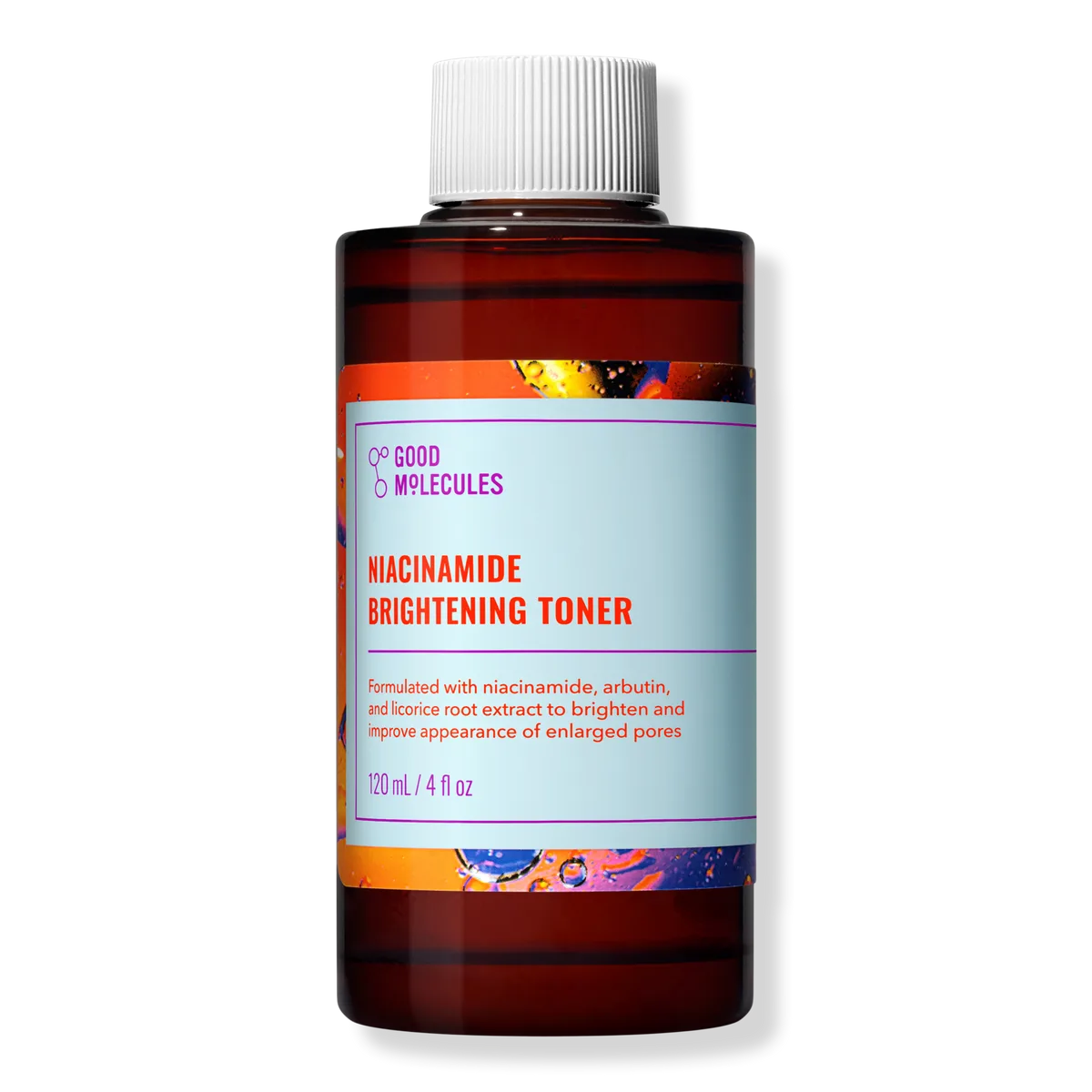
Niacinamide Brightening Toner
Budget Brightening Essential
 Verified reviewer
Pros & cons.
- +Four-pathway brightening approach targets melanin production, transfer, and oxidation simultaneously
- +Excellent value at $14 for 120 mL with full concentration transparency
- +Exceptionally gentle formula suitable for all skin types including sensitive
- +Pregnancy-safe brightening ingredients make it accessible to expecting mothers
- +6.7% glycerin provides genuine hydration uncommon in brightening toners
- +Fragrance-free, fungal acne safe, and free from all common irritants
- −Results are gradual — expect 6-8 weeks for visible brightening improvement
- −0.1% vitamin C is likely too low to contribute meaningful standalone brightening
- −3% niacinamide is moderate and may feel insufficient for intensive brightening needs
- −Very thin liquid consistency may not feel satisfying for those who prefer thicker toners
- −Requires diligent daily sunscreen use to preserve brightening results
The full review.
Dermatologists know that treating hyperpigmentation works best by combining agents that target different steps in the melanin production pathway, rather than using one high-concentration active. Good Molecules uses this principle in a fourteen-dollar toner. The Niacinamide Brightening Toner uses four distinct brightening mechanisms at moderate, tolerable concentrations instead of one aggressive hero ingredient.
Niacinamide at 3% leads the formula; it acts as a melanin transfer inhibitor rather than a melanin production blocker. It intercepts pigment after production to prevent it from reaching surface cells and causing visible discoloration. Arbutin at 2% inhibits tyrosinase, the enzyme that catalyzes melanin synthesis. Licorice root extract provides glabridin, a tyrosinase inhibitor with a different molecular mechanism than arbutin. Finally, 3-O-ethyl ascorbic acid, a stabilized vitamin C derivative, adds antioxidant-mediated melanogenesis suppression.
This four-pronged approach is elegant on paper. In practice, these concentrations deliver meaningful results, but slowly.
The concentration trade-offs are clear. Niacinamide at 3% is within the effective range (studies show brightening effects at 2-5%), but it is lower than the 5-10% concentrations in intensive products. Arbutin at 2% is also moderate. The vitamin C derivative at 0.1% acts more as a supporting ingredient than a functional active, as most studies on ethyl ascorbic acid use 1% or higher for brightening. Licorice root at 0.1% provides anti-inflammatory benefits but offers limited standalone brightening at that dose.
The theory is that these ingredients together target complementary pathways to achieve more than a single high-concentration active. Dermatological combination therapy principles support this, even without a published study on this exact formulation. Real-world user data is encouraging: with 2,300 reviews and a 4.6-star average on Ulta, users report gradual, genuine improvements in skin brightness and dark spot reduction over 6-12 weeks.
The 6.7% glycerin loading provides significant humectant hydration, which many brightening products lack. Well-hydrated skin reflects light more evenly, creating an immediate optical brightening effect before the actives affect melanin production. This is a smart formulation choice.
Texture
The texture is minimal. It feels like slightly enriched water with no viscosity, slip, or residue. It absorbs in seconds and won’t interfere with subsequent layers. The thin consistency works with a cotton pad or pressed in with hands, though hands waste less product.
The ingredient profile is clean. It is fragrance-free, alcohol-free, oil-free, silicone-free, and fungal acne safe. No ingredient on the INCI list should irritate most skin types, making this a rare brightening toner for sensitive skin that avoids redness, stinging, or barrier compromise. Many brightening ingredients, such as high-concentration vitamin C, hydroquinone, or certain acids, carry high irritation potential.
The pregnancy safety profile is also a strength. Niacinamide, arbutin, licorice root, and this vitamin C form are all pregnancy-safe. This makes it one of the few brightening products without a “consult your doctor” warning for expecting mothers treating melasma or pregnancy-related hyperpigmentation.
The honest assessment: this is a brightening product for patient users. It does not deliver dramatic results in two weeks. Moderate concentrations mean effects build slowly. Most users see meaningful differences in dark spots and skin tone after six to eight weeks of consistent twice-daily use. By twelve weeks, the cumulative effect is typically significant.
This gradual approach offers sustainability. Products that brighten rapidly often use mechanisms that cause irritation or rebound pigmentation if used indefinitely. This toner’s gentle approach allows long-term use without over-treating the skin or needing to cycle off.
The value is excellent. Fourteen dollars for 120 mL of a four-active brightening toner with full concentration transparency and a clean formula is hard to beat. The 30 mL size at six dollars makes trial risk-free. For a budget brightening routine, this is a foundation piece—pair it with daily SPF and patience for results.
Ingredient analysis.
Full INCI list
Water, Glycerin, Niacinamide, 1,2-Hexanediol, Arbutin, Propanediol, Betaine, Glycyrrhiza Glabra (Licorice) Root Extract, 3-O-Ethyl Ascorbic Acid, Ethylhexylglycerin, Carbomer, Tromethamine, Trisodium Ethylenediamine Disuccinate, Theobroma Cacao (Cocoa) Seed Extract, Sodium Hyaluronate, Dextrin
Skin match.
The science.
The Science
Dermatologists use multi-pathway approaches to treat hyperpigmentation. Melanin production follows an enzymatic cascade; targeting several points in this cascade works better than single-agent therapy. This toner targets at least three distinct mechanisms.
Niacinamide at 3% inhibits melanosome transfer from melanocytes to keratinocytes. A 2002 study in the British Journal of Dermatology by Hakozaki et al. shows 5% niacinamide reduces hyperpigmentation and increases skin lightness after 8 weeks. While this formula uses 3%, research shows brightening effects at 2%, with the dose-response relationship leveling off between 3-5%.
Arbutin at 2% inhibits tyrosinase to reduce melanin synthesis. Research in the Journal of Biomedical Science (2009) confirmed arbutin suppresses melanogenesis via competitive inhibition of tyrosinase. The 2% concentration used here fits published effective ranges for cosmetic use.
Glycyrrhiza glabra (licorice root) extract contains glabridin, which inhibits tyrosinase using a different binding mechanism than arbutin. A study in the Journal of Agricultural and Food Chemistry (2003) shows glabridin has potent anti-tyrosinase activity. Also, licorice root's anti-inflammatory properties help prevent post-inflammatory hyperpigmentation by reducing the inflammation that triggers excess melanin production.
3-O-Ethyl ascorbic acid is a stable, water-soluble vitamin C derivative with antioxidant properties. The 0.1% concentration is below the typical effective range for standalone brightening, but it adds to the formula's antioxidant environment and enhances the other brightening agents by reducing oxidized melanin.
References
- The effect of niacinamide on reducing cutaneous pigmentation and suppression of melanosome transfer — British Journal of Dermatology (2002)
Dermatologist Perspective
Dermatologists favor multi-ingredient brightening approaches over high-concentration single-agent therapies. Board-certified dermatologists note that combining niacinamide with tyrosinase inhibitors like arbutin and licorice root mirrors the combination therapy used in clinical settings for melasma and hyperpigmentation. These gentle concentrations make this product suitable for long-term maintenance, which dermatologists prefer over aggressive short-term interventions that increase irritation and rebound pigmentation risk. For patients who cannot use hydroquinone or want a pregnancy-safe option, dermatologists commonly recommend toners with this ingredient profile as part of a brightening regimen.
Where it fits in your routine.
Apply to clean skin morning and evening after cleansing. Sweep a cotton pad across the face or press a small amount from your palm into the skin. Follow with serums, moisturizer, and always SPF 30+ in the morning — daily sun protection is essential for any brightening product to work. Use daily for 8-12 weeks for significant brightening results.
At $14 for 120 mL, this toner has four brightening actives and shows full concentration transparency. The price makes it risk-free to try. A 30 mL size at $6 exists for testing compatibility. The 120 mL bottle lasts about 3-4 months with twice-daily use, costing roughly $4 per month. Established brands sell comparable multi-active brightening toners for $25-50, so this is one of the best values in the brightening category.
An affordable, gentle entry into brightening skincare. It works well for sensitive skin users who react to stronger brightening actives, pregnant individuals seeking safe hyperpigmentation treatment, and budget-conscious consumers wanting multi-active brightening at a fraction of typical prices.
People needing fast, intensive brightening for severe hyperpigmentation or melasma will find the moderate concentrations work too slowly for stubborn discoloration. This also applies to those preferring one high-potency active over a multi-ingredient gentle approach.
Product details.
Thin, water-like liquid with low viscosity. Absorbs almost instantly on the skin.
Unscented — no detectable fragrance.
Clear plastic bottle with a screw cap. Available in 30 mL and 120 mL sizes.
The first application feels like slightly enriched water with almost no tactile feedback. It causes no stinging, tingling, or irritation. Brightening effects are cumulative and do not show after a single use.
3-4 months with twice-daily application (120 mL size)
12 months
All Year
The backstory.
Good Molecules developed this toner to offer an accessible entry point to brightening skincare without the irritation risks of high-concentration actives. The multi-ingredient approach was chosen specifically because research shows that targeting multiple steps in the melanin production pathway is more effective than aggressively targeting a single step — a strategy borrowed from dermatological combination therapy.
About Good Molecules
Emerging Brand (2–5 years)Beautylish, the cosmetics e-commerce platform founded by Nils Johnson, launched Good Molecules in 2019 as its in-house skincare brand. The brand offers affordable, ingredient-focused skincare and shows full concentration transparency.
Common myths.
Higher niacinamide concentrations always brighten skin more effectively.
Research shows niacinamide at 2-5% brightens skin. Concentrations above 5% increase irritation risk without adding efficacy. At 3%, this toner stays in the evidence-supported effective range and avoids the flushing or irritation caused by higher concentrations.
You can't combine niacinamide with vitamin C.
This formula contains niacinamide and 3-O-ethyl ascorbic acid without compatibility issues. The old myth about niacinamide-ascorbic acid incompatibility is debunked. Modern formulations stabilize both, and they may enhance each other's brightening effects.
FAQ.
Can I use Good Molecules Niacinamide Toner with retinol?
Yes — niacinamide and arbutin are gentle, non-exfoliating ingredients that pair safely with retinol. This toner uses niacinamide's barrier-strengthening properties to buffer retinol's irritation effects. Apply the toner first, then your retinol product.
Myth
Reality
How to Use
Pairs Well With
Conflicts With
AM routine
PM routine
Is 3% niacinamide enough to see brightening results?
Research shows niacinamide works for brightening at 2% concentrations, but benefits drop above 5%. A 3% concentration stays effective and lowers the risk of irritation and flushing seen at higher levels. The formula uses arbutin, licorice root, and vitamin C to boost the moderate niacinamide level.
Myth
Reality
How to Use
Pairs Well With
Conflicts With
AM routine
PM routine
Can I use Good Molecules Niacinamide Toner every day?
Yes — the gentle, non-exfoliating formula works twice daily. No acids or active ingredients require a break or rotation. All four brightening agents in this formula tolerate daily application well.
Myth
Reality
How to Use
Pairs Well With
Conflicts With
AM routine
PM routine
Is Good Molecules Niacinamide Toner safe during pregnancy?
Yes — niacinamide, arbutin, licorice root extract, and the stabilized vitamin C derivative in this formula are safe for pregnancy. This brightening product lacks pregnancy-restricted ingredients like hydroquinone or retinoids.
Myth
Reality
How to Use
What the community says.
"Visible improvement in skin brightness and evenness"
"Extremely affordable for the ingredient quality"
"Gentle enough for daily use on sensitive skin"
"Noticeable reduction in dark spots over time"
"No stickiness or residue after application"
"Results are gradual and require patience"
"3% niacinamide is lower than some prefer for intensive brightening"
"Liquid consistency is very thin, some prefer a thicker toner"
"Vitamin C concentration is too low to contribute meaningfully"