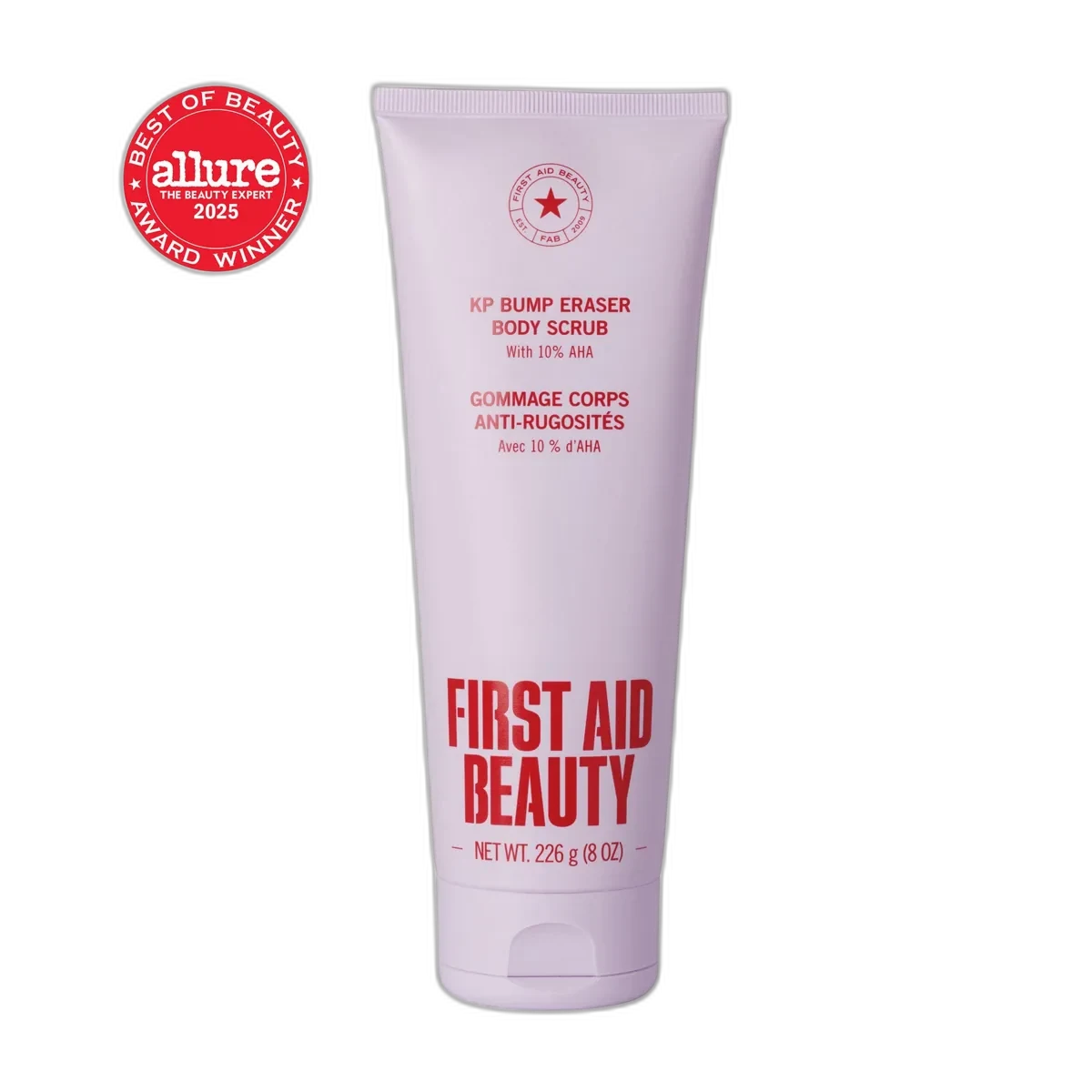
KP Bump Eraser Body Scrub
KP Holy Grail
 Verified reviewer
Pros & cons.
- +Dual chemical and physical exfoliation addresses KP from two angles simultaneously
- +10% AHA blend provides meaningful keratolytic action backed by clinical evidence
- +Colloidal oatmeal and bisabolol buffer irritation from the aggressive active ingredients
- +Fragrance-free original formula minimizes sensitization risk for reactive skin types
- +Noticeable smoothing results after the very first use with cumulative improvement over weeks
- +Versatile beyond KP — effective for ingrown hairs, razor bumps, and general body texture
- +Vegan, cruelty-free, and free from common allergens including gluten, soy, and nuts
- +Multiple size options including travel size make it easy to trial before committing
- −At $30 for 8 oz, cost accumulates quickly with the recommended 2-3x weekly full-body use
- −Tube packaging becomes difficult to squeeze as product runs low, wasting the last portion
- −Stings noticeably on freshly shaved skin — requires planning around shaving schedule
- −10% AHA concentration may be too aggressive for very sensitive or eczema-prone body skin
- −Results are maintenance-dependent — KP bumps return within weeks of discontinuing use
- −Contains dimethicone, which some users prefer to avoid in their body care products
The full review.
There is a particular kind of skincare despair reserved for people who have tried every body scrub on the shelf and still run their fingers over the same constellation of tiny, stubborn bumps on their upper arms. Keratosis pilaris affects roughly 40% of the adult population, and for decades, the beauty industry’s answer was some combination of sugar granules and coconut oil — products that felt nice in the shower and did approximately nothing for the keratin plugs actually causing the problem.
First Aid Beauty’s KP Bump Eraser arrived around 2019 with a different thesis: that treating KP requires dissolving the problem from within while simultaneously clearing the surface. The formula combines glycolic acid and lactic acid at a total concentration of 10%, paired with finely milled pumice particles — essentially packaging a chemical peel and a microdermabrasion session into a single shower-friendly tube. It was a straightforward idea that the prestige body care market had somehow overlooked.
The formulation is more thoughtful than it initially appears. Glycolic acid, the smallest AHA molecule, penetrates quickly to dissolve the keratin buildup inside follicles. Lactic acid, slightly larger and inherently more hydrating, works at the surface level while also functioning as a humectant — a critical detail for body skin that tends toward dryness, especially in the areas where KP is most prevalent. Together they address the condition from two depths simultaneously. The pumice then provides the mechanical component, physically dislodging what the acids have loosened. It is a layered approach, and the sequencing matters.
What prevents this from being an irritation bomb is the supporting cast. Colloidal oatmeal — an FDA-recognized skin protectant — is woven into the formula alongside bisabolol (a chamomile derivative), green tea extract, and licorice root extract. These anti-inflammatory and antioxidant ingredients create a soothing counterbalance that makes the aggressive exfoliation tolerable for regular use. It is the difference between a product that works once and leaves you raw, and one you can sustain two to three times per week without your skin staging a revolt.
In the shower, the texture is a thick, gritty white paste — not glamorous, but purposeful. The pumice particles are finely calibrated: substantial enough to feel like they are accomplishing something, but not so coarse that they leave micro-tears. You apply to wet skin, massage in circular motions, and ideally let it sit for a minute or two to give the AHAs contact time before rinsing. There is a tingling. It is not subtle. The first time you use this on skin that has never met a proper AHA, you will notice it immediately. This is normal, and it subsides. But it is worth noting for anyone whose previous body care routine peaked at a gentle lotion — this product is doing real work, and it does not pretend otherwise.
Results come faster than most KP sufferers are conditioned to expect. Skin feels tangibly smoother after the very first use. Within one to two weeks of consistent application, the characteristic sandpaper texture begins to soften. By four to eight weeks, many users report significant reduction in both the bumps and the redness that accompanies them. The caveat — and it is an important one — is that KP is a chronic condition. Stop using the product, and the bumps gradually return. This is not a cure; it is maintenance. But for a condition that has no cure, effective maintenance is everything.
The product has also found an unexpected second life among people dealing with ingrown hairs, razor bumps, and general body texture issues. The mechanism makes sense: the same chemical-physical exfoliation that clears keratin plugs from KP-affected follicles also frees trapped hairs and smooths post-shave roughness. That said, do not apply this immediately after shaving — the stinging on freshly razored skin is genuinely unpleasant, and the formula’s own directions wisely warn against it.
There are legitimate criticisms. At $30 for eight ounces, the per-use cost adds up quickly when you are covering large areas of the body multiple times per week. The tube packaging, while practical for the shower, becomes an exercise in frustration near the end as you try to extract every last bit of product. And for people with very sensitive skin or active eczema, the 10% AHA concentration may simply be too much, even with the soothing ingredients working overtime.
First Aid Beauty, now under the Procter & Gamble umbrella since its 2018 acquisition, has maintained the formula’s integrity while expanding the line into scented variants (peach, strawberry, toasted coconut) for people who want the same efficacy with a bit more shower experience. The original fragrance-free version remains the safest choice for reactive skin.
The KP Bump Eraser is not a product that reinvents the wheel of skincare. What it does, more importantly, is apply well-understood chemistry — glycolic acid, lactic acid, physical exfoliation, anti-inflammatory botanicals — to a specific, underserved problem with precision and restraint. For the millions of people who have quietly resigned themselves to long sleeves and avoided touching their own upper arms, that precision turns out to be exactly enough.
Formula
Texture
In the shower, the texture is a thick, gritty white paste — not glamorous, but purposeful. The pumice particles are finely calibrated: substantial enough to feel like they are accomplishing something, but not so coarse that they leave micro-tears.
Scent
First Aid Beauty, now under the Procter & Gamble umbrella since its 2018 acquisition, has maintained the formula’s integrity while expanding the line into scented variants (peach, strawberry, toasted coconut) for people who want the same efficacy with a bit more shower experience. The original fragrance-free version remains the safest choice for reactive skin.
Best for
For the millions of people who have quietly resigned themselves to long sleeves and avoided touching their own upper arms, that precision turns out to be exactly enough.
Works for
The product has also found an unexpected second life among people dealing with ingrown hairs, razor bumps, and general body texture issues. The mechanism makes sense: the same chemical-physical exfoliation that clears keratin plugs from KP-affected follicles also frees trapped hairs and smooths post-shave roughness.
Not ideal for
And for people with very sensitive skin or active eczema, the 10% AHA concentration may simply be too much, even with the soothing ingredients working overtime.
Common Complaints
There are legitimate criticisms. At $30 for eight ounces, the per-use cost adds up quickly when you are covering large areas of the body multiple times per week. The tube packaging, while practical for the shower, becomes an exercise in frustration near the end as you try to extract every last bit of product.
Ingredient analysis.
Full INCI list
Pumice, Aqua/Water/Eau, Glycolic Acid, Sodium Cocoyl Isethionate, Lactic Acid, Dimethicone, Stearic Acid, Cetearyl Alcohol, Sodium Hydroxide, Palmitic Acid, Glycerin, C12-15 Alkyl Benzoate, Sorbitol, Colloidal Oatmeal, Tocopherol, Chrysanthemum Parthenium (Feverfew) Extract, Camellia Sinensis Leaf Extract, Glycyrrhiza Glabra (Licorice) Root Extract, Salix Nigra (Willow) Bark Extract, Bisabolol, Hydrogenated Coconut Acid, Xanthan Gum, Steareth-20, Steareth-21, Myristic Acid, Sodium Isethionate, Phenoxyethanol, Potassium Sorbate, Sodium Benzoate, Leuconostoc/Radish Root Ferment Filtrate, EDTA
Skin match.
The science.
The Science
The KP Bump Eraser's approach is grounded in well-established dermatological principles for managing keratosis pilaris. The condition results from excess keratin accumulation within hair follicles, forming the characteristic rough, bumpy texture. Alpha hydroxy acids — specifically glycolic and lactic acid — have been studied extensively for their ability to dissolve this keratin buildup through desmosome disruption at the corneocyte level.
A 2021 study published in the World Journal of Clinical Cases examined the clinical outcomes of glycolic acid treatment for keratosis pilaris in 25 participants, finding significant reduction in perifollicular erythema, papules, and pigmentation with treatment, though noting that long-term maintenance was necessary to sustain results (Xin et al., World J Clin Cases, 2021). This aligns with the clinical reality that KP is a chronic condition requiring ongoing management rather than a one-time fix.
The dual-acid approach in this formula leverages the complementary properties of glycolic and lactic acid. Glycolic acid, with the smallest molecular weight among AHAs at 76 Da, penetrates most rapidly and works deeper within the follicle. Lactic acid, at 90 Da, acts more at the surface while also providing humectant properties — drawing moisture to the skin rather than simply stripping it. A study examining topical keratolytics for KP found that 10% lactic acid achieved a 66% reduction in papules over 12 weeks, outperforming 5% salicylic acid at 53%.
The inclusion of colloidal oatmeal is clinically significant. As an FDA-recognized skin protectant, colloidal oatmeal contains avenanthramides — polyphenolic compounds with demonstrated anti-inflammatory activity that help counterbalance the irritation potential of the acid exfoliation. This is not merely a marketing addition; it directly addresses the tolerability challenge that limits AHA use in body care.
The physical exfoliation component (pumice) provides immediate mechanical debridement of loosened corneocytes, accelerating the visible results that the chemical exfoliation initiates beneath the surface. While physical exfoliation alone has limited evidence for KP management, its combination with chemical keratolysis represents a practical approach to both the superficial and subfollicular components of the condition.
References
- Clinical outcomes and 5-year follow-up results of keratosis pilaris treated by a high concentration of glycolic acid — World Journal of Clinical Cases (2021)
Dermatologist Perspective
Dermatologists frequently recommend alpha hydroxy acid-based treatments as a first-line approach for keratosis pilaris, and this product aligns with that clinical guidance. Board-certified dermatologists note that the combination of glycolic and lactic acids at a 10% concentration falls within the therapeutic range shown to improve KP without requiring a prescription. The addition of anti-inflammatory ingredients like colloidal oatmeal and bisabolol reflects an understanding that exfoliation-induced irritation is the primary reason patients abandon KP treatments prematurely. Dermatologists typically advise patients to follow any AHA body exfoliant with a ceramide-rich moisturizer and to apply sunscreen to treated areas exposed to UV, as photosensitivity is a documented side effect of regular glycolic acid use.
Where it fits in your routine.
Massage into wet skin using gentle circular motions on affected areas like upper arms, thighs, buttocks, or where bumps and rough texture appear. Leave the product on skin for 1-2 minutes for AHA contact time, then rinse thoroughly. Start with 2-3 uses per week and adjust frequency based on skin tolerance. Always follow with a body moisturizer on damp skin. Do not apply to freshly shaved areas, broken skin, or sunburned skin. Apply broad-spectrum sunscreen to treated areas that will see sun exposure.
At $30 for 8 ounces, the KP Bump Eraser costs more than most body exfoliants. However, its active ingredient concentrations justify the price over drugstore body scrubs, which mostly use mechanical exfoliation. The 2-ounce travel size costs $12 for a low-commitment trial. A jumbo 10-ounce size appears periodically and provides better per-ounce value for regular users. For many KP sufferers, the alternative is a dermatologist-prescribed treatment or three separate products (a chemical exfoliant, a physical scrub, and a soothing treatment); this all-in-one formula adds practical value. First Aid Beauty has over 15 years of experience with sensitive skin and uses P&G's quality infrastructure, which brings formulation credibility to the price point.
This works for anyone with keratosis pilaris, chronic ingrown hairs, or persistent rough and bumpy body texture who found gentler scrubs ineffective. It suits people who want clinical-level exfoliation in a convenient shower product instead of using separate acid treatments and physical exfoliants.
Avoid this if you have very sensitive body skin, active eczema flares, or a compromised skin barrier. The 10% AHA concentration and physical pumice particles exfoliate effectively but aggressively, which can worsen inflammation. The per-use cost may be too high for those on a tight budget needing a body exfoliant for large surface areas.
Product details.
A thick, gritty cream paste contains fine pumice particles in a white base. The scrub has a heavy, slightly chalky consistency that works on body skin.
Fragrance-free. A faint, clean chemical note from the AHA base dissipates quickly in the shower.
Opaque squeeze tube with a flip-top cap. It is sturdy and shower-friendly, but the tube gets hard to squeeze when empty.
Expect a mild tingling sensation during first use as the AHAs work — this is normal and usually stops within a minute. Skin feels smoother immediately after rinsing. Redness from the physical and chemical exfoliation fades within 30 minutes. Do not use on broken skin or immediately after shaving.
6-8 weeks with 2-3 uses per week on arms and legs
12 months
All Year
The backstory.
First Aid Beauty launched the KP Bump Eraser around 2019, identifying a gap in the market for a targeted, evidence-based body exfoliant specifically formulated for keratosis pilaris — a condition affecting roughly 40% of adults that was largely ignored by prestige skincare brands. The product quickly became one of FAB's top sellers and earned multiple beauty awards.
About First Aid Beauty
Established Brand (5–20 years)Lilli Gordon founded First Aid Beauty in 2009 to focus on sensitive-skin-safe formulations. Procter & Gamble acquired the brand in 2018. First Aid Beauty is dermatologist tested and sells clean, effective products through Sephora and Ulta.
FAQ.
How often should I use the KP Bump Eraser Body Scrub?
Use 2-3 times per week in the shower on wet skin. If your skin tolerates it after two weeks, use it every other day. The 10% AHA blend needs time between uses to prevent over-exfoliation, and the colloidal oatmeal soothes skin between sessions.
Can I use this scrub on my face?
This formula targets thicker body skin. The pumice particles and 10% combined AHA concentration are too aggressive for facial skin. First Aid Beauty makes separate facial exfoliants with gentler formulations for the face's thinner, more delicate barrier.
Will the KP Bump Eraser help with ingrown hairs?
Yes — the glycolic and lactic acid combination dissolves the dead skin trapping ingrown hairs beneath the surface, while the pumice physically clears the follicle opening. Many users report significant improvement in ingrown hairs on legs, bikini area, and underarms with regular use.
Does this product sting or burn when applied?
A mild tingling is normal; it shows the AHAs are active. Stinging feels stronger on freshly shaved skin or micro-cuts — do not use immediately after shaving. If burning lasts more than 2 minutes, rinse immediately and space out use.
Do I need to wear sunscreen on my body after using this scrub?
Yes. Glycolic and lactic acids increase photosensitivity for up to a week after use. Apply broad-spectrum SPF 30 or higher to any treated areas exposed to sun. This matters most on arms and legs during warmer months.
How long does it take to see results for keratosis pilaris?
Most users notice smoother skin texture after the first use, with visible reduction in KP bumps appearing within 1-2 weeks. Significant improvement in both bumps and associated redness typically takes 4-8 weeks of consistent use at 2-3 times weekly.
Is the KP Bump Eraser safe for sensitive skin?
The formula uses colloidal oatmeal, bisabolol, and licorice root extract to offset the exfoliating acids, and it is fragrance-free. Still, 10% AHA causes irritation for very sensitive skin. Use it once weekly at first and increase use as your skin tolerates it.
What the community says.
"Dramatically smooths KP bumps within weeks"
"Effective for ingrown hairs and razor bumps"
"Pleasant to use in the shower"
"Visible results after first use"
"Fragrance-free and gentle enough for sensitive body skin"
"Can sting on freshly shaved skin"
"Tube packaging makes it hard to get product out near the end"
"Pricey for a body scrub used multiple times weekly"
"Physical scrub particles can feel harsh if pressed too hard"
"Needs consistent use — bumps return if you stop"
People also looked at.