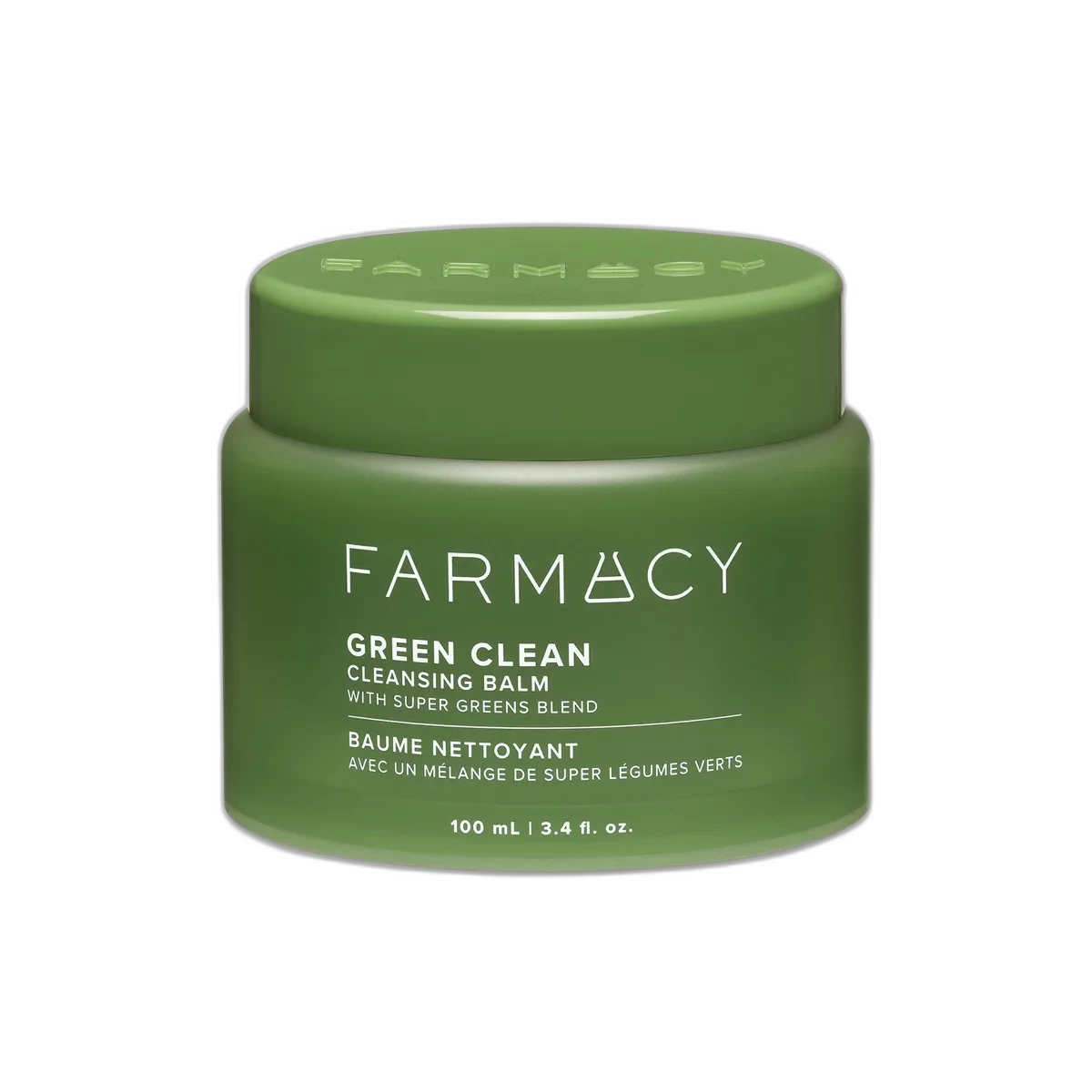
Green Clean Makeup Removing Cleansing Balm
Clean Beauty Cult Classic
 Verified reviewer
Pros & cons.
- +Dissolves waterproof makeup, heavy SPF, and long-wear foundation in under a minute
- +Balm-to-oil-to-milk transformation rinses clean without leaving greasy residue
- +Reformulated to remove microplastics and PEGs while maintaining performance
- +Papaya enzyme adds gentle exfoliation that most cleansing balms lack entirely
- +Sunflower seed oil base supports rather than strips the skin barrier
- +Recyclable packaging made from 50% post-consumer recycled plastic
- +Fragrance-free version available for sensitive skin types
- −Essential oils and fragrance allergens make the original version unsuitable for reactive skin
- −White stringy residue near eyes can cause temporary blurry vision during removal
- −Balm texture can form small shards when scooping rather than smooth sorbet
- −Premium price for a rinse-off product that lasts only two to three months
- −Not fungal acne safe due to sunflower oil and sorbitan sesquioleate
The full review.
There is a particular kind of brand loyalty that forms when a product changes the way you wash your face. For millions of people, Farmacy Green Clean was that product — the one that made the Korean double-cleanse ritual feel accessible and, frankly, enjoyable for a Western audience that had been raised on foaming cleansers and the vague sensation that clean skin should feel tight.
The story behind Green Clean is more interesting than most cleansing balms deserve. When David Chung launched Farmacy in 2015 with his farm-to-face philosophy — partnering with actual organic farms in Pennsylvania and the Catskills — the beauty industry was still figuring out what “clean” meant. Green Clean arrived around 2017 and immediately stood out: a sorbet-textured balm that melted into oil, then into milk, dissolving a full face of makeup with the kind of satisfying thoroughness that makes you want to show someone the dirty cotton pad afterward. It became Farmacy’s runaway bestseller, earned an Allure Best of Beauty award, and planted itself firmly in the Sephora clean beauty section.
Then came the controversy. Sharp-eyed ingredient readers noticed polyethylene in the formula — the same microplastic found in banned facial scrub beads. For a brand built on clean credentials, it was an awkward look. When Procter & Gamble acquired Farmacy in 2021, a full reformulation followed. Out went the PEGs, the polyethylene, and the phenoxyethanol. In came polyglyceryl-based emulsifiers and sunflower seed wax as the new structural backbone. It was a significant gamble: reformulate your best-selling product and hope nobody notices — or worse, that everyone notices and hates it.
The gamble paid off. The current formula is genuinely cleaner and, by most accounts, performs just as well as the original. The sunflower seed wax creates that same satisfying sorbet texture, though it can produce small crystalline shards when you scoop rather than the perfectly smooth consistency the marketing photos suggest. This is a minor cosmetic issue — it melts the moment it touches warm skin regardless.
The ingredient list reads like a thoughtful first cleanser should. Sunflower seed oil carries the heavy lifting, a linoleic acid-rich oil that research has shown preserves skin barrier integrity better than many other plant oils. Moringa oleifera seed oil — upcycled from moringa farming byproducts, if you care about that sort of thing — adds antioxidant depth and extra slip during the oil phase. Papaya fruit extract brings papain enzyme to the party, giving the cleanser a subtle exfoliating quality that most cleansing balms lack entirely. You will not get a chemical peel from this, but over time, the gentle enzymatic action does contribute to smoother texture and brighter tone.
The sensory experience is where Green Clean earns its cult status. The balm melts on contact into a silky oil that spreads easily across the face. You can feel it dissolving makeup in real time — waterproof mascara, long-wear foundation, mineral sunscreen — all of it breaks down within thirty seconds of gentle massage. Add water, and the oil emulsifies into a milky wash that rinses remarkably clean for a balm. The polyglyceryl emulsifier system deserves credit here; it bridges the oil and water phases efficiently enough that most users will not feel a residual film, though double-cleanse purists will still want a gentle second cleanser.
The scent is where this product becomes polarizing. A blend of lime, bergamot, orange, and ylang ylang essential oils gives Green Clean its signature spa-like citrus aroma. Many users adore it — it is consistently cited as a highlight in reviews. But those same essential oils bring along citral, limonene, and linalool, all EU-regulated fragrance allergens. If your skin tolerates fragrance, the scent genuinely elevates the experience. If it does not, Farmacy wisely offers a fragrance-free version that is otherwise identical.
Performance-wise, Green Clean handles everything a first cleanser should. Heavy SPF, full-coverage foundation, eye makeup — it dissolves the lot without requiring aggressive rubbing or multiple passes. The only consistent complaint across thousands of reviews is a white stringy residue that can appear around the eyes, causing temporary blurry vision. This is an emulsifier issue rather than an irritation concern, and rinsing more thoroughly with lukewarm water typically resolves it.
At thirty-nine dollars for 3.4 ounces, Green Clean sits in the mid-premium range for cleansing balms. The jar lasts roughly two to three months with nightly use, which puts it at approximately thirteen to twenty dollars per month — reasonable for a first cleanser but not exactly budget territory for a product that washes down the drain. The jumbo 6.8-ounce size offers better per-ounce economics for committed users. The recyclable packaging, complete with post-consumer recycled plastic and FSC-certified carton, adds some feel-good value to the price tag.
Green Clean is not trying to be a treatment product, and it should not be judged as one. It is a first cleanser — its job is to dissolve the day off your face without damaging the barrier, and it does that job exceptionally well. The papaya enzyme gives it a slight edge over simpler oil cleansers, the reformulation addressed its biggest controversy head-on, and the triple texture transformation remains one of the most satisfying sensory experiences in an evening routine. Eight years and eighty thousand reviews later, it is still earning its shelf space.
Formula
Ingredient analysis.
Full INCI list
Cetyl Ethylhexanoate, Helianthus Annuus (Sunflower) Seed Oil, Polyglyceryl-6 Dicaprate, Helianthus Annuus (Sunflower) Seed Wax, Polyglyceryl-10 Dioleate, Stearyl Behenate, C10-18 Triglycerides, Polyhydroxystearic Acid, Moringa Oleifera Seed Oil, Ocimum Sanctum Leaf Extract, Eruca Sativa Leaf Extract, Carica Papaya (Papaya) Fruit Extract, Zingiber Officinale (Ginger) Root Oil, Linum Usitatissimum (Linseed) Seed Oil, Brassica Campestris (Rapeseed) Seed Oil, Sorbitan Sesquioleate, Citrus Aurantium Dulcis (Orange) Peel Oil, Cananga Odorata Flower Oil, Citrus Aurantium Bergamia (Bergamot) Fruit Oil, Citrus Aurantifolia (Lime) Oil, Stearoyl Glutamic Acid, Caprylic/Capric Triglyceride, Glyceryl Laurate, Tocopherol, Lecithin, Chromium Oxide Greens (CI 77288), Citral, Limonene, Linalool
Skin match.
The science.
The Science
Sunflower seed oil forms the base of Green Clean's formula. It is one of the most studied plant oils in dermatology. A 2013 study in Pediatric Dermatology by Danby et al. compared sunflower seed oil to olive oil on adult skin. The study found sunflower seed oil preserved stratum corneum integrity without inducing erythema, whereas olive oil caused significant barrier disruption. This matters for a daily-use cleanser: the dissolving medium should not compromise the skin. A 2018 review in the American Journal of Clinical Dermatology surveyed evidence for natural oils in barrier repair. It positioned sunflower seed oil favorably among topical plant oils due to its high linoleic acid content.
The papaya fruit extract provides papain, a cysteine protease enzyme. A 2022 review in the Journal of Cosmetic Dermatology examined proteolytic enzymes as exfoliating agents. It noted that papain gently cleaves intercellular bonds between corneocytes, making it a milder alternative to chemical exfoliants like AHAs and BHAs. In Green Clean, this provides a subtle, measurable resurfacing effect during use as the enzyme works during the massage before rinsing. The effect is cumulative, better for maintaining texture than treating active concerns.
Moringa oleifera seed oil is the formula's secondary oil. A 2016 paper in Lipids in Health and Disease reviewed its antioxidant profile, documenting high levels of oleic acid and natural tocopherols. While direct clinical data on topical moringa application is limited, its antioxidant composition stabilizes the formula and contributes free-radical defense.
The tocopherol (vitamin E) in the formula has two roles: it acts as a natural antioxidant for the skin and a preservative stabilizer for the plant oils. Lin et al. (2005) established Vitamin E's photoprotective properties in the Journal of Investigative Dermatology. In this rinse-off context, its main value is formula stability rather than sustained skin protection.
References
- Effect of olive and sunflower seed oil on the adult skin barrier: implications for neonatal skin care — Pediatric Dermatology (2013)
- Natural Oils for Skin-Barrier Repair: Ancient Compounds Now Backed by Modern Science — American Journal of Clinical Dermatology (2018)
- An overview of the use of proteolytic enzymes as exfoliating agents — Journal of Cosmetic Dermatology (2022)
- Promising features of Moringa oleifera oil: recent updates and perspectives — Lipids in Health and Disease (2016)
- Ferulic acid stabilizes a solution of vitamins C and E and doubles its photoprotection of skin — Journal of Investigative Dermatology (2005)
Dermatologist Perspective
Dermatologists often recommend oil-based first cleansers to remove sunscreen and makeup effectively without disrupting the barrier. Board-certified dermatologists note that the "like dissolves like" principle makes oil cleansers more efficient at breaking down sebum-based and silicone-based products than surfactant cleansers alone. Green Clean's sunflower seed oil base matches the dermatological preference for linoleic acid-rich oils, which disrupt the stratum corneum less than oleic acid-dominant alternatives. Dermatologists typically advise patients with fragrance sensitivity to use the unscented version; the citrus essential oils provide no therapeutic benefit and carry a non-trivial sensitization risk with daily use.
Where it fits in your routine.
Use the included spatula to scoop a nickel-sized amount from the jar and warm it between dry palms. Massage it over a dry face in gentle circular motions for thirty to sixty seconds. Focus on areas with heavy makeup or sunscreen. Add lukewarm water to emulsify until the balm turns milky white. Rinse thoroughly, especially around the eye area, until no residue remains. Use a gentle water-based cleanser as the second step of your double-cleanse routine.
At thirty-nine dollars, Green Clean charges a premium for its clean credentials, sustainable packaging, and sensory experience, though the product lasts only two to three months. The sunflower-and-moringa oil base with papaya enzyme is more sophisticated than simple mineral oil-based cleansing balms, and the reformulation added cost without raising the price. The jumbo 6.8-ounce size at sixty-eight dollars lowers the per-ounce cost for committed users. With P&G resources behind the brand, the price is fair—not a steal, but not inflated.
This cleanser works for anyone wearing daily sunscreen, makeup, or both who wants to remove everything without stripping. It suits normal, combination, and dry skin types who prefer the hydration a balm provides over a foaming cleanser.
People with fragrance sensitivities or reactive skin should use the fragrance-free formula instead of the original scented version. Those prone to fungal acne should skip this because of the sunflower oil and sorbitan sesquioleate. If you want a minimalist, no-fuss cleansing experience, the balm-scooping ritual feels unnecessarily involved.
Product details.
Fresh, bright citrus blend with notes of lime, bergamot, orange, and ylang ylang essential oils. Herbaceous and clean without being overpowering. A fragrance-free version is available separately.
Green jar with screw-off lid uses 50% post-consumer recycled plastic and 50% polypropylene; it is fully recyclable. A small spatula allows hygienic scooping. The outer carton uses FSC-certified paper and naturally renewable inks.
The balm melts on contact and dissolves makeup from the first use. Skin feels clean and soft immediately with no adjustment period. Some users notice a light residue that a second cleanse removes. The citrus scent is noticeable but fades quickly after rinsing.
2-3 months with nightly use, using about a nickel-sized scoop each time
12 months
All Year
The backstory.
Born from Farmacy's farm-to-face philosophy, Green Clean launched around 2017 to fill the gap between effective K-beauty oil cleansers and the growing American demand for clean-label skincare. It quickly became Farmacy's best-selling product and a Sephora staple. After Procter & Gamble acquired Farmacy in 2021, the formula was significantly reworked to remove PEGs and microplastics, proving that a legacy product could evolve without losing its identity.
About Farmacy
Established Brand (5–20 years)Farmacy launched in 2015 with a farm-to-face philosophy and Procter & Gamble acquired it in 2021. The brand has Clean at Sephora certification and Leaping Bunny cruelty-free status. Its scientific validation comes from ingredient sourcing transparency instead of proprietary clinical research.
Common myths.
Cleansing balms leave an oily residue that clogs pores.
Green Clean's polyglyceryl emulsifier system emulsifies fully with water and rinses clean. The balm-to-milk transformation prevents oils from sitting on skin; they bind to makeup and wash away, leaving skin hydrated but not greasy.
Use a separate eye makeup remover before using a cleansing balm.
This balm dissolves waterproof mascara and long-wear eye makeup directly. Most users use it instead of a dedicated eye makeup remover, but some avoid the area if they see an occasional white film near the eyes.
FAQ.
Does Farmacy Green Clean remove waterproof mascara?
Yes — the sunflower seed oil and cetyl ethylhexanoate base dissolves waterproof and long-wear eye makeup. Massage gently over closed eyes, then emulsify with water. Some users see white stringy residue near the lash line, so rinse thoroughly.
Do I need a second cleanser after Farmacy Green Clean?
Polyglyceryl emulsifiers help it rinse clean, but most dermatologists recommend a gentle water-based second cleanser afterward. This ensures all sunscreen, makeup, and oil residue is fully removed — especially if you use heavy SPF or long-wear foundation.
Is Farmacy Green Clean good for sensitive skin?
The formula contains citrus essential oils (bergamot, lime, orange) and EU-regulated fragrance allergens (citral, limonene, linalool), which can irritate sensitive or reactive skin. Farmacy offers a fragrance-free version for sensitive skin types.
Does Farmacy Green Clean still contain microplastics?
No. The reformulated version replaces polyethylene (the microplastic that gave the original its texture) with sunflower seed wax, a plant-derived alternative. The current formula lacks PEGs, polyethylene, and synthetic microbeads.
Is Farmacy Green Clean fungal acne safe?
No — the formula contains sunflower seed oil, moringa oil, and sorbitan sesquioleate. These ingredients flag as problematic for Malassezia-prone skin. If you have fungal acne, use an oil-free or MCT-oil-based cleansing option instead.
How long does a jar of Farmacy Green Clean last?
The standard 3.4 oz jar lasts 2-3 months with nightly use, assuming a nickel-sized scoop per cleanse. The jumbo 6.8 oz size has better per-ounce value for committed users.
Can I use Farmacy Green Clean in the morning?
This product works primarily as an evening makeup and sunscreen remover, but you can use it in the morning if your skin feels oily or congested overnight. Most users find a lighter water-based cleanser sufficient for mornings.
Community
What the community says.
"Effortlessly removes heavy and waterproof makeup including sunscreen in one step"
"Emulsifies beautifully and rinses completely clean with no oily residue"
"Leaves skin feeling soft, hydrated, and never stripped or tight"
"Pleasant fresh citrus scent that feels like a mini spa experience"
"Satisfying balm-to-oil-to-milk texture transformation"
"Gentle enough for daily use including around the delicate eye area"
"Can leave a white stringy film in eyes causing temporary blurry vision"
"Texture can form small shards or chips when scooping rather than smooth sorbet"
"Runs out faster than expected at the price point"
"Essential oils and fragrance allergens may irritate truly sensitive skin"
"Some users find a light moisture film remains requiring a second cleanser"
Featured in.
People also looked at.