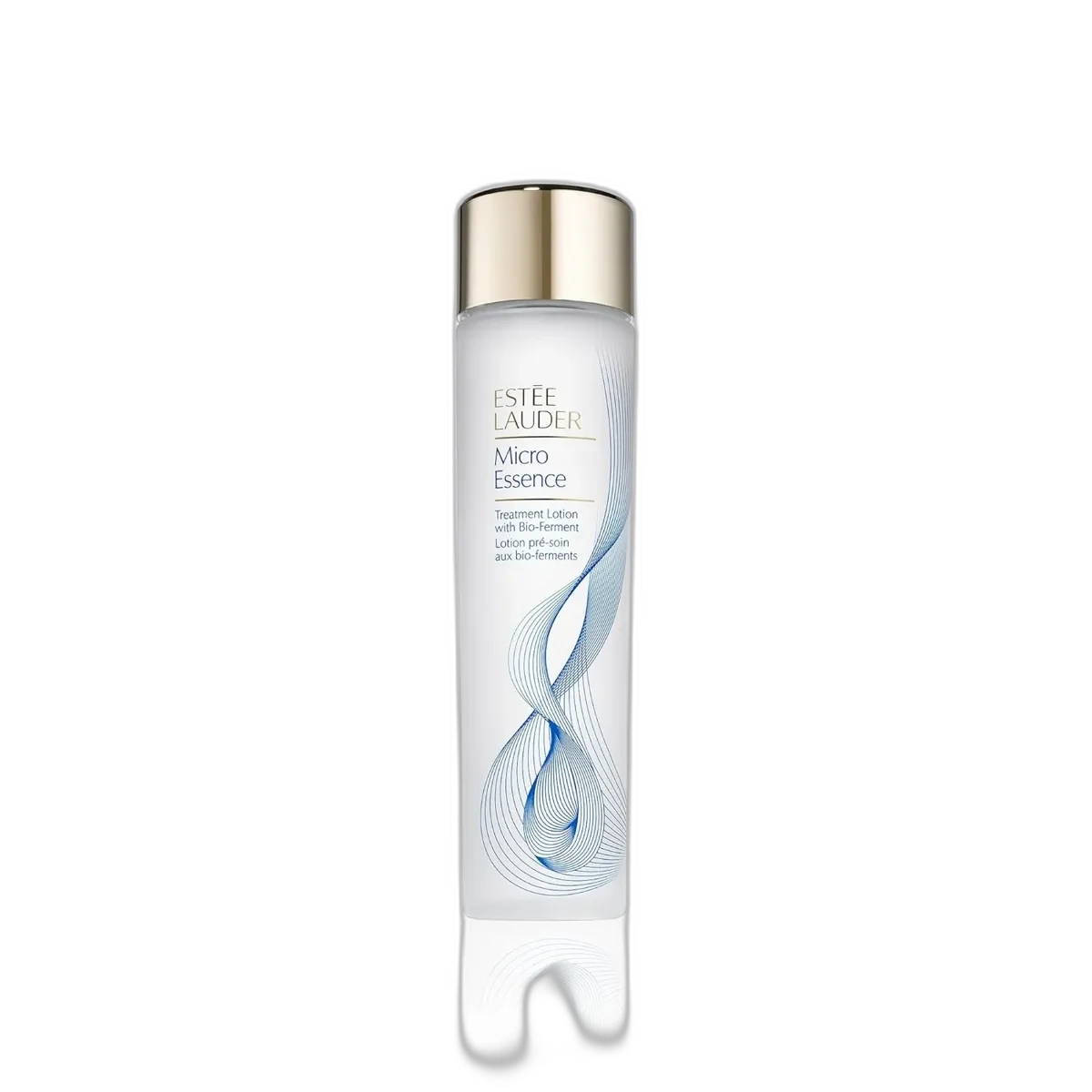
Micro Essence Skin Activating Treatment Lotion
Japanese-Made Essence Ritual
 Verified reviewer
Pros & cons.
- +Remarkably clean 26-ingredient formula — fragrance-free, oil-free, silicone-free, dye-free
- +Bifida Ferment Lysate at second position suggests high concentration of proven barrier-support active
- +Unexpected Argireline inclusion adds genuine anti-wrinkle value to a hydrating essence
- +Dual probiotic ferment system supports both barrier function and skin microbiome
- +Specifically manufactured in Japan reflecting the Asian essence tradition
- +Extremely gentle and suitable for sensitive and reactive skin types
- −Premium price at $120 for a category well-served by more affordable Asian brands
- −Results are subtle and cumulative — may feel like applying expensive water to impatient users
- −Wide-mouth bottle opening leads to product waste with no pump on standard sizes
- −Not cruelty-free despite the otherwise clean formulation
- −Chamomile extract is a potential allergen for those with Asteraceae plant sensitivities
- −Too lightweight for oily skin types who may not perceive meaningful benefit
The full review.
There is something almost paradoxical about a brand known for 77-ingredient formulas with three synthetic dyes going to Japan and coming back with a product that contains 26 ingredients, no fragrance, no silicones, no oils, and no dyes. Micro Essence is what happens when a Western prestige house genuinely absorbs the philosophy of the market it is trying to compete with, rather than just borrowing its aesthetics.
Launched in Japan in February 2014 — months before the global rollout — Micro Essence was Estée Lauder’s answer to a category that SK-II had owned for decades: the treatment essence. In Asian skincare, the treatment essence occupies a sacred position in the routine — applied immediately after cleansing as the first treatment step, it is the foundation on which everything else is built. It is not meant to deliver dramatic visible results on its own. It is meant to create the conditions under which everything else works better. This is a fundamentally different philosophy from the Western approach of loading each product with as many actives as possible and expecting each one to justify its price tag with standalone results.
The current Bio-Ferment reformulation doubles down on this essence philosophy with admirable focus. Bifida Ferment Lysate sits second on the INCI list — the same probiotic ferment that drives the Advanced Night Repair franchise, but in a radically different vehicle. Where ANR wraps it in silicones, PEGs, and dyes, Micro Essence delivers it in a watery, near-transparent liquid that absorbs into skin in seconds. Lactobacillus Ferment adds a complementary probiotic dimension, creating a dual-ferment approach that supports both barrier function and microbiome balance.
The surprise ingredient is Acetyl Hexapeptide-8 — Argireline — a synthetic peptide typically reserved for targeted anti-wrinkle serums. A 2013 randomized, placebo-controlled study published in the American Journal of Clinical Dermatology found that twice-daily application of Argireline produced 48.9% anti-wrinkle efficacy versus 0% in the placebo group after four weeks. Its inclusion in a hydrating essence is an unusual crossover that adds genuine anti-aging value beyond the ferment-driven barrier repair — a quiet overachievement that the brand does not market as heavily as it probably should.
The texture is genuinely water-like — lighter than any Western toner and more similar to Japanese first essences like SK-II Facial Treatment Essence or Kiku-Masamune Sake Lotion. You pour it into your palms, press it into your face, and within five seconds it has disappeared. There is no film, no tackiness, no residue — just skin that feels immediately softer and slightly more resilient. If you are used to Western serums that announce their presence with slip, scent, and visible texture, this may feel like you are applying nothing at all.
But the nothing is doing something. With consistent twice-daily use over two to three weeks, the cumulative effects become apparent. Skin holds onto hydration better throughout the day. Redness and sensitivity diminish — the bifida ferment’s ability to suppress inflammatory cytokines (demonstrated in a 2023 Journal of Cosmetic Dermatology study) creates a calming baseline that makes everything else in the routine more tolerable. Products applied after the essence — serums, moisturizers, even actives like retinol — seem to absorb more effectively. This prep-and-fortify function is the essence’s genuine value proposition, and it is where the category justification lives.
The criticism that Micro Essence is just an expensive toner is understandable but imprecise. The distinction matters: a toner removes residual cleanser and rebalances pH. A treatment essence delivers concentrated actives in a lightweight vehicle designed for rapid, deep absorption. The bifida ferment lysate at second position on the INCI list is not a rinse agent — it is the same active ingredient that anchors a $125 serum, delivered here in a format that prioritizes penetration over texture.
That said, the price is the product’s most legitimate vulnerability. At $120 for 200 mL ($18 per ounce), you are paying premium for a category that many Asian beauty brands execute brilliantly at lower price points. The 400 mL size at $215 offers better per-ounce value, and the 100 mL at $59 provides a reasonable trial size. But the value equation ultimately depends on whether you believe the Estée Lauder ferment quality and Japanese manufacturing justify a markup over Korean and Japanese essences that deliver fermented ingredients at half the price.
The packaging deserves a mild complaint. Standard sizes use a wide-mouth pour opening with no pump, making it easy to dispense more than intended. The 400 mL value size includes a pump, and purchasing that size is probably the most practical decision for committed users. The glass bottle is beautiful and consistent with the Japanese aesthetic the brand is cultivating, but it is heavy and not travel-friendly.
Micro Essence is the Estée Lauder product I would least expect from Estée Lauder. It is restrained, focused, fragrance-free, and confident enough to let its ingredients speak without the usual supporting cast of dyes and parfum. For those who understand the essence category and appreciate what a good first treatment step does for the rest of their routine, it is a genuinely well-formulated product that happens to carry a luxury price tag. For everyone else, it may feel like paying $120 to apply water that does invisible things — which, honestly, is what the best essences have always been.
Formula
Texture
The texture is genuinely water-like — lighter than any Western toner and more similar to Japanese first essences like SK-II Facial Treatment Essence or Kiku-Masamune Sake Lotion. You pour it into your palms, press it into your face, and within five seconds it has disappeared. There is no film, no tackiness, no residue — just skin that feels immediately softer and slightly more resilient. If you are used to Western serums that announce their presence with slip, scent, and visible texture, this may feel like you are applying nothing at all.
Common Praise
With consistent twice-daily use over two to three weeks, the cumulative effects become apparent. Skin holds onto hydration better throughout the day. Redness and sensitivity diminish — the bifida ferment’s ability to suppress inflammatory cytokines (demonstrated in a 2023 Journal of Cosmetic Dermatology study) creates a calming baseline that makes everything else in the routine more tolerable. Products applied after the essence — serums, moisturizers, even actives like retinol — seem to absorb more effectively. This prep-and-fortify function is the essence’s genuine value proposition, and it is where the category justification lives.
Common Complaints
The criticism that Micro Essence is just an expensive toner is understandable but imprecise. The distinction matters: a toner removes residual cleanser and rebalances pH. A treatment essence delivers concentrated actives in a lightweight vehicle designed for rapid, deep absorption. The bifida ferment lysate at second position on the INCI list is not a rinse agent — it is the same active ingredient that anchors a $125 serum, delivered here in a format that prioritizes penetration over texture.
Packaging
The packaging deserves a mild complaint. Standard sizes use a wide-mouth pour opening with no pump, making it easy to dispense more than intended. The 400 mL value size includes a pump, and purchasing that size is probably the most practical decision for committed users. The glass bottle is beautiful and consistent with the Japanese aesthetic the brand is cultivating, but it is heavy and not travel-friendly.
Ingredient analysis.
Full INCI list
Water/Aqua/Eau, Bifida Ferment Lysate, Propanediol, PEG-75, Lactobacillus Ferment, Acetyl Hexapeptide-8, Acetyl Glucosamine, Sodium Hyaluronate, Anthemis Nobilis (Chamomile) Flower Extract, Caffeine, Dipotassium Glycyrrhizate, Hydrolyzed Rice Extract, Betaine, Maltodextrin, Carbomer, Tromethamine, Citric Acid, Trehalose, Butylene Glycol, Caprylyl Glycol, PPG-5-Ceteth-20, Pentylene Glycol, Disodium EDTA, Sodium Citrate, Phenoxyethanol, Potassium Sorbate
Skin match.
The science.
The Science
The formula uses a dual-ferment foundation for scientific credibility. Bifida Ferment Lysate, the second ingredient on the INCI list, upregulates key barrier genes including filaggrin (FLG), loricrin (LOR), involucrin (IVL), transglutaminase 1 (TGM1), and aquaporin-3 (AQP3), according to a 2023 study by Wang et al. in the Journal of Cosmetic Dermatology. AQP3 upregulation matters for an essence; AQP3 channels move water across cell membranes, helping the skin absorb and retain the hydration this lightweight vehicle delivers.
Lactobacillus Ferment supports the microbiome. A 2023 study in Scientific Reports shows probiotic ferment lysates increase skin cell proliferation, provide antioxidant capacity, and reduce damage from S. aureus, hydrogen peroxide, and UV-B radiation — making the essence an effective protective preparation step.
Acetyl Hexapeptide-8 (Argireline) is the formula's anti-aging star. A 2013 randomized, placebo-controlled study in the American Journal of Clinical Dermatology (Wang et al.) found 48.9% total anti-wrinkle efficacy versus 0% in the placebo group after four weeks of twice-daily application, with all roughness parameters decreasing significantly (p < 0.01). The peptide inhibits SNARE complex formation to reduce the muscle contractions that cause expression lines — a mechanism different from the barrier repair of the ferments.
Dipotassium glycyrrhizate (licorice derivative) provides anti-inflammatory support by inhibiting prostaglandin and leukotriene synthesis, which helps reduce redness.
References
- The pivotal role of Bifida Ferment Lysate on reinforcing the skin barrier function and maintaining homeostasis of skin defenses in vitro — Journal of Cosmetic Dermatology (2023)
- The anti-wrinkle efficacy of argireline, a synthetic hexapeptide, in Chinese subjects: a randomized, placebo-controlled study — American Journal of Clinical Dermatology (2013)
- Effects of a lotion containing probiotic ferment lysate as the main functional ingredient on enhancing skin barrier — Scientific Reports (2023)
- Benefits of topical hyaluronic acid for skin quality and signs of skin aging: From literature review to clinical evidence — Dermatologic Therapy (2022)
Dermatologist Perspective
Dermatologists use treatment essences to hydrate and prepare the barrier, especially for patients with sensitive or compromised skin. Board-certified dermatologists note the bifida ferment lysate in this formula matches evidence for probiotic-derived barrier support, and the fragrance-free, oil-free formulation is broadly tolerable. Dermatologists treating Asian patients often know the essence category and its cumulative benefits, while Western-trained dermatologists may see it as redundant if a good hydrating serum is used. The Argireline inclusion adds a feature most essences lack.
Where it fits in your routine.
Pour a quarter-sized amount into clean palms right after cleansing (before other treatment steps). Press into the face and neck with patting motions — do not rub. Apply morning and evening. You can use a cotton pad, but this uses more product. Follow with serum, moisturizer, and sunscreen. For maximum hydration, apply while skin is still slightly damp from cleansing.
At $120 for 200 mL ($18 per ounce), Micro Essence is priced competitively in the luxury essence category, though Korean and Japanese essences with similar fermented ingredients cost much less. The 400 mL value size at $215 ($16 per ounce) with a pump has the best per-ounce value and easiest dispensing. The 100 mL at $59 works as a reasonable trial size. The formula's quality — clean ingredient list, dual ferments, Argireline — justifies a premium over drugstore toners, but ingredients alone do not clearly justify a premium over mid-range Asian essences from brands like Missha or COSRX.
This is for the patient, routine-oriented skincare enthusiast who values the treatment essence category and prefers cumulative barrier support over immediate visible results. It works for dry, dehydrated, and sensitive skin types looking for a fragrance-free first treatment step to anchor a routine.
This product is not for people expecting dramatic standalone results, oily skin types who need more than lightweight essences, budget-conscious consumers who can find cheaper ferment-based essences from Asian brands, or anyone who thinks the essence step is redundant with a hydrating serum.
Product details.
This watery essence is very lightweight. It has a consistency closer to water than lotion, though the 'lotion' name follows Asian skincare terminology where 'lotion' refers to liquid toners. It absorbs into skin within seconds and leaves no film or residue.
Unscented. This fragrance-free formula has no noticeable scent on application.
Estée Lauder uses an elegant glass bottle with a simple pour opening. The 400 mL value size includes a pump, but standard sizes have a wide-mouth opening that causes over-dispensing. Estée Lauder has released limited edition artist-collaboration bottles. Japan manufactures this with a premium feel typical of the Japanese essence category.
The first pour shows a water-like texture — lighter than most Western toners and more like Japanese and Korean first essences. It absorbs so fast you may wonder if it works. Skin feels softer, slightly plumped, and subtly dewy immediately. The real effects are cumulative rather than immediate; this product rewards consistent use over weeks.
2-3 months with twice-daily use (200 mL size); 5-6 months with the 400 mL value size
24 months
All Year
The backstory.
Micro Essence was born from Estée Lauder's observation that the treatment essence category — pioneered by SK-II's Facial Treatment Essence in Japan — had no prestige Western competitor. Launched in Japan in February 2014 before expanding globally, it was specifically formulated and manufactured in Japan as a gesture of respect toward the market that created the category. The current Bio-Ferment version doubles down on the fermentation science, centering the formula around bifida and lactobacillus lysates.
About Estée Lauder
Legacy Brand (20+ years)Estée Lauder launched in 1946 and is a top global prestige beauty company. The Micro Essence line launched in 2014 and is made in Japan, marking the brand's entry into the Asian treatment essence category. The current Bio-Ferment version uses a simplified, 26-ingredient formula — cleaner than many other Estée Lauder products.
Common myths.
Treatment essences are just expensive water
The texture is water-like, but the formula uses mostly Bifida Ferment Lysate. This probiotic-derived active upregulates barrier genes and reduces inflammatory cytokines in published research. The light vehicle absorbs fast by design and does not mean the ingredients are diluted.
Western brands cannot make authentic essences — only Asian brands know the category
Micro Essence is made in Japan using fermentation science from the Japanese and Korean essence tradition. The formula uses 26 ingredients, compared to the 50-70+ in many Estée Lauder products. This simplicity shows that the essence category values focused, clean formulation over ingredient complexity.
FAQ.
Is Estée Lauder Micro Essence worth the price?
Value depends on your expectations. This barrier-supporting, hydrating first essence uses dual probiotic ferments and Argireline. It is a well-formulated product with a clean 26-ingredient list. Results are subtle: improved hydration, less redness, and better absorption of subsequent products. The $120 price may disappoint if you expect dramatic visible transformation. It delivers if you value the cumulative, preventive approach of the essence category.
How do I use Micro Essence in my routine?
Apply immediately after cleansing as your first treatment step. Pour a small amount into your palms and press into skin with patting motions. Follow with your serum, moisturizer, and sunscreen. The essence creates a hydrated base that helps subsequent products absorb better. Use morning and evening.
What is the difference between Micro Essence and a regular toner?
Micro Essence follows the Asian 'treatment lotion' tradition. It does not cleanse or balance pH like Western toners. Instead, it delivers concentrated active ingredients (bifida ferment lysate, lactobacillus ferment, Argireline) in a lightweight, fast-absorbing vehicle. Use this liquid treatment to prep and fortify skin before your serum, not as a post-cleansing rinse.
Is Micro Essence good for sensitive skin?
Yes — this is one of the gentlest products in the Estée Lauder lineup. It is fragrance-free, oil-free, silicone-free, and has only 26 ingredients. The bifida ferment lysate and dipotassium glycyrrhizate (licorice derivative) both have anti-inflammatory properties. The only potential allergen is chamomile flower extract for those with Asteraceae plant allergies.
How does Micro Essence compare to SK-II Facial Treatment Essence?
Both are ferment-based treatment essences made in Japan. SK-II uses Pitera (Saccharomyces Ferment Filtrate) as its signature ferment. Micro Essence uses Bifida Ferment Lysate and Lactobacillus Ferment. Micro Essence includes Argireline (an anti-wrinkle peptide) and has a shorter, cleaner ingredient list. SK-II has a longer track record and more brand-specific clinical data. Both provide hydration and barrier support.
Why is Micro Essence made in Japan?
Estée Lauder manufactures Micro Essence in Japan to honor the market that pioneered the treatment essence category. This Japanese manufacturing shows Estée Lauder's commitment to Japanese skincare fermentation science and quality standards, setting Micro Essence apart from the rest of the Estée Lauder portfolio.
What the community says.
"Lightweight watery texture absorbs instantly with zero residue"
"Effectively boosts skin hydration and softness from first use"
"Visibly reduces redness and calms sensitive skin"
"Fragrance-free and gentle enough for the most reactive skin"
"Preps skin beautifully for subsequent serums and moisturizers"
"Clean short ingredient list is unusually focused for a luxury product"
"Expensive at $120 for results many feel are too subtle to justify"
"Minimal visible improvement in brightness or firmness beyond basic hydration"
"Wide bottle opening makes it easy to dispense too much product"
"Critics argue it is essentially an overpriced hydrating toner"
"Some users with oily skin find it too lightweight to make a difference"