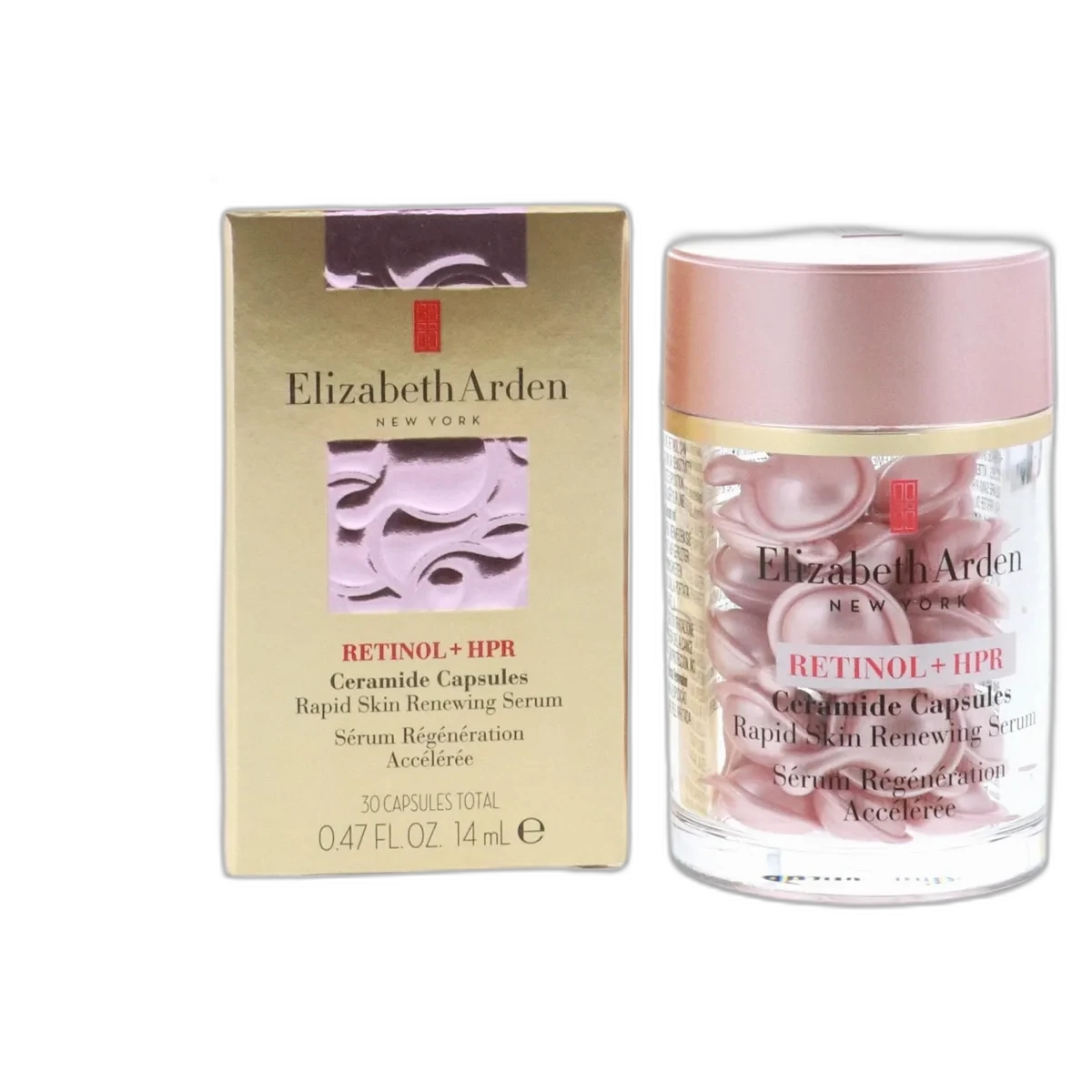
Retinol Ceramide Capsules Line Erasing Night Serum
Beginner-Friendly Retinol
 Verified reviewer
Pros & cons.
- +Pure retinol sealed fresh every dose, no oxidation concerns
- +Two ceramides plus phytosphingosine buffer retinol irritation
- +Matrixyl 3000 peptide duo supports dermal matrix alongside retinol
- +Silicone base layers cleanly under moisturizer without pilling
- +Beginner-friendly adaptation period versus most pure retinol serums
- +Long-running format with years of user reviews behind it
- −Per-milliliter cost is well above drugstore retinol alternatives
- −Too gentle for experienced retinol and tretinoin users
- −Contains avocado and olive oil in the mid-list
- −Single-dose packaging creates more waste than a bottle
The full review.
About Elizabeth Arden
Every retinol serum in your bathroom is slowly dying. This is chemistry: retinol is one of the least stable cosmetic ingredients. Air and light start the countdown immediately. Most brands use airless pumps, dark bottles, or sealed dispensers to delay this, but the potency of your retinol bottle in week eight is less than in week one. This is why many people try retinol, see modest results, and assume it “didn’t work for them”—the bottle no longer delivers what the label claims. Elizabeth Arden’s Retinol Ceramide Capsules solve this using a brute-force method: they put each dose in a sealed, oxygen-free capsule you break open the night you use it. Unlike most capsule formats, this one was invented in 1990—three decades before online debates about retinol oxidation rates—and was in Arden’s arsenal ready for the retinol boom. When you twist one open, you get a weightless silicone-and-oil serum that disappears into dry skin without the drag or grittiness of pure-retinol formats. The base uses cyclopentasiloxane, dimethicone crosspolymer, and light triglycerides. This is an unusual choice for a retinol; it feels more like a primer than a treatment, which is a benefit. It sits under a moisturizer without pilling if you let it set for thirty seconds. There is no sting, tingle, or immediate sense of a serious active on first application. This is due to the light base and the buffering. The capsule delivers retinol alongside Ceramide NP and Ceramide NS—two barrier-repair lipids—plus phytosphingosine, the sphingoid base the skin uses to build its own ceramides. This trio addresses the main reason beginners quit retinol: the barrier-depletion flaking and tightness in week two. You must still respect the ramp-up period (start every third night, then every other night, then nightly if tolerated), but the adaptation is less severe than with most pure-retinol serums. Beyond the retinol, there is a peptide story. The formula includes palmitoyl tripeptide-1 and palmitoyl tetrapeptide-7—the classic Matrixyl 3000 pair—which add a firming angle that pure retinol alone lacks. The peptides do not do anything dramatic alone, but they are additive here: retinol handles cellular turnover and pigmentation, peptides support the underlying dermal matrix, and ceramides protect the stratum corneum. You could recreate this by layering three separate products, but you would be layering three retinol-sensitive actives and hoping they stay stable. The single capsule is the cleaner answer. Tetrahydrodiferuloylmethane is also notable; it is a stabilized curcumin derivative that acts as an antioxidant inside the capsule and on the skin. It helps the formulation stay stable and provides some skin-soothing benefits that retinol usually needs. This is not magic, but it is formulation, which is what you pay for in prestige. Now the honest part. At roughly $88 for 60 capsules, this is not cheap. The per-milliliter cost is well above a CeraVe retinol or a Naturium retinol serum—both excellent products. You are not buying a stronger retinol, but a better-protected, better-buffered, and more forgiving one, plus the Arden brand premium. For someone who quit other retinols due to irritation, or who wants a low-fuss retinol for travel, this is arguably worth the premium. For someone who already tolerates 0.5% retinol from a drugstore brand, this will feel too gentle to justify the cost. The capsule format also creates more packaging than a single bottle, though Arden markets the capsules as biodegradable. It is pregnancy-unsafe like all retinoids, so stop use if you are planning or expecting. A final note on the format: you either love single-dose capsules or find them fiddly. Most people adapt within a week. The tradeoff is never wondering if your retinol is still active, a guarantee that is rarer in this category than people admit.
Ingredient analysis.
Full INCI list
Cyclopentasiloxane, Dimethicone Crosspolymer, C12-15 Alkyl Benzoate, BHT, C18-36 Acid Triglyceride, Camellia Sinensis Leaf Extract, Ceramide NP, Ceramide NS, Cyclohexasiloxane, Dimethiconol, Ethylhexyl Cocoate, Helianthus Annuus (Sunflower) Seed Oil, Lauryl Methacrylate/Glycol Dimethacrylate Crosspolymer, Lecithin, Olea Europaea (Olive) Fruit Oil, Palmitoyl Tetrapeptide-7, Palmitoyl Tripeptide-1, Persea Gratissima (Avocado) Oil, Phytosphingosine, Phytosterols, Polysorbate 20, Propylene Glycol Dicaprylate/Dicaprate, Retinol, Sorbitan Laurate, Tetrahydrodiferuloylmethane
Skin match.
The science.
The Science
Retinol has one of the strongest evidence bases in cosmetic dermatology. Topical retinoids, including OTC retinol, increase epidermal turnover, improve photoaging endpoints, reduce fine wrinkle depth, and fade hyperpigmentation. Most citations come from tretinoin literature — studies by Kligman, Weiss and others — but retinol has its own evidence base. Trials show measurable improvements in fine lines and photodamage markers after 12 to 24 weeks of use at 0.1 to 0.5 percent concentrations. This capsule fits that window. Ceramides are equally well-documented: they reduce trans-epidermal water loss and support recovery of compromised skin. Pairing them with retinol follows clinical literature on reducing retinoid-induced barrier dysfunction. The Matrixyl 3000 peptide duo — palmitoyl tripeptide-1 and palmitoyl tetrapeptide-7 — has a smaller, suggestive body of evidence for supporting type-I collagen synthesis and reducing matrix metalloproteinase activity. Independent data is limited compared to retinol, so the peptides' firming claim is a reasonable adjunct rather than the lead story. The capsule's design addresses stability: retinol oxidation is a common failure mode for OTC retinol serums. A sealed single-dose format delivers a label-accurate concentration per application over the full shelf life.
Dermatologist Perspective
Dermatologists recommend starting retinol users on low concentrations with strong barrier support, and this capsule fits that model. Board-certified dermatologists note that the single-dose format provides more consistent retinol delivery than an open bottle, which improves patient compliance and perceived efficacy. Dermatologists typically advise patients to start retinol two to three nights per week, apply to dry skin only, always follow with a moisturizer, and use broad-spectrum SPF 30 or higher during the day. This product's built-in ceramide and peptide buffering follows the clinical trend of pairing retinol with barrier-support ingredients to improve adherence. Dermatologists also caution that this strength is likely inadequate for patients on prescription tretinoin or advanced OTC retinoid regimens, and that retinol of any kind should be paused during pregnancy and breastfeeding.
Where it fits in your routine.
Use PM only on clean, fully dry skin. Twist one capsule open, squeeze the serum onto your fingertips, and press it onto your face and neck. Avoid the eye area and lip corners. Wait thirty seconds, then apply a ceramide-rich moisturizer. Use two to three nights per week for the first two weeks, then every other night for weeks three and four. Use nightly once your skin feels comfortable. Always apply broad-spectrum SPF 30+ the next morning. If flaking or tightness feels uncomfortable, pause for a few nights, then resume at your previous frequency.
At roughly $88 for 60 capsules, this retinol is premium-priced. Arden offers 90 and 180 count packs that lower the per-capsule cost; the bigger tray offers better value if you commit. Compared to a drugstore retinol like CeraVe Resurfacing Retinol Serum or a mid-price Naturium Retinol Complex, the raw ingredient cost difference is significant. You pay for freshness, a pre-buffered formula, and a prestige brand — not necessarily a stronger retinol. That premium helps first-time retinol users who fear irritation. For value shoppers or experienced retinoid users, a simpler serum plus a ceramide cream does much of the same work for less money.
Choose this if you are a first-time or returning retinol user seeking a gentle, well-buffered, oxidation-proof retinol serum from a recognized prestige brand. It also works for normal-to-dry skin that reacted poorly to other retinols due to barrier depletion.
Retinoid users who tolerate 0.5–1.0% retinol or prescription tretinoin, people with very oily skin prone to olive and avocado oil reactions, anyone pregnant or breastfeeding, and value shoppers who can use a drugstore retinol plus a ceramide cream.
Product details.
Very silky silicone-and-oil serum that disappears into dry skin with zero tack.
None added.
Single-dose biodegradable twist-off capsules sit in a plastic tray — they protect pure retinol from light and air.
The first few applications feel like a weightless silicone serum and do not sting. Expect a short adaptation window: some users feel mild tightness or dryness during the first two weeks. Light flaking around the nose and mouth is normal for any retinol and usually resolves within two to three weeks if you use it conservatively.
About 2 months using one capsule 3–5 nights per week after the ramp-up period.
24 months
fall winter
The backstory.
Arden added a dedicated retinol capsule to its franchise in 2019 specifically to solve the biggest complaint about OTC retinol: oxidation. Open bottles lose potency within weeks, and users rarely finish them fast enough. The single-dose capsule format was the rare case where the original 1990s delivery system was actually engineered for exactly the problem the 2010s retinol boom had.
About Elizabeth Arden
Legacy Brand (20+ years)The Retinol Ceramide Capsules belong to Elizabeth Arden's single-dose capsule franchise, which began in 1990. This retinol-specific version launched in 2019. It stabilizes pure retinol in an oxygen-free dose, a practical use for this format.
Common myths.
Capsule retinol is too gentle to do anything.
Pure retinol at 0.1–0.4% is in the effective OTC range — the capsule is fresh, not weak. You get the actual labeled dose instead of a degraded one two months after opening.
Apply retinol to damp skin to increase absorption.
For most users, damp application increases irritation but does not increase clinical benefit. Applying this capsule to fully dry skin is the standard dermatology recommendation and minimizes flaking.
FAQ.
What percentage of retinol is in each capsule?
Elizabeth Arden does not disclose the exact percentage. Published estimates place the retinol concentration between 0.1% and 0.4%, which falls within the effective and well-tolerated OTC window.
How often should beginners use it?
Use one capsule every three nights for the first two weeks. If your skin tolerates it, use one every other night for two more weeks, then nightly if desired. Using more than one capsule at a time provides no benefit.
Can I use this with vitamin C?
Yes, but on alternating routines. Use vitamin C in the morning and this capsule at night. Do not layer them in one routine; the combined acidity and activity increases irritation for most users.
Is this strong enough for experienced retinoid users?
Probably not. If you use 0.5–1.0% retinol or prescription tretinoin, this feels mild. It works as a beginner-to-intermediate retinol with strong barrier support instead of a max-strength step.
Is it safe during pregnancy?
No. Doctors advise against all retinoids, including OTC retinol, during pregnancy and breastfeeding. Stop retinol use during these times and use peptides and vitamin C instead.
Do I still need a moisturizer after applying the capsule?
Yes. The capsule has excellent buffering ingredients but does not replace a moisturizer. Use a ceramide-based night cream afterward, especially during the first month of use, to minimize flaking.
What the community says.
"Minimal irritation for a retinol"
"Visible texture improvement in a few weeks"
"Capsule format keeps retinol fresh"
"Layered dose prevents over-application"
"Expensive per milliliter"
"Single-dose packaging creates waste"
"Capsules can be tricky to twist open"
"Not strong enough for experienced retinol users"
Featured in.
People also looked at.