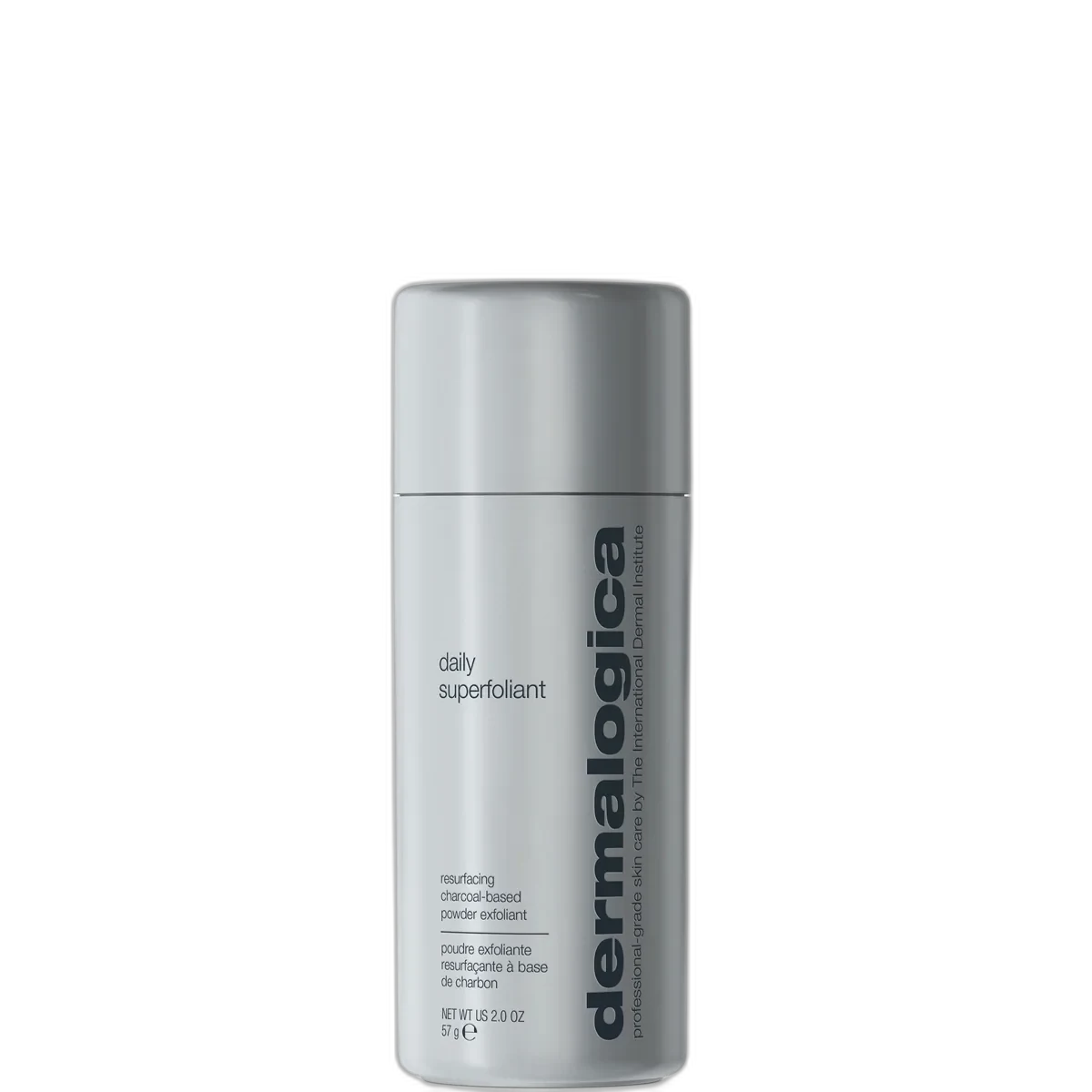
Daily Superfoliant
Urban Skin Defense Exfoliant
 Verified reviewer
Pros & cons.
- +Triple enzyme system (papain, lipase, subtilisin) achieves more thorough exfoliation than single-enzyme products
- +Activated Binchotan charcoal provides legitimate deep-pore purification during the massage phase
- +Dual AHA (malic + lactic acid) adds chemical resurfacing to the enzymatic and physical exfoliation
- +Niacinamide supports barrier integrity during the multi-modal exfoliation process
- +Anti-pollution botanicals (red algae, tara fruit) add antioxidant protection beyond pure exfoliation
- +24-month PAO provides excellent shelf stability for the powder format
- +Amino acid-based surfactants cleanse gently despite the intensive active ingredients
- −$69 for 2.0 oz is more expensive per gram than the Daily Microfoliant at the same price for 2.6 oz
- −Six essential oils and their allergens applied to freshly exfoliated skin is a formulation concern
- −Too intensive for sensitive skin despite the 'Daily' name — most users need every-other-day frequency
- −Charcoal residue can stain white towels and light-colored sink surfaces
- −Anti-pollution claims in a 60-second rinse-off product have limited evidence support
- −Not compatible with retinoids, acne medications, or post-procedure skin
The full review.
The Dermalogica Daily Microfoliant built its following as a consequence-free daily exfoliant. The Daily Superfoliant, launched in 2017, uses that same powder-to-paste ritual but adds enough actives to rival a chemical peel. The format is familiar, but the ambitions differ.
The Microfoliant uses one enzyme, one BHA, and a soothing rice base. The Superfoliant uses three enzymes, two AHAs, activated charcoal, niacinamide, and an anti-pollution botanical complex. It is the difference between a daily walk and interval training—the same motion, but different intensity.
The charcoal is the visual focus. The dark grey powder becomes a slate-colored paste when it touches water, fizzing from the sodium bicarbonate base. This fizz creates a mildly alkaline environment that temporarily opens pores, letting the activated Binchotan charcoal reach deeper into the follicular architecture. Activated charcoal has a legitimate adsorption capacity—up to 3,000 square meters of surface area per gram—to bind organic pollutants, heavy metals, and particulate matter. Because the charcoal has direct skin contact during the massage phase of this rinse-off product, this purification mechanism works.
The triple enzyme system distinguishes this formula from its gentler sibling. Papain handles keratin protein bonds, just as it does in the Microfoliant. Here, it joins lipase, which cleaves lipid bonds in the intercellular cement, and subtilisin, a broad-spectrum proteolytic enzyme that breaks down more protein. Three enzymes using three different biochemical pathways achieve more thorough biological exfoliation than a single enzyme.
Then come the AHAs. Malic acid and lactic acid provide chemical exfoliation alongside the enzymatic and physical modes. This is why the “super” in Superfoliant fits—the product uses four simultaneous exfoliation mechanisms (the enzymatic trio, dual AHA, physical microparticles, and the alkaline environment). This is comprehensive and aggressive, which explains why many users find daily use too intense.
Niacinamide is a forward-thinking choice here. While it provides brightening and anti-inflammatory benefits, its primary role is likely barrier support to maintain skin integrity during multi-modal exfoliation. This ingredient helps the product stay potent without being purely destructive.
The anti-pollution complex—red algae extract and tara fruit pod extract—reflects Dermalogica’s 2017-era urban skin defense positioning. Red algae helps prevent pollutants from adhering to the skin, while tara fruit forms a protective barrier. Whether these ingredients provide meaningful protection in a sixty-second rinse-off product is debatable, but they add antioxidant value.
The essential oils are notable. Six essential oils—lavender, lavandin, bitter orange, lemon, rosemary, and sage—plus allergens like limonene and linalool create an assertive fragrance profile. Applying known sensitizers to freshly exfoliated skin via multi-modal exfoliation is a formulation contradiction that Dermalogica has not reconciled in its range.
User opinions on performance diverge. Those who tolerate it well—usually normal to oily skin types using it two to three times per week—report a mini-facial that leaves skin smoother, brighter, and more refined. Blackheads clear faster than with the Microfoliant alone, and pore appearance improves with consistent use. The charcoal purification and multi-acid resurfacing tackle congestion from multiple angles.
Those who do not tolerate it—sensitive skin types, daily users, or those with a compromised barrier—report irritation, more breakouts, and over-exfoliation that takes weeks to repair. The “Daily” in the name is misleading for these users. Every esthetician and dermatologist found during research recommended starting at two to three times per week; that should be the label guidance.
Charcoal residue is a practical issue. The dark grey paste rinses from skin but marks white towels and light sinks. Use a dark washcloth and rinse your sink immediately. It is a minor but real inconvenience.
At the same sixty-nine dollar price point as the Microfoliant, the Superfoliant comes in a smaller 2.0 oz container (compared to 2.6 oz), so the per-gram cost is higher. However, because you should use it less often, a container lasts two to three months, making the per-use cost comparable to the Microfoliant. Value depends on whether your skin needs the Superfoliant’s intensity or the Microfoliant’s gentleness—they are different tools, not better or worse versions of each other.
Formula
Formula
Ingredient analysis.
Full INCI list
Microcrystalline Cellulose, Sodium Bicarbonate, Sodium Cocoyl Glutamate, Sodium Myristoyl Glutamate, Malic Acid, Sodium Methyl Cocoyl Taurate, Charcoal Powder, Vinyl Dimethicone/Methicone Silsesquioxane Crosspolymer, Maltodextrin, Silica, Magnesium Oxide, Oryza Sativa (Rice) Bran Extract, Polymethylsilsesquioxane, Sapindus Trifoliatus Fruit Extract, Niacinamide, Citrus Aurantium Amara (Bitter Orange) Peel Oil, Zingiber Officinale (Ginger) Root Extract, Lavandula Angustifolia (Lavender) Oil, Lavandula Hybrida Oil, Camellia Sinensis Leaf, Kappaphycus Alvarezii Extract, Caesalpinia Spinosa Fruit Pod Extract, Citrus Limon (Lemon) Peel Oil, Rosmarinus Officinalis (Rosemary) Leaf Oil, Salvia Officinalis (Sage) Oil, Subtilisin, Lipase, Papain, Lactic Acid, Oryza Sativa (Rice) Starch, Sodium Chloride, Sodium Dehydroacetate, Xanthan Gum, Water/Aqua/Eau, Coconut Acid, Calcium Lactate, Capryloyl Glycine, Undecylenoyl Glycine, Cetrimonium Chloride, Limonene, Linalool
Skin match.
The science.
The Science
The multi-modal exfoliation approach in the Daily Superfoliant addresses the skin surface through four mechanistically distinct pathways. The triple enzyme system — papain (cysteine protease), lipase (lipid hydrolase), and subtilisin (serine protease) — targets three different biological bonds simultaneously. Papain cleaves peptide bonds in devitalized keratin, lipase hydrolyzes the lipid bonds in intercellular cement, and subtilisin provides broad proteolytic activity against protein substrates. This multi-enzyme approach achieves more comprehensive desquamation than any single enzyme could deliver.
The dual AHA component — malic acid (an alpha-hydroxy dicarboxylic acid) and lactic acid — provides chemical exfoliation through a different mechanism entirely. AHAs disrupt ionic bonds between corneocytes in the stratum corneum, promoting cell turnover and revealing fresher skin beneath. Lactic acid's larger molecular size compared to glycolic acid provides somewhat slower but gentler penetration, while its inherent humectant properties help counterbalance the drying potential of the multi-modal exfoliation.
Activated charcoal's purification mechanism is based on physical adsorption — its microporous structure provides an enormous surface area (up to 3,000 m² per gram for high-grade activated charcoal) that attracts and binds organic molecules through van der Waals forces. Binchotan — Japanese white charcoal produced at temperatures exceeding 1,000°C — is considered a high-grade activated charcoal with superior adsorption characteristics. In a topical application with direct skin contact during the massage phase, the charcoal has opportunity to adsorb surface pollutants and sebum-trapped environmental particles.
Niacinamide's role in this context extends beyond its well-documented brightening and anti-inflammatory effects. Research has demonstrated that niacinamide increases ceramide and fatty acid synthesis in the stratum corneum, strengthening the lipid barrier. In a product that actively disrupts the barrier through multiple exfoliation modes, this ceramide-boosting function serves as a built-in repair mechanism — helping the skin recover from the exfoliation it just experienced.
Dermatologist Perspective
Board-certified dermatologists would view this as an intensive exfoliant with a well-designed multi-modal approach — appropriate for normal to oily skin types seeking deep resurfacing. The combination of enzymatic, chemical, and physical exfoliation mechanisms is aggressive by dermatological standards, and most practitioners would recommend starting at two to three times per week rather than the daily use the name implies. The warning against concurrent use with retinoids and acne medications is clinically sound — compounding exfoliation from multiple sources risks barrier compromise, irritant dermatitis, and paradoxical breakouts. The essential oil content would be noted as a formulation concern for any patient with fragrance sensitivity.
Where it fits in your routine.
Put about half a teaspoon of powder into very wet hands. Rub your palms together to make a creamy, slightly fizzing paste. Massage the paste onto a damp face using gentle circular motions for about 60 seconds. Avoid the eye area. Rinse thoroughly. Use in the morning 2-3 times per week, then increase frequency if your skin tolerates it. Always follow with sunscreen. Do not use on the same day as retinol, AHA/BHA serums, or benzoyl peroxide treatments. Avoid use on sunburned, irritated, or recently professionally treated skin.
At $69 for 2.0 oz, the Superfoliant costs more per gram than the Microfoliant ($69 for 2.6 oz). But because you use it less often (2-3 times weekly vs daily), a container lasts about 2-3 months in both cases, making the monthly cost similar. A travel size (~$22-24 for 0.45 oz) works as a trial. The formulation—triple enzymes, dual AHAs, activated charcoal, niacinamide, and anti-pollution botanicals—uses sophisticated ingredients that justify a higher price than simpler exfoliants. Whether the Superfoliant justifies a premium over the Microfoliant depends on if your skin needs that extra intensity.
People with normal to oily skin facing congestion, dullness, enlarged pores, and environmental skin stress. It works for city dwellers wanting deep-pore purification and resurfacing. It suits users who used the Daily Microfoliant and want more intensity, or those preferring less frequent, more impactful exfoliation over gentle daily maintenance.
Multi-modal exfoliation is likely too intensive for sensitive or dry skin. Avoid adding this level of exfoliation if you use retinoids, prescription acne treatments, or undergo professional skin treatments. The six essential oils and their associated allergens concern those with fragrance sensitivity. If the Daily Microfoliant meets your exfoliation needs, do not trade gentleness for intensity.
Product details.
Fine dark grey powder fizzes slightly with water, turning into a creamy, lightly foaming paste. It is smoother than expected and lacks the scratchy or gritty feel of charcoal. The sodium bicarbonate fizzing adds a tactile dimension the Microfoliant lacks.
Herbal and botanical — a blend of lavender, bitter orange, lemon, rosemary, and sage essential oils creates a strong scent. This aroma is more complex and assertive than the Microfoliant's scent. It has no synthetic fragrance, but the natural oil blend is strong.
Dark grey cylindrical shaker bottle with sifter top matches the Dermalogica Age Smart line aesthetic. A desiccant bag inside keeps the powder dry; remove it before first use. Sizes include 2.0 oz full size, 0.45 oz travel size, and 4 oz professional size. All packaging components are recyclable.
The dark grey powder looks striking. The slight fizz when water hits it adds a sensory element to the cleansing ritual. The paste massages smoothly and has no harsh particles despite the charcoal. Skin feels polished and clear after rinsing, showing immediate brightness in the mirror. The charcoal may leave faint grey residue on light-colored towels.
2-3 months with use every other day (2.0 oz size)
24 months
All Year
The backstory.
Launched in 2017 as Dermalogica's response to the growing awareness of urban pollution's impact on skin aging, the Daily Superfoliant was designed for city dwellers whose skin faces daily assault from particulate matter, heavy metals, and environmental oxidants. The activated Binchotan charcoal — a Japanese white charcoal traditionally used for air and water purification — was chosen specifically for its high-grade adsorption capacity, going beyond the cosmetic charcoal trend to offer genuine purification functionality.
About Dermalogica
Legacy Brand (20+ years)Jane Wurwand founded Dermalogica in 1986 in Los Angeles, working with the International Dermal Institute. The Daily Superfoliant launched in 2017 as an intensive version of the brand's iconic Daily Microfoliant to target anti-pollution and deep resurfacing.
Common myths.
The Superfoliant is the Microfoliant with charcoal added.
The formulations differ fundamentally. The Superfoliant uses three enzymes (vs one), two AHAs (vs one BHA), activated charcoal, niacinamide, an anti-pollution algae complex, and a different base. They only share the powder format, rice extract, and microcrystalline cellulose.
Charcoal in skincare is just a marketing gimmick.
Activated charcoal has a documented adsorption capacity. Its large surface area (up to 3,000 m² per gram) binds organic compounds, heavy metals, and particulate matter. In a rinse-off exfoliant where the charcoal touches skin during massage, this purification works beyond cosmetics.
FAQ.
What's the difference between the Daily Superfoliant and Daily Microfoliant?
The Superfoliant is more intensive. It uses three enzymes (vs one), two AHAs (vs one BHA), activated charcoal to purify pores, and an anti-pollution complex with red algae and tara fruit. The Microfoliant is gentler. It uses a rice-based formula and colloidal oatmeal to soothe and brighten. Use the Superfoliant for oily, aging, or city-exposed skin; use the Microfoliant for sensitive skin or daily-gentle exfoliation.
***
How often should I use the Daily Superfoliant?
Despite the 'Daily' name, start 2-3 times per week and increase use as your skin tolerates it. The triple enzyme plus dual AHA combination is more intensive than the Microfoliant. Normal to oily skin types may use it daily; combination and drier types typically use it every other day.
Will the charcoal stain my skin or towels?
Charcoal rinses cleanly from skin but leaves faint grey marks on white towels, washcloths, and light-colored porcelain. Use a dark washcloth to pat dry and rinse your sink immediately after use. The staining is minor and washes out of fabrics.
Can I use this with retinol?
Avoid using this on the same day as retinol or retinoid products. The triple exfoliation (enzyme + AHA + physical) plus retinol's exfoliating effect can damage the skin barrier and cause irritation. Use the Superfoliant on mornings when you did not apply retinol the night before.
Is the Dermalogica Daily Superfoliant good for acne?
Charcoal pore purification, triple enzymatic exfoliation, and AHA resurfacing manage congestion-driven acne and blackheads. Dermalogica warns not to use it with topical acne medications. The Microfoliant is a safer option for active inflammatory acne.
***
Community ---
What the community says.
"Leaves skin immediately soft, smooth, and visibly brighter after just one use"
"Surprisingly gentle despite being a potent multi-modal exfoliant"
"Effective at clearing blackheads and deep congestion over time"
"Long-lasting product — a little powder goes a long way"
"Creates a professional mini-facial experience at home"
"$69 for 2 oz is expensive — consistently the top user complaint"
"Charcoal residue can stain white towels, washcloths, and sink surfaces"
"Too intense for very sensitive skin if used daily — many need 2-3 times weekly"
"Multiple essential oils may irritate those with fragrance sensitivity"
"Some users find results don't justify the significant price premium"
People also looked at.