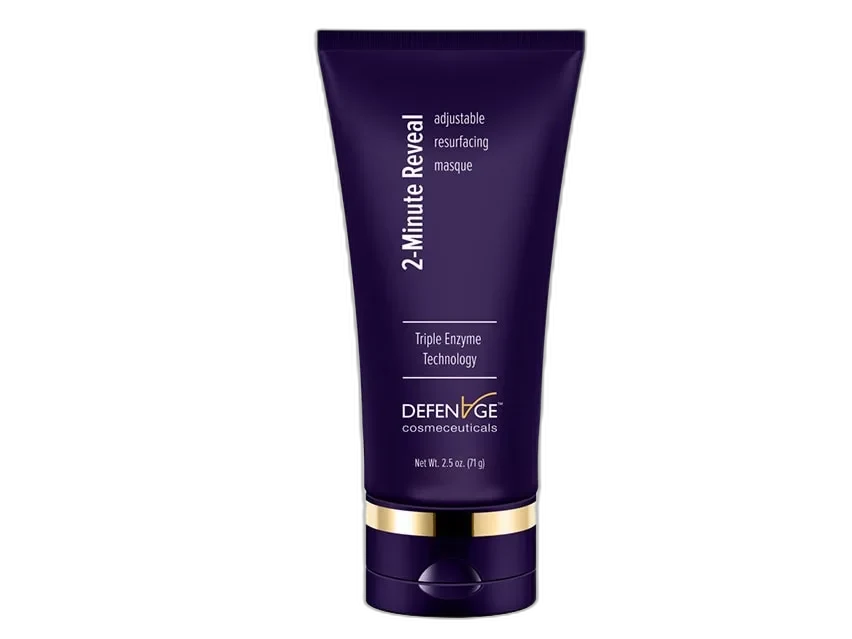
2-Minute Reveal Masque
Derm Office Staple
 Verified reviewer
Pros & cons.
- +Multi-mechanism exfoliation from enzymes, sugar crystals, and lactic acid in one step
- +Dissolving sugar crystals prevent the micro-tears associated with harsh scrubs
- +Immediate smoother, brighter finish visible after one two-minute use
- +Sea whip extract provides real anti-inflammatory buffering
- +Dermatology-channel positioning with established clinical credibility
- +Cruelty-free and vegan formulation
- +Effective alternative to in-office enzyme peels at home
- −Essential oil blend unsuitable for sensitive or fragrance-allergic users
- −Premium price compared to effective drugstore enzyme masks
- −Can over-exfoliate when combined with other acids or retinoids same night
- −Lactic acid and papain together cause noticeable tingle on reactive skin
- −Only available through dermatology offices and select online retailers
The full review.
The 2-Minute Reveal Masque exists because DefenAge needed a physical product that aestheticians could hand to patients leaving the dermatology office after a Defensin-based treatment. The brand’s core technology is peptide work on skin stem cells, and the masque was designed to complement that core by giving patients a way to maintain smoother, brighter skin between in-office visits. The result is a product that reads as a clinical tool first and a retail experience second — which is part of what’s interesting about it, and part of why the price feels steep if you find it online without the professional context.
What makes the formula worth discussing is the multi-mechanism approach to exfoliation. Most masks do one thing. Acid masks dissolve dead cells with AHAs or BHAs. Enzyme masks use proteolytic enzymes like papain to break down keratin. Scrub masks use physical particles to lift debris. This one does all three, carefully calibrated so that none of them dominates. Ultrafine sugar crystals deliver mechanical exfoliation that dissolves during the two-minute massage, so you’re not left with abrasive residue that could cause micro-tears. Papain handles the enzymatic keratin breakdown, backed up by fermented pumpkin and pomegranate extracts for additional enzyme activity. A small dose of lactic acid tips the formula into the mild AHA range. Each mechanism is gentler than it would be as a standalone, but the combined effect is genuinely effective.
Applying it is a distinctive experience. The mask pumps out as a white cream with visible granular texture. You spread it across clean dry skin, wait two minutes — a mild tingle from the lactic acid and papain is normal — and then massage in small circular motions for thirty seconds before rinsing. The massage step is the interesting part because that’s when the sugar crystals dissolve and you feel the texture of the mask change under your fingers from granular to creamy. Rinsed off, the immediate result is visibly smoother, brighter skin with a subtle pink flush that fades within ten minutes. Most users notice the improvement immediately, and the cumulative effect over three or four uses compounds into genuinely better texture and tone.
Best for
For whom does this actually work well? The sweet spot is dull, mildly congested, or photoaged skin that’s shown up to a peel-style product before and handled it fine but wants something gentler and less time-consuming. Post-sun summer skin that’s lost its glow. Winter skin that’s gone rough and uneven. Pre-event skin that needs to look its best on Saturday. It’s also a reasonable pick for people who’ve plateaued on nightly retinol and need a once-a-week reset to accelerate surface turnover. Where it doesn’t work as well is on genuinely sensitive skin — the combination of papain, lactic acid, and the ylang ylang and orange peel essential oils is too much for reactive barriers to handle, and the tingle that would be normal on normal skin becomes uncomfortable on sensitive types.
Scent
The essential oil content is worth dwelling on because it’s the one formulation choice that stops this from being an unqualified recommendation. Ylang ylang, orange peel, and their associated linalool and limonene compounds are known sensitizers. In a product designed to be rinsed off after two minutes they’re less of a risk than in a leave-on cream, but they still bother certain users and they contribute nothing to the efficacy story. DefenAge could have made this mask scent-free without losing anything clinical, and the fact that they didn’t is a small but real mark against it.
Performance
Performance-wise, it holds its own against both cheaper enzyme masks and more aggressive chemical peels. Compared to Drunk Elephant’s T.L.C. Sukari Babyfacial, the DefenAge mask is gentler, shorter, and less prone to post-use sensitivity. Compared to Dermalogica’s Daily Microfoliant — a long-standing enzyme staple — it’s a more intense single-session treatment rather than a gentle daily use. Compared to a $12 Pixi Glow Mud Cleanser or similar drugstore enzyme products, the DefenAge version delivers a more complete resurfacing experience thanks to the sugar crystals and lactic acid backup. Whether that difference justifies the price gap depends on how much you value the clinical-channel positioning and the professional recommendation behind it.
Value
Value is the hardest part of the assessment. At around $88 for 2.5 oz, this is roughly eight times the price of an acceptable drugstore enzyme mask. A tube lasts ten to twelve weeks at the recommended twice-weekly frequency, which puts monthly cost around $30. Compared to the cost of an in-office enzyme peel with an aesthetician ($100-150 per session), using this mask at home is the cheaper option. Compared to building your own routine with The Ordinary Lactic Acid, a simple enzyme cleanser, and any standard face mask, you’re paying a premium for convenience and the multi-mechanism packaging. Both framings are reasonable; it depends on what you’re comparing against.
Recommendation
The final recommendation is clear: if you have normal, combination, or mildly dry skin that’s lost its glow and you want a once-or-twice-weekly resurfacing mask that delivers visible results without the harshness of stronger peels, this is one of the better professional-channel options on the market. If you have sensitive skin, rosacea, or fragrance allergies, skip it — the essential oils will cause problems the formulation didn’t need to have. And if you’re shopping purely on price, there are solid drugstore enzyme masks that will cover eighty percent of the same ground for a quarter of the cost.
Ingredient analysis.
Full INCI list · pH 4
Butylene Glycol, PEG-8, Tapioca Starch, Sucrose, Titanium Dioxide, Hydroxyethyl Acrylate/Sodium Acryloyldimethyl Taurate Copolymer, Squalane, Polysorbate 60, Carica Papaya (Papaya) Fruit, Papain, Aloe Barbadensis Leaf Juice, Lactobacillus/Pumpkin Ferment Extract, Lactobacillus/Punica Granatum Fruit Ferment Extract, Sea Whip Extract, Cananga Odorata Flower Oil, Citrus Aurantium Dulcis (Orange) Peel Oil, Caprylic/Capric Triglyceride, Lactic Acid, Phenoxyethanol, Caprylyl Glycol, Ethylhexylglycerin, Hexylene Glycol
Skin match.
The science.
The Science
Multi-mechanism exfoliation works because different methods target different skin processes. Physical exfoliation uses particles like sugar crystals to lift superficial dead cells mechanically. Enzyme exfoliation uses papain and fruit-derived proteases to selectively break peptide bonds in keratin protein, a process studied in cosmetic chemistry since the 1970s. Research shows papain preferentially targets dead and damaged keratin over live cells, making it a more selective exfoliant than broadly active acids at the same strength.
Lactic acid is a well-studied AHA with published data on hydration, barrier function, and pigmentation. Research in journals like Dermatologic Surgery shows lactic acid at 5-12% improves photoaging markers and skin smoothness. The concentration in this mask is lower than a standalone treatment, but it reaches the active range when paired with the enzymes. This uses lactic acid's buffering-amenable properties more efficiently than using higher concentrations alone.
Sea whip extract — derived from a soft coral species — has a smaller, documented evidence base as an anti-inflammatory ingredient. Studies show its components inhibit PLA2, an enzyme in inflammatory cascades. This provides a mechanistic basis for using it in formulas that work on the stratum corneum without triggering redness.
Pumpkin and pomegranate ferment extracts have the least independent research in this formula. Fermented botanical extracts are popular in probiotic-adjacent skincare, but clinical trial data is limited. In this mask, they likely provide supplemental enzyme activity and antioxidant support rather than load-bearing efficacy.
Dermatologist Perspective
Dermatologists and aestheticians who stock DefenAge products in their practices generally use this mask as an at-home maintenance tool between in-office treatments. Board-certified dermatologists note that multi-mechanism exfoliating masks deliver meaningful resurfacing for appropriate candidates without the downtime of a medium-depth peel. Aestheticians commonly recommend the product for mild to moderate photoaging, post-summer dullness, and as a gentler alternative for patients who reacted to stronger glycolic peels. Professional guidance typically emphasizes using the mask no more than twice weekly, avoiding same-night layering with retinoids or acids, and patch-testing on the jawline first for anyone with a history of reactivity.
Where it fits in your routine.
On clean, dry skin, pump a small amount into fingertips and spread a thin, even layer across face and neck, avoiding the immediate eye area. A mild tingle within 30 seconds is expected. Leave on for exactly two minutes — no longer. Then, wet fingertips and massage the mask in small circular motions across the face for about 30 seconds; you'll feel the texture shift from granular to creamy as the sugar crystals dissolve. Rinse thoroughly with lukewarm water and follow with a hydrating serum and moisturizer. Use one to two times per week, not on the same nights as other acids or retinoids. Always use sunscreen the following morning.
At around $88 for 2.5 oz, this is premium pricing for an exfoliating mask — and DefenAge is transparent about positioning itself in the professional-channel tier where that price point is normal. A tube lasts ten to twelve weeks at twice-weekly use, putting monthly cost near $30, which is meaningful but manageable. Compared to the cost of in-office enzyme peels ($100-150 per session), home use with this mask is significantly cheaper, which is one of the more defensible value framings. Compared to a DIY routine built from a separate enzyme cleanser, a lactic acid toner, and a simple gel mask, you're paying for convenience and the multi-mechanism packaging — whether that's worth it depends on your appetite for routine building. For the clinical-experience buyer, value is fine. For the optimizer looking for max exfoliation per dollar, it's not the pick.
People with normal, combination, or mildly dry skin facing dullness, uneven texture, or mild photoaging want an at-home resurfacing treatment that works faster than daily acids. It works well for pre-event skin prep, a seasonal reset, or as a gentle alternative for those who reacted to stronger glycolic peels.
Skip this if you have sensitive skin, rosacea, active eczema, or fragrance allergies — the essential oil content and multi-mechanism exfoliation cause irritation. Skip this if you use nightly prescription retinoids, as the mask's exfoliation compounds the retinoid effect and risks over-exfoliation.
Product details.
White creamy mask with fine granular sugar crystals suspended throughout
Light floral-citrus from the ylang ylang and orange peel oils
White pump-top tube with clinical branding
Apply the mask to clean skin for a cool, slightly textured feel. The lactic acid and papain cause a mild tingle within 30 seconds. After two minutes, massage in circular motions to dissolve the sugar crystals, then rinse. Most users see smoother, brighter skin immediately.
10-12 weeks at 1-2 uses per week
12 months
All Year
The backstory.
DefenAge was founded in 2015 by a team pursuing 'Defensin' peptide technology — a novel approach to skin renewal through activation of stem cell populations. The 2-Minute Reveal Masque launched in 2017 as the brand's resurfacing partner to the Defensin-based serums, designed for use in dermatology and medspa environments where professional staff could recommend it alongside in-office procedures.
About DefenAge
DefenAge launched in 2015, founded by a team including dermatologists around patented Defensin peptide technology. The brand sells through dermatology offices and medspas instead of direct-to-consumer retail. Its core products have undergone independent clinical trials, a rare commitment for a brand of its size.
Common myths.
Enzyme masks are too weak to actually do anything
This formula uses low-dose lactic acid and physical sugar crystals to back its papain and ferment enzymes. This multi-mechanism approach exfoliates effectively, even though each component is gentler than a 10% glycolic peel.
Physical exfoliants are always too harsh for sensitive skin
This mask uses ultrafine sucrose crystals that dissolve during massage. This differs from permanent abrasive particles. Harsh scrubs fail because of particle shape and durability, not mechanical exfoliation.
FAQ.
How often should I use this mask?
Most skin types use this one to two times per week. Using it more often causes over-exfoliation because enzymes, sugar crystals, and lactic acid work together. Use it once per week if you layer other acids or retinoids into your routine.
Can I use it with retinol?
Don't use them on the same night. The mask provides enough exfoliation alone; stacking it with retinol or other acids increases irritation without adding benefit. Use the mask on a night when you skip your usual retinoid.
Is it actually gentler than a glycolic peel?
Yes and no. The individual components are milder than a concentrated 10% glycolic peel, but the multi-mechanism approach — enzymes plus sugar crystals plus lactic acid — delivers comparable resurfacing. Most users get a gentler experience with similar outcomes.
Will it help with dark spots?
Consistent use fades mild post-inflammatory pigmentation over 6-8 weeks by exfoliating surface cells. It does not replace targeted pigmentation treatments like tranexamic acid or prescription hydroquinone for stubborn melasma.
Why is it so expensive compared to other masks?
DefenAge sells mostly through dermatology offices as a clinical brand. The price reflects its professional channel and clinical trials for core products. Cost justification is individual; the formulation is solid but not uniquely better than $30-40 enzyme masks.
Can I use it during pregnancy?
The active ingredients are pregnancy-safe. Some users prefer to avoid essential oils during pregnancy as a precaution, in which case this mask contains small amounts of ylang ylang and orange peel oils worth considering.
Community
What the community says.
"visible smoothing in one use"
"gentler than typical acid masks"
"noticeable brightness improvement"
"satisfying exfoliation experience"
"expensive for the size"
"contains essential oils"
"can tingle on sensitive skin"
People also looked at.