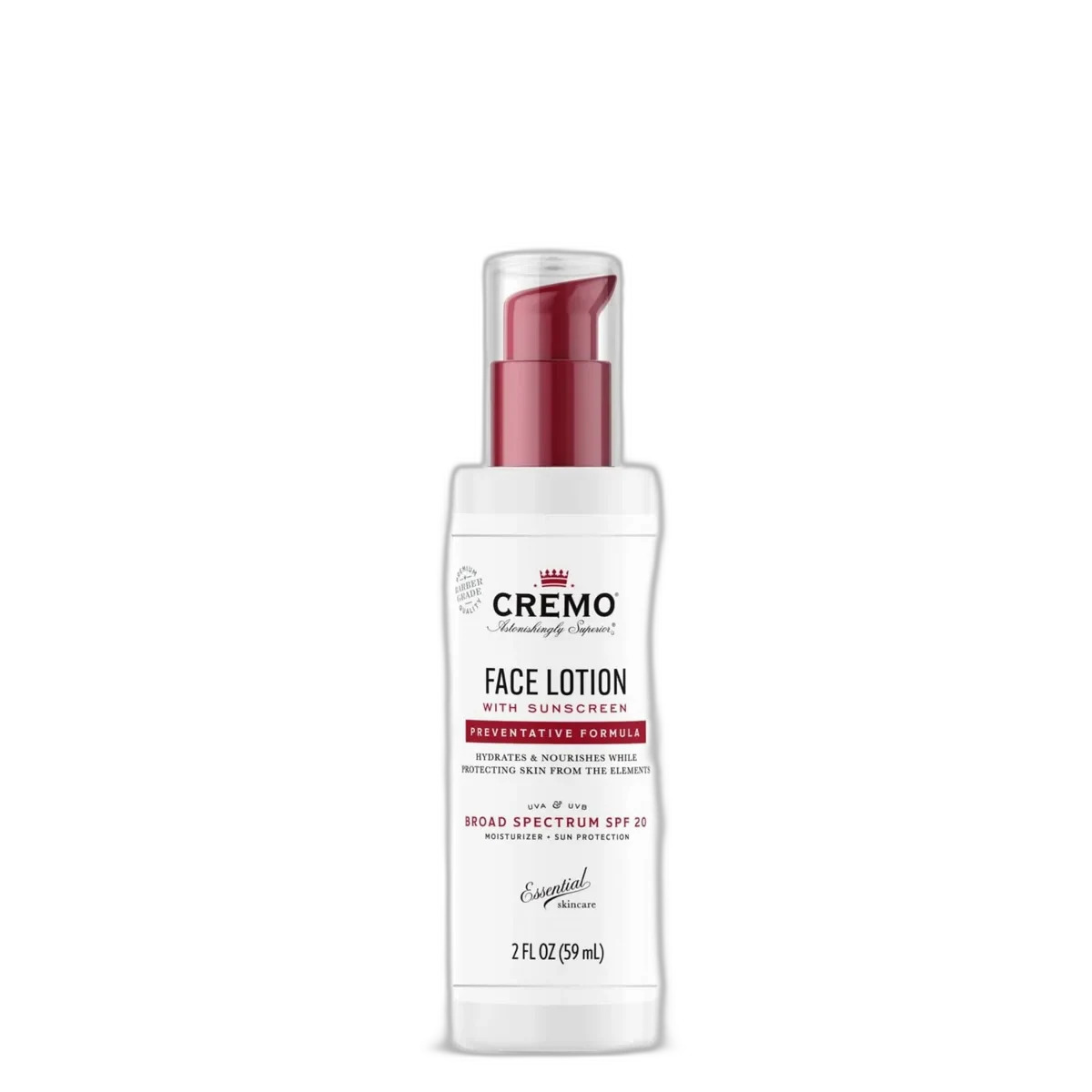
All Season Face Moisturizer SPF 20
No-Fuss Daily SPF
 Verified reviewer
Pros & cons.
- +Exceptionally lightweight matte finish that eliminates the greasy feel men typically dislike
- +Convenient all-in-one format combining moisturizer and SPF in a single step
- +Budget-friendly at under $10 for a daily SPF moisturizer
- +Nearly unscented formula that does not compete with aftershave or cologne
- +TSA-friendly 2 oz tube is perfect for travel
- +Green tea and pomegranate antioxidants provide supplementary UV protection
- −SPF 20 falls below the dermatologist-recommended minimum of SPF 30
- −Product appears discontinued or increasingly difficult to find at retailers
- −Contains cyclotetrasiloxane and propylene glycol flagged as potential concerns
- −Very limited user review data compared to mainstream moisturizers
- −Chemical UV filters have been questioned regarding systemic absorption levels
- −Parent company Edgewell is not cruelty-free certified
The full review.
Cremo made its name by convincing men that good shaving cream did not need to cost twenty dollars or come in a can. The pitch was simple: better product, fair price, no nonsense. When the brand expanded into skincare around 2016, the All Season Face Moisturizer SPF 20 carried that same philosophy — one tube, one step, daily protection and hydration for a face that just got shaved.
The product understood its audience with almost anthropological precision. Men who had never used a dedicated face moisturizer in their lives were not going to adopt a three-step routine. They wanted one product that did not feel greasy, did not smell like a department store counter, and did not require any thought beyond applying it after the morning shave. On those terms, Cremo delivered.
The texture is genuinely impressive for the price point. This is a lightweight lotion that absorbs in under thirty seconds and leaves a matte finish that eliminates the shine men associate with moisturizers. There is no white cast from the chemical UV filters, no residual tackiness, and no scent beyond the faintest whisper of mint that disappears almost immediately. If the goal is to feel like you are wearing nothing on your face, mission accomplished.
The formula builds its sun protection around a standard chemical filter trio: avobenzone at three percent for UVA coverage, octocrylene at 7.5 percent as both a UVB absorber and an essential stabilizer for the photolabile avobenzone, and octisalate at five percent for additional UVB absorption. It is a functional sunscreen system — nothing innovative, but competent at providing broad-spectrum daily protection.
Around this SPF core, the formula adds a modest supporting cast. Aloe vera juice provides soothing anti-inflammatory benefits that are particularly relevant for post-shave skin. Green tea extract brings antioxidant polyphenols that research has shown can complement UV filters by neutralizing the free radicals that slip past the sunscreen barrier. Pomegranate extract and vitamin E add to the antioxidant layer. Sunflower oil provides emollient moisture. It is a simple but sensible ingredient architecture.
PM routine
The larger issue is availability. Cremo’s skincare line appears to be in the process of discontinuation or significant restructuring following the brand’s acquisition by Edgewell Personal Care in 2020. The official Cremo website no longer features skincare products, and retail availability has become sporadic. If you find this product on a shelf, it may be existing stock rather than an actively replenished item.
The review footprint is correspondingly thin. Unlike the thousands of reviews that popular moisturizers accumulate, this product has a modest presence across platforms — consistent with a niche men’s grooming product rather than a mainstream skincare player. The feedback that does exist is generally positive about the texture and convenience, with the same recurring complaints about SPF level and ingredient quality.
At under ten dollars for a two-ounce tube, the value proposition was genuine. A month or two of daily SPF moisturizing for less than the price of a fast food meal is difficult to argue with, especially for men who would otherwise wear no sunscreen at all. And that is perhaps the most important thing this product got right: it lowered the barrier to sun protection for a demographic that historically ignores it. Any SPF is better than no SPF, and if this tube convinced even a fraction of its users that daily sunscreen was worth the thirty seconds, it did real good.
But the men’s skincare market has evolved significantly since 2016. Products from brands across the price spectrum now offer SPF 30 or higher in equally lightweight, matte-finish formulations with cleaner ingredient profiles. The window in which a sub-SPF-30 men’s moisturizer with cyclic silicones could be a reasonable recommendation has largely closed.
The Cremo All Season Face Moisturizer SPF 20 was the right product at the right time for men who needed a gentle push toward basic skincare. It met them where they were — minimal effort, minimal cost, minimal fuss. That it now feels dated is less a criticism of the product than an acknowledgment of how quickly the market has improved. If you still have a tube, use it. If you are shopping for a new daily SPF moisturizer, the bar has been raised.
Ingredient analysis.
Full INCI list
Active Ingredients: Avobenzone 3%, Octisalate 5%, Octocrylene 7.5%. Inactive Ingredients: Acrylamide/Sodium Acryloyldimethyl Taurate Copolymer, Aloe Vera Juice, Water (Aqua), Green Tea Extract, Carbomer, Cetyl Alcohol, Cyclopentasiloxane, Cyclotetrasiloxane, Dimethicone, Ethylhexylglycerin, Sunflower Oil, Isohexadecane, Phenoxyethanol, Polysorbate 20, Polysorbate 80, Propylene Glycol, Pomegranate Extract, Stearic Acid, Tocopheryl Acetate, Triethanolamine
Skin match.
The science.
The Science
The Cremo All Season Face Moisturizer uses a well-established chemical filter combination for UV protection. Avobenzone at 3% provides UVA coverage, absorbing the 310-400nm wavelength range that causes photoaging and indirect DNA damage. But avobenzone is photolabile; without stabilization, it loses about 50% of its protective capacity within one hour of UV exposure. Octocrylene at 7.5% solves this with a dual role: it absorbs UVB radiation and photostabilizes avobenzone via energy transfer mechanisms that stop the UVA filter's molecular breakdown.
A 2019 study in JAMA by Matta et al. examined systemic absorption of common chemical sunscreen ingredients. They found avobenzone, octocrylene, and octisalate — the three active ingredients in this formula — exceeded the FDA's 0.5 ng/mL plasma threshold after maximal application. Consequently, the FDA classified these filters as requiring more safety data (non-GRASE status). However, the study's authors and dermatological organizations state this absorption does not indicate harm and should not discourage sunscreen use.
Green tea extract, pomegranate extract, and vitamin E provide a secondary antioxidant defense layer. A 2013 study by Gianeti et al. in Dermatologic Therapy showed that green tea extract in cosmetic formulations improved skin moisture levels over time and provided antioxidant protection to complement primary UV filters. Aloe vera also adds photoprotective support to the chemical filter system by stimulating metallothionein production, a protein that scavenges free radicals from UV exposure.
References
- Effect of Sunscreen Application on Plasma Concentration of Sunscreen Active Ingredients — JAMA (2019)
- The use of green tea extract in cosmetic formulations: not only an antioxidant active ingredient — Dermatologic Therapy (2013)
Dermatologist Perspective
Dermatologists see the convenience for men who skip daily sun protection — any SPF is better than none. However, board-certified dermatologists recommend SPF 30 as the daily minimum, so the SPF 20 rating is a limitation. The chemical filter combination works and provides broad-spectrum protection, but the level is below clinical guidelines. Dermatologists might view this product as a reasonable entry point for men starting a skincare routine, while suggesting an upgrade to SPF 30+ once daily application becomes a habit. The aloe vera and antioxidant botanicals provide modest benefits but do not offset the sub-standard SPF level.
Where it fits in your routine.
Apply a nickel-sized amount liberally to the face and neck. Use this as the final step of your morning routine — after cleansing and any serums, or directly after shaving. Wait 15 minutes before sun exposure so the chemical filters activate. Reapply every 2 hours during extended outdoor time. This formula is not water-resistant — reapply after swimming or heavy sweating.
At $9.99 for 2 oz, the Cremo SPF 20 Moisturizer was one of the cheapest daily SPF options available. The $5 per-ounce cost is much lower than most SPF moisturizers. Daily use lasts 1-2 months, keeping annual costs between $60-120. Because it is discontinued, this value analysis only applies to remaining stock. Budget-conscious men seeking affordable men's SPF moisturizers now have several SPF 30+ alternatives at this price, so the Cremo SPF 20 Moisturizer is less unique than at launch.
Men wanting the simplest daily skincare routine use one product to moisturize and provide sun protection in under thirty seconds. This works for people who have never used a face moisturizer and need low cost, low complexity, and low barrier to entry.
People seeking dermatologist-recommended SPF 30+ protection should look elsewhere. The propylene glycol or chemical UV filters may cause reactions in sensitive skin. If you prioritize ingredient quality or want a product in active production, the apparent discontinuation makes this a poor long-term choice.
Product details.
This lightweight, fast-absorbing lotion feels like a standard moisturizer rather than a sunscreen. It is non-greasy and leaves no heavy or oily residue. The formula reduces shine, a specific concern for men who avoid facial moisturizers.
It is nearly unscented with a faint note of mint. It has no heavy fragrance or cologne-like scent, so it does not compete with aftershave or cologne.
White squeeze tube with masculine, minimalist Cremo branding. The 2 oz size fits TSA carry-on rules. Simple, functional design matches Cremo's no-frills grooming aesthetic.
The first application provides a lightweight lotion that absorbs within 30 seconds. It leaves a matte, non-greasy finish with no white cast or sunscreen smell. It feels like wearing nothing on your face, which suits men's daily wear. There is no adjustment period; use it daily immediately.
1-2 months with once-daily facial application
12 months
All Year
The backstory.
Cremo built its reputation on shaving cream — the brand's founding product was designed to prove that a drugstore-priced grooming product could outperform premium alternatives. The face moisturizer line, launched around 2016, extended that philosophy to skincare with an all-in-one approach targeting men who want minimal steps in their routine. The brand's subsequent $235 million acquisition by Edgewell Personal Care in 2020 validated the demand for quality men's grooming at accessible prices.
About Cremo
Established Brand (5–20 years)Cremo started in 2005 in Newport Beach, California, as a shaving cream brand. The company entered skincare around 2016 and Edgewell Personal Care acquired it for $235 million in 2020. Cremo has high brand recognition in men's grooming, but its skincare line lacks the dermatological heritage of clinical skincare brands.
Common myths.
SPF 20 provides adequate sun protection for daily use.
Dermatologists recommend SPF 30 as the daily minimum. SPF 20 blocks about 95% of UVB rays, while SPF 30 blocks 97%. This 2% gap means 50% more UVB radiation reaches the skin. SPF 20 works for incidental daily exposure like commuting or brief outdoor time, but it is not enough for extended outdoor activities.
Men do not need daily sunscreen because their skin is thicker.
Male skin is on average 25% thicker than female skin, but UV radiation damages all skin equally at the cellular level. Men have higher melanoma rates in many demographics, partly due to lower sunscreen usage historically. Any SPF works better than none; adding it to a daily moisturizer removes the compliance barrier.
FAQ.
Is the Cremo Face Moisturizer SPF 20 still available?
This product is discontinued or being phased out by major retailers. The Cremo brand website no longer lists skincare products, and Target and Walmart have inconsistent availability. Check Amazon or specialty retailers for remaining stock.
Is SPF 20 enough for daily sun protection?
Dermatologists recommend at least SPF 30 for daily use. SPF 20 blocks about 95% of UVB rays, while SPF 30 blocks 97%. This difference means roughly 50% more UV radiation reaches the skin. SPF 20 provides meaningful protection for brief incidental exposure (commuting, indoor work near windows), but it is insufficient for extended outdoor time or as your sole sun protection strategy.
Can women use the Cremo Face Moisturizer SPF 20?
The formula contains no gender-specific ingredients. The lightweight, matte finish and unscented formula work for any skin type. Marketing toward men is a branding choice, not a formulation choice.
Does the Cremo SPF moisturizer leave a white cast?
No — this product uses chemical UV filters (avobenzone, octisalate, octocrylene) instead of mineral filters like zinc oxide or titanium dioxide. Chemical sunscreens absorb into the skin and leave no visible white cast on any skin tone.
Is Cremo cruelty-free?
Cremo says it does not test on animals, but lacks Leaping Bunny or PETA certification. Edgewell Personal Care acquired the brand in 2020; this larger corporation is not cruelty-free certified. This product fails to meet third-party cruelty-free certification standards.
What the community says.
"Non-greasy lightweight texture that absorbs quickly with no oily residue"
"Convenient all-in-one product combining moisturizer and SPF protection"
"Nearly unscented formula suitable for fragrance-averse users"
"Good value at under $10 for a daily SPF moisturizer"
"TSA-friendly 2 oz tube ideal for travel"
"Product increasingly difficult to find — appears discontinued at most retailers"
"SPF 20 falls below the dermatologist-recommended minimum of SPF 30"
"Contains cyclotetrasiloxane and propylene glycol flagged as potential concerns"
"Limited moisturizing power for very dry skin types"
"Chemical UV filters have been questioned regarding systemic absorption"
People also looked at.