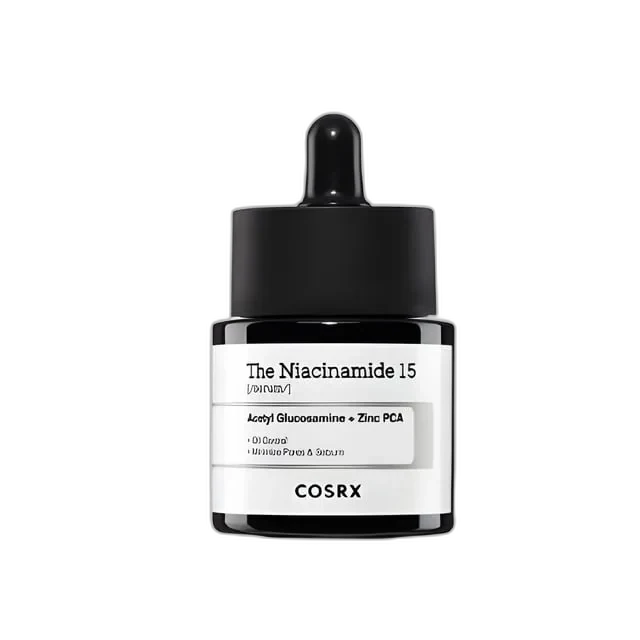
The Niacinamide 15 Serum
Maximum-Strength Oil Controller
 Verified reviewer
Pros & cons.
- +15% niacinamide with clinical testing showing 50% sebum reduction in 4 weeks
- +Acetyl glucosamine synergy enhances brightening beyond niacinamide alone
- +Zinc PCA provides sebum control without the rebound dryness of simpler zinc forms
- +Only 15 ingredients — every component serves a clear purpose with no filler
- +Completely fragrance-free, fungal acne safe, and non-comedogenic tested
- +Lightweight texture absorbs instantly without stickiness or residue
- +Trehalose and allantoin buffer irritation from the high active concentration
- −15% concentration causes flushing, tingling, or irritation in sensitive skin types
- −20 mL bottle at $25 lasts only 4-6 weeks — expensive per month of use
- −No barrier-repair ingredients — dry or compromised skin needs additional ceramide support
- −Not ideal for dry skin — can feel drying and over-mattifying with extended use
- −Some users report pilling under certain moisturizers
The full review.
About COSRX
There’s an appealing neatness to COSRX’s The Niacinamide 15 Serum. Fifteen ingredients. Fifteen percent concentration. It’s the kind of formulation that looks like someone sat down with a spreadsheet and eliminated everything that wasn’t pulling its weight. And for the oily-skin population that’s been waiting for a niacinamide serum that actually commits to its active, this might be exactly the right product at exactly the wrong size.
Reality
The fifteen percent concentration is the headline, and it deserves scrutiny. Most niacinamide serums on the market sit at four to five percent — the concentration range where the foundational clinical studies demonstrated significant benefits for sebum regulation, pore size reduction, and hyperpigmentation. Going to fifteen percent doesn’t triple the benefits, but it does meaningfully intensify the sebum reduction effect. COSRX’s own clinical testing, conducted by the Dermacosmetic Skin Science Laboratory, showed a fifty percent reduction in sebum levels after four weeks of use. That’s a substantial claim, and one that aligns with what oily-skin users consistently report: this serum noticeably mattifies.
Reality
But concentration alone isn’t what makes this formula interesting. It’s the supporting cast. Acetyl glucosamine, present at an estimated two to four percent, enhances niacinamide’s brightening effects through a mechanism that’s elegantly complementary. Niacinamide inhibits the transfer of melanosomes — packets of melanin — from melanocytes to surrounding keratinocytes. Acetyl glucosamine targets a different step in the pigmentation pathway, inhibiting glycosaminoglycan synthesis involved in hyperpigmentation. Together, they address dark spots from two angles simultaneously. This isn’t two ingredients doing the same thing; it’s two ingredients doing different things that compound into a better result. A 2007 study published in the British Journal of Dermatology confirmed this synergy, showing that the combination outperformed either ingredient alone for reducing hyperpigmentation.
Reality
Zinc PCA adds another layer of intelligence. Rather than using basic zinc oxide or zinc gluconate, COSRX chose the pyrrolidone carboxylic acid salt — a form that combines zinc’s established anti-inflammatory and sebum-regulating properties with PCA’s role as a natural component of the skin’s moisture factor. This matters because aggressive oil control can create a paradox: strip too much sebum, and the skin overcompensates by producing even more. The humectant properties of the PCA moiety help prevent that reactive sebum surge, keeping the oil control steady rather than triggering a rebound.
Reality
Trehalose and allantoin round out the formula as buffering agents. Trehalose is an osmolyte that protects skin cells from dehydration stress — important when you’re running fifteen percent of an active that can feel drying on some skin types. Allantoin provides gentle soothing and promotes cell turnover. These aren’t headline ingredients, but they’re the reason this serum is tolerable at fifteen percent when a less thoughtfully formulated version would be irritating.
Texture
The texture experience is clean and uncomplicated. The serum is lightweight, nearly watery, and absorbs within seconds. No fragrance, no tint, no sensory experience to speak of — it’s a product that prioritizes function over feeling. Oily skin types will appreciate the immediate mattifying effect, which you can actually notice within a few hours of the first application. Over the first week, the oil control becomes more consistent. By week four, you’re reaching for blotting papers less often.
Who Should Buy
Here’s where the serum’s audience narrows, and it narrows significantly. At fifteen percent, niacinamide can cause flushing, tingling, and redness in sensitive skin. The research literature supports this: while niacinamide is generally well-tolerated, high concentrations can trigger a histamine-like flushing response in susceptible individuals. If your skin reacts to five percent niacinamide, fifteen percent will not be a good time. Dry skin types also report tightness and an over-mattified feeling with extended use — this is a serum designed for skin that produces too much oil, and it will further deplete skin types that don’t.
Not ideal for
The formula’s minimalism is both a strength and a limitation. Fifteen ingredients means nothing unnecessary, but it also means no hydrating backup beyond trehalose and the zinc PCA’s humectant contribution. There are no ceramides, no hyaluronic acid, no fatty acids providing barrier support. If you have oily skin with a healthy barrier, this isn’t a problem. If you have oily skin with a compromised barrier — a common combination — the lack of barrier-repair ingredients means you’ll need to layer this under a ceramide moisturizer to avoid drying yourself out.
Reality
The value conversation is unavoidable. Twenty milliliters at twenty-five dollars lasts approximately four to six weeks. That’s a monthly cost of twenty-five to thirty-five dollars for a single active step. For perspective, excellent five-percent niacinamide serums offer thirty milliliters for under fifteen dollars. The fifteen percent concentration and the acetyl glucosamine synergy justify a premium, but the magnitude of the premium depends on whether you need clinical-grade oil control or whether five percent would serve you just as well. For many people, it would.
Reality
The Costco two-pack in the thirty-milliliter size represents significantly better value and is worth seeking out. Otherwise, Dermstore’s auto-replenish discount brings the cost down modestly.
Who Should Buy
COSRX built this serum for a specific person: someone with oily, breakout-prone skin who has dark spots to fade and pores to refine, and who has the resilience to handle fifteen percent niacinamide without flinching. For that person, this is one of the best-formulated niacinamide serums available at any price. For everyone else, the concentration is either more than you need or more than your skin can handle.
Ingredient analysis.
Full INCI list
Water, Pentylene Glycol, Niacinamide, Butylene Glycol, Acetyl Glucosamine, 1,2-Hexanediol, Zinc PCA, Trehalose, Xanthan Gum, Pullulan, Allantoin, Ethylhexylglycerin, Sodium Phytate, Citric Acid, Tocopherol
Skin match.
The science.
The Science
Niacinamide at 2-5% concentrations has robust evidence. The 15% concentration in this serum enters territory with less published research but sound pharmacological rationale.
Draelos et al. (2006) in Dermatologic Surgery provides the foundational study for topical niacinamide; their controlled trial showed 2% niacinamide significantly reduced sebum excretion and improved skin barrier function. A later study by Bissett et al. in the International Journal of Cosmetic Science (2005) showed 5% niacinamide significantly reduced wrinkles, hyperpigmentation, and red blotchiness while improving skin elasticity over 12 weeks. At 15%, sebum-regulating effects should amplify, following dose-response relationships seen in pharmacology.
A pivotal 2007 study in the British Journal of Dermatology (Kimball et al.) supports the niacinamide-acetyl glucosamine synergy. They found 5% niacinamide plus N-acetyl glucosamine significantly reduced hyperpigmentation compared to niacinamide alone. The mechanisms complement each other: niacinamide inhibits melanosome transfer from melanocytes to keratinocytes, while N-acetyl glucosamine inhibits proMMP-9 to active MMP-9 conversion and reduces tyrosinase glycosylation—both pathways in melanin production and distribution.
Zinc PCA combines zinc's anti-inflammatory properties (zinc modulates NF-kB and reduces pro-inflammatory cytokine production) with pyrrolidone carboxylic acid, a natural humectant. Research in the Journal of the European Academy of Dermatology and Venereology shows zinc derivatives reduce sebum production by inhibiting 5-alpha reductase activity, the same enzyme pharmaceutical sebum-control treatments target.
Trehalose, the stabilizing sugar in this formula, protects proteins and cell membranes under osmotic stress. Research in the Journal of Biological Chemistry shows trehalose prevents protein denaturation during dehydration. This protects skin cells from the drying effects high-concentration niacinamide can cause. Its inclusion manages the trade-offs of clinical-strength actives.
References
- Niacinamide-containing facial moisturizer improves skin barrier and benefits subjects with rosacea — Dermatologic Surgery (2006)
- The effect of niacinamide on reducing cutaneous pigmentation and suppression of melanosome transfer — British Journal of Dermatology (2007)
Dermatologist Perspective
Board-certified dermatologists often recommend niacinamide as a versatile active for oily and acne-prone skin, though most clinical guidance cites the 4-5% concentration range for the strongest evidence. Dermatologists note 15% niacinamide is a clinical-grade approach that may benefit patients with treatment-resistant oiliness or hyperpigmentation, but they emphasize patch testing and gradual introduction. Dermatological literature recognizes the acetyl glucosamine combination as a synergistic brightening approach that outperforms niacinamide alone. Dermatologists commonly recommend pairing high-concentration niacinamide with a ceramide moisturizer to offset potential barrier disruption, especially for combination skin where oily zones tolerate the serum but drier areas do not.
Where it fits in your routine.
Apply 2-3 drops to clean, dry skin after toning. Pat it in until absorbed; this takes seconds. Follow with a moisturizer, ideally containing ceramides or hyaluronic acid to offset drying. Use morning and evening. If you are new to high-concentration niacinamide, use it once daily for the first week, then increase to twice daily as tolerated. Do not apply to broken skin or active eczema patches. If flushing occurs, use it every other day.
At $25 for 20 mL (about one month of supply), this serum costs roughly $0.80 per day with twice-daily application. The formulation quality exceeds its price; acetyl glucosamine synergy and zinc PCA make it better than basic niacinamide serums. Users must decide if they need 15% or if a 5% serum at a lower cost works for them. The 30 mL Costco 2-pack (~$22 for two bottles) offers the best value for regular users. COSRX's clinical testing data and nearly four years of market validation justify the formulation premium, despite the small bottle size.
Oily and combination skin types with excess sebum, enlarged pores, post-acne hyperpigmentation, or persistent oiliness that lower-concentration niacinamide serums do not control. This works for those who want minimalist, no-nonsense formulations and clinical-grade potency without fragrance or filler.
Skip this if you have sensitive or dry skin that flushes or feels tight from niacinamide. Also skip if 5% niacinamide works for you; 15% niacinamide increases irritation risk without tripling the benefits. If you have a tight budget, decide if the formulation premium over cheaper niacinamide serums justifies your specific skin concerns.
Product details.
Scentless. It has no fragrance, essential oils, or detectable chemical odor.
Dark glass bottle with a black dropper follows COSRX's The RX line design. It comes in a compact 20 mL size. A 30 mL size is also available at Costco (2-pack). The dark glass prevents light degradation of the formula.
The first application is smooth and absorbs in seconds. Sensitive skin users may feel mild tingling or warmth from the niacinamide, which usually subsides within minutes. Oily skin types see a mattifying effect almost immediately. Sebum control shows within the first week, though no dramatic transformation occurs on day one.
4-6 weeks with twice-daily use (2-3 drops per application)
12 months
All Year
The backstory.
Part of the The RX DermSerum line launched in mid-2022, this serum represented COSRX's push into clinical-concentration territory. The line sold out within 24 hours, driven largely by the Niacinamide 15's promise of a 50% sebum reduction in four weeks — a claim backed by independent clinical testing. The minimalist 15-ingredient formula was a deliberate match between ingredient count and active percentage.
About COSRX
Established Brand (5–20 years)COSRX launched in South Korea in 2013. The name combines 'Cosmetics' with 'Rx' to signal a clinical approach to K-beauty. The brand has 135+ global beauty awards and sells in 146+ countries. It has a reputation for effective, no-frills formulations using well-researched actives.
Common myths.
You can't use niacinamide and vitamin C together
This outdated advice stems from a 1963 study that mixed pure niacin (not niacinamide) with ascorbic acid at extreme temperatures. Modern niacinamide and vitamin C formulations stay stable together at room temperature. However, layering 15% niacinamide with high-concentration L-ascorbic acid may cause flushing in some people — separating them by time of day is a practical precaution, not a chemistry requirement.
Higher niacinamide concentration does not always yield better results
Most clinical studies show significant results at 4-5%. Increasing to 15% boosts sebum reduction but also raises irritation risk, especially for sensitive and dry skin types. The ideal dose depends on your skin — oily, resilient skin benefits from the higher dose, while sensitive skin gets equivalent results from a 5% serum with less irritation.
FAQ.
Is 15% niacinamide too strong for sensitive skin?
Yes, for many sensitive skin types. At 15%, niacinamide causes redness, tingling, and flushing, mostly during the first few weeks. If you have sensitive or reactive skin, use this serum every other day to build tolerance, or use a 5% niacinamide product instead — clinical studies show significant results at 5% with less irritation risk.
How long does it take to see results with COSRX Niacinamide 15?
Oil reduction shows in 1-2 weeks. Clinical testing shows a 50% reduction in sebum after 4 weeks. Pore refinement appears at 4-6 weeks. Post-acne mark fading and brightening take longer — expect 6-12 weeks for meaningful hyperpigmentation improvement.
Can I use this niacinamide serum with retinol?
Yes — niacinamide and retinol work well together. Apply this serum first, let it absorb, then use retinol. The niacinamide strengthens the skin barrier and buffers retinol irritation. If you are new to both, introduce them separately before combining.
Why does COSRX Niacinamide 15 contain acetyl glucosamine?
Acetyl glucosamine boosts niacinamide's brightening effects via a complementary mechanism. Niacinamide inhibits melanin transfer from melanocytes to skin cells, but acetyl glucosamine targets a different step in the pigmentation pathway. Research confirms this synergy addresses hyperpigmentation more effectively than niacinamide alone.
Is this serum fungal acne safe?
Yes. The formula has no oils, fatty acids, or esters that feed Malassezia yeast. The 15-ingredient list lacks fungal acne triggers, making this one of the few high-concentration niacinamide serums safe for fungal acne-prone skin.
Why is the bottle only 20 mL?
COSRX markets this as a concentrated, clinical-grade serum; 2-3 drops per application works. The small size ensures use within its optimal potency window. However, the 20 mL size at $25 is a value concern — check the 30 mL size at Costco in 2-packs for better per-unit value.
What the community says.
"Effective oil control — visible sebum reduction within weeks"
"Noticeably refines pore appearance after consistent use"
"Lightweight non-sticky texture absorbs quickly"
"Clean minimal 15-ingredient formula with no fragrance"
"Helps fade post-acne marks and even out skin tone"
"15% concentration causes redness and tingling in sensitive skin"
"Very small 20 mL bottle runs out in 4-6 weeks for the price"
"Can feel drying on non-oily skin types with extended use"
"Some experience initial purging when starting"
"Occasional pilling when layered under certain moisturizers"
Featured in.
People also looked at.