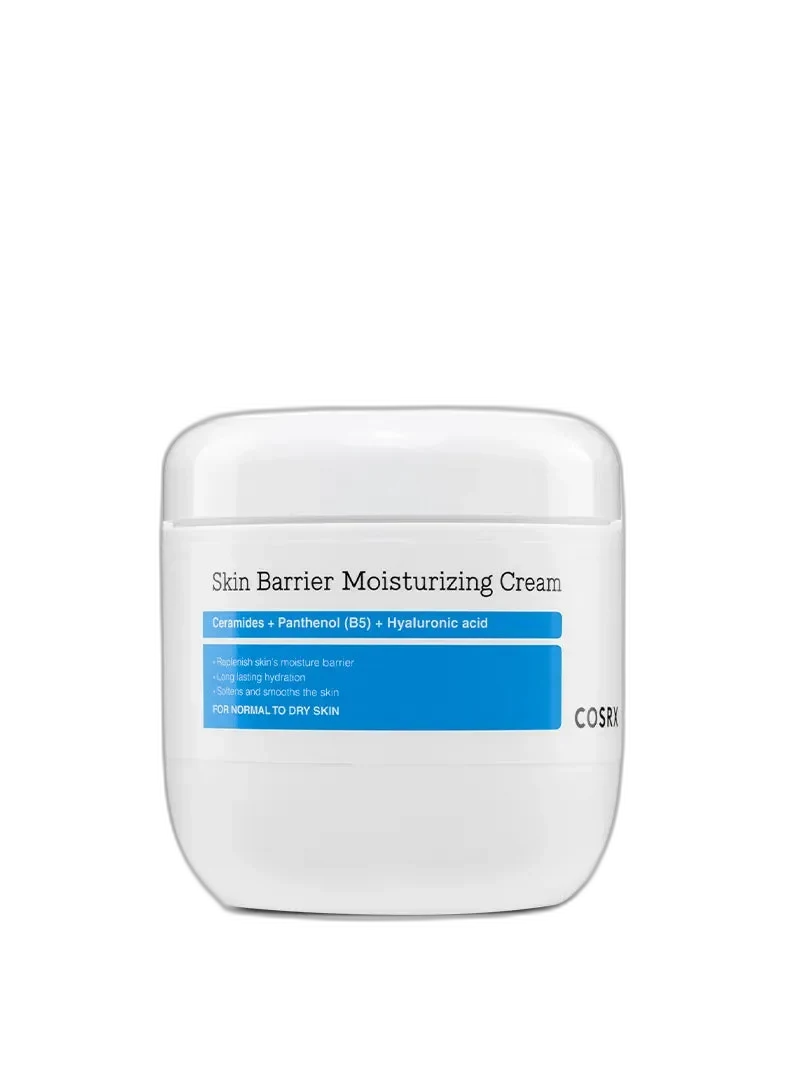
Skin Barrier Moisturizing Body Cream
Face-Grade Body Care
 Verified reviewer
Pros & cons.
- +Five ceramides plus cholesterol and fatty acids provide complete barrier repair architecture
- +Five types of hyaluronic acid create multi-depth, long-lasting hydration system
- +Eight-amino-acid NMF complex is unusual and sophisticated for a body cream
- +Completely fragrance-free with clinical irritation and non-comedogenic testing
- +Excellent value at $25 for 450 mL with face-care-level ingredient complexity
- +Absorbs faster than expected for a rich cream, settling into a satin finish
- +Petrolatum and dimethicone provide reliable occlusive sealing over the active ingredients
- −Initial dewy-greasy phase lasts 2-5 minutes before full absorption
- −Tub packaging with screw lid is less hygienic than a pump dispenser
- −Too rich for very oily skin types or use in hot, humid climates
- −Only six months on market — limited long-term user data available
- −Cholesterol source (animal vs. plant) not specified by COSRX
The full review.
For a brand that spent twelve years perfecting facial skincare, COSRX took its time getting to the body. And when they finally did, in September 2025, they didn’t phone it in with a simplified version of their popular Ceramide Skin Barrier Moisturizer and call it a day. They built a body cream with the kind of ingredient list that most face creams would envy — and priced it at twenty-five dollars for a 450 mL tub that could double as a small dumbbell.
The formulation reads like a dermatology textbook’s wish list for barrier repair. Five ceramides — NP, NS, AP, AS, and EOP — represent the major ceramide classes found in healthy human skin. Each has a slightly different molecular architecture that slots into a different position in the intercellular lipid matrix. Ceramide NP and NS handle the bulk of general barrier repair. Ceramide AP and AS contribute to deeper lipid organization. Ceramide EOP, the largest and most complex, links the lipid layers to the corneocyte envelope, creating the structural anchoring that prevents the whole system from falling apart. Most body creams that bother with ceramides include one, maybe two. Five is a statement of intent.
But ceramides alone are just one pillar of the barrier. The formula also includes cholesterol, which organizes the ceramides into functional lamellar structures — think of it as the architectural scaffolding that lets the ceramides do their job. And palmitic and stearic acids provide the fatty acid component, completing the three-pillar system (ceramides + cholesterol + fatty acids) that dermatological research has established as the optimal barrier repair approach. This isn’t marketing-driven ingredient dumping. This is a formula that reads the literature.
The five hyaluronic acid types deserve their own paragraph because the approach is genuinely clever. Standard sodium hyaluronate provides broad-spectrum hydration. Hydrolyzed hyaluronic acid penetrates deeper due to its smaller molecular size. The crosspolymer form creates a long-lasting surface moisture reservoir that doesn’t evaporate as quickly. Sodium acetylated hyaluronate has enhanced skin adhesion — it literally sticks better to the skin surface for extended hydration. And full-size hyaluronic acid forms a breathable film on top. Together, they support the product’s clinical claim of 100-hour hydration, and while real-world results will vary with environment, showering, and activity, the multi-delivery system is scientifically sound.
Then there’s the eight-amino-acid NMF complex — serine, alanine, glycine, glutamic acid, lysine, threonine, arginine, and proline. These are components of the skin’s Natural Moisturizing Factor, the water-soluble humectant system that operates inside the corneocytes themselves. If the ceramides repair the walls between skin cells and the hyaluronic acid hydrates the spaces around them, the NMF amino acids hydrate the cells from within. It’s a three-level hydration architecture that would be noteworthy in a fifty-dollar face serum, let alone a twenty-five-dollar body cream.
Texture
Texturally, the cream lands in a satisfying middle ground. It’s rich enough to feel like it means business on genuinely dry skin — elbows, shins, knees, the whole winter-skin parade — but it absorbs faster than its density suggests. There is a brief dewy phase, lasting maybe two to five minutes after application, where your skin has a visible sheen. This is the petrolatum and dimethicone establishing their occlusive seal before the humectants pull the moisture down. If you dress immediately after applying, your clothes might catch a bit of that initial dewiness. The workaround is simple: apply to damp skin right after toweling off, and the absorption accelerates significantly.
Scent
The fragrance-free formulation is a relief in the body cream category, where even products marketed for sensitive skin often sneak in parfum or essential oils. There’s nothing here that will irritate a compromised barrier, trigger eczema, or compete with your perfume. It’s ingredient-forward and scent-neutral — exactly what barrier repair calls for.
Packaging
The packaging is the one area where COSRX made a pragmatic rather than ideal choice. The 450 mL tub with a screw-top lid is generous and affordable, but anyone who’s used a body cream from a tub knows the hygiene trade-off compared to a pump bottle. You’re scooping with your fingers (or a spatula if you’re diligent), which introduces bacteria into a product designed to go on potentially compromised skin. For a body cream that costs twenty-five dollars, a pump dispenser would have been worth the few cents of additional packaging cost.
Best for
For the dry-skin population that’s been managing with basic drugstore lotions, this cream represents a genuine upgrade in formulation philosophy. It doesn’t just add moisture to the surface and hope for the best. It repairs the barrier’s lipid structure, fills the cells with humectants, deposits multiple forms of hyaluronic acid at different depths, and seals everything with an occlusive layer. It’s the body cream equivalent of finally getting your car properly serviced instead of just adding windshield fluid and hoping.
As COSRX’s first body product, this sets a high bar. If the brand applies the same ingredient-density philosophy to body washes, body serums, or targeted treatments, they could carve out a meaningful position in a category that’s been coasting on basic formulations for decades. For now, this cream stands alone — and it stands well.
Ingredient analysis.
Full INCI list
Aqua/Water, Glycerin, Cetearyl Alcohol, Caprylic/Capric Triglyceride, Cetyl Alcohol, Ceteareth-20, Behentrimonium Methosulfate, Dimethicone, Petrolatum, Butylene Glycol, Caprylyl Glycol, Potassium Phosphate, Ethylhexylglycerin, Disodium EDTA, Dipotassium Phosphate, Panthenol, Betaine, Synthetic Wax, Hydrogenated Lecithin, Squalane, Propanediol, Sodium PCA, Sodium Lactate, Stearic Acid, PCA, Sodium Hyaluronate, Polyglyceryl-10 Stearate, 1,2-Hexanediol, Serine, Alanine, Glycine, Hydrolyzed Hyaluronic Acid, Glutamic Acid, Lysine HCL, Threonine, Arginine, Ceramide NP, Sodium Hyaluronate Crosspolymer, Cholesterol, Hyaluronic Acid, Tocopherol, Proline, Palmitic Acid, Ceramide NS, Phytosphingosine, Sodium Acetylated Hyaluronate, Ceramide AP, Ceramide AS, Ceramide EOP
Skin match.
The science.
The Science
This formula uses a three-pillar barrier repair approach — ceramides, cholesterol, and fatty acids — which is one of the most well-validated concepts in dermatological research. This body cream implements this approach more completely than most face creams.
Research from Peter Elias and colleagues established that the stratum corneum's barrier function depends on an equimolar ratio of ceramides, cholesterol, and free fatty acids in lamellar structures. A landmark study in the Journal of Clinical Investigation (1993) showed that replacing all three lipid classes simultaneously produced optimal barrier repair, while replacing individual lipids alone was insufficient or counterproductive. This principle — that ceramides need cholesterol and fatty acids to function — explains why many ceramide-only products underperform.
The five ceramide types (NP, NS, AP, AS, EOP) are the major structural classes in human skin. Research in the Journal of Lipid Research (2012) characterized how ceramide subclasses contribute to barrier architecture: EOP ceramides, the largest molecules, anchor the lipid lamellae to the corneocyte lipid envelope, while shorter-chain ceramides like NP fill intercellular spaces. Products mimicking this natural diversity show superior barrier repair compared to single-ceramide formulations.
The five hyaluronic acid types address different hydration mechanisms. Sodium hyaluronate crosspolymer, studied in the International Journal of Biological Macromolecules (2019), forms a three-dimensional network on the skin surface that provides sustained hydration release instead of rapid evaporation. Sodium acetylated hyaluronate, which adds acetyl groups to the HA backbone, shows enhanced skin retention and deeper penetration in comparative studies because of its increased lipophilicity. The combination of standard, hydrolyzed, crosspolymer, and acetylated forms creates a multi-kinetic hydration system where different forms release moisture at different rates.
The NMF amino acid complex reflects research on the skin's endogenous humectant system. Sodium PCA (included separately) and free amino acids together make up approximately 40% of the skin's NMF. Studies in the British Journal of Dermatology correlate decreased NMF levels with increased dryness and barrier dysfunction, especially in eczema-prone skin, validating topical supplementation.
References
- Basis for the barrier abnormality in atopic dermatitis: outside-inside-outside pathogenic mechanisms — Journal of Clinical Investigation (1993)
Dermatologist Perspective
Dermatologists recommend ceramide-containing moisturizers as a cornerstone of barrier repair for dry, eczema-prone, and sensitive skin. Board-certified dermatologists note that this formula's five-ceramide approach with cholesterol and fatty acid co-delivery is the current gold standard in topical barrier repair — a system validated by decades of lipid biochemistry research. Dermatologists value the inclusion of petrolatum as an occlusive, as it is the most effective single ingredient for preventing transepidermal water loss. For patients with atopic dermatitis, dermatologists frequently recommend fragrance-free, ceramide-rich moisturizers applied to damp skin immediately after bathing — a use case this product is specifically designed for. The non-comedogenic and irritation testing adds clinical credibility for body-wide application.
Where it fits in your routine.
Apply a generous amount to slightly damp skin right after bathing or showering to maximize absorption and reduce the initial dewy phase. Cover all dry areas: arms, legs, torso, elbows, and knees. Use a thicker layer on very dry areas. Apply morning and evening for maximum barrier repair. Wait 2-5 minutes for full absorption before dressing. Use as an overnight intensive treatment on extremely dry patches.
At twenty-five dollars for 450 mL, this body cream matches CeraVe and Eucerin on price but has more complex formulation — five ceramides and five hyaluronic acids compared to CeraVe's three ceramides and one HA form. The NMF amino acid complex, cholesterol, and squalane also improve ingredient quality. For dry-skin users who spend this much (or more) on body creams, the higher active ingredient density matters. COSRX's twelve-year history in facial skincare backs their body care debut.
This works for dry, very dry, or sensitive body skin needing barrier repair beyond basic moisturization. It suits eczema-prone individuals seeking a fragrance-free, clinically tested option with comprehensive ceramide support. It also fits those who want body skin to have the same ingredient quality as facial skin.
Skip this if you have very oily skin and dislike thick creams, especially in warm climates. Avoid it if you prefer pump packaging for hygiene or need a lightweight, fast-absorbing body lotion for quick morning application — the initial dewy phase makes this better for evening use or unhurried mornings.
Product details.
This cloud-soft cream sits between a lightweight gel and a thick cream. It spreads easily over large body areas and absorbs faster than its density suggests. A brief dewy phase occurs before it settles into a satin finish.
Fragrance-free. It has no added fragrance, essential oils, or aromatic botanicals.
A large 450 mL tub uses COSRX's signature minimalist white design and a screw-top lid. This size works for a body cream but lacks a pump dispenser for hygiene.
The first application softens skin and relieves post-shower tightness immediately. A dewy phase lasts a few minutes before the cream absorbs into a comfortable satin finish. There is no tingling, no fragrance, and no drama—only immediate hydration.
Apply twice daily to the full body for 2-3 months; use once daily or on targeted areas for 3-5 months
12 months
fall winter
The backstory.
Launched in September 2025 as COSRX's first dedicated body care product, this cream represents the brand's expansion from facial skincare into body care. Rather than creating a simplified 'body version' of their popular Ceramide Skin Barrier Moisturizer, COSRX maintained the full formulation complexity — five ceramides, five hyaluronic acids, and an NMF complex — at a price point that competes directly with CeraVe and Eucerin.
About COSRX
Established Brand (5–20 years)COSRX launched in South Korea in 2013. The name combines 'Cosmetics' with 'Rx' to signal a clinical K-beauty approach. The brand has 135+ global beauty awards and sells in 146+ countries. It uses well-researched actives for effective, no-frills formulations.
Common myths.
Body creams require fewer active ingredients than face creams
Body skin faces the same barrier challenges as facial skin: dryness, environmental damage, and hot water exposure from showers. Body skin is generally thicker and less sensitive, but the ceramide-cholesterol-fatty acid barrier repair system works identically on both. Because the body has a larger surface area, barrier dysfunction impacts overall skin comfort more.
More hyaluronic acid types is just marketing — they all work the same way
Different HA derivatives have different properties. Sodium hyaluronate crosspolymer creates a long-lasting surface reservoir. Sodium acetylated hyaluronate adheres to the skin better for extended hydration. Hydrolyzed HA penetrates deeper because its molecular size is smaller. This multi-delivery approach supports the 100-hour hydration claim.
FAQ.
How does COSRX Body Cream compare to CeraVe Moisturizing Cream for body use?
Both contain ceramides and hyaluronic acid. COSRX includes five ceramides and five HA types, while CeraVe has three ceramides and one HA form. COSRX also adds an eight-amino-acid NMF complex and cholesterol for more comprehensive barrier repair. At $25 for 450 mL, COSRX costs slightly more than the CeraVe 19 oz tub but has a more complex formulation.
Can I use COSRX Skin Barrier Body Cream on my face?
The ingredient list is sophisticated enough for facial use and shares many ingredients with face creams, but the texture is optimized for body application and feels too thick for most facial skin types. COSRX makes a separate Ceramide Skin Barrier Moisturizer specifically formulated for the face with a lighter texture.
Is COSRX Body Cream good for eczema?
The five-ceramide, cholesterol, and petrolatum formula mirrors dermatologist recommendations for eczema management. The fragrance-free formulation and clinical irritation testing suit eczema-prone skin. It is not a medically classified eczema treatment — consult a dermatologist for prescription options during active flares.
Why does the cream feel greasy at first?
Petrolatum and dimethicone create an occlusive layer for the initial dewy feel, while ceramides, hyaluronic acids, and humectants absorb into the skin. This phase lasts 2-5 minutes before the cream settles into a satin finish. Applying to damp skin (right after showering) speeds absorption and reduces the greasy feeling.
What does 100-hour hydration mean?
COSRX claims clinical testing shows hydration benefits last up to 100 hours after one application. The formula uses a multi-layer approach: five HA types provide different hydration durations, sodium hyaluronate crosspolymer creates a long-lasting moisture reservoir, and the petrolatum-dimethicone occlusive layer stops evaporation. Real-world results depend on environment and activity level.
Community
What the community says.
"Excellent long-lasting hydration that noticeably softens rough, dry skin"
"Fragrance-free and gentle enough for sensitive and eczema-prone skin"
"Absorbs surprisingly well for such a rich, nourishing formula"
"Great value for 450 mL with this level of ingredient sophistication"
"Calms and soothes irritated, post-shower skin immediately"
"Initial dewy-greasy feel on application before it fully absorbs"
"May feel too heavy and rich for very oily skin or hot humid weather"
"Tub packaging raises hygiene concerns compared to pump dispensers"
"Slightly higher price than basic drugstore body creams"