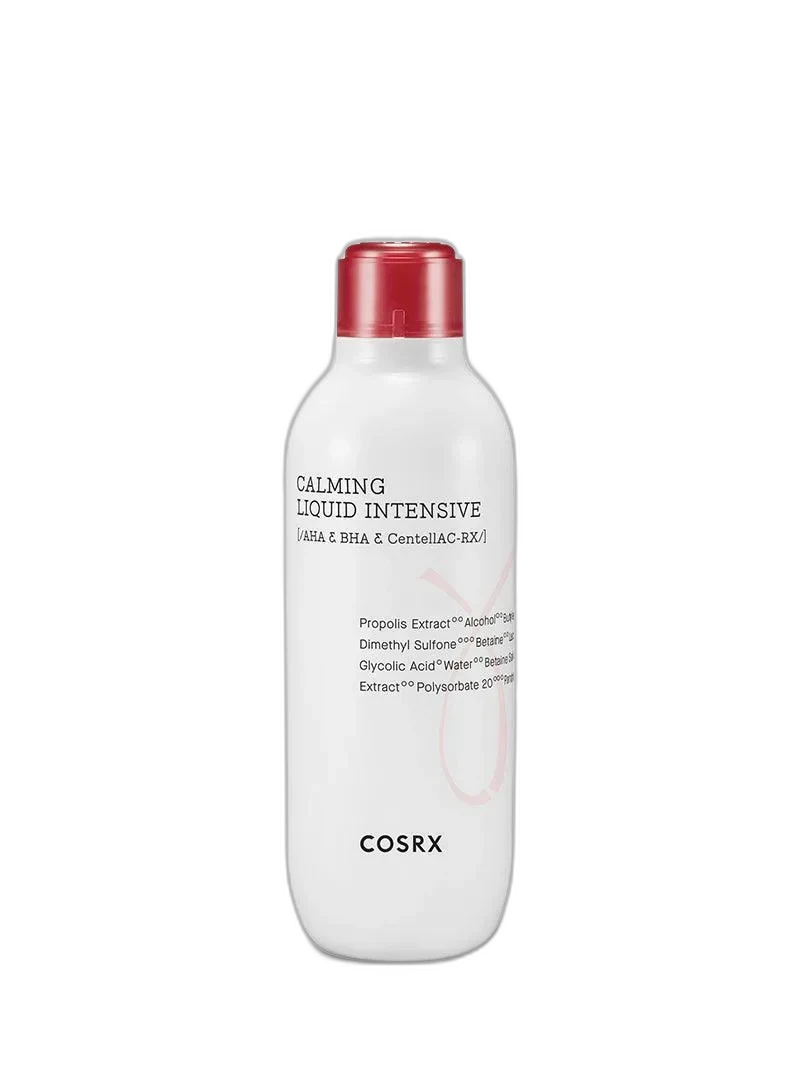
AC Collection Calming Liquid Intensive
Multi-Acid Acne Fighter
 Verified reviewer
Pros & cons.
- +Triple exfoliation system (AHA + BHA + propolis) targets acne through multiple pathways simultaneously
- +60% propolis base provides antibacterial action and moisturizing comfort unusual for acid toners
- +Zinc PCA adds targeted sebum control for oily skin types
- +CentellAC-RX complex promotes healing of active acne lesions during treatment
- +Moderate acid concentrations allow for regular use without extreme irritation risk
- +Noticeable reduction in breakout redness and inflammation within days of use
- −Alcohol as the second ingredient can compromise the moisture barrier with repeated use
- −pH of 4-5 is above optimal range for AHA/BHA exfoliation efficacy
- −Not suitable for dry, sensitive, or normal skin types — narrow suitability window
- −Earthy propolis and tea tree scent is off-putting to some users
- −Not vegan due to 60% propolis (bee-derived) content
- −6-month PAO is shorter than typical COSRX products
The full review.
COSRX does not use alcohol lightly. The brand builds its identity on gentle, skin-barrier-respecting formulations like low-pH cleansers, snail mucin, and centella creams. Because the AC Collection Calming Liquid Intensive lists alcohol as its second ingredient after 60% propolis extract, the brand makes a deliberate choice: this product treats active acne aggressively, even if it compromises the gentleness COSRX is known for.
The formula is a triple-acid cocktail in propolis. Lactic acid and glycolic acid provide 1.7% AHA exfoliation to accelerate surface cell turnover and prevent dead skin from trapping sebum in pores. Betaine salicylate at 0.9% provides BHA pore-clearing action to dissolve sebum plugs that cause blackheads and inflammatory breakouts. The 60% propolis extract base delivers antibacterial and anti-inflammatory benefits that pure-acid toners lack. This layered approach uses acids to clear congestion, propolis to fight bacteria, and centella triterpenoids to promote healing.
Alcohol serves a functional purpose beyond cost-cutting. It acts as a solvent for the propolis extract, which is naturally resinous and needs help dissolving into a liquid. Alcohol also helps the AHA and BHA penetrate the stratum corneum, making moderate acid concentrations more effective than in a water-based vehicle. For oily skin, the temporary defatting provides immediate mattification.
The trade-off is real. Alcohol denat. strips lipids from the skin surface, and repeated use can compromise the moisture barrier—the same barrier critical for preventing acne flares. COSRX partially offsets this with propolis, panthenol, sodium hyaluronate, and allantoin. Success depends on your skin type. Oily skin with robust sebum production generally tolerates this formula well. Combination skin needs a strategic approach, such as using it only on the T-zone. Dry or sensitive skin should use the Mild version instead.
Zinc PCA adds sebum-absorbing functionality exclusive to the Intensive version. This zinc salt reduces surface oil and provides mild antimicrobial action in the pore environment. This addition targets oily skin and is a clear differentiator from the Mild version.
The texture is pleasant for a multi-acid, alcohol-containing treatment. It has more body than water and slips smoothly when using a cotton pad. The earthy, herbal scent of propolis and tea tree is polarizing; some find it therapeutic, while others find it medicinal. It fades within a minute of application.
One formulation caveat: the pH is around 4-5, which is higher than optimal for AHA and BHA efficacy. Glycolic acid works best below pH 3.8, and salicylic acid ideally works at pH 3-4. At pH 4-5, the acids are active but less intense. COSRX likely chose this higher pH to balance efficacy against irritation; a lower pH would be more potent but more aggressive, conflicting with the “calming” positioning of the AC Collection. The result is moderate exfoliation suitable for daily use rather than dramatic weekly treatment.
Results follow a predictable timeline. Active breakout redness and inflammation diminish within the first few days as propolis and centella work. Improved skin texture, fewer blackheads, and reduced pore congestion develop over 2-4 weeks through cumulative AHA/BHA exfoliation. Full acne-clearing results, including fewer new breakouts and faded post-inflammatory hyperpigmentation, take 6-8 weeks of consistent use.
This is not a standalone acne solution for severe cases. It is a treatment toner—one step in a routine including gentle cleansing, hydration, moisturizing, and sunscreen (non-negotiable when using AHA). For moderate acne with significant oiliness, it sits between the Mild version and prescription-strength treatments.
At $26 for 125 mL, it is reasonably priced for a multi-acid treatment toner with 60% propolis. The 6-month PAO is shorter than most COSRX products due to the active acid content; use it consistently once opened.
The COSRX AC Collection Calming Liquid Intensive earns its name. It is more intensive than its sibling due to higher acid concentrations, added AHA, alcohol, and zinc PCA. It delivers for oily, acne-prone skin that needs more than gentle maintenance. Respect the intensity: start slowly, hydrate aggressively, and never skip morning sunscreen.
Ingredient analysis.
Full INCI list · pH 4.5
Propolis Extract, Alcohol, Butylene Glycol, Sodium Lactate, Dimethyl Sulfone, Betaine, Lactic Acid, 1,2-Hexanediol, Glycolic Acid, Water, Betaine Salicylate, Cassia Obtusifolia Seed Extract, Polysorbate 20, Panthenol, Allantoin, Sodium Hyaluronate, Polysorbate 60, Hydroxyethylcellulose, Zinc PCA, Melaleuca Alternifolia (Tea Tree) Leaf Oil, Ethyl Hexanediol, Asiaticoside, Asiatic Acid, Madecassic Acid
Skin match.
The science.
The Science
This formula uses a triple-acid approach to target acne through different mechanisms. The AHA component (1.7% combined lactic and glycolic acid) works on the skin surface to dissolve intercellular bonds between dead keratinocytes. This accelerates turnover and prevents dead cell accumulation from plugging pores. Glycolic acid penetrates most effectively as the smallest AHA; lactic acid provides gentler exfoliation and humectant properties. A 2020 Cochrane systematic review in JDDG confirmed AHA's evidence base for acne treatment.
Betaine salicylate at 0.9% provides the BHA dimension. As a lipophilic acid, it penetrates sebum-filled pores—which AHA cannot reach—to dissolve sebum plugs from within. Betaine salicylate is a conjugated form that releases salicylic acid gradually. This provides similar pore-clearing action with lower irritation than pure salicylic acid at equivalent concentrations.
The 60% propolis extract base adds antimicrobial and anti-inflammatory layers that pure acid toners lack. Propolis shows activity against Cutibacterium acnes in multiple studies, and its flavonoid content provides antioxidant protection. A 2025 study showed propolis extract disrupts C. acnes biofilm formation and reduces virulence gene expression—important because biofilm-protected bacteria resist conventional treatments.
Zinc PCA regulates sebum. Zinc salts reduce sebum output and provide mild antimicrobial activity, supporting the acid and propolis components in controlling the oily environment where acne bacteria thrive.
References
- Evidence-based topical treatments for acne: Cochrane systematic review — JDDG: Journal der Deutschen Dermatologischen Gesellschaft (2020)
- Propolis extract against C. acnes biofilm and virulence gene expression — PMC (2025)
Dermatologist Perspective
Dermatologists view this as a moderately potent acne treatment toner for oily skin with stubborn breakouts. Board-certified dermatologists appreciate the multi-acid approach but note the pH of 4-5 limits the exfoliating acids' full potential—a lower pH increases efficacy but also irritation. The alcohol content concerns dermatologists who prioritize barrier integrity, though some acknowledge its necessity to dissolve the propolis and enhance acid penetration. Dermatologists typically recommend this product for patients who have outgrown gentle maintenance products but do not need prescription-strength treatments like tretinoin.
Where it fits in your routine.
Dispense a moderate amount onto a cotton pad after cleansing. Swipe gently across the face, targeting oily and breakout-prone areas. Avoid the eye area and open wounds. Use only in the evening, starting every other night for the first 1-2 weeks. Use nightly if tolerated. Always follow with a hydrating serum and moisturizer. Apply broad-spectrum SPF 50 every morning because the AHA increases photosensitivity. Do not use with other strong acids, retinoids, or vitamin C in the same routine session.
At $26 for 125 mL, this multi-acid treatment toner is a good value. It costs as much as or less than acid toners from Western brands like Paula's Choice or The Ordinary's multi-acid peels (though those are weekly treatments rather than daily use). The 60% propolis base adds more ingredient value than water-based acid toners. One bottle lasts 2-3 months, averaging $9-13 per month of daily treatment. The 6-month PAO means you should use it daily once opened instead of occasionally.
People with oily, acne-prone skin facing active breakouts, persistent blackheads, and rough skin texture who need more than gentle maintenance. Users who found the Mild version insufficient for their acne severity. K-beauty users seeking a multi-acid treatment toner that includes the antimicrobial benefit of propolis.
Choose the alcohol-free Mild version if you have dry, sensitive, or dehydrated skin. People with rosacea or compromised skin barriers face more irritation. Those allergic to bee products must avoid the propolis. Vegans use the Mild version, which uses green tea water instead of propolis. Adding this product to prescription retinoids or strong acid treatments risks over-exfoliation.
Product details.
The texture is slightly thicker than water and has good slip — users call it one of the more pleasant textures for an acid product. It is lightweight and non-viscous, absorbs quickly, and leaves no sticky or tacky finish.
Tea tree oil and propolis undertones create an earthy, herbal scent. The smell is intense at first but fades fast as the product absorbs. No artificial fragrance is added; the scent comes only from the propolis extract and tea tree leaf oil.
125 mL frosted plastic bottle with a twist-off cap. The rounded shape uses COSRX's minimalist AC Collection branding. It is lightweight and travel-friendly.
AHA/BHA content causes mild tingling, especially on active breakouts. Alcohol provides a cooling, quick-drying sensation. Skin feels slightly tight after application, but a hydrating product resolves this. Use every other day to assess tolerance before daily use.
Use daily every evening with a cotton pad for 2-3 months, or apply to problem areas only for 3-4 months.
6 months
All Year
The backstory.
The AC Collection offered two versions of its treatment liquid from launch — Intensive and Mild — recognizing that acne-prone skin exists on a spectrum. The Intensive version was designed for oily skin with active, stubborn acne that needs multi-acid exfoliation alongside antimicrobial propolis. Where the Mild version holds your hand, the Intensive version rolls up its sleeves.
About COSRX
Established Brand (5–20 years)COSRX launched in 2013, building its reputation on effective, no-frills acne and skincare solutions. The AC Collection line is the brand's dedicated acne range and uses their proprietary CentellAC-RX complex. Amorepacific has owned the brand as a subsidiary since 2023.
Common myths.
The alcohol in this product damages the skin barrier and worsens acne.
Alcohol (denat.) is the second ingredient, which is a valid concern, but context matters. In this formula, the alcohol acts as a solvent for the propolis extract and increases active acid penetration. The 60% propolis provides antimicrobial and barrier-supportive properties that partially offset the drying effect of the alcohol. This temporary defatting helps oily skin, but the trade-off fails dry or sensitive skin.
Higher acid percentages do not always mean better acne treatment.
This formula uses 1.7% AHA and 0.9% BHA at moderate levels. Higher concentrations increase irritation and barrier damage, which triggers breakouts via the impaired-barrier-to-acne cycle. The formula works through consistent, moderate exfoliation and propolis's antimicrobial action—a sustained strategy instead of a chemical assault.
FAQ.
What's the difference between COSRX AC Calming Liquid Intensive and Mild?
The Intensive version is stronger: 60% propolis base, 1.7% AHA (lactic + glycolic acid), 0.9% BHA, zinc PCA for oil control, and contains alcohol. The Mild version is gentler: 85.6% green tea water base, only 0.2% BHA, 0.2% PHA (gluconolactone), no AHA, no alcohol. Choose Intensive for oily skin with active acne; choose Mild for sensitive skin with mild breakouts.
Can I use the Intensive version every day?
Use this every other evening and monitor your skin. If you have no excessive dryness or irritation after 1-2 weeks, use it every evening. Do not use it twice daily; the AHA/BHA and alcohol combination is too strong for AM and PM use. Always follow with hydrating products and wear sunscreen the next morning.
Does this product contain alcohol?
Yes — alcohol (denat.) is the second ingredient. It acts as a solvent for the propolis extract and helps the acids penetrate better. Oily skin can use this, but the Mild (alcohol-free) version is better for dry, dehydrated, or sensitive skin.
Should I use sunscreen when using this product?
The AHA (lactic and glycolic acid) in this formula increases photosensitivity. Wear broad-spectrum SPF 50 every morning when using this product, even on cloudy days. Skipping sunscreen while using AHA causes hyperpigmentation and sun damage, which undermines the product's skin-clearing benefits.
Is the COSRX AC Calming Liquid Intensive vegan?
No — the formula contains 60% propolis extract, a bee-derived ingredient. For a vegan acne treatment toner, the Mild version uses green tea water as its base instead of propolis and has no animal-derived ingredients.
What the community says.
"Accelerates breakout healing, especially when paired with pimple patches"
"Effective sebum control that keeps oily skin matte throughout the day"
"60% propolis base provides hydrating comfort despite being an acid treatment"
"Reduces redness and inflammation from active breakouts noticeably within days"
"Pleasant hydrating texture for an exfoliating acid toner"
"Alcohol as the second ingredient is too drying for many users"
"pH of 4-5 is too high for AHA and BHA to exfoliate at maximum efficacy"
"Can leave skin feeling tight and dehydrated with frequent use"
"Earthy herbal scent from propolis and tea tree is off-putting to some"
"Less effective than dedicated AHA/BHA treatments from the same brand"