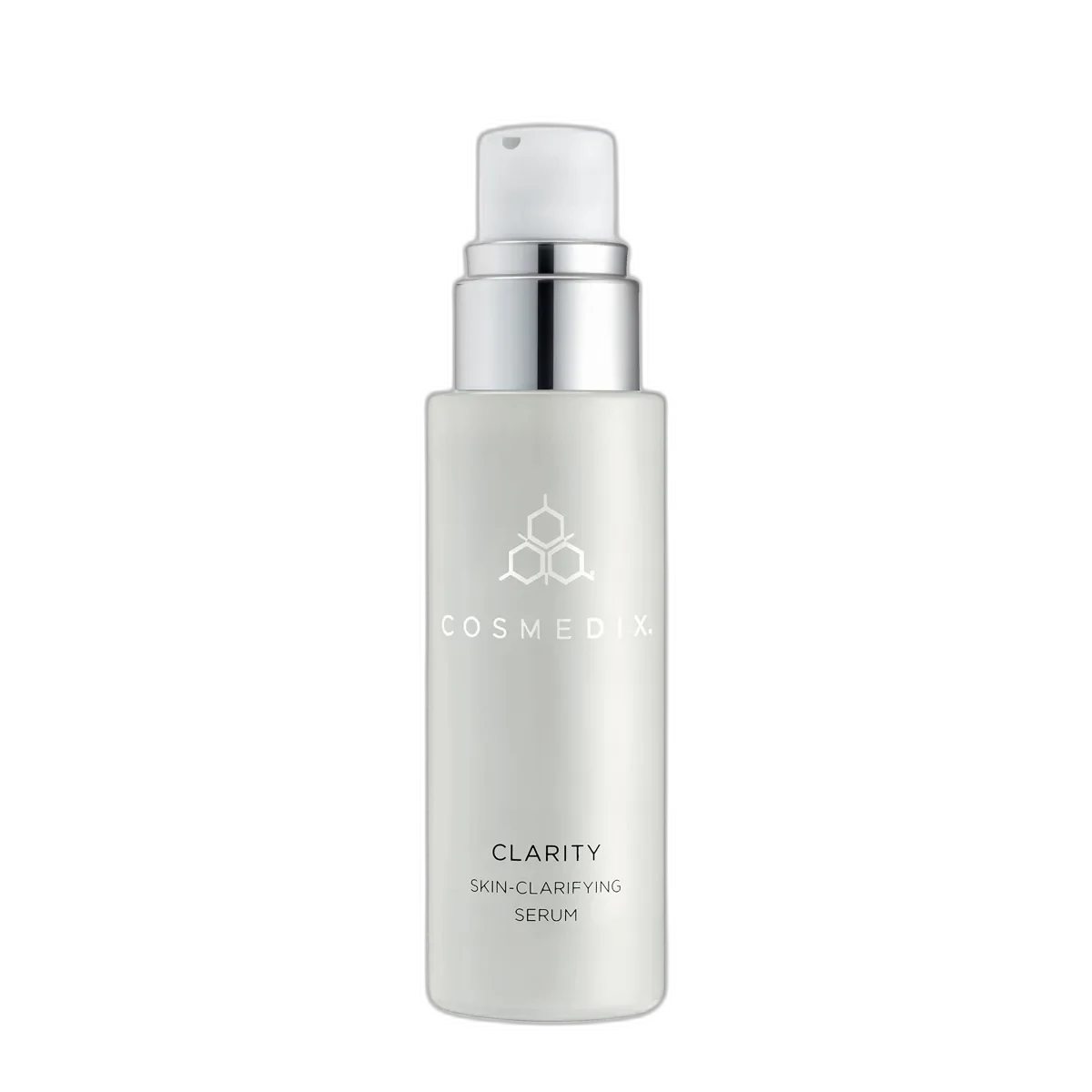
Clarity Skin-Clarifying Serum
Medspa-Grade BHA
 Verified reviewer
Pros & cons.
- +2% salicylic acid at pH ~3.5 delivers maximum BHA efficacy
- +Tea tree oil adds evidence-backed antimicrobial support
- +Niacinamide and lactic acid provide complementary exfoliation and calming
- +Fast-absorbing lightweight serum preferred by oily skin
- +Professional aesthetician-endorsed formulation with medspa heritage
- +Visible results on stubborn acne within 2-4 weeks
- −Alcohol content can be drying with daily use
- −Low pH requires careful introduction and solid moisturizer support
- −Not suitable for sensitive, rosacea, or barrier-compromised skin
- −Tea tree oil is a potential sensitizer for some users
- −Premium pricing compared to equivalent retail BHA serums
- −Not pregnancy-safe
The full review.
Long-term users of salicylic acid products know that 2% BHA serums yield different results. Some clear breakouts and blackheads within a month. Others do nothing after weeks of use. Even with identical concentration labels and similar ingredient lists, real-world outcomes vary. Formulation pH is the reason; it is the most important variable for acid efficacy and receives little attention in marketing. Salicylic acid has a pKa of approximately 2.97. The acid exists in its active, non-dissociated form only at pH values below this threshold. As pH rises above pKa, more acid becomes a dissociated salt form. This form is less lipophilic and penetrates sebum-filled follicles less effectively. A 2% salicylic acid serum at pH 4.0 delivers roughly half the active form compared to the same concentration at pH 3.5, and even less than pH 3.0. This is why professional-grade acid products often use the lower end of the effective range, despite requiring more careful introduction and less daily forgiveness. Cosmedix Clarity uses a pH of approximately 3.5, placing it in the professional effectiveness zone. Most retail BHA serums — including Paula’s Choice 2% BHA — formulate around pH 4.0 to prioritize daily tolerability for more skin types. The Cosmedix approach prioritizes maximum acid efficacy; users must introduce it carefully, use solid hydration, and avoid applying it to compromised skin. This follows the same philosophy as professional-strength glycolic peels versus gentler over-the-counter exfoliants — more effective when used correctly, more problematic when used carelessly. The formula’s supporting ingredients reflect its professional positioning. Tea tree oil provides a natural antimicrobial with peer-reviewed evidence against Cutibacterium acnes at 5% concentration, supporting the salicylic acid’s acne mechanism through a complementary pathway. Niacinamide regulates sebum and post-inflammatory erythema, both relevant for persistent acne. Lactic acid provides AHA surface exfoliation and mild hydration. Panthenol, allantoin, and centella asiatica add a calming layer to offset irritation from alcohol and low pH. Alcohol denat. is the second ingredient, meaning it is present at a meaningful concentration. In an acne formula, alcohol degreases the skin for better acid penetration and evaporates quickly to leave a matte, non-sticky finish for oily skin. While alcohol can contribute to barrier disruption and dryness, this serum requires solid moisturizer support and careful use frequency to manage that. For oily, resilient skin with active acne, alcohol is a feature. For dry or barrier-compromised skin, it is a reason to choose a different product. The serum applies as a thin clear liquid that absorbs within 30 seconds, leaving a slightly drying after-feel. Some users feel mild initial stinging that resolves within the first week. Results appear faster than with gentler BHA options — most users report visible reduction in active breakouts within 10-14 days, blackhead clearing within 3-4 weeks, and sustained skin clarity over 8-12 weeks of consistent use. For stubborn acne resistant to retail options, Cosmedix Clarity often breaks the cycle. The limitations are specific. This is not a daily-use product for sensitive skin, rosacea, eczema, or compromised barriers — the low pH and alcohol will cause problems. It is not pregnancy-safe due to the 2% salicylic acid. It is not compatible with retinoids in the same routine; alternate nights are the minimum required for tolerability. It requires solid moisturizer support to offset dryness. At $54 for 30ml, the price is premium for a BHA serum when cheaper options offer similar active concentrations at lower pH values. For users needing a professional-grade approach — stubborn acne, blackhead-prone skin, or an existing professional treatment protocol — the price is defensible. For a more forgiving daily BHA, Paula’s Choice 2% BHA Liquid Exfoliant or CeraVe SA Cleanser are more appropriate and cost less. This serum is the right tool for a specific job, and it works well for that job.
Formula
Ingredient analysis.
Full INCI list · pH 3.5
Water, Alcohol Denat., Salicylic Acid, Glycerin, Sodium PCA, Pyrus Malus (Apple) Fruit Extract, Aloe Barbadensis Leaf Juice, Propanediol, Niacinamide, Panthenol, Allantoin, Centella Asiatica Extract, Melaleuca Alternifolia (Tea Tree) Leaf Oil, Lactic Acid, Sodium Hydroxide, L-Arginine, Xanthan Gum, Phenoxyethanol, Ethylhexylglycerin, Disodium EDTA.
Skin match.
The science.
The Science
The pharmacokinetics of topical salicylic acid are well-studied, and the relationship between formulation pH and acid efficacy is foundational to understanding why some BHA serums work and others don't. Salicylic acid's pKa of 2.97 means that at pH 3.0, approximately 50% of the acid exists in its non-dissociated active form. At pH 3.5, that drops to roughly 23%. At pH 4.0, about 9%. At pH 5.0, less than 1%. For a lipophilic acid whose mechanism requires penetration into sebum-filled follicles, the active form percentage directly predicts efficacy. This is why formulation pH matters more than concentration for comparing acid serums. The peer-reviewed evidence for 2% salicylic acid in acne treatment is robust — multiple randomized controlled trials have demonstrated meaningful reductions in comedonal and inflammatory acne lesions over 8-12 weeks of consistent use. A 2013 study in the Journal of Cosmetic Dermatology compared 2% salicylic acid to benzoyl peroxide in mild-to-moderate acne and found comparable efficacy with better tolerability for the salicylic acid arm. The tea tree oil addition has its own evidence base — a 2007 randomized trial in the Indian Journal of Dermatology, Venereology and Leprology compared 5% tea tree oil to 5% benzoyl peroxide and found significantly slower onset but similar efficacy and better tolerability for tea tree, though at lower concentrations the effect scales down. Niacinamide's role in sebum regulation is supported by a 2002 study in the British Journal of Dermatology showing measurable sebum reduction at 2% topical concentration. The formulation's alcohol content accelerates penetration but also contributes to barrier disruption in longer-term use — this is a known tradeoff that cosmetic chemistry generally accepts for active acne formulations where penetration is prioritized.
Dermatologist Perspective
Dermatologists generally recognize 2% topical salicylic acid as an effective over-the-counter acne treatment with a strong evidence base, and board-certified dermatologists frequently recommend BHA serums for patients with comedonal acne, blackheads, or persistent congestion. The Cosmedix formulation's professional positioning and lower pH make it effective but also more demanding — dermatologists treating patients with sensitive skin, rosacea, eczema, or compromised barriers typically recommend gentler alternatives. For acne patients with resilient skin who need a stronger retail BHA option, this serum fits the professional treatment philosophy. Pregnancy is an absolute contraindication due to the 2% salicylic acid content.
Where it fits in your routine.
Cleanse and dry skin thoroughly, then apply 3-4 drops to the full face in the evening. Avoid the eye area. Wait 5 minutes before you apply a hydrating moisturizer. Use it every other night for the first 1-2 weeks, then increase to nightly use as tolerated. Always use daily SPF 30+ in the morning because salicylic acid increases photosensitivity. Do not use retinoids or other strong exfoliants in the same routine. Reduce frequency if dryness or irritation occurs, and consult a dermatologist if irritation persists.
Cosmedix Clarity costs $54 for 30ml, a premium price for a BHA serum. Paula's Choice 2% BHA Liquid Exfoliant (118ml at around $34) and CeraVe SA Cleanser and Lotion (both under $20) provide similar active concentrations at much lower per-ml costs, despite different pH targets and formulation approaches. The professional positioning, lower formulation pH, and medspa heritage justify the price for users needing stronger action and having the routine discipline to support it. Cheaper alternatives work better for users wanting a gentler daily BHA. A 30ml bottle lasts about 2-3 months with nightly use.
Users with oily or combination skin face persistent acne, blackheads, or congestion that resists gentler retail BHA options. It also suits those using a medspa or aesthetician who want a retail product to support a professional treatment protocol. This works best for resilient skin that handles an active formulation.
Choose gentler alternatives for sensitive, rosacea, eczema, or barrier-compromised skin. Pregnant or breastfeeding users must avoid salicylic acid at this concentration. Check with a dermatologist before adding this serum if you use prescription acne treatments. Budget-focused buyers can find cheaper BHA serums with similar core benefits.
Product details.
Clear thin liquid serum with a quick-absorbing finish.
Mild herbal tea tree note.
Amber glass bottle with pipette dropper.
The first use feels like a light liquid that absorbs in 30 seconds and leaves a slightly drying after-feel. Skin may sting during initial use as it adapts to the low-pH formula. Blackheads and active breakouts improve gradually within the first 2-3 weeks.
About 2-3 months with nightly application.
12 months
All Year
The backstory.
Cosmedix developed the Clarity serum as part of its professional-grade acne treatment line, aimed at licensed aestheticians and medspas who needed a retail-compatible BHA serum that would pair with in-office acne peels and lasers. It's one of the brand's most consistently recommended products in professional settings.
About Cosmedix
Established Brand (5–20 years)Cosmedix launched in 2003 as a professional skincare brand for medspas and aestheticians. The brand uses chirally correct actives and makes active-forward formulations that provide professional-grade results in a retail-accessible format.
Common myths.
Stronger salicylic acid is always better for acne.
2% is the over-the-counter maximum. It works for most users if the pH is correct. Higher concentrations used at home without professional supervision usually cause more irritation than benefit — and this irritation can worsen inflammatory acne.
FAQ.
How does Cosmedix Clarity compare to Paula's Choice 2% BHA?
Both use 2% salicylic acid. Cosmedix has a lower pH (~3.5 vs ~4.0) for better penetration and includes tea tree oil plus clinical supporting ingredients. Paula's Choice costs less and is more barrier-friendly for daily use. Cosmedix works harder but requires careful introduction.
Can I use it every night?
Yes, eventually. Use it every other night for the first 1-2 weeks so skin adapts. If dryness or irritation occurs, use it less often. Most users use it nightly after 3-4 weeks, but some use it every other night indefinitely for tolerability.
***
Does it work for hormonal acne?
It treats surface symptoms—clogged pores and inflammatory lesions—but does not change the hormonal root cause. For persistent hormonal acne, use it with a systemic approach (spironolactone, hormonal contraception, or dermatologist-directed protocol). It works as topical support.
Can you use it with retinol?
Do not use them on the same night — the combined acid and retinoid load irritates most skin. Alternate nights: use a retinoid one night, then Cosmedix Clarity the next. Watch for dryness and reduce use if skin cannot tolerate the schedule.
Is it safe during pregnancy?
No. 2% topical salicylic acid is above the conservative pregnancy-safe threshold. Most dermatologists recommend avoiding it during pregnancy and breastfeeding. Azelaic acid is a common pregnancy-safe alternative for acne treatment.
***
Community
What the community says.
"clears active breakouts quickly"
"noticeably reduces blackheads"
"pleasant light texture"
"works alongside professional treatments"
"drying with daily use"
"alcohol content"
"pricey for a BHA serum"
"tea tree scent bothers some"
People also looked at.