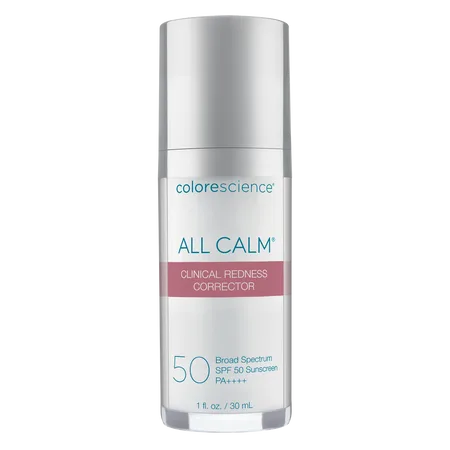
All Calm Clinical Redness Corrector SPF 50
Rosacea Relief SPF
 Verified reviewer
Pros & cons.
- +Instantly neutralizes redness and rosacea flushing with calibrated green mineral pigments
- +SPF 50 mineral-only protection that's gentle enough for the most reactive skin
- +BioSolace complex with niacinamide, bisabolol, and magnolia bark treats underlying inflammation
- +Iron oxides provide additional visible light protection — a known rosacea trigger
- +Fragrance-free, essential oil-free, and alcohol-free — minimal irritation risk
- +Replaces separate sunscreen, color corrector, and anti-redness serum in one step
- +Sets to a natural, satin finish when applied in the correct amount
- −Extremely expensive at $115 per ounce — annual cost can approach $750-1000
- −Steep learning curve on application amount — too much looks thick and chalky
- −Only one shade available, limiting use for deeper skin tones
- −Small 1 oz tube requires frequent repurchasing for daily users
- −Silicone-heavy base won't suit those who avoid silicones on principle
The full review.
Walk into a dermatologist’s office and ask what sunscreen they recommend for rosacea patients, and there’s a good chance you’ll walk out with a tube of Colorescience All Calm. This isn’t the kind of product that goes viral on TikTok or gets unboxed by beauty influencers — it’s the kind that gets quietly prescribed by board-certified dermatologists who are tired of their patients coming back with worse flares because their sunscreen irritated their skin. The distribution channel tells you something about who this product is for and how seriously it takes the problem it’s trying to solve.
The engineering challenge here is formidable. Rosacea skin needs mineral-only sun protection (chemical filters are known triggers), but mineral sunscreens at SPF 50 typically require high concentrations of titanium dioxide and zinc oxide that make the product feel like wall plaster. The skin also needs anti-inflammatory treatment — not just cosmetic coverage — to manage the chronic vascular reactivity that causes persistent redness. And ideally, the product should look like nothing is on your face, despite containing enough mineral filters and green pigments to paint a small canvas.
Colorescience threads this needle with impressive precision. The dual mineral system — 11.6% titanium dioxide and 8.6% zinc oxide — provides genuine SPF 50 broad-spectrum protection. The titanium dioxide handles the heavy lifting on UVB, while the zinc oxide fills in UVA coverage. The addition of iron oxides and chromium oxide greens serves double duty: cosmetically, the green tint neutralizes the red and pink tones that rosacea sufferers know all too well. Functionally, these mineral pigments add protection against visible light — an often-overlooked trigger for rosacea that standard UV filters don’t address. Studies have shown that visible light can induce hyperpigmentation and potentially aggravate rosacea, making tinted mineral sunscreens genuinely more protective than their untinted equivalents for this population.
The BioSolace complex is where the formula moves from protection to treatment. Niacinamide — positioned early in the inactive ingredient list, suggesting meaningful concentration — strengthens the compromised skin barrier that’s characteristic of rosacea, reduces inflammation through multiple pathways, and has been shown in clinical studies to decrease redness and blotchiness. Bisabolol provides potent anti-inflammatory action by inhibiting pro-inflammatory mediators. Magnolia bark extract contributes honokiol and magnolol, biphenolic compounds with demonstrated antioxidant and anti-inflammatory effects that help modulate the vascular overreactivity underlying rosacea flushing. Ginger root extract adds gingerols to the anti-inflammatory cocktail.
The silicone base is a deliberate formulation choice that prioritizes wearability. Cyclopentasiloxane and dimethicone crosspolymer create the slip and smoothness that allow the heavy mineral load to spread evenly and set to a comfortable finish. If you’re someone who avoids silicones on principle, this product won’t be for you — but the silicones are doing genuine functional work here, not just creating a pleasant texture. Without them, getting SPF 50 mineral protection to feel this lightweight would be nearly impossible.
Application requires a learning curve. The product is highly concentrated — more so than any tinted moisturizer or BB cream you’ve used before. The green tint is vivid in the tube, and the natural instinct is to use too much. Start with less than a pea-sized amount for the full face. Pat it on rather than rubbing, working it into areas of redness first. The green pigments disappear as they blend, leaving behind a neutral, skin-tone finish that effectively cancels the ruddy undertones rosacea creates. Once you’ve dialed in your amount, the finish is beautiful — satin-smooth, natural-looking, and genuinely effective at making redness invisible.
But that learning curve matters, because using too much results in a thick, chalky layer that sits on top of the skin rather than blending in. The one-shade-fits-all approach also has inherent limitations. The green-beige tint works best on light to medium skin tones with redness — the population most likely to have visible rosacea. On deeper skin tones, the tint may not blend seamlessly, and on very fair skin without significant redness, the green cast can look off.
The uncomfortable conversation is the price. At $115 for one ounce, this is an expensive commitment — especially for a product meant for daily use. At the recommended usage, a tube lasts roughly six to eight weeks, putting the annual cost around $750-$1000. That’s a significant financial burden, even for a product that genuinely works.
The counterargument — and it’s a fair one — is that All Calm replaces multiple products. If you’re currently buying a separate mineral sunscreen, a redness serum, and a green color corrector, the combined cost might approach what you’d spend on this. It also reduces application steps, which matters for sensitive skin — fewer products means fewer potential irritants and less physical manipulation of already reactive skin.
For the person this product is designed for — someone with diagnosed rosacea or chronic redness who has tried and been irritated by conventional sunscreens, who is tired of layering multiple products to achieve both protection and coverage, and who has access to a dermatology office where this is stocked — All Calm earns its reputation. It’s not a product for casual sunscreen shoppers. It’s a clinical tool that happens to come in a pretty tube.
Ingredient analysis.
Full INCI list
Active Ingredients: Titanium Dioxide 11.6%, Zinc Oxide 8.6%. Inactive Ingredients: Cyclopentasiloxane, Caprylic/Capric Triglyceride, Water/Aqua/Eau, Dimethicone Crosspolymer, Niacinamide, Disteardimonium Hectorite, Dimethicone/Vinyl Dimethicone Crosspolymer, Propylene Carbonate, Disodium Lauriminodipropionate Tocopheryl Phosphates, Crithmum Maritimum Extract, Magnolia Officinalis Bark Extract, Zingiber Officinale (Ginger) Root Extract, Magnesium Carboxymethyl Beta-Glucan, Jojoba Esters, Bisabolol, Silica, Polyhydroxystearic Acid, Dimethiconol, Alumina, Glyceryl Behenate/Eicosadioate, Phenoxyethanol, Triethoxycaprylylsilane, Ethylhexylglycerin, Tocopherol, Dehydroacetic Acid, Benzoic Acid, Glycolic Acid, Chloroacetic Acid, Chromium Oxide Greens (CI 77288), Iron Oxides (CI 77491, CI 77492, CI 77499)
Skin match.
The science.
The Science
The dual mineral filter system (11.6% titanium dioxide + 8.6% zinc oxide) provides SPF 50 broad-spectrum protection by scattering and reflecting UV radiation. A 2020 study in the Journal of the American Academy of Dermatology shows that tinted mineral sunscreens with iron oxides protect better against visible light than untinted versions. This matters for rosacea patients, as visible light triggers flushing and can worsen the condition.
Niacinamide benefits rosacea-prone skin. A 2005 study in the International Journal of Dermatology showed that topical niacinamide reduced skin redness and improved barrier function over 12 weeks. It works by strengthening ceramide synthesis, reducing TEWL, and inhibiting melanosome transfer—addressing both barrier dysfunction and pigmentary changes from chronic redness.
Bisabolol (alpha-bisabolol) reduces inflammation by inhibiting 5-lipoxygenase and cyclooxygenase pathways. A 2014 study in the Journal of Clinical and Aesthetic Dermatology confirmed it reduces UV-induced erythema, supporting its use in products for reactive, redness-prone skin.
Magnolia officinalis bark extract contains honokiol and magnolol—neolignan biphenols with potent anti-inflammatory and antioxidant activity in multiple studies. A 2011 review in the International Journal of Molecular Sciences documented how honokiol inhibits NF-kB and modulates inflammatory pathways, justifying its use in anti-redness formulations. The extract also has antimicrobial properties that help manage Demodex mite overgrowth in some rosacea subtypes.
References
- Visible light protection in tinted mineral sunscreens — Journal of the American Academy of Dermatology (2020)
- The effect of niacinamide on reducing cutaneous pigmentation and suppression of melanosome transfer — International Journal of Dermatology (2005)
Dermatologist Perspective
Board-certified dermatologists often recommend the All Calm Redness Corrector for rosacea management. Dermatologists note the mineral-only SPF 50 is critical for rosacea patients, since UV and visible light both trigger flushing. Adding iron oxides for visible light protection is an evidence-based approach that exceeds standard sunscreen. Dermatologists often prescribe this product with prescription treatments like metronidazole or ivermectin, and for post-procedure recovery after laser treatments (IPL, V-Beam) where sun protection and redness management are essential. The fragrance-free, non-irritating formula is a sunscreen option dermatologists recommend to their most sensitive patients.
Where it fits in your routine.
Apply a very small amount (less than pea-sized for the full face) as the last step of your morning skincare routine. Pat gently onto skin instead of rubbing — start at areas of greatest redness and blend outward. Let it set for 30 seconds. Use less than you think you need; you can add more to problem areas later. Wear it alone or under foundation. Reapply every two hours during extended sun exposure.
At $115 for 1 ounce, this is expensive. However, the product combines three categories: mineral SPF 50 ($30-50), clinical anti-redness treatment ($40-60), and color-correcting primer ($20-30). As a three-in-one, the per-function cost is lower. The $750-1000 annual cost for daily use is high. Budget-conscious consumers can use a separate mineral sunscreen and an over-the-counter niacinamide serum to get 80% of the results for 30% of the cost. For rosacea patients who find this product uniquely effective after cheaper options fail, the premium improves quality of life.
People with rosacea and chronic redness who need mineral sun protection that does not trigger flares. Post-procedure patients recovering from laser treatments who need gentle SPF with redness coverage. Anyone wanting to combine sunscreen, color corrector, and anti-redness treatment into one product.
Budget-conscious shoppers who get adequate results from separate, cheaper products. People with deeper skin tones who find the single shade incompatible. Anyone avoiding silicones — the formula uses silicone-based delivery. People without redness concerns who need everyday sunscreen.
Product details.
Thick, pigmented cream that spreads easily. The green-beige tint requires blending. It sets to a smooth, semi-matte finish.
Unscented — no fragrance or essential oils.
Sleek white squeeze tube with a clinical design. It is small and portable, but the 1 oz size is too small for the price.
The green-tinted cream looks more pigmented than expected on first use. A small amount (less than a pea-sized dot) covers the full face. The green tint neutralizes red areas and settles into a natural skin-tone finish when blended. The silicone base makes the texture silky and it doesn't feel heavy despite the mineral filters. It causes no irritation, stinging, or burning — even on actively flushed rosacea skin.
6-8 weeks with daily facial application using a small amount.
12 months
All Year
The backstory.
Colorescience developed All Calm specifically for dermatology patients who struggled to find sun protection that didn't aggravate their rosacea or sensitivity. The BioSolace complex was formulated to address the gap between cosmetic color correction (instant but superficial) and clinical anti-inflammatory treatment (effective but invisible). The product is primarily sold through dermatology offices, which is unusual for a tinted sunscreen.
About Colorescience
Established Brand (5–20 years)Diane Ranger founded Colorescience in 2000, pioneering mineral makeup and sun protection. The brand's products are patented, clinically tested, and dermatologists widely recommend them in medical offices. Colorescience is not dermatologist-founded, but it has credibility from published clinical data and professional-channel distribution.
Common myths.
Green-tinted products will make your face look green.
The green pigments (chromium oxide) in this formula neutralize red tones. When blended well in small amounts, the green disappears and leaves a natural, even-toned finish. Use less than you think because it is very concentrated.
Mineral sunscreens feel heavy and white before they reach SPF 50.
This formula reaches SPF 50 using 11.6% titanium dioxide and 8.6% zinc oxide. A silicone-based vehicle spreads the mineral particles evenly and stops the chalky, heavy feel of traditional mineral sunscreens.
FAQ.
Does Colorescience All Calm work for rosacea?
Yes — this product targets rosacea-prone skin. The mineral-only SPF 50 prevents UV-triggered flares, the green tint neutralizes visible redness, and the BioSolace complex (niacinamide, bisabolol, magnolia bark, ginger) gives ongoing anti-inflammatory benefits. Many dermatologists recommend it for rosacea management routines.
Is this product worth $115?
The price is high. You pay for a dermatologist-grade formula with clinically tested ingredients, dual mineral SPF 50, and a color-correction system that works. Compared to buying a separate mineral sunscreen ($30-40), a clinical redness serum ($40-60), and a color corrector ($20-30), the total value is competitive. However, the 1 oz size requires frequent repurchasing.
What shade is the Colorescience All Calm Redness Corrector?
One greenish-beige shade neutralizes redness and blends into a universal skin tone. It works best on light to medium skin tones with redness. The tint blends less seamlessly on deeper skin tones, and green pigments show on very fair skin without redness.
Can I wear makeup over this product?
Yes. The silicone-based formula creates a smooth, semi-matte canvas that works well under foundation and concealer. Many users use less foundation with this product because the redness correction reduces the need for heavy coverage.
How much product should I use?
Use less than you expect. Start with a small pea-sized amount for the full face and add more only where needed. This product is highly pigmented and concentrated; too much creates a thick, chalky appearance. Pat onto skin gently instead of rubbing vigorously for a natural finish.
What the community says.
"Instantly neutralizes redness and rosacea flushing"
"Mineral SPF 50 that's gentle enough for post-procedure skin"
"Feels soothing and calming on application"
"Replaces both sunscreen and color corrector in one step"
"Fragrance-free and non-irritating for extremely sensitive skin"
"Very expensive at $115 per ounce"
"Can look thick or chalky if too much is applied"
"Limited to one greenish-beige shade that may not suit all skin tones"
"Small tube doesn't last long for daily use"
"Takes practice to learn the right application amount"
People also looked at.