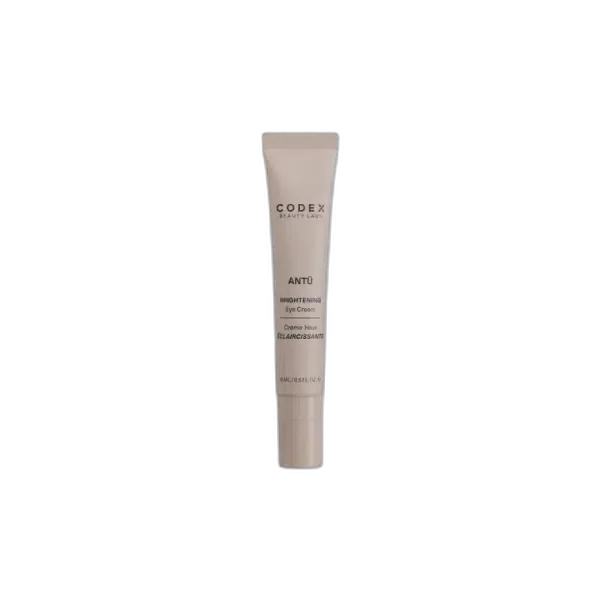
Antü Brightening Eye Cream
Patagonian Botanical Eye Cream
 Verified reviewer
Pros & cons.
- +Genuinely distinctive botanical formulation built around Chilean Patagonian plants
- +Rich hydrating texture delivers immediate relief to dry under-eyes
- +Sustainable wild-harvest sourcing story with indigenous partnerships
- +Microbiome-friendly positioning backed by lactobacillus ferment
- +Airless pump packaging protects sensitive botanical actives
- +Vegan, cruelty-free, and Leaping Bunny certified
- −Expensive at $52 for 15ml compared to proven caffeine or vitamin C alternatives
- −Citrus essential oils make this risky for sensitive or reactive eye areas
- −Modest impact on structural dark circles compared to hydration improvement
- −Clinical claims rest primarily on in-house Codex studies rather than independent research
The full review.
Codex Labs has an origin story that’s unusual for the clean-beauty category. Barbara Paldus, a Stanford-trained engineer who spent years in semiconductor research, founded the brand in 2018 after becoming frustrated by what she saw as the scientific vacuum inside most natural skincare marketing. Her pitch was that clean beauty could be rigorous — that you could source botanicals sustainably, test them clinically, and formulate them with the same discipline as conventional skincare. The Antü line is where that philosophy meets Patagonia. The brand partnered with indigenous harvesters in Chile to source three specific plants — matico, maqui, and murtilla — that Codex combined into what it calls the AntüComplex. That botanical triad is the whole story of this eye cream. Matico (Buddleja globosa) is a Chilean shrub used in traditional medicine for wound healing and inflammation. Maqui berries are one of the most antioxidant-dense fruits in the world by ORAC measurement. Murtilla is a Chilean myrtle whose leaves carry a distinctive polyphenol profile. Take those three botanicals, add a substantial lactobacillus ferment for the microbiome-friendly positioning, throw in hibiscus peptides, dragon’s blood resin, and a plant-oil base, and you have a formula that exists nowhere else in the eye cream category. It is genuinely, provably distinctive. The question is whether distinctive means effective for the specific problem of dark circles and orbital brightening. The answer is: sort of. The cream delivers real, immediate hydration. Applied around the orbital bone, it softens dryness lines, smooths the crepey texture that develops on dehydrated under-eyes, and creates a subtle optical brightening effect that makes the area look less shadowed under foundation. That part works within the first few days of use. The texture is rich and cushiony without being heavy, and it layers well under eye makeup. The scent is fresh, citrus-herbal, and distinctly Codex — if you’ve used the Antü Facial Oil or Cleanser, you recognize it immediately. What the cream does not do convincingly is eliminate structural dark circles. Most dark circles are not a hydration problem — they’re a combination of thin under-eye skin revealing underlying vasculature, hereditary pigmentation, and the shadow cast by the orbital bone structure. No eye cream fixes those fundamentals, and botanical antioxidants are among the weaker tools in the dark circle toolkit. If your shadows are primarily dehydration-driven, you’ll see modest improvement. If they’re vascular or pigmentation-based, you’ll be underwhelmed. A caffeine-based eye cream from The Ordinary or Inkey List will deliver more visible vascular brightening for one-tenth the price, and a vitamin C eye serum will do more for pigmentation. The other concern worth surfacing is the citrus essential oil content. Lemon peel oil, lime peel oil, and palmarosa are all present in the formula, and while they’re in low concentrations typical for cosmetic use, the eye area is particularly intolerant of volatile fragrance compounds. Sensitive-eye users and anyone with rosacea-adjacent reactivity should be cautious — not because the formulation is reckless, but because the eye zone amplifies any risk that exists elsewhere on the face. Codex does not conceal these ingredients; they’re disclosed on the allergen list as limonene, citral, and linalool. Price-wise, $52 for 15ml places this eye cream in the luxury clean-beauty tier. The sustainability sourcing story and the proprietary complex are doing some of the heavy lifting on that number — you’re paying for the provenance and the formulation story, not just for the raw ingredient cost. For shoppers who value that story and specifically want a botanical alternative to conventional brightening eye creams, it’s a defensible purchase. For users focused purely on results per dollar, there are cheaper and more effective options. Overall, this is a product that deserves credit for doing something different in a category that’s often just iterations of caffeine, peptides, and hyaluronic acid. The Patagonian botanical story is real, the formulation is thoughtful, and the brand’s scientific rigor is better than most of its clean-beauty peers. Whether that adds up to a must-have depends entirely on how much the distinctiveness matters to you.
Formula
```markdown
###

### Texture

The texture is rich and cushiony without being heavy, and it layers well under eye makeup.

### Scent

The scent is fresh, citrus-herbal, and distinctly Codex — if you've used the Antü Facial Oil or Cleanser, you recognize it immediately.

### Common Praise

The cream delivers real, immediate hydration. Applied around the orbital bone, it softens dryness lines, smooths the crepey texture that develops on dehydrated under-eyes, and creates a subtle optical brightening effect that makes the area look less shadowed under foundation. That part works within the first few days of use.

### Common Complaints

What the cream does not do convincingly is eliminate structural dark circles. Most dark circles are not a hydration problem — they're a combination of thin under-eye skin revealing underlying vasculature, hereditary pigmentation, and the shadow cast by the orbital bone structure. No eye cream fixes those fundamentals, and botanical antioxidants are among the weaker tools in the dark circle toolkit. If your shadows are primarily dehydration-driven, you'll see modest improvement. If they're vascular or pigmentation-based, you'll be underwhelmed. A caffeine-based eye cream from The Ordinary or Inkey List will deliver more visible vascular brightening for one-tenth the price, and a vitamin C eye serum will do more for pigmentation. The other concern worth surfacing is the citrus essential oil content. Lemon peel oil, lime peel oil, and palmarosa are all present in the formula, and while they're in low concentrations typical for cosmetic use, the eye area is particularly intolerant of volatile fragrance compounds. Sensitive-eye users and anyone with rosacea-adjacent reactivity should be cautious — not because the formulation is reckless, but because the eye zone amplifies any risk that exists elsewhere on the face. Codex does not conceal these ingredients; they're disclosed on the allergen list as limonene, citral, and linalool.

### Best for

For shoppers who value that story and specifically want a botanical alternative to conventional brightening eye creams, it's a defensible purchase.

### Not ideal for

For users focused purely on results per dollar, there are cheaper and more effective options.Ingredient analysis.
Full INCI list
Aqua/Water, Propanediol, Lactobacillus Ferment, Glycerin, Coco-Caprylate, C15-19 Alkane, Polyglyceryl-6 Stearate, Hydrogenated Olive Oil Unsaponifiables, Lactobacillus, Carrageenan, Prunus Amygdalus Dulcis (Sweet Almond) Oil, Butyrospermum Parkii (Shea) Butter Extract, Caprylyl/Capryl Glucoside, Hydrolyzed Hibiscus Esculentus Extract, Dextrin, Pfaffia Paniculata Root Extract, Ptychopetalum Olacoides Bark/Stem Extract, Cocos Nucifera Fruit Extract, Sodium Benzoate, Lilium Candidum Flower Extract, Potassium Sorbate, Xanthan Gum, Polyglyceryl-6 Behenate, Citrus Limon Peel Oil, Citrus Aurantifolia Peel Oil, Calcium Chloride, Squalene, Sucrose Polystearate, Citric Acid, Hydrolyzed Sodium Hyaluronate, Sodium Phytate, Glyceryl Undecylenate, Cymbopogon Martini Motia Herb Oil, Argania Spinosa Kernel Oil, Croton Lechleri Resin Extract, Benzyl Alcohol, Tocopherol, Buddleja Globosa Leaf Extract, Aristotelia Chilensis (Maqui) Leaf Extract, Ugni Molinae (Murtilla) Leaf Extract, Limonene, Citral, Linalool
Skin match.
The science.
The Science
The formulation's efficacy story centers on the AntüComplex — a trio of Chilean Patagonian botanicals that Codex has positioned as its signature antioxidant blend. Aristotelia chilensis (maqui) has the strongest independent evidence base of the three; peer-reviewed research on maqui berry extract has documented its anthocyanin content, with ORAC antioxidant values among the highest measured in any edible fruit. Topical applications of maqui in cosmetic formulations have been explored for photoprotection and environmental defense, with in-vitro studies suggesting meaningful free radical scavenging activity. Buddleja globosa (matico) has traditional use in Chilean and Mapuche medicine for wound healing, and some preliminary research has explored its phenolic compound profile and anti-inflammatory potential, though the evidence base is narrower than for maqui. Ugni molinae (murtilla) is the least-studied of the three in the peer-reviewed literature but shares the anthocyanin-rich polyphenol profile common to Chilean myrtles. The supporting ingredient architecture is more conventional. Lactobacillus ferment delivers postbiotic metabolites that support microbiome balance, with a growing but still emerging evidence base for topical probiotic applications. Hydrolyzed hibiscus extract functions as a plant-based peptide source, and while the clinical case for it as a firming active is less robust than synthetic peptide alternatives like Matrixyl, it's a reasonable inclusion. Hydrolyzed sodium hyaluronate provides low-molecular-weight humectant action appropriate for the thin eye area. The citrus essential oil blend is the formulation's weakest link — limonene and citral are among the more common contact sensitizers in cosmetic ingredients, and the periocular skin is particularly intolerant of volatile aromatic compounds. Codex's own clinical testing claims moderate improvements in dark circle appearance after consistent use, but these results come from in-house consumer studies rather than independent peer-reviewed research.
Dermatologist Perspective
Dermatologists generally approach botanical brightening eye creams with measured expectations. Board-certified dermatologists note that dark circles have multiple etiologies — vascular, pigmentary, and structural — and that no single topical product addresses all three. For hydration-related under-eye shadowing, a well-formulated hydrating eye cream can provide visible improvement. For vascular dark circles, caffeine-based formulations are typically preferred. For hereditary pigmentation, dermatologists often steer patients toward professional treatments or prescription options rather than over-the-counter products. The essential oil content in this formulation is the concern dermatologists commonly raise — the periocular area is among the most sensitive on the face, and even low concentrations of citrus oils can trigger contact reactions in susceptible patients. For users without a history of eye-area sensitivity who are drawn to clean-beauty formulations and value sustainable sourcing, this product is typically considered a reasonable option, though dermatologists will often suggest it as an adjunct to a more proven brightening ingredient rather than a standalone solution.
Where it fits in your routine.
Pat a rice-grain sized amount onto the orbital bone of each eye, moving from the inner corner outward. Apply once or twice daily after serums and before facial moisturizer. Do not put the cream on the eyelid or inside the lash line; citrus oils migrate and cause sensitivity. Use broad-spectrum SPF in the morning because UV damage accelerates under-eye pigmentation. If you have rosacea or eye-area sensitivity, patch test on the inner wrist for several days before first use.
At $52 for 15ml, this eye cream sits in the luxury clean-beauty tier and competes more with brands like Tata Harper and RMS Beauty than with mainstream eye creams. You're paying for the Patagonian sourcing story, the proprietary AntüComplex, Codex's in-house clinical testing program, and the brand's clean-beauty positioning. For users who specifically value those things, the price is defensible. For users focused on visible results per dollar, cheaper and more effective alternatives exist — The Ordinary's Caffeine Solution runs about $9 and addresses vascular dark circles more directly, while CeraVe's Eye Repair Cream delivers better hydration for roughly a quarter of the price. Codex does not offer a larger size. The verdict: a premium purchase that earns its price through distinctiveness rather than raw efficacy.
Clean-beauty enthusiasts seeking botanical formulations and sustainable sourcing fit this profile, especially those with dry or normal skin wanting hydration-focused brightening around the eye area. It also suits users who tried conventional caffeine and vitamin C eye creams without satisfaction and want botanical alternatives.
Avoid this formula if you have eye-area sensitivity, rosacea, or contact reactions to citrus oils. Skip this if you want to treat vascular or structural dark circles; caffeine-based alternatives work better. Skip this if you want the highest impact per dollar, as The Ordinary and Inkey List offer cheaper options for these concerns.
Product details.
Thick, cushiony cream that softens with warmth and spreads easily around the orbital bone
Fresh citrus-herbal with a soft floral note
Airless pump tube with matte white exterior and recyclable components
It applies smoothly without tingling and absorbs within a minute. It leaves a subtle velvety finish that makeup layers over cleanly. The citrus-herbal scent is noticeable at first but fades quickly. Visible dark circle improvement takes time; expect immediate hydration first, then brightening over weeks.
About 4 months with twice-daily application to both eye areas
6 months
All Year
The backstory.
Codex Labs (originally Codex Beauty Labs) was founded in 2018 by Barbara Paldus, a Stanford-trained engineer who pivoted from semiconductor research into clean beauty after becoming frustrated by the lack of scientific rigor in the clean-beauty space. The Antü line specifically grew out of Paldus's interest in Chilean botanicals and the brand's partnership with indigenous harvesters in Patagonia to source the ingredients sustainably.
About Codex Labs
Emerging Brand (2–5 years)Barbara Paldus, a Stanford-trained engineer, founded Codex Labs (originally Codex Beauty Labs) in 2018. The brand uses in-house clinical testing and microbiome-friendly formulations to act as a science-forward clean-beauty brand. Codex Labs publishes in-vitro and consumer study results on its website, but independent peer-reviewed validation of its proprietary complexes is limited.
Common myths.
Dehydration primarily causes dark circles, but the right eye cream fixes them.
Most dark circles stem from structure or pigmentation—thin skin showing blood vessels or hereditary hyperpigmentation in the orbital area. Eye creams improve hydration-related shadowing but do not remove dark circles caused by vascular visibility or melanin deposits. Set expectations accordingly.
Natural and organic ingredients are gentler for the eye area.
The eye area reacts easily to essential oils and botanical fragrance compounds. This formula uses lemon, lime, and palmarosa oils. These are natural, but they often cause contact irritation near the eyes. Natural origin does not guarantee safety.
FAQ.
Does this eye cream actually reduce dark circles?
Modestly. Botanical antioxidants and hydration ingredients improve the look of shadowing from dehydration and dullness. For vascular or pigmentation-based dark circles, a vitamin C or caffeine-based eye cream shows more visible results. Set realistic expectations — this product brightens rather than erases dark circles.
Can I use this with retinol eye cream?
Yes, but alternate — use this cream in the morning and retinol at night, or skip retinol on nights you use this cream. The citrus oils in this formula increase irritation from retinoids.
Is this safe during pregnancy?
Yes — the formulation has no retinoids or high-concentration salicylic acid and is pregnancy-safe. As with any eye-area product, patch test first if your skin is more sensitive.
How long will a 15ml tube last?
Apply to both eye areas twice daily. One rice-grain sized amount covers each eye area. Expect the supply to last roughly four months.
Is this microbiome-friendly?
Yes — the formula contains a lactobacillus ferment and markets itself as supporting the skin microbiome. Codex conducts in-house microbiome compatibility testing on its products.
Why is this so expensive?
Your cost covers the proprietary AntüComplex, Codex's clinical testing program, the sustainable wild-harvest sourcing model, and the clean-beauty positioning. Value depends on whether you prioritize the sustainability story or raw ingredient efficacy.
Can men use this eye cream?
Yes — the formulation is gender-neutral and works for any skin type seeking a botanical brightening eye cream. The scent is fresh and herbal instead of floral, making it more versatile for many users.
What the community says.
"Pleasant botanical scent"
"Smooth rich texture"
"Non-irritating under makeup"
"Noticeable hydration benefit"
"Expensive for 15ml"
"Results on dark circles are modest"
"Citrus oils concerning for sensitive eye area"
"Not a strong brightener compared to vitamin C eye creams"
People also looked at.