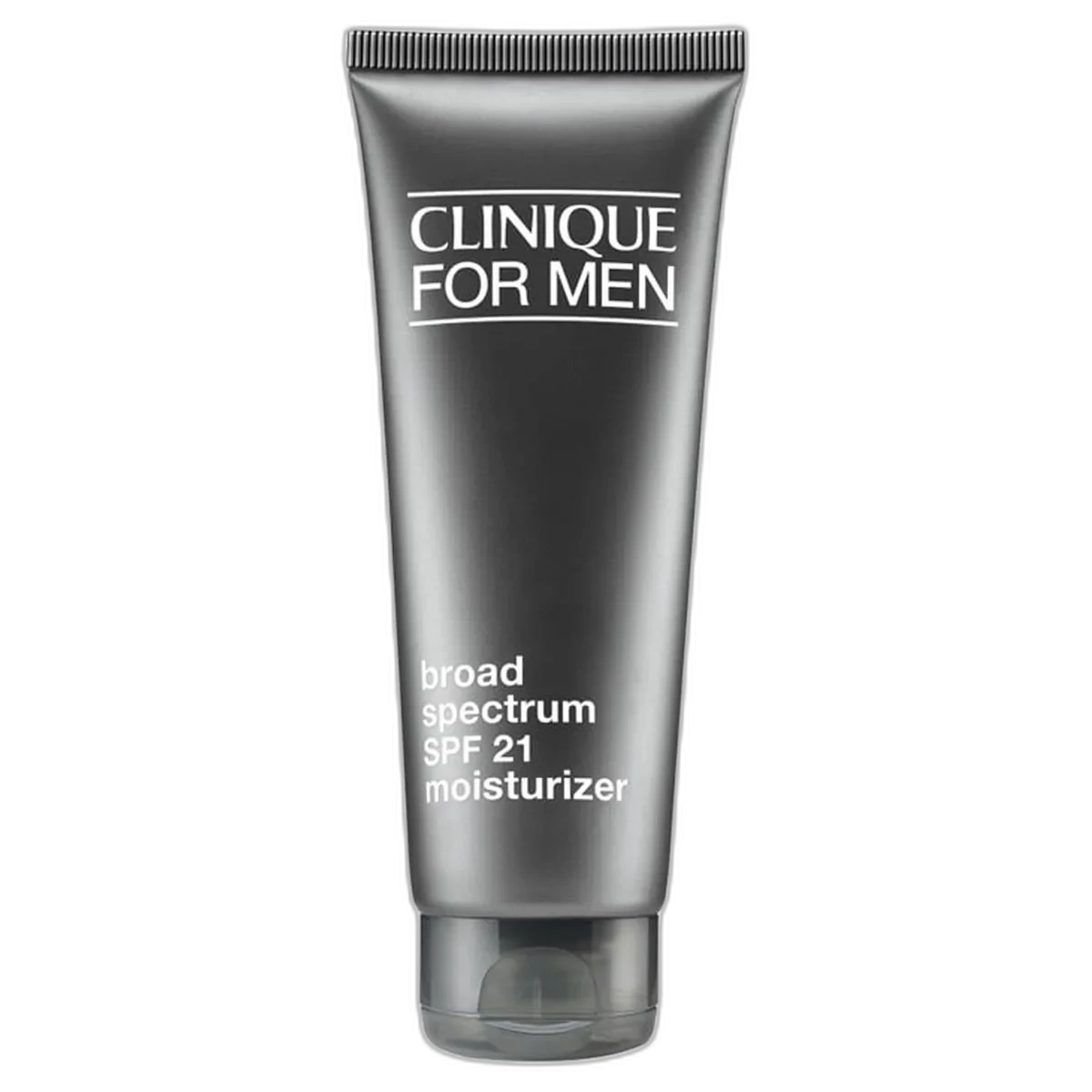
Broad Spectrum SPF 21 Moisturizer
Gentleman's Daily Shield
 Verified reviewer
Pros & cons.
- +Exceptionally lightweight texture absorbs in seconds with no white cast
- +Oil-free formula keeps oily skin matte without feeling suffocating
- +Fragrance-free, allergy-tested, and dermatologist-tested — core Clinique standards
- +Broad-spectrum UVA/UVB coverage from a stabilized four-filter system
- +Cholesterol and botanical extracts provide genuine moisturizing and soothing benefits
- +Effortless application makes daily sunscreen use a zero-friction habit
- +Proven track record with loyal users reporting benefits over decades of daily use
- −SPF 21 is below the dermatologist-recommended minimum of SPF 30 for daily protection
- −Contains oxybenzone — a controversial UV filter with systemic absorption concerns
- −Unnecessary synthetic dyes that cause yellowish residue when mixed with sweat
- −Premium price of 2 is steep for SPF 21 in a competitive market
- −Not reef-safe due to oxybenzone and octinoxate content
- −Contains algae extract which can be comedogenic for acne-prone skin
The full review.
Clinique for Men has marketed moisturizer to men since 1976, when the concept required cultural persuasion. Originally “Skin Supplies for Men,” the brand framed skincare as a necessity rather than beauty—like ammunition or motor oil. The branding softened after the 2014 rebrand, but the goal is unchanged: make skincare simple enough that men use it.
This SPF 21 Moisturizer is the line’s daily workhorse and succeeds in one key way. The texture is excellent. It applies like a lightweight lotion, absorbs in under a minute, leaves zero white cast, and finishes so naturally you forget it is there. For men—especially those who do not wear sunscreen voluntarily—this frictionless experience matters. The best sunscreen is the one you actually use every morning, and this product removes almost every excuse.
The four-filter chemical sunscreen system covers UVA and UVB wavelengths. Avobenzone at 3% handles UVA, while octinoxate at 7.4% is the primary UVB worker. Octisalate at 5% adds UVB coverage and stabilizes the avobenzone, which is notoriously photolabile. Oxybenzone at 2% provides extra broad-spectrum support and further stabilization.
This is where the product shows its age. Oxybenzone is a controversial sunscreen ingredient. Studies in JAMA in 2019 and 2020 show oxybenzone absorbs through the skin at levels above the FDA’s 0.5 ng/mL threshold after one application, triggering ongoing safety reviews. Hawaii, Key West, and Palau ban it because research links it to coral reef damage. For a brand built on allergy testing and dermatologist oversight, keeping oxybenzone feels like institutional inertia rather than a principled choice.
The synthetic dyes—Yellow 5, Yellow 6, and Red 33—are also hard to justify. They only give the product color in the tube, yet Yellow 5 (tartrazine) is a known allergen for some. Multiple user reviews say the product leaves a yellowish-brown residue on towels and hands when mixed with sweat. For a fragrance-free, allergy-tested product, these unnecessary dyes are a contradiction.
Then there is the SPF 21. When this was formulated, SPF 21 was adequate. Today, dermatological consensus sets SPF 30 as the minimum daily protection. SPF 21 blocks about 95.2% of UVB rays, while SPF 30 blocks 96.7%—a small gap that means SPF 30 lets roughly 30% less UV radiation reach the skin. For a forty-two dollar product from a dermatologist-developed brand, anything below SPF 30 is a missed opportunity.
The moisturizing system is well-constructed. Cholesterol—a skin-identical lipid—supports barrier function, while dimethicone creates a lightweight layer that seals in hydration without heaviness. Butylene glycol provides humectant benefits without the stickiness of glycerin. Lactobacillus ferment adds a probiotic element, and botanical extracts from chamomile, cucumber, and barley soothe the skin to offset potential irritation from chemical UV filters. The oil-free formula keeps oily skin matte without feeling suffocating.
The product has a loyal user base, many of whom have used it for ten years or more. Long-term users often credit it with keeping their skin looking younger and healthier. This is expected—even imperfect daily sunscreen use provides massive long-term benefits compared to no sunscreen. The ritual itself has value.
Loyalty should not prevent honest assessment. At forty-two dollars for 3.4 ounces—about twelve dollars per ounce—this is a premium product. Premium products should lead, not lag. The market has changed since this was formulated: dozens of lightweight, invisible, SPF 30+ moisturizers exist at equal or lower prices, many without oxybenzone or synthetic dyes.
The Clinique promise of allergy-tested, fragrance-free, dermatologist-developed skincare is still compelling. The packaging is clean and functional. The user experience is excellent. But the formulation looks like a product that earned its reputation years ago and now coasts on goodwill while the category passes it. What was once a pioneer is now an option you recommend with caveats.
Ingredient analysis.
Full INCI list
Active Ingredients: Avobenzone 3.0%, Octinoxate 7.4%, Octisalate 5.0%, Oxybenzone 2.0%. Inactive Ingredients: Water/Aqua/Eau, Butylene Glycol, Dimethicone, Neopentyl Glycol Diheptanoate, Cetearyl Alcohol, Silica, PEG-100 Stearate, Isododecane, Hydrogenated Lecithin, Polyethylene, Phenoxyethanol, Cholesterol, Caprylyl Glycol, Cetearyl Glucoside, Carbomer, Tromethamine, Oleth-10, Chlorphenesin, Stearyl Alcohol, Zeolite, Algae Extract, Laureth-4, Laureth-23, Disodium EDTA, Propylene Glycol Dicaprate, Potassium Sorbate, PVP, Hexylene Glycol, Helianthus Annuus (Sunflower) Seedcake, Cetrimonium Chloride, Sodium Citrate, Lactobacillus Ferment, Tridecyl Stearate, Chamomilla Recutita (Matricaria), Tridecyl Trimellitate, Dipentaerythrityl Hexacaprylate/Hexacaprate, Hordeum Vulgare (Barley) Extract/Extrait D'Orge, Yellow 5 (CI 19140), Cucumis Sativus (Cucumber) Fruit Extract, Yellow 6 (CI 15985), Sodium Benzoate, Red 33 (CI 17200)
Skin match.
The science.
The Science
This moisturizer uses a four-filter chemical sunscreen system for broad-spectrum protection. Avobenzone at 3% acts as the sole UVA filter, absorbing UVA radiation from 310-400 nm. Avobenzone is photolabile and degrades under UV exposure. This formula stabilizes it with octisalate and oxybenzone; both absorb energy from excited avobenzone molecules to maintain UVA protection.
Octinoxate at 7.4% is the main UVB filter, absorbing radiation in the 280-320 nm range. It offers good cosmetic elegance but faces scrutiny. A 2019 JAMA study by Matta et al. found that six common chemical sunscreen ingredients, including octinoxate and oxybenzone, entered the bloodstream at concentrations above the FDA's 0.5 ng/mL threshold after one application. A 2020 JAMA study confirmed these results across more formulation types. The FDA is still reviewing the clinical significance of this absorption, and dermatological consensus still recommends sunscreen use.
Oxybenzone at 2% is the most controversial ingredient. Besides systemic absorption concerns, a 2015 study in Archives of Environmental Contamination and Toxicology (Downs et al.) showed that oxybenzone causes coral bleaching and DNA damage at concentrations as low as 62 parts per trillion. This led to legislative bans in Hawaii, the U.S. Virgin Islands, Key West, and Palau.
The moisturizing system contains cholesterol, a skin-identical lipid in the stratum corneum's lipid matrix. Research shows topical cholesterol repairs barrier function and reduces transepidermal water loss. Lactobacillus ferment provides postbiotic conditioning, and chamomilla recutita (chamomile) extract contains bisabolol and chamazulene, which have anti-inflammatory properties in dermatological literature.
References
- Effect of Sunscreen Application Under Maximal Use Conditions on Plasma Concentration of Sunscreen Active Ingredients — JAMA (2019)
- Effect of Sunscreen Application on Plasma Concentration of Sunscreen Active Ingredients: A Randomized Clinical Trial — JAMA (2020)
- Toxicopathological Effects of the Sunscreen UV Filter, Oxybenzone (Benzophenone-3), on Coral Planulae and Cultured Primary Cells — Archives of Environmental Contamination and Toxicology (2015)
Dermatologist Perspective
Board-certified dermatologists generally like this product's lightweight, fragrance-free formulation and how it helps men use daily sunscreen. However, dermatologists now universally recommend SPF 30 as the daily minimum, so the SPF 21 rating is suboptimal. Dermatologists also note rising caution regarding oxybenzone due to systemic absorption data; many suggest mineral or newer-generation chemical filters for concerned patients. For oily-skinned patients who avoid sunscreen, dermatologists may still recommend this product because it wears well—reasoning that consistent SPF 21 use provides more protection than inconsistent SPF 50 use.
Where it fits in your routine.
Apply a liberal amount to the face and neck as your last morning skincare step, at least 15 minutes before sun exposure. Apply separate serums or moisturizers first and let them absorb before layering this product on top. Reapply every two hours during extended outdoor exposure. One morning application works for daily indoor or light commuting use. Use a nickel-sized amount for the face and a dime-sized amount for the neck.
At 2 for 3.4 fl oz, this costs roughly 2.35 per ounce, placing it in the premium tier. The price is harder to justify now that the product uses SPF 21 and older filter technology. Clinique's allergy testing, fragrance-free commitment, and dermatologist-developed heritage explain the premium cost, but the market has changed. Excellent SPF 30+ moisturizers from drugstore and prestige brands now offer similar or better textures at similar or lower prices. The value depends on the Clinique experience: the trust, the texture, and the decades-long track record. Whether that intangible justifies the premium depends on if you value the Clinique brand promise over raw ingredient performance.
Men with oily or combination skin want a single-step morning product that combines moisturization with sun protection. This product works for men who avoid sunscreen because of greasy textures or strong scents. It also suits anyone who values the Clinique allergy-tested, fragrance-free standard.
People seeking SPF 30 or higher for daily protection will find this falls below current dermatological recommendations. It is not for anyone avoiding oxybenzone for health or environmental reasons. Those with dry skin need more moisture. Budget-conscious shoppers can find comparable or better SPF moisturizers for less.
Product details.
This lightweight, fluid lotion spreads easily and absorbs within seconds. It leaves no greasy or sticky residue. Once fully absorbed, it feels like wearing nothing on the skin.
Fragrance-free. A faint, neutral sunscreen scent exists during application but fades fast.
Squeezable green-gray plastic tube with a screw cap and Clinique for Men branding. The compact design works well for travel.
Applies smoothly without a white cast or visible tint. It absorbs in 30-60 seconds and leaves skin lightly moisturized, not heavy. Most users feel no stinging or burning, though those sensitive to chemical sunscreens may feel mild warmth. The matte-natural finish works under or without makeup.
3-4 months with daily morning face application
12 months
All Year
The backstory.
Clinique for Men launched in 1976 as "Skin Supplies for Men," making it one of the earliest prestige men's skincare lines at a time when the idea of men using moisturizer was culturally foreign. This SPF moisturizer has been a quiet pillar of the line for over two decades, designed to make sun protection effortless for men who want a single-step morning product. The 2014 rebrand updated the packaging but kept the formula largely unchanged.
About Clinique for Men
Legacy Brand (20+ years)Dr. Norman Orentreich, Carol Phillips, and Evelyn Lauder co-founded Clinique in 1968. Clinique was the first fragrance-free cosmetics brand that dermatologists developed and allergy-tested. Every product undergoes allergy testing and dermatologist testing as a core brand standard.
FAQ.
Is SPF 21 enough for daily sun protection?
SPF 21 provides moderate UVB protection and blocks about 95% of UVB rays. Most dermatologists recommend SPF 30 as the daily minimum. SPF 21 works for incidental sun exposure like commuting or office work, but fails during extended outdoor time.
Does Clinique for Men SPF 21 Moisturizer leave a white cast?
No. This chemical sunscreen absorbs completely into the skin without a white cast or visible residue. The lightweight lotion formula is invisible on all skin tones after absorption.
Can women use Clinique for Men SPF 21 Moisturizer?
Yes — despite the men's branding, this is a standard SPF moisturizer with no gender-specific ingredients. The oil-free, fragrance-free formula works for anyone who prefers a lightweight daily SPF moisturizer.
Does this moisturizer contain oxybenzone?
Yes, it contains 2% oxybenzone as one of its four UV filters. Oxybenzone is linked to endocrine disruption concerns and coral reef environmental impact. Users who avoid oxybenzone should choose mineral or newer-generation chemical sunscreens.
Is Clinique for Men SPF 21 Moisturizer good for oily skin?
Yes — this is one of its strongest suits. The oil-free formula absorbs fast and leaves a natural-to-matte finish without shine. Silica and zeolite in the formula absorb excess oil throughout the day.
Why does this product leave a yellow residue when I sweat?
Synthetic dyes (Yellow 5, Yellow 6, and Red 33) color the formula. These dyes can leave a visible yellowish-brown residue on towels or hands when mixed with sweat and wiped or rubbed. This is cosmetic and does not affect the sunscreen's effectiveness.
Is Clinique cruelty-free?
No. The Estée Lauder Companies owns Clinique, which lacks Leaping Bunny or PETA cruelty-free certification. Clinique has historically sold in mainland China, where animal testing requirements existed.
What the community says.
"Lightweight and non-greasy texture absorbs quickly into skin"
"No white cast — invisible finish suitable for all skin tones"
"Oil-free formula works well for oily and combination skin"
"Fragrance-free and comfortable for daily wear"
"Good as a combined moisturizer and sunscreen in one step"
"Long-term users report healthier-looking skin over years of daily use"
"SPF 21 is below the dermatologist-recommended minimum of SPF 30"
"Can sting eyes when sweating during exercise"
"Leaves yellowish-brown residue when wiped off with sweat"
"Contains oxybenzone which is a controversial ingredient"
"Price has increased significantly over the years"
"Not reef-safe due to oxybenzone and octinoxate content"
Featured in.
People also looked at.