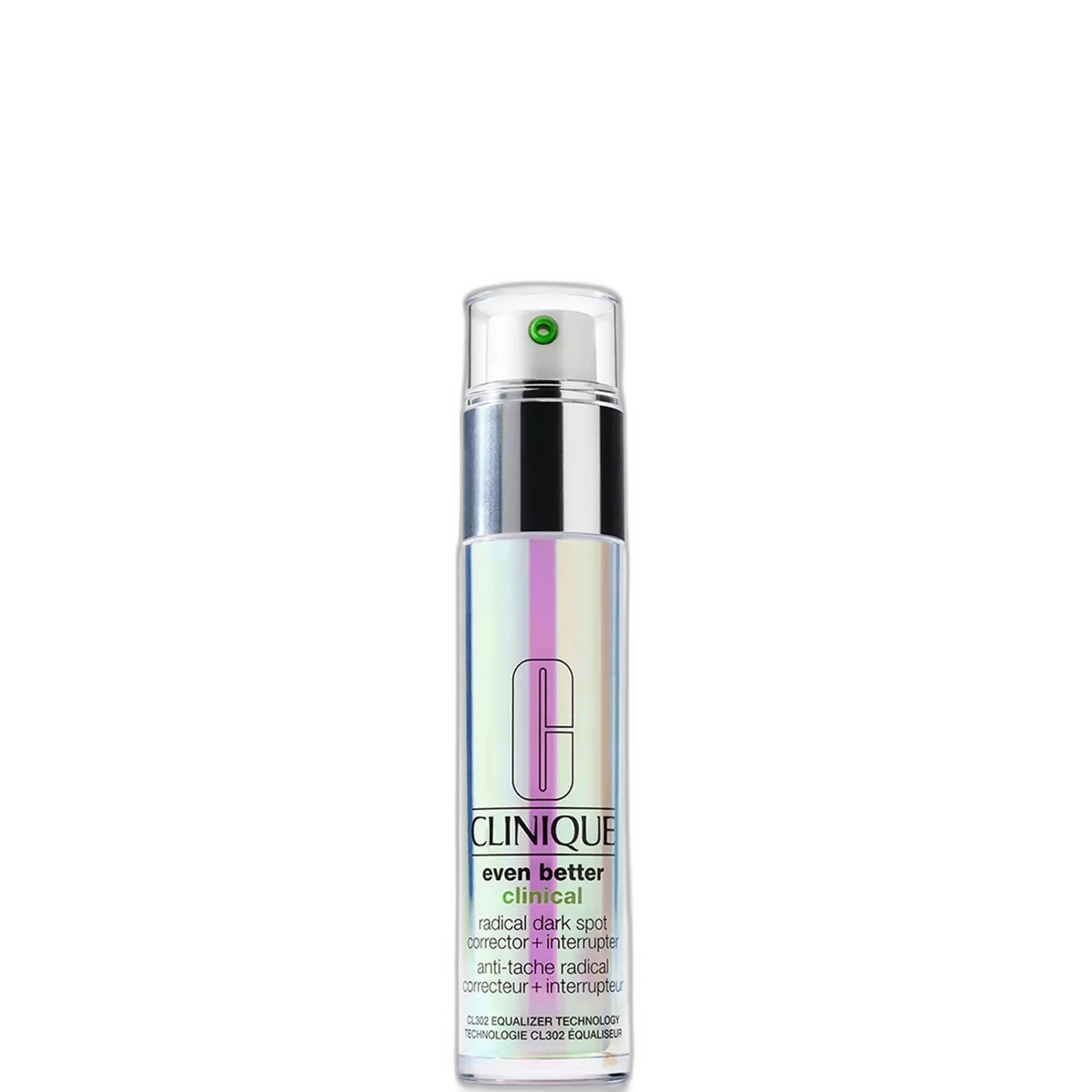
Even Better Clinical Radical Dark Spot Corrector + Interrupter
Clinical-Strength Dark Spot Eraser
 Verified reviewer
Pros & cons.
- +Five distinct anti-melanin pathways provide the most comprehensive OTC dark spot treatment available
- +Proprietary CL302 resorcinol derivative offers tyrosinase inhibition not found in typical consumer serums
- +Clinically tested with quantified results — 39% dark spot reduction at twelve weeks
- +Glycyrrhetinic acid specifically targets post-inflammatory hyperpigmentation from acne and injury
- +Fragrance-free and allergy-tested consistent with Clinique's sensitive skin commitment
- +Lightweight silicone vehicle absorbs quickly and works under moisturizer and makeup
- +Salicylic acid accelerates pigmented cell turnover while enhancing active ingredient penetration
- −Fifty-seven dollars for one ounce requires commitment to the full twelve-week course to see value
- −Results require twelve-plus weeks of patience which tests consumer expectations
- −Salicylic acid content makes pregnancy safety uncertain — consult a healthcare provider
- −May cause mild dryness or flaking during the first week as skin adjusts
- −Contains multiple silicones and polysorbates which some consumers prefer to avoid
The full review.
Most brightening serums rely on one idea: vitamin C inhibits tyrosinase to fade dark spots. This view is incomplete. Melanin production involves a complex cascade of enzymatic steps, regulatory signals, and transfer mechanisms. Blocking one step is like trying to stop a river by blocking one tributary. The Clinique Even Better Clinical Radical Dark Spot Corrector uses a different approach: it blocks five tributaries simultaneously.
The five-pathway strategy makes this formula interesting from a formulation science perspective. Ascorbyl glucoside — a stable vitamin C derivative — provides tyrosinase inhibition. But dimethoxytolyl propylresorcinol, Clinique’s proprietary CL302 compound, attacks tyrosinase through a different binding mechanism. Acetyl glucosamine interferes with tyrosinase glycosylation, reducing enzymatic activity through another distinct pathway. Salicylic acid accelerates the shedding of pigmented surface cells to remove dark spots faster. Finally, glycyrrhetinic acid — derived from licorice root — suppresses the inflammatory cascade that triggers reactive melanin overproduction after acne, irritation, or injury.
These are not five ingredients doing the same thing five ways. These five ingredients target five different steps in melanin production and distribution. This level of mechanistic diversity in a single OTC product is unusual; it separates this from the hundreds of vitamin-C-and-hope brightening serums on the market.
The CL302 compound deserves attention. Dimethoxytolyl propylresorcinol is not in most consumer skincare; it is a synthetic compound developed specifically for melanin suppression. Research shows resorcinol derivatives have potent tyrosinase inhibitory activity, and this derivative was selected for its efficacy-to-irritation ratio. This ingredient reflects Estée Lauder’s research investment — the parent company’s labs have resources smaller brands lack.
The silicone-based vehicle works well for a treatment applied twice daily. Cyclopentasiloxane and dimethicone create a lightweight, quick-absorbing base that deposits actives evenly without the greasiness or wait time of many treatment serums. The texture feels like a silky lotion rather than a traditional serum — it has a subtle cushion that smooths over skin on application.
Clinique’s clinical testing reported a 39% visible reduction in dark spots at twelve weeks. This is a meaningful claim because most prestige brands avoid quantified efficacy numbers — they are legally binding, unlike vague claims about “visibly brighter skin.” A 39% reduction at three months is substantial for an OTC treatment and provides a realistic expectation benchmark.
Salicylic acid works as both an exfoliant and a penetration enhancer. By removing the dead cell layer between the actives and the living epidermis, it increases the bioavailability of the brightening compounds. This is smart formulation — the actives only work if they reach the melanocytes, and the BHA clears the path.
Glycyrrhetinic acid addresses post-inflammatory hyperpigmentation — the dark marks from acne, razor burn, or skin injury. PIH is inflammation-driven, and most vitamin C serums do not target the inflammatory component. By suppressing the inflammatory cascade that triggers reactive melanin overproduction, this ingredient makes the formula relevant for more hyperpigmentation causes than pure brightening serums.
The limitation is time. Dark spot correction is slow because melanin is embedded in keratinocytes that must complete a natural turnover cycle — roughly four to six weeks — before they shed. Salicylic acid accelerates this, but visible results require consistent application over twelve or more weeks. Users expecting dramatic change in two weeks will be disappointed. Users who commit to the full timeline and pair it with daily SPF 30+ will see improvement.
At fifty-seven dollars for one ounce, this is a significant investment. The 1.7 oz and 3.4 oz sizes offer better per-ounce value for those committing to the three-month course. For a five-active brightening formula with a proprietary compound from a legacy prestige brand, the price is competitive with other Estée Lauder-tier brands. Whether OTC brightening at this price is better than prescription options like hydroquinone or tretinoin is a calculation for your dermatologist.
This product is prestige skincare at its most scientifically ambitious. It does not just slap vitamin C on a label and call it a dark spot corrector. It builds a multi-pathway suppression strategy that addresses the biological complexity of hyperpigmentation. That ambition — combined with Clinique’s allergy-tested, fragrance-free discipline — makes it one of the most sophisticated OTC brightening serums available.
Formula
Formula
Ingredient analysis.
Full INCI list
Water/Aqua/Eau, Cyclopentasiloxane, Dimethicone, Polysilicone-11, Isododecane, Butylene Glycol, Ascorbyl Glucoside, PEG-10 Dimethicone, PEG-6, Morus Bombycis (Mulberry) Root Extract, Scutellaria Baicalensis Root Extract, Camellia Sinensis (Green Tea) Leaf Extract, Cucumis Sativus (Cucumber) Fruit Extract, Saccharomyces Lysate Extract, Hordeum Vulgare (Barley) Extract/Extrait D'Orge, Salicylic Acid, Triticum Vulgare (Wheat) Germ Extract, Cholesterol, Oryza Sativa (Rice) Bran Extract, Squalane, Acetyl Glucosamine, Sodium Hyaluronate, Caffeine, Isohexadecane, Betula Alba (Birch) Bark Extract, Trametes Versicolor Extract, Sodium RNA, Glycyrrhetinic Acid, Dimethoxytolyl Propylresorcinol, Di-C12-18 Alkyl Dimonium Chloride, Helianthus Annuus (Sunflower) Seedcake, Yeast Extract/Faex/Extrait De Levure, Caprylyl Glycol, Propylene Glycol Dicaprate, Ammonium Acryloyldimethyltaurate/VP Copolymer, Acrylamide/Sodium Acryloyldimethyltaurate Copolymer, Polysorbate 20, Tocopheryl Acetate, Polysorbate 80, Tromethamine, Sodium Hydroxide, Hexylene Glycol, Disodium EDTA, Sodium Benzoate, Sodium Metabisulfite, Sodium Sulfite, Phenoxyethanol, Yellow 6 (CI 15985), Yellow 5 (CI 19140)
Skin match.
The science.
The Science
This formula uses a multi-pathway approach because melanogenesis is a complex cascade, not a single enzymatic step. Tyrosinase — the rate-limiting enzyme in melanin synthesis — has multiple inhibition points: direct competitive inhibition (ascorbyl glucoside), alternative binding site interference (dimethoxytolyl propylresorcinol), and post-translational modification disruption (acetyl glucosamine's interference with tyrosinase glycosylation). Targeting all three at once suppresses melanin more comprehensively than any single inhibitor.
Salicylic acid works through a different mechanism — it accelerates desquamation of pigmented keratinocytes in the upper epidermis, physically removing cells that contain excess melanin. This creates visible fading before the melanin production inhibitors fully work, providing earlier results while the deeper suppression builds.
Glycyrrhetinic acid from licorice root addresses the inflammatory side of hyperpigmentation. Pro-inflammatory cytokines — particularly IL-1, TNF-alpha, and endothelin-1 — trigger post-inflammatory hyperpigmentation by stimulating melanocyte activity after tissue injury. By suppressing this inflammatory signaling, glycyrrhetinic acid prevents the reactive melanin overproduction that causes dark marks after acne, irritation, or mechanical trauma. Research shows licorice-derived compounds reduce PIH through this anti-inflammatory mechanism.
Dermatologist Perspective
Dermatologists view this as one of the most comprehensive OTC brightening formulations available. Board-certified dermatologists note that the multi-pathway approach follows evidence-based principles for treating hyperpigmentation — targeting melanin synthesis, transfer, and removal simultaneously produces better outcomes than single-active strategies. The proprietary resorcinol derivative adds a mechanism rarely found in consumer products. Dermatologists typically recommend pairing this with daily broad-spectrum SPF 30+ and setting patient expectations for twelve-plus weeks before evaluating results. For moderate to severe hyperpigmentation or melasma, dermatologists may recommend this as part of a combination strategy alongside prescription agents.
Where it fits in your routine.
Apply a thin layer to a clean face morning and evening after toner and before moisturizer. Use fingertips to spread it evenly, focusing on discoloration. Wait thirty seconds for absorption before layering the next product. In the morning, use sunscreen SPF 30 or higher. Without sunscreen, UV exposure creates new dark spots faster than the serum fades existing ones. Use for at least twelve weeks before evaluating results.
At fifty-seven dollars for one ounce, this prestige brightening serum is premium but not an outlier. One bottle lasts two to three months with twice-daily use. The 1.7 oz size costs approximately eighty dollars and the 3.4 oz costs approximately one hundred fifteen dollars, offering better per-ounce value. This pricing is competitive for a five-active formula with a proprietary compound and clinical testing data from a legacy brand. Because results require a twelve-week commitment, you must spend the cost of at least two bottles before you can assess if it works.
This is the most comprehensive OTC brightening approach from a trusted, fragrance-free prestige brand for dark spots, sun damage, post-acne marks, or uneven skin tone. It works best for normal, combination, and oily skin types using daily sunscreen for a twelve-week course.
Sensitive or eczema-prone skin may react to the salicylic acid. Pregnant or breastfeeding individuals should consult their healthcare provider. Users on a tight budget cannot commit to the twelve-week timeline needed for results. Anyone not willing to wear daily SPF — without sunscreen, this product cannot outpace UV-driven melanin production.
Product details.
This lightweight, silky serum-lotion hybrid uses a silicone-based vehicle to absorb quickly. It is not watery like typical serums; it has a slightly cushiony feel that smooths over skin.
Fragrance-free. No detectable scent.
White and beige sleek pump bottle. It comes in 0.34 oz (travel), 1 fl oz (standard), 1.7 oz, and 3.4 oz. The pump dispenses controlled amounts. Opaque packaging protects the vitamin C derivative from light degradation.
Absorbs in seconds to a smooth, non-greasy finish. Silicone-smoothed skin surfaces give some users a subtle glow after the first application. The salicylic acid causes mild tingling; this is normal and subsides within the first week. No purging occurs. Dark spots show no visible change for at least two to four weeks.
2-3 months with twice-daily face application (1 fl oz)
12 months
All Year
The backstory.
The Even Better Clinical line represents Clinique's most advanced approach to hyperpigmentation, developed through the brand's research into melanin biology. The 'Radical' reformulation launched around 2020, introducing the proprietary CL302 Brightening Complex — centered on dimethoxytolyl propylresorcinol, an ingredient not commonly found in consumer skincare. Brand-sponsored clinical testing showed a 39% visible reduction in dark spots at twelve weeks, providing the kind of quantified efficacy claim that prestige brands rarely make.
About Clinique
Legacy Brand (20+ years)Clinique launched in 1968, the first prestige cosmetics brand to be fragrance-free and allergy-tested. It was developed with dermatologist Norman Orentreich. As an Estée Lauder Companies subsidiary, Clinique led dermatologist-guided skincare and is one of the most recognized prestige skincare brands worldwide.
Common myths.
Dark spot correctors work by bleaching the skin
This serum suppresses melanin production at multiple enzymatic steps and accelerates the turnover of already-pigmented cells. It does not bleach or lighten surrounding skin. It targets areas of excess pigmentation to gradually match your natural skin tone.
You can skip sunscreen when using a dark spot corrector
Sunscreen is the most important product to use with any brightening treatment. UV exposure triggers melanin production, which is the process this serum suppresses. Using this serum without SPF 30+ is like bailing water from a boat with a hole in it.
FAQ.
How long does Clinique Even Better Clinical take to work?
Overall brightness improves subtly within two weeks. Dark spots fade visibly at four to six weeks. Clinical testing shows a 39% reduction in visible dark spots at twelve weeks. Maximum results require twelve to sixteen weeks of consistent twice-daily use and diligent sunscreen application.
Does Clinique Even Better work on melasma?
This multi-pathway approach targets melanin production through five distinct mechanisms, making it a comprehensive OTC option for melasma. However, hormones and UV exposure drive melasma as a chronic condition. This serum improves appearance but won't fully resolve melasma without dermatological treatment and strict sun protection.
Can I use Clinique Even Better with retinol?
Yes, but introduce it gradually. The salicylic acid in this serum increases exfoliation. Use the serum in the morning and retinol at night first. After your skin acclimates over two to three weeks, use both in your evening routine if tolerated. Always follow with moisturizer.
Is Clinique Even Better safe during pregnancy?
This formula contains salicylic acid, which some dermatologists advise avoiding during pregnancy. The concentration is not disclosed. Consult your healthcare provider before using this product while pregnant or breastfeeding.
What is CL302 in Clinique Even Better?
CL302 is Clinique's proprietary Brightening Complex. It contains dimethoxytolyl propylresorcinol, a potent tyrosinase inhibitor rare in consumer skincare. This ingredient uses a different mechanism than vitamin C, adding a second melanin suppression pathway for a more comprehensive brightening effect.
Does Clinique Even Better work on all skin tones?
Yes — this serum works on all skin tones. It targets excess melanin in dark spots without lightening surrounding skin, gradually matching discolored areas to your natural tone. Clinical testing included diverse skin types.
What the community says.
"Visible dark spot fading within four to six weeks of consistent use"
"Lightweight silky texture absorbs quickly under moisturizer and makeup"
"Works on multiple types of discoloration including sun spots acne marks and melasma"
"Fragrance-free formula from a trusted allergy-tested brand"
"The dual corrector-plus-interrupter approach prevents new spots while fading old ones"
"Suitable for all skin tones without causing unwanted lightening of surrounding skin"
"Fifty-seven dollars for one ounce is a significant investment"
"Results require twelve-plus weeks of patience before dramatic improvement"
"Contains salicylic acid which may concern pregnant or breastfeeding users"
"Can cause mild dryness or flaking during the first week of use"
"Some users with very dark spots report modest rather than dramatic improvement"
Featured in.
People also looked at.