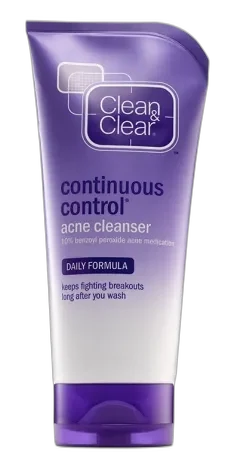
Continuous Control Acne Cleanser 10% Benzoyl Peroxide
Discontinued Budget Acne Fighter
 Verified reviewer
Pros & cons.
- +10% benzoyl peroxide is bactericidal within 30 seconds — clinically proven and resistance-proof
- +Extremely affordable at under $10 for a 5 oz tube
- +Cream base with petrolatum and glycerin partially buffers the BP's drying effect
- +Zinc lactate adds anti-inflammatory support alongside antibacterial action
- +HSA/FSA eligible as an FDA-registered OTC acne medication
- +Consistent long-term efficacy without diminishing returns or resistance development
- −Menthol and fragrance add unnecessary irritation to an already potent formula
- −Very drying at 10% concentration — significant peeling and flakiness for many users
- −Bleaches towels, pillowcases, and clothing — an unavoidable BP reality
- −Discontinued by manufacturer — remaining stock only
- −10% BP is no more effective than 2.5-5% per Cochrane review, just more irritating
- −Contains BHT and benzyl alcohol as additional potential sensitizers
The full review.
For about twenty years, the Clean & Clear Continuous Control Acne Cleanser filled a specific niche in American drugstores: the cheapest, strongest non-prescription acne treatment. At under ten dollars for a 10% benzoyl peroxide tube, parents bought it when their teenager’s breakouts peaked. It lacked elegance and gentleness, but it worked—with caveats.
The active ingredient is well-known. 10% benzoyl peroxide is the maximum over-the-counter concentration the FDA allows. Its antibacterial mechanism is simple: BP generates free radicals that oxidize Cutibacterium acnes proteins, the bacterium that drives inflammatory acne. A 2022 study in Clinical, Cosmetic and Investigational Dermatology shows 10% BP kills bacteria within thirty seconds of contact—fast enough for a wash-off product used for under a minute.
The cream base partially mitigates the expected harshness of a maximum-strength BP cleanser. Petrolatum and glycerin provide emolliency and humectant hydration during the brief wash, making it less stripping than the gel-based BP washes that dominate the market. Zinc lactate adds mild anti-inflammatory support. The formula uses these to cushion the 10% BP.
However, menthol and fragrance undercut this care. These two ingredients have no therapeutic purpose and irritate the compromised skin acne patients wash. Menthol produces a cooling tingle users often mistake for “the product working,” but it is just a sensory distraction from the bacterial mechanism. Adding a cooling irritant to a potent oxidizer on inflamed acne-prone skin is like prescribing cough medicine with pepper.
Drying is significant. Most users need heavy moisturizer immediately after washing; flakiness and peeling are common during the first one to two weeks. This stems partly from benzoyl peroxide at any concentration, but 10% dosing increases the effect. A 2020 Cochrane review found 2.5%, 5%, and 10% BP are equally effective at treating acne—higher concentrations mostly increase irritation without extra antibacterial benefit. This distinction matters for leave-on products. For a thirty-second wash, 10% is tolerable for most resilient skin, but a gentler 5% wash provides similar acne-fighting power.
Bleaching is another reality. Benzoyl peroxide oxidizes fabric dyes just as it oxidizes bacterial proteins. Every user has a story of a ruined towel, bleach-spotted pillowcase, or discolored shirt collar. White towels and white pillowcases become necessary. This is not a flaw, but a result of BP chemistry that newer, lower-concentration formulas reduce.
The product’s core mission—killing acne bacteria—is well-documented. A 2011 study in the Journal of Clinical and Aesthetic Dermatology found a 10% BP cleanser used twice daily achieved a 93.5% reduction in P. acnes by Day 5 and a 97.5% reduction by Day 15. Another advantage: BP does not promote antibiotic resistance like topical antibiotics such as clindamycin. You can use it for years without diminishing returns, which helped it become a medicine cabinet staple.
At roughly nine dollars for a five-ounce tube, value and efficacy were the product’s main selling points. Nothing else at this price offered this concentration of clinically validated antibacterial power. HSA and FSA eligibility as an OTC medication increased accessibility.
The product is discontinued. Clean & Clear lists it on their discontinued products page, and retail stock is dwindling. Many loyal long-term users are now searching for alternatives. PanOxyl Acne Foaming Wash offers the same 10% BP in a more modern formulation. Neutrogena and Differin provide gentler 2.5-5% options that research shows are equally effective.
The discontinuation ends a product representing an older acne care philosophy: maximum strength, minimum finesse. It worked through force, using the highest legal dose of a well-studied acne ingredient. Modern acne care recognizes that gentler formulations with lower BP concentrations, barrier-supporting ingredients, and no unnecessary irritants achieve the same bacterial reduction with less skin damage. The Clean & Clear Continuous Control Acne Cleanser was effective, affordable, and honest. The skincare world has moved on.
Formula
Ingredient analysis.
Full INCI list
Active Ingredient: Benzoyl Peroxide 10%. Inactive Ingredients: Water, Cetyl Alcohol, Petrolatum, Zinc Lactate, Steareth-2, Glycerin, Potassium Cetyl Phosphate, Acrylates/C10-30 Alkyl Acrylate Crosspolymer, Xanthan Gum, Benzyl Alcohol, Fragrance, Disodium EDTA, Laureth-4, BHT, Menthol
Skin match.
The science.
The Science
Benzoyl peroxide works by decomposing into benzoic acid and oxygen. This generates free radicals that oxidize proteins and lipids in the cell membranes and ribosomes of Cutibacterium acnes. This oxidative mechanism is bactericidal (killing bacteria) instead of bacteriostatic (inhibiting growth). Crucially, it does not induce antibiotic resistance, a fact confirmed in a 2009 comprehensive review in Expert Opinion on Pharmacotherapy (PMID: 19761357).
A 2022 study in Clinical, Cosmetic and Investigational Dermatology (PMC8922035) tested BP at 1.25%, 2.5%, 5%, and 10% concentrations to find the minimum contact time for a bactericidal effect. The study shows 10% BP works within 30 seconds, making it suitable for wash-off formulations with brief contact times. However, the study also shows 5% BP achieves similar results in comparable timeframes.
The Cochrane Database published a 2020 systematic review (PMC7077870) of three randomized controlled trials with 2,234 participants. The review concludes BP improves acne versus placebo, but shows no significant efficacy difference between 2.5%, 5%, and 10% concentrations. Higher concentrations increase irritant contact dermatitis.
A 2011 review in the Journal of Clinical and Aesthetic Dermatology (PMC3016935) evaluated BP cleansers. It found a 10% BP cleanser used twice daily reduced C. acnes counts by 93.5% at Day 5 and 97.5% at Day 15. These reductions are clinically meaningful and support using BP washes for both acne treatment and prevention.
Clinical consensus now recommends lower BP concentrations (2.5-5%) for leave-on products, though 10% in wash-off formats is acceptable because of brief contact times. The trade-off is simple: higher concentrations provide equal efficacy but cause more drying and irritation.
References
- Minimum contact time of benzoyl peroxide for bactericidal activity against Cutibacterium acnes — Clinical, Cosmetic and Investigational Dermatology (2022)
- Topical benzoyl peroxide for acne (Cochrane systematic review) — Cochrane Database of Systematic Reviews (2020)
- Benzoyl peroxide cleansers and their effect on P. acnes counts and acne lesions — Journal of Clinical and Aesthetic Dermatology (2011)
Dermatologist Perspective
Board-certified dermatologists view benzoyl peroxide as a first-line OTC acne treatment because it kills bacteria without promoting resistance. Dermatologists increasingly recommend lower concentrations (2.5-5%) for leave-on products, but accept 10% in wash-off formulations due to brief skin contact. Dermatologists often caution against the menthol and fragrance in this formulation; inflamed acne-prone skin needs fewer irritants. The cream base with petrolatum is a reasonable choice for a high-concentration BP wash, even if modern BP cleansers use more cosmetically elegant bases. Since this product is discontinued, dermatologists typically direct patients to PanOxyl or pharmacy-brand BP washes.
Where it fits in your routine.
Wet your face with lukewarm water. Apply a small amount of cleanser and massage gently for 20-30 seconds. Avoid the eye area, lips, and mouth. Rinse thoroughly and pat dry. Use once daily (preferably PM) and increase to twice daily as tolerated. Always follow with moisturizer — the drying effect is significant. If using in the AM, apply broad-spectrum SPF 30+ sunscreen afterward. Use white towels to avoid bleaching. If excessive drying, peeling, or redness occurs, use every other day.
At about $9 for 5 oz, this was one of the cheapest maximum-strength acne treatments available. It costs much less than prescription options and competes with drugstore alternatives. HSA/FSA eligibility adds value. One tube lasts 4-6 weeks with twice-daily use, so the annual cost is roughly $80-120. Discontinuation limits availability, but remaining stock at original pricing offers excellent value per dollar for maximum-strength BP. Kenvue's history as a Johnson & Johnson spinoff provides manufacturing credibility, though the formulation uses older cosmetic chemistry standards.
Oily-skinned people with mild-to-moderate inflammatory acne who tolerate strong actives and want maximum antibacterial punch at minimum cost. Best for resilient skin that has used BP products before. Stock up while available if this is your go-to.
People with dry, sensitive, eczema-prone, or rosacea-affected skin. Those reacting to fragrance, menthol, or benzyl alcohol. New benzoyl peroxide users should start with a lower-concentration product (2.5-5%) first. Anyone wanting a long-term repurchasable product, given the discontinuation.
Product details.
This thick, creamy cleanser has little foam. The petrolatum and cetyl alcohol base feels smooth when massaged onto wet skin. Menthol produces an immediate cooling tingle during application.
The minty-menthol fragrance is strong and medicinal. A cooling sensation on skin reinforces the menthol scent. This is polarizing: some users find it satisfying, while others find it overwhelming.
White squeeze tube with Clean & Clear blue-and-teal branding. Simple, drugstore-standard packaging. The 5 oz tube fits in travel kits but runs out fast with twice-daily use.
Menthol produces a pronounced cooling tingle on first use. Skin feels very clean after rinsing, though tightness appears within minutes. The 10% BP drying effect shows after the first few days; many users see flakiness or peeling around the chin, nose, and cheeks. This usually stabilizes after 1-2 weeks as skin acclimates.
4-6 weeks with twice-daily use
12 months
All Year
The backstory.
A drugstore acne staple for roughly two decades, this product built a devoted following among users who needed maximum-strength antibacterial cleansing at minimum cost. Its recent discontinuation has sent loyal users scrambling for remaining stock and alternatives — a pattern increasingly common as Kenvue reshapes the Clean & Clear product line.
About Clean & Clear
Legacy Brand (20+ years)Clean & Clear was created by Revlon in 1956 and acquired by Johnson & Johnson in 1991 (now operated by Kenvue). The brand has been a drugstore acne care mainstay for decades. Note: this specific product has been discontinued by the manufacturer.
FAQ.
Is the Clean & Clear Continuous Control Acne Cleanser discontinued?
Yes — the product is on Clean & Clear's discontinued products page. Amazon, Walmart, and eBay may have remaining stock, but no new production is planned. Users looking for alternatives can use other 10% BP washes from brands like PanOxyl, Neutrogena, or Differin.
Is 10% benzoyl peroxide too strong for everyday use?
Most acne-prone skin types tolerate 10% BP in a wash-off format with 30-60 seconds of contact time if introduced gradually. Use it once daily, then move to twice daily as tolerated. Research shows 2.5-5% BP works just as well with less irritation; higher concentrations increase drying potential without adding proportional acne-fighting benefit.
Why does this cleanser bleach my towels and clothes?
Benzoyl peroxide is an oxidizing agent. It generates free radicals that kill acne bacteria, but this oxidative action also bleaches textiles. This happens with all BP products regardless of brand. Use white towels and pillowcases, and rinse thoroughly after washing to minimize transfer.
Can I use this cleanser with retinol or salicylic acid?
Yes, but introduce it gradually. Using 10% BP with retinol or salicylic acid increases drying and irritation risks. Many dermatologists suggest using the BP wash in the morning and retinol/BHA at night, or alternating days, until your skin handles the combination.
What are good alternatives now that this product is discontinued?
PanOxyl Acne Foaming Wash (10% BP) is the most direct, widely available equivalent. Neutrogena Stubborn Acne AM Treatment (2.5% BP) is a gentler option. Differin Daily Deep Cleanser (5% BP) sits in the middle. You can find all three at major drugstores and online retailers.
Community
What the community says.
"Highly effective at clearing active breakouts — many users see results within days"
"Extremely affordable compared to other OTC and prescription acne treatments"
"The cooling menthol sensation feels satisfying and clean"
"Works well as a daily preventive wash for persistently acne-prone skin"
"Long-time users report sustained clear skin with consistent use over years"
"Very drying — most users need heavy moisturizer and still experience peeling"
"Bleaches towels, pillowcases, and colored clothing on contact"
"Strong menthol scent is polarizing and can sting sensitive skin"
"Can cause initial purging or increased breakouts before improvement"
"Now discontinued — increasingly difficult to find in retail stores"
Featured in.
People also looked at.