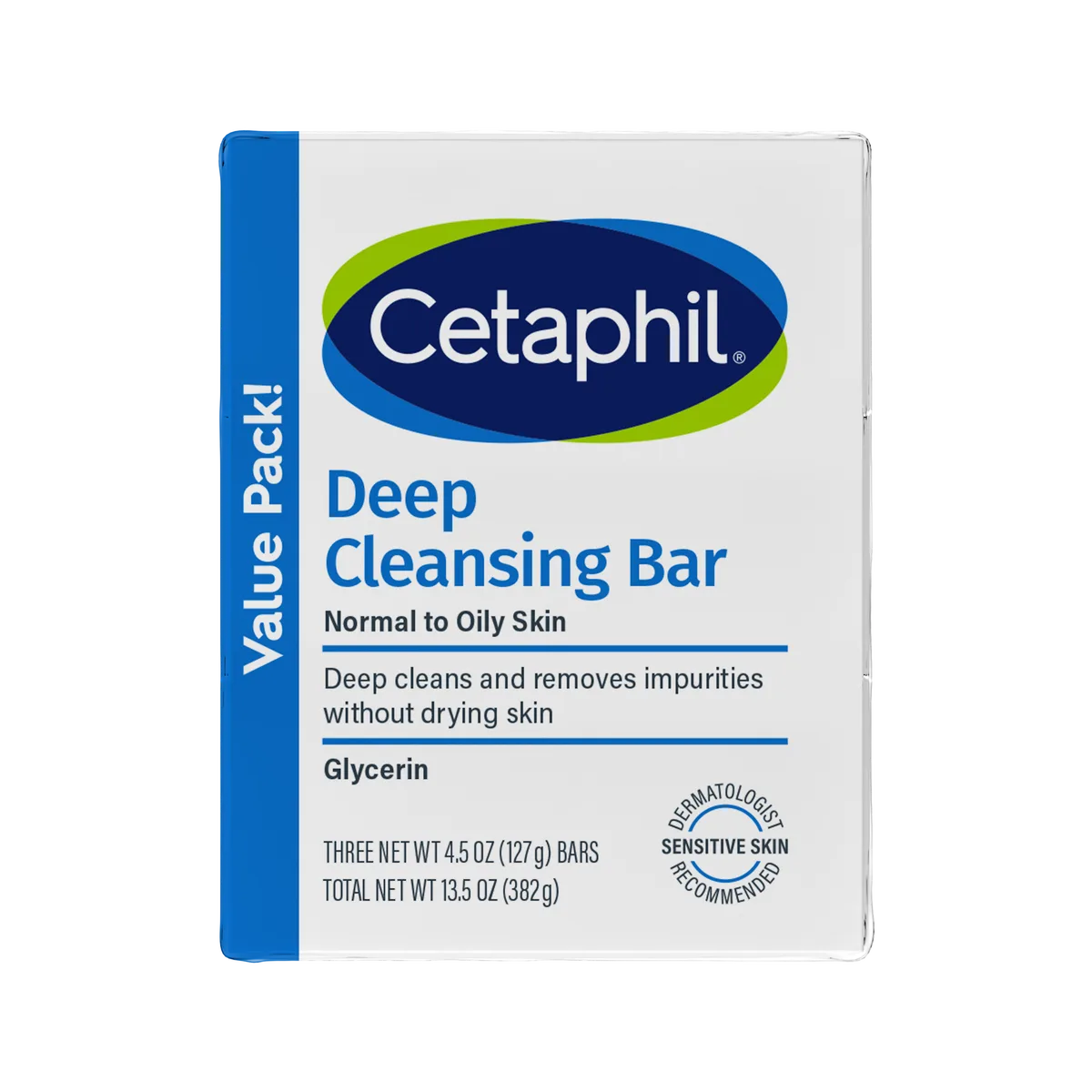
Deep Cleansing Bar
Soap-Free Switch Pick
 Verified reviewer
Pros & cons.
- +SCI syndet formula cleanses at a skin-friendly pH unlike traditional soap bars at pH 9-10
- +Rich, creamy lather satisfies the bar-cleansing experience without barrier disruption
- +Petrolatum and butyl avocadate conditioning system prevents post-wash tightness
- +Versatile for both face and body use — simplifies the shower routine
- +Exceptional value at roughly $4 per bar in the 3-pack for 4-6 weeks of use
- +Sulfate-free and paraben-free with a dermatologist-tested formulation
- −Contains fragrance despite being marketed for sensitive skin — an unnecessary addition
- −Not vegan — sodium tallowate is derived from animal fat
- −Bar softens and dissolves quickly when stored in wet conditions
- −Contains BHT, a preservative that can trigger contact dermatitis in sensitive individuals
- −Not suitable for fungal acne due to stearic acid and butyl avocadate content
The full review.
In September 2017, the FDA banned triclosan in consumer wash products due to antimicrobial resistance and potential hormonal disruption. This created an existential regulatory moment for the pharmacy-aisle staple Cetaphil’s Antibacterial Gentle Cleansing Bar. Cetaphil rebuilt the formula from the ground up; the resulting Deep Cleansing Bar is a different and arguably superior product to its predecessor.
The reformulation relies on sodium cocoyl isethionate, or SCI, the surfactant that distinguishes modern syndet bars from traditional soap. A study in the Journal of the Society of Cosmetic Chemists shows SCI micelles are too large to penetrate skin’s aqueous pores. This molecular property allows the bar to remove surface oil and grime without pulling moisture from deeper skin layers. Traditional soap saponifies at pH 9-10 and disrupts the stratum corneum lipid matrix. The difference is significant: it is the difference between hosing a car and stripping its paint.
The lather is a highlight. Many syndet bars produce thin, watery foam. Cetaphil’s formula creates a dense, creamy lather that meets expectations for bar cleansing—thick enough to feel effective, but without the squeaky-clean feeling that signals barrier damage. It rinses completely with no soapy film or slippery residue. Your skin feels clean, not aggressively clean.
A conditioning system works within the lather. Petrolatum—the most proven occlusive in dermatology with over a century of clinical use—deposits a thin protective layer to prevent excessive transepidermal water loss. Butyl avocadate, an emollient from avocado oil, adds skin-softening properties uncommon in bar cleansers at this price point. Most bars are purely subtractive; this one adds something back.
The bar’s versatility is a practical advantage. It works on both face and body. It handles the oily T-zone, the back, underarms, and post-gym full-body rinses, simplifying the shower without losing gentleness. For minimalists who find twelve-product shower routines absurd, this bar provides sanity.
The formula has imperfections. The inclusion of fragrance—labeled as masking fragrance in some versions and plain fragrance in others—is unnecessary for a product targeting sensitive skin. The scent is faint and the irritation risk is low, but it is an extra addition. Cetaphil’s own Gentle Skin Cleanser liquid works without it.
Sodium tallowate—rendered animal fat—provides structural integrity and helps the lather. However, this makes the product unsuitable for vegan consumers, a segment Cetaphil’s brand positioning could otherwise serve. This choice prioritizes bar performance over ingredient inclusivity.
BHT, used as an antioxidant preservative in the latest version, is another minor flag. While generally well-tolerated, BHT is a known contact allergen for some sensitive individuals. In a twenty-one-ingredient formula containing fragrance, tallow, and BHT, the ingredient list has more risks than a sensitive-skin-first product should have.
The bar’s main weakness is its relationship with water. In a wet soap dish, it softens and dissolves faster than traditional soap—a trait of syndet bars generally, not just Cetaphil. A well-draining soap dish or soap saver bag is mandatory. This adds a small requirement that liquid cleansers do not.
Value is a strength. At roughly four dollars per bar in the three-pack, lasting four to six weeks of daily face-and-body use, the cost-per-wash is negligible. Because one bar replaces both facial cleanser and body wash, the economics are even better. It is one of the most efficient ways to switch from traditional soap to a product that respects the skin barrier.
The Deep Cleansing Bar fills a specific niche in the Cetaphil lineup for people who prefer bars. If you prefer liquid cleansers, Cetaphil makes those. If your skin is dry or eczema-prone, the Gentle Cleansing Bar is better. But for normal-to-oily skin seeking simplicity, zero-waste appeal, and thorough cleaning without dryness, this bar earns its place.
Ingredient analysis.
Full INCI list
Sodium Cocoyl Isethionate, Stearic Acid, Sodium Tallowate, Water, Sodium Cocoate, Sodium Stearate, Glycerin, Sodium Chloride, PEG-20, Titanium Dioxide, Sodium Isethionate, Fragrance, Petrolatum, Sodium Gluconate, Butyl Avocadate, Sodium Isostearoyl Lactylate, Sucrose Cocoate, Tetrasodium Glutamate Diacetate, Tocopherol, BHT, Sodium Ferrocyanide
Skin match.
The science.
The Science
Decades of clinical evidence favor syndet bars over traditional soap. sodium cocoyl isethionate — the backbone of this formula — is the most studied mild surfactant in the syndet category.
A 2007 study in the Journal of the Society of Cosmetic Chemists investigated why SCI is inherently mild to the skin barrier. Researchers found that SCI forms micelles too large to penetrate the skin's aqueous pores. This allows it to solubilize and remove surface sebum and particulate matter without disrupting the intercellular lipid matrix of the stratum corneum. Traditional soap surfactants form smaller micelles that penetrate and extract barrier lipids, causing the typical tightness and dryness after washing.
Clinical comparative studies confirm this. A 2001 study comparing classical bar soap to a syndet cleansing bar found traditional soap was significantly more irritating in both normal-use conditions and controlled soap chamber testing. A 2006 dermatology journal study examined 50 subjects with mild atopic dermatitis using syndet bars for 28 days. Syndet use reduced eczema severity scores and maintained skin hydration — a result counterintuitive for traditional soap.
The petrolatum in this formula adds evidence-based barrier support. Research shows petrolatum is an occlusive agent that reduces transepidermal water loss by over 98% when applied at sufficient thickness. In a rinse-off context, the deposited layer is thinner, but it still provides measurable barrier protection that mitigates the drying potential of any surfactant-based cleansing.
A 2009 cross-over tolerability trial comparing syndet bars with different SCI ratios confirmed that higher SCI concentration correlates with better skin tolerance. This supports the decision to list SCI as the first ingredient in this bar.
References
- Why is sodium cocoyl isethionate (SCI) mild to the skin barrier? — Journal of the Society of Cosmetic Chemists (2007)
- A comparative study of the effects on the skin of a classical bar soap and a syndet cleansing bar — Dermatology (2001)
- Benefits of mild cleansing: synthetic surfactant-based (syndet) bars for patients with atopic dermatitis — Dermatology (2006)
- In-use tolerability of two new syndet bars with sodium cocoyl isethionate — Journal of the American Academy of Dermatology (2009)
Dermatologist Perspective
Dermatologists often recommend syndet bars over traditional soap for patients with sensitive or reactive skin, and this bar fits that category. Board-certified dermatologists suggest it for patients who prefer bar cleansers but must avoid the high-pH disruption of conventional soap. Dermatological literature recognizes the SCI surfactant system as the gold standard for gentle bar cleansing. Clinicians value its versatility as a face-and-body product that simplifies routines for patients. However, dermatologists treating highly reactive skin or confirmed fragrance allergies typically suggest Cetaphil's fragrance-free liquid options instead.
Where it fits in your routine.
Wet the bar and hands with lukewarm water. Lather the bar in your palms to make foam — do not rub the bar directly on facial skin. Apply the lather to your face in gentle circular motions, then rinse thoroughly. For body use, apply the bar directly or lather it on a washcloth. Rinse well. Store in a well-draining soap dish between uses so it does not soften. Use morning and evening for facial cleansing, or once daily for combined face-and-body use in the shower.
The Deep Cleansing Bar offers high value in the three-pack format at about $11.49 for three 4.5 oz bars — roughly $3.83 per bar. Each bar lasts 4-6 weeks with daily face-and-body use, making the cost per wash cents. Even as a single bar at $5.99, it is a strong value for a dermatologist-recommended syndet formula. Galderma's pharmaceutical heritage ensures formulation rigor that many premium bar cleansers costing two to three times more lack. The dual face-and-body utility increases the value — one bar replaces two separate products.
Looking to switch from traditional soap to a gentler bar format? This works for normal-to-oily skin types wanting a thorough clean, shower minimalists using one product for face and body, and budget-conscious consumers seeking dermatologist-backed quality at drugstore pricing.
People with very dry or eczema-prone skin should use Cetaphil's Gentle Cleansing Bar or a cream cleanser. Vegan consumers should avoid this because of the sodium tallowate. Anyone with confirmed fragrance allergies should use Cetaphil's fragrance-free liquid cleansers. Those with fungal acne should avoid this due to the stearic acid and butyl avocadate content.
Product details.
A solid white bar that makes a thick, creamy lather when rubbed between wet hands. This lather is denser than many syndet bars, which often produce thin, watery foam. It rinses cleanly without soapy residue.
Contains masking fragrance that smells faintly clean. It is not strongly perfumed but is detectable, like neutral soap rather than truly unscented. The scent does not stay on skin after rinsing.
A white rectangular bar sits in a cardboard box with Cetaphil's standard teal and white clinical branding. The 3-pack uses a slightly larger cardboard sleeve. The packaging is basic and functional without premium design elements. The box is recyclable.
The first use feels like a gentle cleansing bar. The lather is thick but rinses softly, avoiding the tight, squeaky-clean feeling of traditional soap. Users switching from regular soap notice the difference immediately. No adjustment period is needed.
4-6 weeks per bar with daily face and body use
12 months
All Year
The backstory.
This bar evolved from Cetaphil's earlier Antibacterial Gentle Cleansing Bar, which contained triclosan — an ingredient the FDA banned from OTC antiseptic wash products in 2017 due to concerns about antimicrobial resistance and hormonal effects. Rather than simply removing triclosan, Galderma reformulated the bar around a modern syndet system with conditioning ingredients, effectively creating a better product from a regulatory setback.
About Cetaphil
Legacy Brand (20+ years)Pharmacist Erwin S. Whiting created Cetaphil in 1947. Galderma, a Swiss dermatological pharmaceutical company, owns the brand now. Dermatologists worldwide frequently recommend Cetaphil, which has nearly eight decades of clinical trust.
Common myths.
Bar cleansers dry and irritate skin more than liquid cleansers.
Traditional soap bars saponify at pH 9-10. This syndet bar uses sodium cocoyl isethionate at a lower pH. Clinical studies show syndet bars are as mild as or milder than many liquid cleansers. Surfactant chemistry, not the format, determines gentleness.
Sharing a bar of soap spreads bacteria between family members.
Studies show bacteria on bar soap do not transfer to users during normal hand washing. The surfactants in the lather — especially SCI in this syndet formula — disrupt bacterial membranes during cleansing.
What the community says.
"Gentle enough for sensitive skin while still providing a thorough clean"
"Rich, satisfying lather that rinses completely without residue"
"Skin feels soft and hydrated after use rather than tight and stripped"
"Excellent value especially in the 3-pack at roughly $4 per bar"
"Versatile for both face and body cleansing"
"Does not aggravate acne or cause new breakouts"
"Contains masking fragrance despite sensitive skin marketing — confuses consumers"
"Bar dissolves and gets mushy quickly when left in wet shower conditions"
"Can still feel drying for those with very dry or eczema-prone skin"
"Not vegan — contains sodium tallowate derived from animal fat"
"Some longtime users preferred the older antibacterial formula with triclosan"
People also looked at.