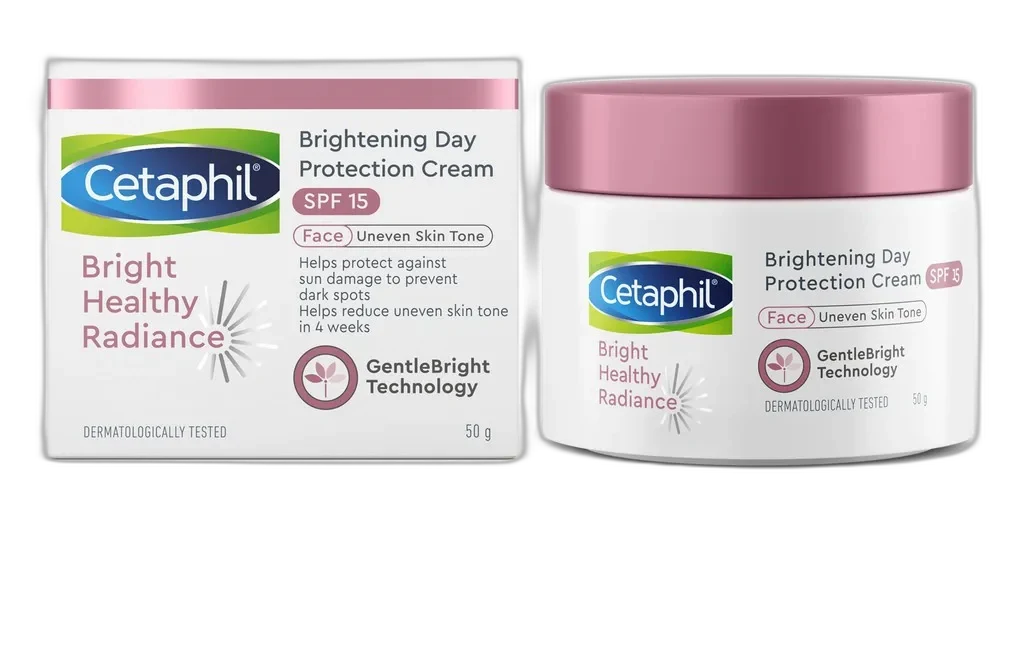
Bright Healthy Radiance Brightening Day Protection Cream SPF 15
Gentle Brightener
 Verified reviewer
Pros & cons.
- +Triple anti-pigmentation pathway targets melanin through three different mechanisms simultaneously
- +Niacinamide high in the formula provides well-established brightening backed by clinical research
- +Gentle enough for sensitive skin with a dermatologist-tested, fragrance-free formulation
- +Xylitol complex promotes aquaporin channels for deeper hydration beyond surface moisturizing
- +Published clinical survey shows measurable brightening results in nearly half of patients
- +Vegan formula consistent with Cetaphil's 75-year heritage of effective gentleness
- −SPF 15 is insufficient as standalone sun protection, especially for a hyperpigmentation-targeting product
- −Contains octinoxate, an older UV filter with endocrine disruption and reef safety concerns
- −Can feel sticky or greasy on oily skin types especially in humid climates
- −Jar packaging is less hygienic than tube or pump alternatives
- −Not available in the US market — requires import purchasing at a premium
The full review.
About Cetaphil
Cetaphil has spent seventy-five years building a reputation on one word: gentle. So when the brand decided to tackle hyperpigmentation — a condition that most effective treatments address with aggressive ingredients like hydroquinone, high-concentration acids, or potent retinoids — it faced an identity question. How do you fight dark spots without abandoning the gentleness that defines you?
About the Product
The Bright Healthy Radiance Brightening Day Protection Cream SPF 15 is Cetaphil’s answer, and it is a characteristically cautious one. Rather than deploying a single powerful active at a high concentration, the formula layers three distinct anti-pigmentation pathways under what Cetaphil calls GentleBright Technology. The idea is that multiple gentle interventions, working on different steps of the melanin production process simultaneously, can collectively achieve meaningful results without individual irritation.
Active Ingredients
Niacinamide leads the charge, positioned fourth in the INCI list — a concentration that likely places it in the 3-5% range. Its mechanism is well-established: it inhibits the transfer of melanosomes from melanocytes to surrounding keratinocytes, effectively intercepting pigment after it has been produced but before it reaches the skin surface. A 2002 study published in the British Journal of Dermatology demonstrated that 5% niacinamide significantly decreased hyperpigmentation after four weeks through this mechanism.
Pancratium Maritimum — sea daffodil extract — attacks earlier in the melanin pathway, inhibiting tyrosinase, the enzyme that catalyzes the first steps of melanin synthesis. Research has shown this extract can reduce melanin production by 29-65% depending on stimulation conditions. Tricholoma matsutake, the matsutake mushroom extract, adds a third pathway through kojic acid derivatives. Three different approaches to the same problem, each gentle enough to use daily.
Hydration
The xylitol complex — xylitylglucoside, xylitol, and anhydroxylitol — provides hydration through an interesting mechanism. These plant-derived sugars promote aquaporin water channels in the skin, drawing moisture from deeper layers rather than just sitting on the surface. Combined with glycerin and the olive-derived emulsifier system, the result is a cream that moisturizes meaningfully rather than simply coating.
Texture
The texture is medium-weight — richer than a lotion but not as dense as a night cream. On normal to dry skin, it absorbs comfortably within a minute or two. On oily skin, particularly in humid environments, it can feel sticky and leave an unwanted sheen. This is not an ultra-light formula, and users who need a matte finish for oily skin will find it too heavy.
SPF
Now for the elephant in the room: SPF 15. For a brightening product specifically designed to address hyperpigmentation and dark spots, this level of sun protection is a significant compromise. UV radiation is the primary trigger for melanin overproduction. Every dermatologist treating hyperpigmentation prescribes SPF 30 at minimum, often SPF 50. Using a brightening cream with SPF 15 is like watering a garden while leaving half the hose leaking — you are addressing the symptom while not fully controlling the cause.
UV Filters
The UV filter system itself raises additional questions. Ethylhexyl methoxycinnamate — commonly known as octinoxate — is an older-generation UV filter that has drawn scrutiny for potential endocrine disruption and reef damage. Several jurisdictions have restricted or banned it, and many consumers actively avoid it. Its inclusion in a 2020-launched product feels like a formulation decision made for texture and cost rather than for modern safety standards.
Availability
Availability is another consideration. This SPF 15 version is sold primarily in international markets — the UK, India, Southeast Asia, and the Middle East. The US market receives a different reformulation called the Healthy Radiance Whipped Day Cream SPF 30, which addresses both the SPF gap and uses different UV filters. US-based consumers can purchase the SPF 15 version through import retailers, but the price premium and shipping complexity make the domestic alternative more practical.
Clinical Data
The clinical data supporting this product is encouraging if modest. A published survey of 203 healthcare professionals in the International Journal of Research in Dermatology found that 48.7% of patients showed major improvement in brightness, and 47.2% of HCPs rated the product’s efficacy as excellent. These are respectable numbers for a gentle brightening product, though the survey’s sponsorship by Galderma should be noted.
Who Should Buy
For the right user — someone with normal to dry skin, mild to moderate hyperpigmentation, and sensitivity that precludes stronger actives — this cream fills a genuine gap. The triple-pathway approach is smart, the formulation is gentle, and Cetaphil’s legacy of sensitive-skin expertise provides credibility. But the SPF 15 limitation is a structural weakness in a product category where sun protection is not optional, and the inclusion of octinoxate feels dated for a formulation that launched in 2020.
Conclusion
The Cetaphil Bright Healthy Radiance cream is a product of caution — the good kind (gentle actives, botanical approach) and the limiting kind (insufficient SPF, older UV filters). It represents what Cetaphil does well: careful, measured skincare that prioritizes not making things worse. Whether that caution serves you depends on whether your hyperpigmentation needs a gentle whisper or a confident intervention.
Ingredient analysis.
Full INCI list
Aqua, Homosalate, Ethylhexyl Methoxycinnamate, Niacinamide, Ethylhexyl Salicylate, Cetearyl Alcohol, Glycerin, Isoamyl p-Methoxycinnamate, Butyl Methoxydibenzoylmethane, Octocrylene, Dipropylene Glycol, Cetearyl Olivate, Sorbitan Olivate, 1,2-Hexanediol, Acrylates/C10-30 Alkyl Acrylate Crosspolymer, Anhydroxylitol, Caprylyl Glycol, Disodium EDTA, Ethylhexylglycerin, Glyceryl Stearate, Hydrolyzed Cicer Seed Extract, Pancratium Maritimum Extract, Potassium Cetyl Phosphate, Rhododendron Chrysanthum Leaf Extract, Sodium Hydroxide, Tricholoma Matsutake Extract, Xylitol, Xylitylglucoside
Skin match.
The science.
The Science
The brightening strategy in this cream relies on interrupting melanin production at three distinct points in the pathway, an approach that maximizes efficacy while minimizing the concentration — and therefore the irritation potential — of each individual active.
Niacinamide's role in hyperpigmentation treatment is among the most well-documented in cosmetic dermatology. A 2002 study published in the British Journal of Dermatology demonstrated that 5% niacinamide significantly decreased hyperpigmentation by inhibiting melanosome transfer from melanocytes to keratinocytes. A separate 2004 study in the International Journal of Cosmetic Science confirmed that topical niacinamide reduces hyperpigmented spots, yellowing, and skin blotchiness over 12 weeks. Importantly, niacinamide does not inhibit melanin production itself — it intercepts the delivery of completed melanin to surrounding cells, which is why pairing it with tyrosinase inhibitors creates a complementary dual-pathway approach.
Pancratium Maritimum (sea daffodil) extract targets tyrosinase, the rate-limiting enzyme in melanogenesis. Research on this extract has demonstrated melanin synthesis inhibition of 29% in unstimulated conditions and 32-65% when melanogenesis is actively stimulated — the conditions most relevant to sun-triggered hyperpigmentation. This mechanism operates upstream of niacinamide's action, creating a sequential blockade: melanin production is reduced at the source, and what melanin is produced is less efficiently delivered to visible skin cells.
The xylitol-based hydration complex (xylitylglucoside, xylitol, anhydroxylitol) has been studied for its ability to stimulate aquaporin 3 expression in keratinocytes. Aquaporins are membrane proteins that facilitate water transport across cell membranes, and their upregulation promotes hydration from within rather than relying solely on topical occlusion — a mechanism distinct from conventional humectants like glycerin.
A 2024 survey published in the International Journal of Research in Dermatology evaluated this specific product line across 203 healthcare professionals and their patients, finding that 48.7% of patients showed major improvement in brightness and 45.8% achieved even skin tone. While this is manufacturer-sponsored research, the publication in a peer-reviewed dermatology journal provides a baseline of clinical credibility.
References
- The effect of niacinamide on reducing cutaneous pigmentation and suppression of melanosome transfer — British Journal of Dermatology (2002)
- Topical niacinamide reduces yellowing, wrinkling, red blotchiness, and hyperpigmented spots in aging facial skin — International Journal of Cosmetic Science (2004)
- Niacinamide and sea daffodils-based bright healthy radiance product range for dark spots: a survey of Indian dermatologists' views and patient insights — International Journal of Research in Dermatology (2024)
Dermatologist Perspective
Dermatologists view this cream as a gentle entry point into brightening for patients with sensitive skin who cannot tolerate hydroquinone, high-concentration vitamin C, or retinoids. Board-certified dermatologists note that the multi-pathway approach — combining melanosome transfer inhibition with tyrosinase inhibition — is sound in principle and avoids the rebound hyperpigmentation risk associated with stronger agents. However, dermatologists consistently point out that the SPF 15 rating is a significant limitation for a hyperpigmentation-targeting product, and most recommend applying an additional SPF 30 or higher sunscreen over this cream for adequate photo-protection.
Where it fits in your routine.
Apply a moderate amount to clean, dry skin as your last morning skincare step. Spread it evenly over the face and neck, but avoid the eye area. Wait one to two minutes for absorption before you apply makeup. Apply a dedicated SPF 30 or higher sunscreen over this cream for sun protection, especially if you spend time outdoors. Use it every morning for brightening results — the botanical actives work cumulatively over weeks.
In native international markets, this cream costs about eighteen to twenty-two dollars for 50 grams. This price is reasonable for a multi-active brightening SPF cream from a legacy dermatological brand. For US consumers buying through import retailers at twenty-six to thirty-five dollars, value drops, especially since the domestically available Cetaphil Healthy Radiance Whipped Day Cream SPF 30 offers higher sun protection for a similar price. The 50g jar lasts about eight to ten weeks with daily use.
People with normal to dry, sensitive skin and mild to moderate hyperpigmentation need a gentle approach. This works for anyone who cannot tolerate hydroquinone, high-concentration acids, or aggressive brightening treatments, and wants a convenient two-in-one moisturizer with basic sun protection. It is best for international markets where it is readily available.
SPF 15 fails to treat hyperpigmentation effectively; users need robust sun protection. Oily skin types will find the cream texture too heavy and sticky. US-based consumers have easier access to the reformulated SPF 30 version. People avoiding octinoxate for environmental or health concerns will also skip this.
Product details.
This medium-weight cream feels silky when applied in small amounts. Over-application makes it sticky or greasy, especially in humid environments. The UV filters leave a slight white cast that blends in within a minute.
Fragrance-free. The UV filters add a faint chemical or medicinal note. It has no strong scent.
White plastic jar has a screw-top lid and protective inner seal. White and gold branding matches the Bright Healthy Radiance line. The jar format requires finger-dipping, making it less hygienic than a tube or pump.
Skin feels moisturized and slightly luminous after one application. The cream absorbs in one to two minutes and leaves a satin-dewy finish. Most users feel no tingling or irritation. Brightening effects build over time and show after several weeks of consistent use.
8-10 weeks with daily morning application
12 months
All Year
The backstory.
Cetaphil launched the Bright Healthy Radiance line in late 2020 to address hyperpigmentation — one of the most common skincare concerns globally, particularly in Asian, Middle Eastern, and African markets where the line is primarily sold. Rather than using harsh bleaching agents, Cetaphil developed their GentleBright Technology around botanical extracts and niacinamide, staying true to the brand's seven-decade identity of effective gentleness.
About Cetaphil
Legacy Brand (20+ years)Galderma, a major dermatological pharmaceutical company, owns Cetaphil, which launched in 1947. Dermatologists have recommended the brand for over 75 years. It is one of the most recognized names in gentle, sensitive-skin skincare worldwide.
Common myths.
SPF 15 is enough for daily sun protection
SPF 15 blocks about 93% of UVB rays. It is better than no protection, but dermatologists generally recommend SPF 30 as the daily minimum. Higher SPF is vital for brightening products targeting hyperpigmentation because UV exposure is the primary trigger for dark spot formation. This cream works best when layered with additional sun protection.
Brightening products bleach the skin
The actives in this formula — niacinamide, sea daffodil extract, and matsutake mushroom extract — regulate melanin production and distribution instead of bleaching or stripping existing pigment. They help the skin return to its natural, even tone over time rather than lightening it below its baseline.
FAQ.
Does the Cetaphil Bright Healthy Radiance cream actually reduce dark spots?
Clinical surveys show 48.7% of patients saw major improvement in skin brightness during the study. The formula uses three anti-pigmentation pathways — niacinamide, sea daffodil extract, and matsutake mushroom extract — to target melanin production and distribution. Results are gradual and show after four to eight weeks of consistent daily use.
Is SPF 15 enough in the Cetaphil Brightening Day Cream?
SPF 15 offers moderate UVB protection and blocks about 93% of UVB rays. Most dermatologists recommend SPF 30 as the daily minimum, especially for those treating hyperpigmentation, because UV exposure triggers dark spot formation. Use this cream as a base layer, then apply additional sunscreen for extended outdoor exposure.
Is the Cetaphil Bright Healthy Radiance cream available in the US?
The SPF 15 version sells mainly internationally — in the UK, India, Southeast Asia, and the Middle East. The US market uses a reformulated Healthy Radiance Whipped Day Cream SPF 30, which has different UV filters and a different texture. You can buy the SPF 15 version through online import retailers.
Can I use the Cetaphil Brightening cream on sensitive skin?
Yes — the formula is dermatologist-tested, hypoallergenic, and fragrance-free, matching Cetaphil's sensitive skin heritage. The GentleBright Technology uses botanical brightening agents instead of aggressive chemical lighteners. However, chemical UV filters may irritate some very sensitive skin types, so a patch test is recommended.
How long does it take to see results from the Cetaphil Brightening cream?
Most users see skin tone and brightness improve within four weeks of daily use. Dark spot reduction and even skin tone show more progress over eight to twelve weeks. Use it daily — the botanical brightening actives work via melanin regulation, not instant bleaching.
What the community says.
"Effective at brightening skin tone and reducing dark spots within four to eight weeks"
"Gentle and non-irritating for sensitive skin types"
"Good moisturizing properties with the xylitol hydration complex"
"Convenient two-in-one brightening moisturizer with sun protection"
"Vegan formula with no added fragrance"
"Good value compared to premium brightening products"
"SPF 15 is too low for adequate standalone sun protection"
"Can feel sticky or greasy especially in hot and humid climates"
"Thick consistency is not ideal for oily skin types"
"Jar packaging is less hygienic than a tube or pump"
"Contains octinoxate which raises reef safety and endocrine concerns"
"Brightening results are modest rather than dramatic"
People also looked at.