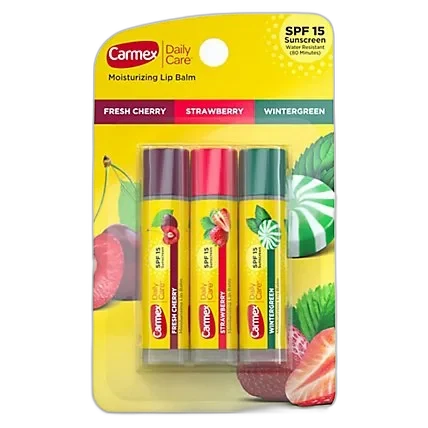
Daily Care Lip Balm SPF 15
Everyday SPF Lip Protection
 Verified reviewer
Pros & cons.
- +Affordable SPF lip protection at roughly $3 per stick
- +Smooth, comfortable texture without the medicated tingle of Classic Carmex
- +Petrolatum and lanolin base provides proven occlusive moisture protection
- +Water resistant for up to 80 minutes during outdoor activities
- +Available in multiple pleasant flavors for all-day comfortable wear
- +Widely available at virtually every drugstore and grocery chain
- −Contains oxybenzone, a controversial UV filter banned in several jurisdictions
- −SPF 15 provides only moderate protection with limited UVA coverage
- −Lanolin may cause allergic reactions in sensitive individuals
- −Not reef-safe due to oxybenzone and octinoxate content
- −Artificial flavors may irritate those with flavor sensitivities
The full review.
For decades, Carmex meant one thing: the tingling, medicinal yellow-capped lip balm in your grandmother’s purse. The brand launched the Daily Care line in 2016 to broaden its identity. It aims to offer an everyday lip balm to compete with the Burt’s Bees and Blistex products that dominate the non-medicated SPF lip care shelf. The result gets the basics right but uses a formulation choice that is hard to defend.
The good news: the base formula is classic Carmex. Petrolatum leads the inactive ingredients, providing the same proven occlusive protection that made the brand a pharmacist favorite for decades. Lanolin adds deep conditioning, cocoa butter provides thickness, and meadowfoam seed oil offers plant-based emolliency. The texture is smoother and lighter than Classic Carmex, designed for all-day wear rather than intensive treatment. There is no camphor tingle, no menthol cooling, and no medicinal scent. It is lip balm, not lip medicine.
The flavors—Strawberry, Wintergreen, Fresh Cherry, and rotating seasonal options—are pleasant, not cloying. Stevia extract adds subtle sweetness. If you apply lip balm ten times a day (and research suggests SPF lip balm users should reapply at least that often), a flavor you tolerate matters.
The issue is oxybenzone. At 4%, it is the secondary UV filter behind octinoxate at 7.50%. Together, they provide SPF 15 broad-spectrum protection. However, oxybenzone is a controversial sunscreen ingredient. Hawaii, Key West, Palau, and the U.S. Virgin Islands banned it due to demonstrated coral reef toxicity. A 2020 FDA study showed it was absorbed systemically at levels exceeding the agency’s safety threshold after full-body application. Also, you will inevitably ingest small amounts of a lip product when you eat, drink, or lick your lips.
To be clear: evidence of harm from oxybenzone at typical lip balm exposure levels is not established. The systemic absorption studies used full-body application. Endocrine disruption data mostly comes from animal studies at higher concentrations. But the industry is moving away from oxybenzone, and consumers actively avoid it. For a product launched in 2016—not 2006—choosing oxybenzone over a newer UV filter or mineral alternative is a missed opportunity.
The SPF 15 rating matters. SPF 15 blocks roughly 93% of UVB rays, while SPF 30 blocks 97%. For daily activities like commuting, errands, or desk work near a window, it is adequate. But lips are vulnerable to UV damage (lip cancer accounts for approximately 0.6% of all cancers in the United States, and the lower lip is 12 times more likely to develop cancer than the upper lip due to sun exposure). The limited UVA coverage of this filter combination provides only partial protection.
The 80 minutes of water resistance is useful for outdoor activities, though eating and drinking limit the durability of any lip product. In real-world use, reapply every hour during active outdoor time.
At roughly $3 for a stick or lower per-unit costs in multi-packs, Carmex Daily Care is one of the cheapest SPF lip products available. It costs the same as plain lip balm, making the SPF essentially free. If you choose between this and an unprotected lip balm at the same price, the SPF lip balm wins; even imperfect protection beats none.
If you want SPF lip protection and will spend more, the market has moved on. Mineral SPF lip balms using zinc oxide or titanium dioxide are widely available, offer broader UV protection, and avoid the oxybenzone controversy. Carmex Daily Care moisturizes and provides SPF 15, but its formulation felt behind the curve at launch and feels more so now.
Ingredient analysis.
Full INCI list
Active Ingredients: Octinoxate 7.50%, Oxybenzone 4.00%. Inactive Ingredients: Petrolatum, Lanolin, Isopropyl Palmitate, Ceresin, Yellow Wax, Cetyl Esters Wax, Paraffin, Theobroma Cacao Seed Butter, Limnanthes Alba (Meadowfoam) Seed Oil, Flavor, Stevia Rebaudiana Extract
Skin match.
The science.
The Science
The octinoxate (7.50%) and oxybenzone (4.00%) UV filter combination provides SPF 15 broad-spectrum protection by absorbing UV radiation. Octinoxate absorbs UVB (280-320 nm) mainly, while oxybenzone absorbs across UVB and UVA2 (320-340 nm) ranges. Neither filter provides substantial UVA1 (340-400 nm) protection, which causes deeper skin damage, photoaging, and melanoma risk.
Regulators and scientists increasingly scrutinize oxybenzone. A 2020 FDA maximal usage trial in JAMA showed oxybenzone systemic absorption at concentrations above the FDA's 0.5 ng/mL threshold after one application, with plasma concentrations staying high for days. These studies used generous body-wide application instead of lip balm use, but they led the FDA to request more oxybenzone safety data.
The environmental profile of oxybenzone is more certain. Research by Downs et al. in Archives of Environmental Contamination and Toxicology (2016) showed oxybenzone induces coral bleaching, damages coral DNA, and disrupts coral reproduction at concentrations in coastal waters — causing legislative bans in Hawaii (effective 2021) and other reef-adjacent jurisdictions.
Lip products have a different exposure pathway than body sunscreen: lip balm is ingested through eating, drinking, and lip-licking, alongside dermal absorption. The total ingested quantity is small, but this oral exposure route is unique to lip products and existing dermal safety studies do not fully capture it.
References
- Effect of Sunscreen Application on Plasma Concentration of Sunscreen Active Ingredients: A Randomized Clinical Trial — JAMA (2020)
- Toxicopathological Effects of the Sunscreen UV Filter, Oxybenzone (Benzophenone-3), on Coral Planulae and Cultured Primary Cells — Archives of Environmental Contamination and Toxicology (2016)
Dermatologist Perspective
Board-certified dermatologists often steer patients away from oxybenzone-containing products, especially children and pregnant individuals. The lip balm application area is small and systemic exposure is low, but dermatologists note that effective oxybenzone-free alternatives are widely available, making the risk-benefit calculus less favorable for formulations that include it. Dermatologists also note lips are a high-risk site for actinic damage and squamous cell carcinoma, particularly the lower lip, and recommend SPF 30+ lip protection for patients with a history of sun exposure or lip lesions.
Where it fits in your routine.
Apply liberally to lips 15 minutes before sun exposure. Reapply at least every two hours, and immediately after eating, drinking, swimming, or toweling off. Use a lip product with higher SPF for extended outdoor activities. The twist-up stick format allows hygienic, mess-free application. Store at room temperature to keep the texture optimal.
Carmex Daily Care is the cheapest SPF lip protection on the market at approximately $3 per stick, with multi-packs costing even less. The price gap between this and an unprotected lip balm is negligible. It is an easy choice for anyone wanting lip sun protection without thought. However, mineral SPF lip balms from brands like Sun Bum and Burt's Bees cost $4-6 and avoid oxybenzone concerns — a small premium for a cleaner UV filter profile.
Budget-conscious consumers want basic daily SPF lip protection without the medicinal tingle of Classic Carmex. It works for anyone wanting a flavored, comfortable-wearing lip balm with sun protection for regular daily activities.
This works for people avoiding oxybenzone for health or environmental reasons, those with lanolin or fragrance allergies, pregnant individuals avoiding chemical UV filters, and anyone needing UVA protection for high-exposure activities.
Product details.
This waxy stick feels slightly softer than the Classic medicated formula. It glides on without tugging. The texture is less thick and coating than the jar version, as it targets everyday comfort instead of intensive treatment.
Strawberry, Wintergreen, Fresh Cherry, and seasonal varieties are available. The scents and flavors are light and present without being overwhelming.
A standard twist-up lip balm stick in Carmex's signature branding. Carmex sells these individually or in multi-flavor packs. The size is compact and pocket-friendly.
It applies smoothly with a light, pleasant flavor. This formula lacks the camphor and menthol found in the Classic version, so it has no medicated tingle. The lips feel moisturized immediately with a comfortable, non-greasy coating. The difference from Classic Carmex is noticeable immediately.
1-2 months with regular daily use
12 months
All Year
The backstory.
Launched in 2016, the Daily Care line represents Carmex's first major expansion beyond its iconic medicated formula. Recognizing that many consumers wanted everyday SPF lip protection without the camphor and menthol tingle, Carmex developed a gentler formula in flavored varieties that could serve as daily-wear lip balm rather than a treatment product.
About Carmex
Legacy Brand (20+ years)Alfred Woelbing founded Carmex in 1937 in Wauwatosa, Wisconsin. The company has stayed family-owned for nearly 90 years. The Daily Care line launched in 2016, adding everyday SPF protection and flavored options to the classic medicated formula.
Common myths.
SPF 15 on lips is enough for extended sun exposure.
SPF 15 blocks about 93% of UVB rays, which covers incidental daily exposure. Dermatologists recommend SPF 30+ for lip and facial protection during extended outdoor time. This formula also has limited UVA coverage, so protection against photoaging and deeper UV damage is incomplete.
Chemical sunscreens in lip balm absorb into the body at dangerous levels.
A 2019 JAMA study shows chemical UV filters enter the system when applied to large skin areas, but lip balm covers a very small surface area. However, eating and drinking causes frequent ingestion of lip balm, a unique exposure pathway body sunscreens do not have.
FAQ.
Does Carmex Daily Care have the same tingle as Classic Carmex?
No — Daily Care lacks camphor, menthol, phenol, or salicylic acid, so it doesn't have the medicated tingle found in Classic Carmex. It is a gentler, everyday lip moisturizer with SPF instead of a medicated treatment.
Is Carmex Daily Care reef-safe?
No — this formula uses 4% oxybenzone. This chemical UV filter links to coral reef damage and is banned from sunscreen products in Hawaii and Key West. For reef safety, use mineral (zinc oxide or titanium dioxide) lip balms.
Can I use Carmex Daily Care SPF 15 during pregnancy?
Some studies flag Oxybenzone as a potential endocrine disruptor, so some healthcare providers recommend avoiding it during pregnancy. The lip balm application area is small, but pregnant individuals concerned about chemical UV filters may prefer mineral-based SPF lip products. Consult your healthcare provider for personalized guidance.
How often should I reapply Carmex Daily Care SPF 15?
Reapply at least every two hours during continuous sun exposure, and immediately after eating, drinking, swimming, or toweling off. The formula is water-resistant for up to 80 minutes, but lip balm wears off faster than body sunscreen due to eating and talking.
Is SPF 15 enough for lip protection?
SPF 15 blocks approximately 93% of UVB rays and is considered adequate for incidental daily exposure by the Skin Cancer Foundation. For extended outdoor activities, beach days, or high-altitude sun exposure, dermatologists recommend SPF 30+ protection for lips as well as skin.
Community
What the community says.
"Affordable daily lip protection with SPF"
"Smooth, non-waxy texture"
"Pleasant flavors without being overpowering"
"Water resistant for outdoor activities"
"Easy twist-up stick application"
"Contains oxybenzone which many users prefer to avoid"
"Limited UVA protection"
"Flavors contain artificial ingredients"
"Not reef-safe due to oxybenzone"
"Lanolin can cause reactions in allergic individuals"