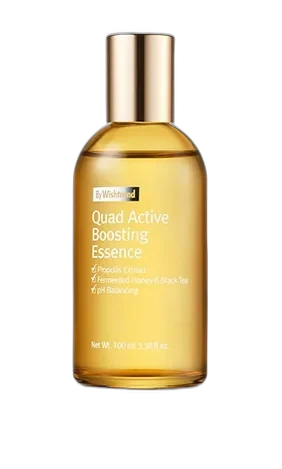
Quad Active Boosting Essence
First-Essence Workhorse
 Verified reviewer
Pros & cons.
- +Four named botanical actives at honest percentages on the INCI
- +Willow bark, cornflower, schisandra, mulberry and lotus combined for ~45% of the formula
- +Postbiotic ferments add microbiome and amino-acid support
- +Genuinely watery, fast-absorbing, non-tacky texture
- +Fragrance-free, alcohol-free, essential-oil-free
- +Fungal-acne safe — no fatty alcohols, esters or plant oils
- +100ml lasts 3-4 months at twice-daily use
- +Pregnancy-safe option for sensitive skin
- −Effects are subtle on its own — works as part of a routine
- −Faint herbal smell from botanical extracts isn't universally loved
- −Glass bottle is heavier than plastic for travel
- −Not vegan due to propolis and honey ferment content
- −Willow bark percentage doesn't translate to BHA-strength exfoliation
The full review.
The first treatment essence is a K-beauty invention the rest of the world took thirty years to match. SK-II popularized the format in the 1980s with Facial Treatment Essence — a single galactomyces ferment used as a watery first step — and the category has dominated East Asian skincare ever since. Most imitators fail to match the original. They label glycerin water with a token ferment as a “first essence” and hope consumers do not read the ingredient list. By Wishtrend’s Quad Active Boosting Essence is different. The brand took the SK-II concept and built a formula where the front-of-bottle claim matches the INCI math.
The “quad” in the name is literal. Willow bark extract at 10% is the second ingredient, right after water. Cornflower flower water is 9%. Schisandra fruit extract is 9%. Mulberry bark extract is 8.7%. Lotus leaf extract is 8.7%. These named botanical actives make up roughly 45% of the formula, which is rare for this category. Cornflower flower water replaces an equivalent fraction of plain water as the carrier, adding botanical hydration and a soothing flavonoid layer. By the time you pass the methylpropanediol and glycerin in slots seven and eight, you have already used five named actives in honest concentrations. Below those, two postbiotic ferments — saccharomyces-honey and saccharomyces-xylinum-black tea — add a microbiome and amino-acid layer. A 1% dose of propolis rounds out the back half. Citric acid and sodium citrate buffer the pH to around 5.0 — near the skin’s natural surface acidity, the right choice for a first-step product.
What does this ingredient density do? It does what a first essence should: provides immediate hydration and preps the skin. The texture is watery and slippery, like a good hydrating toner, and absorbs in under ten seconds without tackiness or residue. Pat it onto damp skin after cleansing to help the next product layer more cleanly. After a few days, the skin feels slightly plumper and smoother, and the routine feels more cohesive. You notice this structural improvement most when you skip the step for a week and the routine feels less polished.
Willow bark deserves its own paragraph because marketing often oversells it. Willow bark contains salicin, the natural precursor to salicylic acid, and many K-beauty brands imply “natural BHA” essences equal a 0.5% salicylic acid product. They do not. Salicin converts only partially when applied topically. The real benefit of willow bark in this essence is its polyphenol fraction and gentle anti-inflammatory action, not BHA-strength exfoliation. If you want an exfoliating essence, use the brand’s mandelic acid prep water instead. If you want a soothing, hydration-and-prep essence with a botanical stack, this is a top option.
The other botanicals make the formulation interesting. Schisandra is an adaptogenic berry with antioxidant and mild astringent properties. Cornflower water has been used in European herbalism for centuries to calm sensitive skin and the eye area. Mulberry bark provides mulberroside-A and other tyrosinase-inhibiting flavonoids, giving this essence a modest brightening effect that works with any vitamin C or niacinamide layered on top. Lotus leaf adds its own polyphenol-and-flavonoid load. Black tea ferment provides postbiotics and catechins. The formula stacks plant polyphenols; the cumulative effect on skin tone over four to six weeks of daily use is more noticeable than any single ingredient.
The limitations are small. The effects are subtle because this is a prep step, not a treatment; users expecting dramatic before-and-after photos will be disappointed. The faint herbal smell from the extracts won’t bother most, but some will notice it. The 100ml glass bottle is heavier than plastic, which matters for travel. Finally, the propolis and honey ferment content means this essence is not vegan and is unsuitable for those with bee-product allergies.
For combination, normal, sensitive and oily skin seeking an active first step without the SK-II price, this is one of the better-formulated essences in K-beauty. It is not the flashiest product and makes no dramatic claims, but it is a structural step that makes the rest of a routine work better. It is one of the few essences in its category that earns its price through actual ingredient density.
Ingredient analysis.
Full INCI list · pH 5
Aqua (Water), Salix Alba (Willow) Bark Extract (10%), Centaurea Cyanus Flower Water (9%), Schisandra Chinensis Fruit Extract (9%), Morus Alba Bark Extract (8.7%), Nelumbo Nucifera Leaf Extract (8.7%), Methylpropanediol, Glycerin, Saccharomyces/Honey Ferment Filtrate, Saccharomyces/Xylinum/Black Tea Ferment, 1,2-Hexanediol, Propolis Extract (1%), Butylene Glycol, Benzyl Glycol, Hydroxyethylcellulose, Citric Acid, Sodium Citrate, Disodium EDTA, Ethylhexylglycerin
Skin match.
The science.
The Science
First treatment essences as a category have less direct clinical literature than treatment serums, but the individual botanical actives in this formula have their own evidence bases. Salix alba (willow) bark contains salicin, which is metabolized to salicylic acid only partially in topical application — research published in the International Journal of Cosmetic Science has examined topical salicin and noted that its anti-inflammatory and antioxidant effects come more from its own polyphenol fraction than from significant conversion to salicylic acid. The 10% willow bark concentration in this essence is well above typical cosmetic levels, putting it in a range where the polyphenol payload is meaningful. Centaurea cyanus (cornflower) water has a long European herbalism history for sensitive skin applications, and modern phytochemistry has identified flavonoids, anthocyanins and tannins in the extract that have mild anti-inflammatory and astringent activity. Schisandra chinensis is an adaptogenic berry with documented antioxidant activity in topical models — a 2018 study in the International Journal of Molecular Sciences examined schisandra extract effects on UV-induced oxidative stress in keratinocyte models and found measurable protection. Morus alba (mulberry) bark contains mulberroside-A and oxyresveratrol, both of which are tyrosinase inhibitors with documented activity in pigmentation models, providing the brightening dimension of this essence. Nelumbo nucifera (lotus) leaf contributes flavonoids and alkaloids with anti-inflammatory and antioxidant activity. The combination of postbiotic ferments — saccharomyces-honey and saccharomyces-xylinum-black tea — adds amino acids, peptides and additional polyphenols to the formula. The propolis at 1% sits at a lower concentration than the brand's treatment ampoules but contributes its own polyphenol fraction. The combination is the formulation logic: rather than relying on a single high-concentration hero, this essence stacks five botanical actives and two ferments, all at meaningful concentrations, to create cumulative anti-inflammatory, antioxidant and mild brightening effects that emerge over weeks of consistent use.
References
- Antioxidant and anti-inflammatory effects of botanical extracts in topical formulations — International Journal of Cosmetic Science (2019)
Dermatologist Perspective
Dermatologists generally view first treatment essences as supportive rather than essential — they are not a category with the depth of clinical literature that retinoids or hydroxy acids have, and the dermatological view is typically that a well-formulated essence is a pleasant addition to a routine but not a substitute for evidence-based treatment. That said, board-certified dermatologists frequently note that polyphenol-rich botanical formulas can have meaningful supportive effects on sensitive, reactive and pigmentation-prone skin, and the willow bark and mulberry bark in this formula have legitimate evidence for anti-inflammatory and tyrosinase-inhibiting activity. The fragrance-free, alcohol-free formulation is consistent with what dermatologists typically recommend for sensitive skin. The product is generally considered appropriate for use during pregnancy.
Guidance
Where it fits in your routine.
Apply this first after cleansing, ideally onto damp skin. Pour a small amount into your palms and pat it into your face and neck instead of using a cotton pad; patting increases absorption and reduces waste. Wait 15-30 seconds, then apply toners, ampoules, serums and moisturizer as usual. Use morning and evening. It works well with the brand's vitamin C serum (AM) and propolis ampoule (both AM and PM).
At about twenty-three dollars for 100ml, this is a high-value K-beauty first essence. SK-II Facial Treatment Essence costs five to six times more for the same volume, and most mid-range Korean essences cost as much or more for smaller sizes. The 100ml bottle lasts three to four months using it twice daily, making the monthly cost similar to a basic-toner. The price reflects the ingredient density: five named botanical actives at honest percentages and two postbiotic ferments. This combination is unusual at this price point. Cheaper essences exist, but most use a single hero ferment in a glycerin base. This is the version to buy if you want the polyphenol stack approach.
Combination, normal, sensitive, and oily skin types seeking an active first essence step. Users preferring a polyphenol-stack approach over a single-hero ferment essence. Anyone disappointed by the empty-vehicle first essences that dominate the lower end of the category.
Users who skip a first essence step. People with confirmed propolis or bee-product allergies. Vegan shoppers avoiding bee-derived ingredients.
Product details.
Thin, watery essence with the slip of a hydrating toner; absorbs in seconds.
Botanical extracts create a faint, slightly herbal natural smell; there is no added fragrance.
A tinted orange-amber glass bottle with a screw cap protects the polyphenol botanicals from light.
It is uneventful — no sting, no purging, and no sensation besides a faint hydrating feel. Most users see better product layering and smoother skin within the first week, plus subtle tone improvements after one month of consistent use.
100ml lasts about 3-4 months with twice-daily use applied with hands.
12 months
All Year
The backstory.
By Wishtrend developed the Quad Active Boosting Essence in 2020 as a deliberate alternative to single-ingredient first essences like SK-II Facial Treatment Essence. The 'quad' framing was an honest reference to the four named botanical actives and the brand's interest in stacking polyphenols rather than relying on a single hero.
About By Wishtrend
Established Brand (5–20 years)By Wishtrend launched in 2013 as Korean retailer Wishtrend's in-house brand. The Quad Active Boosting Essence is the brand's first-step prep essence, built around a quad of botanical actives at honest concentrations.
Common myths.
First essences are an unnecessary K-beauty step.
A well-formulated first essence improves subsequent product absorption and provides its own hydration and active payload. Arguments against them only apply to the empty-vehicle versions that dominate the lower end of the category.
Willow bark at 10% is the same as salicylic acid at 0.5%.
Willow bark contains salicin, a salicylic acid precursor that converts only partially when applied topically. The willow bark's polyphenol fraction and gentle anti-inflammatory effects drive the activity, not BHA-strength exfoliation.
FAQ.
What is a first treatment essence?
A first treatment essence is a watery, lightweight product. Apply it right after cleansing as the first hydrating layer in a routine. SK-II Facial Treatment Essence popularized this category in the 1980s, making it a foundational K-beauty step. It delivers immediate hydration and preps the skin to absorb subsequent products.
How does this compare to SK-II Facial Treatment Essence?
SK-II uses one hero ferment (Pitera/galactomyces) at a high concentration. This essence uses four named botanical actives and two postbiotic ferments at a much lower price. The two products use different formulation philosophies — single-hero versus stack — and both have legitimate use cases.
Is the willow bark exfoliating?
It works mildly, but not as a primary effect. Willow bark contains salicin, a salicylic acid precursor that does not convert efficiently when used topically. The 10% willow bark here provides more anti-inflammatory and polyphenol benefits than BHA-style exfoliation.
Can I use it morning and night?
Yes — use it twice daily. Apply it as the first product immediately after cleansing, ideally on damp skin. The 100ml bottle lasts about 3-4 months at this rate.
Is it fungal acne safe?
Yes — the formula lacks fatty alcohols, esters, or plant oils that feed Malassezia. It is safe for fungal-acne-prone users.
Does it work for sensitive skin?
Yes — cornflower water and lotus leaf extracts soothe sensitive skin. The formula is fragrance-free, alcohol-free and essential-oil-free. The willow bark concentration stays below irritating levels for most users.
What the community says.
"actually preps skin for what comes next"
"non-sticky watery texture"
"no fragrance, no sting"
"100ml lasts a long time"
"fungal acne safe"
"faint herbal smell"
"subtle effects on its own"
"not exfoliating despite the willow bark"
People also looked at.