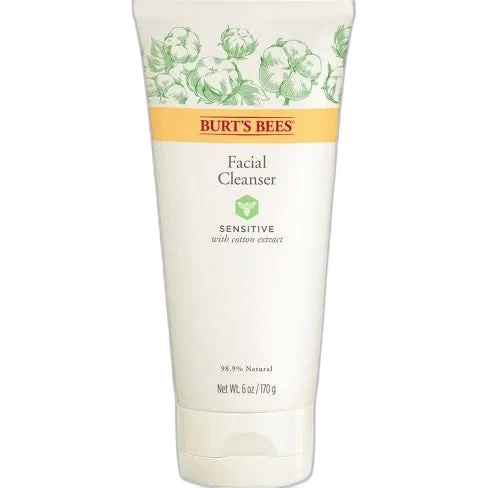
Sensitive Facial Cleanser
Sensitive Skin Staple
 Verified reviewer
Pros & cons.
- +Completely fragrance-free and hypoallergenic — rare for Burt's Bees
- +Natural saponin-based cleansing from quillaja and yucca instead of synthetic surfactants
- +Sunflower seed oil base rich in barrier-supporting linoleic acid
- +Sulfate-free and soap-free — minimizes barrier disruption during cleansing
- +Dermatologist tested and clinically proven to moisturize while cleansing
- +Excellent value at ~$10 for a 6 oz tube lasting 3-4 months
- −Alcohol denat is a surprising inclusion in a sensitive-skin formula
- −Witch hazel water may irritate some rosacea or eczema-prone skin
- −Very limited makeup removal capability
- −Cream texture can feel like it doesn't rinse fully clean
- −Minimal cleansing power for oily or acne-prone skin types
The full review.
There is a quiet irony in Burt’s Bees making a sensitive skin cleanser. This is a brand whose identity is built on botanical richness — peppermint lip balm, lavender-scented hand cream, cleansers perfumed with clary sage and citrus oils. The fragrance is the brand, or at least a significant part of it. So when they strip all of that away and make something deliberately, almost aggressively unscented, it feels like a conscious act of restraint from a company that usually cannot resist putting one more essential oil into the formula.
The Sensitive Facial Cleanser launched as part of a line designed for the substantial population that loves the natural-ingredient philosophy but whose skin treats essential oils like hostile invaders. No fragrance. No essential oils. No botanical perfume of any kind. Just a clean, neutral cream that smells like nothing in particular, which is exactly the point.
The cleansing mechanism is interesting because it avoids conventional surfactants entirely. Instead of sodium lauryl sulfate, cocamidopropyl betaine, or even the gentler amino acid surfactants, this formula relies on natural saponins — from quillaja bark and yucca extract — to do the cleaning. Saponins are nature’s own surfactants: glycoside compounds that produce a mild foam and dissolve surface oils without the barrier-disrupting action of synthetic detergents. They have been used for centuries in traditional washing practices, and their presence here feels like Burt’s Bees returning to roots even older than the brand itself.
The base is built on sunflower seed oil and glycerin — the second and third ingredients, respectively — which means this cleanser is more emollient than it is cleansing. Sunflower seed oil is particularly well-chosen for sensitive skin because of its high linoleic acid content. Research has shown that linoleic acid strengthens the skin barrier and is often deficient in people with eczema and other inflammatory skin conditions. Using it as the primary vehicle for a sensitive-skin cleanser is a genuinely thoughtful formulation choice.
Cotton flower extract gets the marketing spotlight as the hero ingredient, and while the evidence base for cotton extract specifically is thin, the concept is sound — it is a gentle, non-irritating botanical that provides mild conditioning without sensitization risk. Rice extract and aloe vera add established soothing and moisturizing properties. The overall botanical approach is cautious and deliberate, favoring ingredients with low irritation potential over flashier actives.
The texture is exactly what you would expect from a cream cleanser at this richness level — thick, milky, almost lotional. It spreads across damp skin like a moisturizer that happens to clean, and it produces essentially no lather. If your definition of clean involves bubbles, this cleanser will test your patience. If your definition of clean involves skin that feels comfortable, calm, and slightly nourished, it delivers.
The honest complications live in two ingredients that seem to contradict the sensitive-skin positioning. Alcohol denat appears near the bottom of the ingredient list, likely as a solvent for plant extracts at a very low concentration. At this level, it is probably non-irritating for most users, but its presence in a product specifically marketed for sensitive skin raises eyebrows. Witch hazel water — while natural — contains tannins that can be astringent and irritating for some sensitive skin types, particularly those with rosacea or eczema. These are not dealbreaker inclusions at their low concentrations, but they are worth noting for anyone with extremely reactive skin who scrutinizes every ingredient.
Performance is modest and appropriate. This cleanser handles daily grime, light sunscreen, and surface oil without difficulty. It does not handle makeup with any particular skill, and waterproof products are beyond its mandate entirely. As a morning cleanser, it refreshes without stripping. As an evening cleanser, it works best for no-makeup days or as a gentle second step after oil-based makeup removal.
At roughly ten dollars for six ounces, the value is solid. The tube lasts three to four months with twice-daily use, and the formulation quality — sunflower seed oil base, plant saponins, no synthetic surfactants — represents genuine thought at a drugstore price. For sensitive-skin consumers who have been burned by products claiming gentleness while hiding irritants in their formulas, this cleanser delivers on its promise of non-reactivity for the vast majority of users.
This is not a glamorous product. It does not have a distinctive scent, a satisfying lather, or a clever marketing hook. It is simply a gentle cream cleanser that does not irritate sensitive skin, from a brand with four decades of natural skincare experience. Sometimes the most important thing a product can do is nothing — no stinging, no tightness, no redness, no reaction. This cleanser does a lot of nothing, and does it very well.
Texture
The texture is exactly what you would expect from a cream cleanser at this richness level — thick, milky, almost lotional. It spreads across damp skin like a moisturizer that happens to clean, and it produces essentially no lather. If your definition of clean involves bubbles, this cleanser will test your patience. If your definition of clean involves skin that feels comfortable, calm, and slightly nourished, it delivers.
Scent
It does not have a distinctive scent, a satisfying lather, or a clever marketing hook.
Common Complaints
The honest complications live in two ingredients that seem to contradict the sensitive-skin positioning. Alcohol denat appears near the bottom of the ingredient list, likely as a solvent for plant extracts at a very low concentration. At this level, it is probably non-irritating for most users, but its presence in a product specifically marketed for sensitive skin raises eyebrows. Witch hazel water — while natural — contains tannins that can be astringent and irritating for some sensitive skin types, particularly those with rosacea or eczema. These are not dealbreaker inclusions at their low concentrations, but they are worth noting for anyone with extremely reactive skin who scrutinizes every ingredient.
Works for
As a morning cleanser, it refreshes without stripping. As an evening cleanser, it works best for no-makeup days or as a gentle second step after oil-based makeup removal.
Ingredient analysis.
Full INCI list
Water, Helianthus Annuus (Sunflower) Seed Oil, Glycerin, Cetyl Alcohol, Cera Alba (Beeswax), Sucrose Stearate, Cetearyl Alcohol, Cocos Nucifera (Coconut) Oil, Gossypium Herbaceum (Cotton) Flower Extract, Oryza Sativa (Rice) Extract, Beta Vulgaris (Beet) Root Extract, Quillaja Saponaria Bark Extract, Theobroma Cacao (Cocoa) Seed Butter, Yucca Schidigera Leaf/Root/Stem Extract, Artemisia Umbelliformis Extract, Euphrasia Officinalis Extract, Hamamelis Virginiana (Witch Hazel) Water, Saccharum Officinarum (Sugar Cane) Extract, Aloe Barbadensis Leaf Juice, Silica, Sucrose, Fructose, Glucose, Coco-Glucoside, Inositol, Maltodextrin, Citric Acid, Benzoic Acid, Trehalose, Xanthan Gum, Potassium Sorbate, Sodium Benzoate, CI 77947 (Zinc Oxide), Alcohol Denat, Phenoxyethanol
Skin match.
The science.
The Science
The saponin-based cleansing system uses compounds from quillaja bark (Quillaja saponaria) and yucca root (Yucca schidigera). Saponins are triterpenoid glycosides that emulsify oils and reduce surface tension as natural surfactants. Research in the Journal of Surfactants and Detergents shows saponins cause significantly less skin irritation than sodium lauryl sulfate while cleansing effectively for daily hygiene.
The sunflower seed oil base suits sensitive skin because it contains approximately 65-70% linoleic acid in its fatty acid profile. A landmark study in Pediatric Dermatology shows topical sunflower seed oil improves skin barrier function and reduces clinical sepsis in preterm infants—the most barrier-compromised population—proving its mildness and barrier-supporting properties.
Studies show glycerin works as a humectant in rinse-off products because glycerin deposited during cleansing stays on the skin surface after rinsing to provide hydration. In this cream cleanser, the glycerin works with the sunflower oil to maintain stratum corneum hydration during cleansing, which reduces the transient barrier disruption caused by even gentle cleansing.
Dermatologist Perspective
Dermatologists often recommend fragrance-free, sulfate-free cleansers for sensitive skin routines. Board-certified dermatologists note the saponin-based cleansing approach in this formula follows clinical guidance for patients with rosacea, contact dermatitis, or atopic tendencies, where minimizing surfactant-induced barrier disruption is a priority. The sunflower seed oil base provides linoleic acid to support barrier repair—a well-established dermatological principle. Dermatologists may view the alcohol denat and witch hazel as minor concerns for the most reactive patients, but at low concentrations in a rinse-off product, they likely won't cause issues for most sensitive skin presentations.
Where it fits in your routine.
Wet your face with lukewarm water (avoid hot water; heat irritates sensitive skin). Squeeze a nickel-sized amount onto your fingertips. Massage in circular motions for 30-60 seconds, avoiding the eye area. Rinse well with lukewarm water; the thick texture may require a second rinse to remove completely. Pat dry with a soft towel; do not rub. Apply toner and moisturizer while skin is still damp to lock in hydration.
At about $10 for six ounces, this is one of the cheapest fragrance-free, hypoallergenic cream cleansers. Pharmacy brand sensitive-skin cleansers usually cost $12-18 for similar sizes. The saponin-based cleansing system and sunflower seed oil base offer quality above this price. One tube lasts three to four months with twice-daily use. This makes the per-wash cost under five cents—great value for a dermatologist-tested sensitive-skin product.
This fragrance-free natural cleanser works for sensitive, reactive, or easily irritated skin. It suits rosacea-prone skin (patch test first), people leaving harsh cleansers, and anyone who likes Burt's Bees but cannot tolerate their fragranced products.
Oily and acne-prone skin types will find this cleanser lacks enough power to manage excess sebum and breakouts. Anyone needing effective makeup removal should use a dedicated first cleanse. Those with extreme sensitivities to any form of alcohol or witch hazel should check with their dermatologist before use.
Product details.
Thick, milky cream that feels like a moisturizer during application and has minimal to no lather
Fragrance-free — very faint, neutral scent from the natural ingredients
Standard 6 oz squeeze tube for hygienic dispensing
The cream feels gentle and moisturizing on first use, like a light lotion rather than a cleanser. It has zero tingling and zero tightness. Users of foaming cleansers may think the lack of lather means it isn't working, but skin feels clean and comfortable after rinsing.
3-4 months with twice-daily use
12 months
All Year
The backstory.
Part of Burt's Bees' Sensitive line, this cleanser was developed for the significant portion of consumers who love the brand's natural philosophy but cannot tolerate the essential oils and fragrance in their standard products. Cotton extract was chosen as the hero ingredient for its gentle, skin-softening properties, and the formula uses plant-derived saponins from quillaja bark for cleansing — a nod to traditional botanical soap-making.
About Burt's Bees
Legacy Brand (20+ years)Burt's Bees launched in 1984 and is the number-one dermatologist-recommended natural skincare brand. This sensitive line is fragrance-free, dermatologist-tested, and hypoallergenic to suit reactive skin.
Common myths.
Sensitive skin products clean less effectively than regular cleansers.
This cleanser uses natural saponins from quillaja bark and yucca extract to clean gently and effectively. It does not remove heavy makeup, but it cleans daily dirt, oil, and light sunscreen. This trade-off for gentleness is by design, not a flaw.
Natural always means gentle enough for sensitive skin.
This formula is a counterexample: it contains witch hazel water and alcohol denat, which are natural but can irritate some sensitive skin. Even in a sensitive-skin product, you must evaluate individual ingredients.
FAQ.
Is Burt's Bees Sensitive Facial Cleanser fragrance-free?
Yes — most Burt's Bees cleansers contain natural fragrance or essential oils, but this product is fragrance-free. It is hypoallergenic and dermatologist-tested, so it works well for reactive or easily irritated skin.
Does this cleanser remove makeup?
It removes light daily wear — tinted moisturizer, light powder, non-waterproof mascara — well. But it is not a makeup remover and struggles with heavy foundation, waterproof products, or long-wear formulas. For full makeup removal, use a micellar water or oil cleanser first, then use this as your gentle second step.
Is Burt's Bees Sensitive Cleanser good for rosacea?
The fragrance-free, sulfate-free formula with cotton extract and aloe works well for rosacea-prone skin. But it contains witch hazel water and a small amount of alcohol denat, which some rosacea patients find irritating. Patch-test on your jawline before daily facial use.
Why does this sensitive cleanser contain alcohol?
alcohol denat is near the end of the ingredient list, so the concentration is low. It likely acts as a solvent for plant extracts instead of a primary ingredient. This level rarely causes irritation, but users with reactive or eczematous skin should note its presence.
Can I use this cleanser with retinol?
Yes — this fragrance-free, gentle formula works well with retinol and other active treatments. Its moisturizing cream base protects the skin barrier that retinol can compromise. The lack of fragrance and harsh surfactants reduces the total irritation load on sensitive, retinol-treated skin.
What the community says.
"Truly gentle — no stinging, burning, or redness"
"Fragrance-free is a huge plus for reactive skin"
"Leaves skin feeling soft and moisturized after washing"
"Affordable for a sensitive skin cleanser"
"Doesn't remove makeup effectively"
"Some users find the cream texture too rich and hard to rinse"
"Contains alcohol denat despite being for sensitive skin"
"Minimal cleansing power for oily or acne-prone skin"
People also looked at.