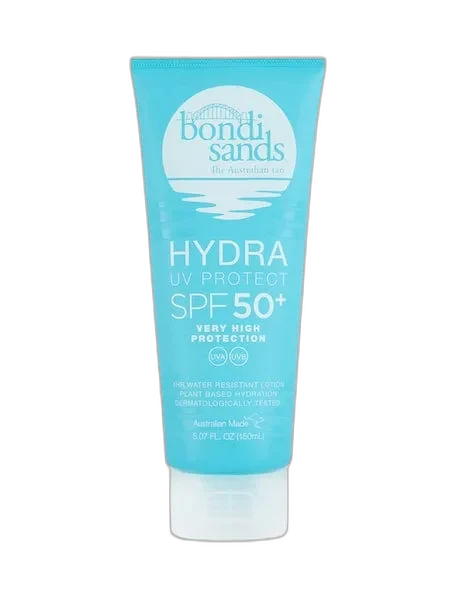
Hydra UV Protect SPF 50+ Body Sunscreen Lotion
European-Filter Body SPF
 Verified reviewer
Pros & cons.
- +Uses ethylhexyl triazone — a next-generation UVB filter unavailable in US sunscreens
- +TGA-tested to Australian broad-spectrum standards
- +Fragrance-free base suitable for reactive and sensitive body skin
- +Genuinely hydrating on dry body areas via glycerin and algae extract
- +4-hour water resistance under AU testing methodology
- +Vegan and cruelty-free with no beeswax
- +No white cast on any skin tone
- −Not sold in the US market — requires import or travel
- −150ml bottle runs through quickly on beach days at correct dosing
- −Contains fatty esters so not fungal-acne safe
- −Price higher than the original Bondi Sands Gold Standard body lotion
- −Hydration messaging may feel oversold for oily body types in humid climates
The full review.
Bondi Sands uses regulatory arbitrage in its catalog. Hidden beneath beach marketing and tanning foams, the Hydra UV Protect SPF 50+ Body Lotion sold in Australia and the UK uses a filter system Americans cannot buy at retail. Ethylhexyl triazone provides most of the UVB protection in this lotion at a 3% concentration. It has awaited FDA approval under the TEA (Time and Extent Application) process for years with no clear timeline. EU and Australian regulators consider its safety and efficacy well established, but the US OTC monograph is frozen in 1999 and the approval pipeline is broken. Practically, a shopper in London or Sydney can buy a body sunscreen that is more protective per gram than anything on a US shelf. This is one of those bottles.
The filter set is the story: ethylhexyl triazone at 3%, 4-methylbenzylidene camphor at 4%, avobenzone at 4%, and octocrylene at 4%. Ethylhexyl triazone is a highly UVB-efficient filter; its molar extinction coefficient is high enough that small concentrations deliver substantial protection. Combined with the 4-MBC booster, the UVB load matches what American formulations reach using 10% homosalate and 5% octisalate. Those US versions require more total filter weight for equivalent protection and often feel sticky. Avobenzone covers UVA, and octocrylene stabilizes it. It is simple, efficient, and not available in your Target.
The Hydra range differs from the brand’s older Gold Standard body SPF by more than just the filter set. Bondi Sands rebuilt the base using glycerin and ethically-sourced algae extract to claim 72 hours of moisture retention. This is the first Bondi Sands body sunscreen that does not feel like applying protection over dry skin; it makes shins and elbows feel softer on the first application. The finish is lightweight and non-greasy, following modern EU body SPF trends. The formula is fully chemical, so there is no white cast on any skin tone.
The fragrance-free claim is accurate. This body sunscreen has no masking scent, no coconut-beach tropical note, and no botanical essential oil perfume. This neutrality helps sensitive body skin, eczema-prone elbows, and the back of the neck, or anyone who avoids smelling like vacation in a conference room. Water resistance is rated to 4 hours under AU TGA testing. This is a stricter methodology than the US FDA’s 40- or 80-minute claims, though you must still reapply after heavy sweating or towel drying.
There are limitations. The biggest is availability: US shoppers cannot easily buy this through normal retail channels. You must import from Cult Beauty or Boots, or buy it while traveling. The 150ml bottle is small for a body sunscreen; one long beach day with reapplication can use a third of the bottle, raising the per-use cost. While the hydration is genuine, oily-body users or those in humid tropical climates may find the claim oversold—it is still a body lotion that feels like product on skin.
The bigger frustration is the US FDA’s failure to approve a new sunscreen filter since 1999. Photoprotection experts agree US filter options are the weakest in the developed world. Every American body SPF uses technology Europe considered outdated a decade ago. Bondi Sands Hydra UV Protect Body shows the alternative: less filter load, stronger protection, and better feel for the same price. Regulatory paralysis, not formula failure, keeps it from US domestic markets. It is worth sourcing if you can, and frustrating if you cannot.
Formula
Ingredient analysis.
Full INCI list
Actives (AU/EU formula): 4-Methylbenzylidene Camphor 4%, Butyl Methoxydibenzoylmethane (Avobenzone) 4%, Octocrylene 4%, Ethylhexyl Triazone 3%. Inactive: Aqua, Glycerin, Caprylyl Glycol, Octanohydroxamic Acid, Algae Extract, Tocopheryl Acetate, Phenoxyethanol
Skin match.
The science.
The Science
Ethylhexyl triazone is one of the UVB filters at the center of the ongoing gap between US and international sunscreen regulation. It has a molar extinction coefficient high enough that relatively small concentrations — typically 2–3% — deliver UVB absorption equivalent to much larger doses of older filters like homosalate. In published photoprotection research it has consistently been shown to be among the most efficient and photostable UVB absorbers available, with low systemic absorption and minimal skin penetration compared to homosalate and octocrylene.
The US FDA has not approved a new sunscreen filter since 1999, and ethylhexyl triazone has been pending review under the TEA pathway for more than two decades without resolution. The EU approved it in 1994 and Australia's TGA has long included it in their approved filter list. The practical consequence is that an SPF 50+ product formulated in the EU or Australia can achieve its label with a lighter, cleaner, more cosmetically elegant filter load than a US-formulated equivalent, and can typically maintain stronger UVA protection under the EU's stricter UVA-PF testing rules.
The combination in this lotion — ethylhexyl triazone plus 4-methylbenzylidene camphor plus avobenzone plus octocrylene — is a classic modern European formulation pattern. The photostabilization load is low (4% octocrylene), which means the risk of octocrylene degradation byproducts like benzophenone (a concern flagged in recent peer-reviewed research on aging sunscreen formulas) is correspondingly reduced. For shoppers concerned about that specific issue, this filter set is a meaningfully more conservative choice than octocrylene-heavy US formulations.
Dermatologist Perspective
Dermatologists in the US frequently note that American sunscreen formulations lag behind European and Asian ones due to FDA regulatory delays, and patients who travel are often advised to stock up on international sunscreens with access to newer filters. Board-certified dermatologists note that ethylhexyl triazone's photostability and low absorption profile make it an attractive filter for patients prioritizing long-term safety data and UVB efficiency, and products like this one are sometimes specifically recommended in photoaging and post-procedure consultations when patients ask about the best possible body protection.
Where it fits in your routine.
Apply generously to all exposed body skin 15 minutes before sun exposure, using roughly 2–3 tablespoons for a full body coverage adult dose. Reapply every two hours in direct sun and immediately after towel drying or heavy sweating. The lotion rubs in easily without leaving a film and layers well under swimwear. Store the bottle out of direct heat and sunlight, and replace annually regardless of remaining product.
At around £12–16 (roughly $16–20 USD) for 150ml, this lotion costs as much as Garnier Ambre Solaire or Altruist in the AU/EU market. The filter set provides protection technology that costs more than double per milliliter in Japanese or Korean face sunscreens. This offers strong value for those who can access it, but the 150ml size and import logistics reduce the value for US buyers. The Hydra body range has no larger size. The original Bondi Sands Gold Standard body SPF costs less and comes in 500ml bottles if you prioritize volume-for-dollar, but it lacks the advanced filter set.
Buy this if you can source EU or AU sunscreens and want the strongest UVB filter technology in a hydrating, fragrance-free body lotion. It works well for sensitive body skin, dry climates, or photoaging prevention routines seeking the best daily body coverage.
US shoppers who cannot import will find this impractical. People managing fungal acne on the body need a fatty-ester-free alternative. Budget-focused shoppers wanting maximum volume per dollar should choose the original Gold Standard body line or larger-format options.
Product details.
Thick white lotion that rubs out to a lightweight hydrated finish Scent
Fragrance-free with only a faint cosmetic base note Packaging
Opaque plastic squeeze bottle with flip cap — travel friendly Finish
The first application feels cool and hydrating, not filter-heavy. It does not sting and leaves minimal tackiness once absorbed. Most users see drier body areas look and feel less tight after the first application. How Long It Lasts
One 150ml bottle lasts for roughly 8–12 full body applications — about a long weekend at the beach or two weeks of casual daily use. Period After Opening
12 months Best Season
All Year Certifications
The backstory.
Bondi Sands launched the Hydra UV Protect range in around 2022 as a response to European shopper demand for sunscreens that felt like skincare rather than beach product. By formulating specifically to the AU and EU markets, the brand could reach for filters unavailable in its US range — and the body lotion became the category hero, positioning itself against thirstier, tighter traditional body sunscreens.
About Bondi Sands
Established Brand (5–20 years)Bondi Sands' Hydra UV Protect range is the brand's newer hydration-focused sunscreen line, launched around 2022. In the Australian and European markets, it uses Ethylhexyl Triazone, a high-performance UVB filter not yet approved in the United States. This gives the AU/EU version stronger single-filter UVB absorption than the original Gold Standard line.
Common myths.
All SPF 50+ body sunscreens offer equivalent UV protection
The UV filter set matters more than the SPF label. This lotion's ethylhexyl triazone and 4-methylbenzylidene camphor provide UVB coverage that homosalate-heavy formulas from American brands cannot match.
Hydrating body sunscreens don't deliver real protection
This formula reaches SPF 50+ under AU TGA testing. It includes glycerin and algae extract at skincare-grade levels. Efficient filter loads allow for a proper humectant base, so hydration and protection work together.
FAQ.
What makes Hydra UV Protect different from the original Bondi Sands body SPF?
The Hydra AU/EU formula uses ethylhexyl triazone and 4-methylbenzylidene camphor—filters approved in Australia and Europe but not the US—and a high glycerin-and-algae hydration base. The original Gold Standard body SPF uses the older homosalate-avobenzone-octocrylene-octisalate filter set.
Is this sunscreen sold in the United States?
The AU/EU Hydra UV Protect Body formula is not available at US retailers because it contains filters not approved by the US FDA. US shoppers typically import it from UK retailers like Cult Beauty or Boots, or travel with it from overseas.
Is the Hydra Body formula vegan?
Yes — the Hydra body lotion is vegan and cruelty-free. Unlike the brand's fragrance-free face SPF, it lacks beeswax. Algae extract and glycerin provide hydration instead of animal-derived emollients.
How water resistant is it?
The lotion has a 4-hour water resistance rating under the Australian TGA standard. This is roughly double the US FDA 40- or 80-minute water resistance label. Reapply after towel drying or heavy sweat, but the filter set works well during swimming.
Will it leave a white cast?
No. The fully chemical filter set rubs in clear on all skin tones, including deep complexions. The formula has no zinc oxide or titanium dioxide.
Can it be used on the face?
Technically yes, but Bondi Sands makes a separate Hydra UV Protect face version for wearing under makeup. The body version is heavier and works less well on the face.
What the community says.
"Genuinely hydrating on dry body areas"
"No white cast on any skin tone"
"Uses filters unavailable in US sunscreens"
"Lightweight lotion layers under clothing cleanly"
"Not available in US market directly"
"150ml burns through quickly on a beach day"
"Some find the hydration message overstated for oily body skin"
"Price higher than the original Gold Standard body SPF"