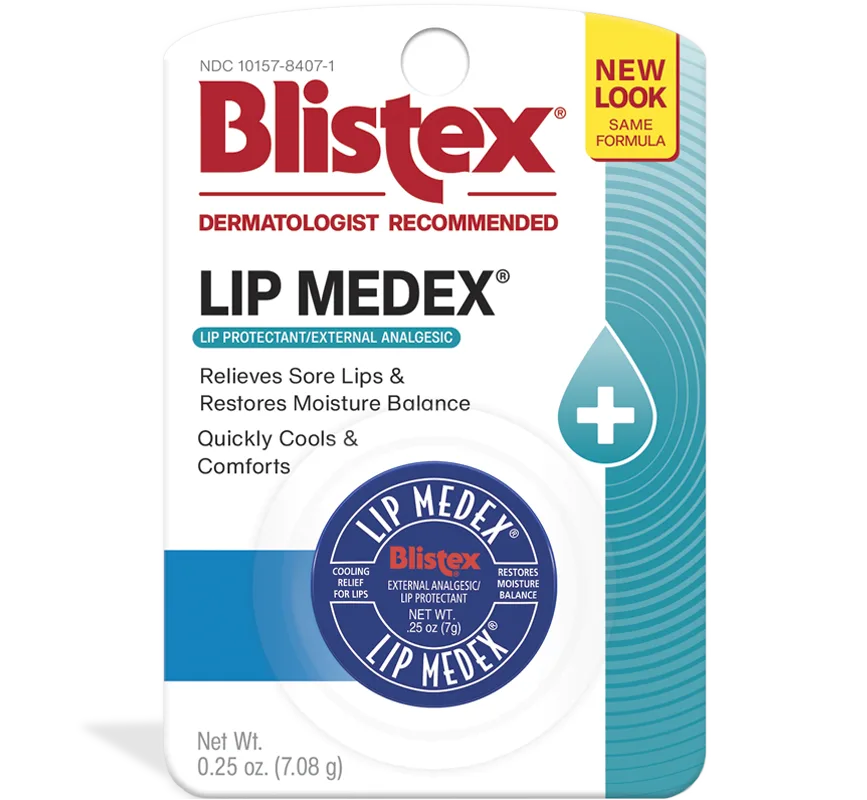
Lip Medex
Emergency Lip Rescue
 Verified reviewer
Pros & cons.
- +59.14% petrolatum provides the most aggressive occlusive lip protection available OTC
- +Triple analgesic action (camphor, menthol, phenol) delivers immediate pain relief
- +FDA-regulated drug product with genuine therapeutic claims
- +Extraordinarily affordable at approximately $3 per pot lasting months
- +Available in a larger value size (0.38 oz) for even better per-unit value
- +Universally available at every major drugstore, pharmacy, and grocery chain
- −Loaded with potential irritants: menthol, camphor, phenol, fragrance, benzyl alcohol
- −Contains lanolin — a common contact allergen that can worsen lip dermatitis
- −No SPF protection despite being used on UV-vulnerable lip tissue
- −Strong medicinal sensation can be overwhelming on severely damaged lips
- −Not cruelty-free, not vegan (contains beeswax and lanolin)
- −Pot format requires finger application — less hygienic than stick alternatives
The full review.
Some products fit a daily routine, while others are for 2 AM emergencies when your lips feel like they are barely held together by dried skin. Blistex Lip Medex is the latter. It is not a daily lip balm or a beauty product. It is a medicated intervention in a small blue pot, and it has functioned this way for over thirty years.
The formula is pharmaceutical, not cosmetic. The FDA regulates Lip Medex as an OTC drug product, specifically an external analgesic and lip protectant. The active ingredients are camphor at 1%, menthol at 1%, phenol at 0.54%, and petrolatum at 59.14%. Three of these four ingredients relieve pain. One is the most effective occlusive moisturizer in dermatological science. Together, they numb pain and seal in moisture.
The petrolatum concentration is nearly sixty percent. This is more petrolatum than most dedicated petroleum jelly products contain after adding other ingredients. It forms an overwhelming, barrier-forming layer of occlusive protection. When applied to cracked, painful lips, it creates a seal that stops moisture loss and keeps environmental irritants out. If your lips are chapped to the point of bleeding, a dermatologist would recommend petrolatum, and Lip Medex delivers it in industrial quantities.
The analgesic trio defines the product experience. When you apply Lip Medex, you feel it immediately. Menthol hits first with a sharp, cool blast that activates cold receptors in your lip tissue. Camphor follows with a deeper, medicinal cooling. Phenol adds a faint numbing effect that dulls the sting of cracked skin. The sensation is intense, especially on raw lips. It is almost aggressive. Some people love it; some wince. Nobody ignores it.
This intensity is both the product’s greatest strength and its main criticism. For truly painful lips—those that crack when you smile, bleed with citrus, or wince in cold wind—the analgesic relief is genuine and immediate. The pain fades, the protective barrier forms, and life becomes bearable. For this use case, Lip Medex is difficult to beat.
However, for lips that are merely dry—not damaged or cracked, just needing routine moisture—the medicinal cocktail is overkill. Menthol, camphor, and phenol are mild irritants. Repeated application to sensitive lip tissue can create a cycle where the analgesics provide temporary relief while causing low-grade irritation that makes the lips feel like they need more product. This explains the lip balm addiction myth; it is not true dependence, but a real phenomenon of irritant-driven reapplication.
The inactive ingredient list raises concerns for the ingredient-conscious. Lanolin is an effective emollient but a common contact allergen. Fragrance and flavors are present without therapeutic purpose. Benzyl alcohol serves as a preservative and mild anesthetic but can irritate sensitive tissue. Beeswax and lanolin make this unsuitable for vegans. This is not a clean formula by modern definitions. It is a formula designed to work, not to win an ingredient-list beauty contest.
Cocoa butter and castor oil provide conditioning benefits beyond the petrolatum base. Cocoa butter’s fatty acids nourish and soften dried lip tissue, while castor oil adds protective emollience and a touch of gloss. These ingredients do real work beneath the medicinal fireworks on the surface.
The iconic blue pot is both charming and frustrating. It is charming because it is instantly recognizable; generations of Americans have seen this pot in medicine cabinets, glove compartments, and coat pockets. It is frustrating because finger application is less hygienic than a stick or tube. Blistex offers a tube version, but the pot remains the classic format.
Value is the product’s unassailable strength. At roughly three dollars per pot, and with each pot lasting months, Lip Medex costs less per application than almost any other lip product. It is available at every drugstore, grocery store, and gas station in America. Accessibility is complete. For a product providing genuine OTC drug-level pain relief and aggressive occlusive protection without a prescription, the price is low.
The absence of SPF is notable compared to its sibling DCT. For daytime outdoor use, Lip Medex provides no sun protection—a gap for a lip protectant, as lip tissue is vulnerable to UV damage. For nighttime or indoor use, this is irrelevant. But anyone using Lip Medex as their sole lip product should know sun protection is not included.
Blistex Lip Medex does not try to be sophisticated, clean, elegant, or Instagram-worthy. It tries to make your lips stop hurting and start healing as quickly and cheaply as possible. On those terms, it has succeeded since before most clean beauty brands existed. The formula is outdated. The ingredient list would give a modern formulator heart palpitations. But when your lips are cracked and bleeding at 2 AM in February, you will reach for the blue pot, and it will work.
Ingredient analysis.
Full INCI list
Active Ingredients: Camphor 1.0% (External Analgesic), Menthol 1.0% (External Analgesic), Petrolatum 59.14% (Lip Protectant), Phenol 0.54% (External Analgesic). Inactive Ingredients: Beeswax, Benzyl Alcohol, Diisopropyl Adipate, Flavors, Fragrances, Lanolin, Menthoxypropanediol, Microcrystalline Wax, Myristyl Myristate, Ricinus Communis (Castor) Seed Oil, Saccharin, Theobroma Cacao (Cocoa) Seed Butter
Skin match.
The science.
The Science
Lip Medex works as a skin protectant and an external analgesic. Petrolatum acts as the protectant, while the camphor-menthol-phenol trio acts as the analgesic. Petrolatum at 59.14% forms a near-impermeable hydrophobic barrier. Research in the Journal of the American Academy of Dermatology shows this reduces transepidermal water loss from lip tissue by up to 98%. This occlusive mechanism is vital for lips, which lack the sebaceous glands found in facial skin and cannot generate their own protective lipid film.
The three analgesic actives use distinct neurological mechanisms. Menthol at 1% activates TRPM8 cold-sensing receptors, creating a cooling sensation without lowering tissue temperature. Camphor at 1% stimulates TRPV3 warm receptors at low concentrations, adding a complex thermal sensation to the menthol. Phenol at 0.54% provides a mild local anesthetic effect by desensitizing nerves. These FDA-regulated actives offer documented temporary relief from pain and itching from minor lip irritation.
The counterirritant mechanism requires scrutiny during chronic use. Research in the British Journal of Dermatology shows that repeated camphor and menthol application to mucosal tissue can induce subclinical irritant contact dermatitis, which may perpetuate the dryness the product treats. This is not true physiological dependence, but it can create a use cycle exceeding what the petrolatum base alone requires. For acute lip discomfort, the trade-off between analgesic relief and mild irritation is clinically justifiable. For routine daily maintenance, dermatologists prefer plain petrolatum without counterirritants.
Dermatologist Perspective
Dermatologists generally recommend plain petrolatum as the first-line treatment for chapped lips, noting that Lip Medex's high petrolatum concentration is its most therapeutically valuable component. Board-certified dermatologists recognize the utility of the analgesic ingredients for acute lip pain but often advise against chronic daily use, because camphor, menthol, and phenol can maintain low-grade irritation in sensitive patients. For patients with recurrent cheilitis or lip dermatitis, dermatologists typically recommend eliminating products containing lanolin, fragrance, and counterirritants — all present in Lip Medex — as a first diagnostic step. Dermatologists view Lip Medex as appropriate for short-term acute relief but suggest transitioning to simpler formulations for daily maintenance once the acute episode resolves.
Where it fits in your routine.
Apply a small amount to lips with clean fingers as needed. The label says use no more than 3-4 times daily. The thick paste warms with body heat and spreads easily. Apply a thick layer before bed for overnight intensive treatment. Apply gently for acute cracking or bleeding; the analgesic ingredients may sting open wounds at first. Store at room temperature. Stop use if irritation worsens or lasts over 7 days and consult a healthcare provider.
At approximately $2.99 for 0.25 oz, Blistex Lip Medex is one of the least expensive medicated lip products available. The value size at 0.38 oz offers even better per-unit cost. Given that each pot lasts two to three months with regular use, the annual cost of daily Lip Medex use is under $20. For an FDA-regulated drug product providing both pain relief and moisture protection, this pricing is essentially unbeatable. The product is available at mass retailers, drugstores, and grocery stores nationwide.
Use this for acutely painful, severely chapped, or cracked lips that need immediate pain relief and intensive moisture protection. It works for cold weather emergencies, outdoor workers, and anyone wanting a no-frills medicated lip treatment at a drugstore price.
Use this if you have lanolin allergies, fragrance sensitivity, or chronic lip dermatitis. Do not use for daily maintenance; the analgesic ingredients exceed what routine dryness requires. Vegans and cruelty-free advocates should choose alternatives. Those seeking lip care with SPF protection should use Blistex DCT or other SPF lip products.
Product details.
Thick, dense paste with a slightly waxy feel. The consistency is very similar to DCT but has a more pronounced medicinal character. Use fingers to apply; it warms quickly with body heat to spread easily.
The product has a distinct medicinal menthol-camphor scent with added fragrance. This medicated smell defines the product.
Iconic small blue pot with a screw-off lid. A value size (0.38 oz) also exists. It is compact and fits in a pocket, but you apply it with your fingers.
Menthol and camphor provide an immediate, strong cooling sensation—much more intense than the DCT formula. Lips feel coated and protected within seconds. The medicinal scent is noticeable. The cooling effect fades in 2-3 minutes, leaving a thick, protective layer. It can sting on severely cracked or bleeding lips.
2-3 months with 3-4 daily applications
24 months
fall winter
The backstory.
Lip Medex was developed as Blistex's medicated answer to acute lip discomfort — not just dryness, but the pain and itching that come with severely chapped, cracked, and weather-beaten lips. The external analgesic classification means it went through FDA drug review, not just cosmetic regulation, positioning it as a treatment product rather than a beauty item. The iconic blue pot has been a medicine cabinet and coat pocket staple for over three decades.
About Blistex
Legacy Brand (20+ years)Blistex was founded in 1947 by Charles Arch in Chicago and has been a pharmacy-brand staple in lip care for nearly eight decades. The family-owned company headquartered in Oak Brook, Illinois, has its own R&D and manufacturing facilities since 1967.
Common myths.
Medicated lip balms like Lip Medex cause lip dependency.
No physiological dependence mechanism exists. The cooling agents (menthol, camphor) mildly irritate lip tissue, which makes lips feel like they need more balm sooner—but the 59% petrolatum base protects and conditions. The perceived "addiction" is behavioral habit and mild irritant response, not true dependence.
A stronger tingle means the lip balm works better.
Counterirritant analgesics activate nerve receptors to cause the tingling sensation. This is a pain-relief mechanism, not a moisturizing mechanism. The petrolatum base provides the actual moisturizing and has no sensation. A non-tingling lip balm with high petrolatum moisturizes equally or more.
FAQ.
What is the difference between Blistex Lip Medex and Blistex DCT?
Lip Medex is a medicated external analgesic that relieves pain on irritated lips. It has more petrolatum (59% vs 55%) and stronger cooling agents. DCT is a daily conditioning treatment with SPF 20 sun protection. Use Lip Medex for acute lip discomfort and DCT for daily preventive care with sun protection.
Can I use Blistex Lip Medex every day?
The label directs use not more than 3-4 times daily. For daily maintenance, the medicated analgesic ingredients may be stronger than needed — Blistex makes non-medicated options for routine daily use. Lip Medex is best reserved for times when lips are actively painful, cracked, or severely chapped.
Why does Blistex Lip Medex tingle so much?
Three FDA-classified external analgesics cause the tingle: camphor (1%), menthol (1%), and phenol (0.54%). These ingredients activate cold and pain receptors in the lip tissue to provide temporary numbing and cooling relief. The sensation is intentionally strong; it is a medicated pain relief response, not a cosmetic effect.
Is Blistex Lip Medex good for cold sores?
Lip Medex is not an antiviral and does not treat cold sores directly. The petrolatum base protects cold sore tissue from drying and cracking, while the analgesic ingredients provide temporary pain relief. Ask a pharmacist about dedicated antiviral lip products for cold sore treatment.
Does Blistex Lip Medex contain SPF?
Lip Medex lacks sunscreen filters and provides no UV protection. For lip care with SPF, use Blistex DCT (SPF 20) or Blistex Five Star Lip Protection (SPF 30) from the same brand.
What the community says.
"Immediate cooling relief for painfully chapped lips"
"Heavy-duty moisture that lasts for hours"
"Iconic blue pot is recognizable and portable"
"Unbeatable price for how well it works"
"Strong medicinal cooling sensation can be overwhelming"
"Contains fragrance and multiple potential irritants"
"Pot format requires finger application"
"Menthol and camphor may worsen sensitive lip conditions over time"