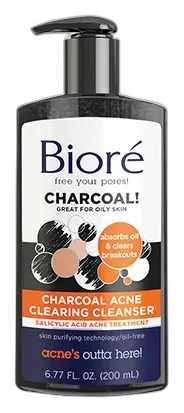
Charcoal Acne Clearing Cleanser
Budget Oil Fighter
 Verified reviewer
Pros & cons.
- +Very affordable at approximately $6.50 for 200 ml — one of the cheapest BHA cleansers available
- +1% salicylic acid provides genuine but mild daily chemical exfoliation for oily skin
- +HSA/FSA eligible as an FDA-registered OTC drug product
- +Pump dispenser is hygienic and convenient for daily use
- +Rinses completely clean with no residue — good for double-cleansing routines
- +Available in multiple sizes including a bulk 11.45 fl oz option
- −Charcoal is listed last at a token concentration — marketing-forward, not efficacy-forward
- −Contains SLES, fragrance with multiple EU-listed allergens, and menthol — heavy irritant load
- −Not cruelty-free — parent company Kao is not certified by any cruelty-free organization
- −1% salicylic acid may be too mild for moderate to stubborn acne
- −Can be stripping and drying with twice-daily use, particularly in winter
- −Fragrance components include known sensitizers (linalool, limonene, citronellol, geraniol)
The full review.
There is a specific kind of cleanser that earns its shelf space not through innovation or exceptional formulation but through sheer reliability at a price point that makes overthinking unnecessary. Biore’s Charcoal Acne Clearing Cleanser is that product. It has occupied drugstore shelves for a decade, outlasting the charcoal beauty trend that inspired its creation, and continues to sell steadily at a price most people spend on a coffee without thinking twice.
The active ingredient doing the actual work is 1% salicylic acid, an FDA-approved beta-hydroxy acid with decades of clinical validation behind it. At this concentration — half the maximum allowed in over-the-counter products — it provides a mild but consistent dose of chemical exfoliation. Salicylic acid’s oil-solubility allows it to dissolve into the sebum-filled environment inside a clogged pore and break up the mixture of dead cells and oil that forms comedones. In a wash-off format with roughly a minute of skin contact, you are not getting the deep, sustained BHA treatment that a leave-on product provides, but you are getting a daily maintenance dose that helps keep pores from reaching the tipping point into full-blown breakouts.
And then there is the charcoal. Listed dead last among the inactive ingredients, charcoal powder is present in what can only be a token concentration. Activated charcoal is a legitimate adsorbent — emergency rooms use it to treat poisoning — but its efficacy as a topical skincare ingredient in a wash-off cleanser with thirty to sixty seconds of skin contact is not supported by clinical evidence. The charcoal does two things here: it turns the gel an appealing dark gray color, and it gives the product a name that sounds more interesting than ‘Biore 1% Salicylic Acid Gel Cleanser.’ There is nothing wrong with a marketing-forward ingredient as long as you understand what it is.
The base formula is standard-issue drugstore: sodium laureth sulfate provides the primary cleansing action, with cocamidopropyl betaine as a gentler co-surfactant. SLES is effective at cutting through oil and grime, which is exactly what oily, acne-prone skin needs, but it is also more stripping than the sulfate-free alternatives that have become increasingly common in skincare. Glycerin and sorbitol provide some humectant offset, and the gel lathers into a respectable foam that rinses clean without residue.
The fragrance situation is where this formula shows its age. The product contains not just generic ‘Fragrance’ but a detailed list of fragrance sub-components that reads like a roll call of EU-regulated allergens: linalool, D-limonene, citronellol, geraniol, benzyl acetate. Menthol adds a cooling sensation on top of this aromatic cocktail. For oily-skinned users who are not fragrance-sensitive, this all translates to a pleasant citrusy-minty wash experience. For anyone with reactive skin, it is a minefield of potential triggers in a product category where irritation directly worsens the condition being treated.
Using this cleanser is straightforward and unremarkable in the best way. Pump out a small amount onto wet hands, work it into a lather, massage across the face for thirty to sixty seconds, rinse. The menthol provides an immediate cooling tingle that many users genuinely enjoy — there is something psychologically satisfying about feeling a cleanser ‘do something,’ even when the sensation has no correlation with acne treatment efficacy. Post-rinse, skin feels notably matte and clean. The tightness that follows is a signal to moisturize promptly, not a feature.
Results align with what you would reasonably expect from a 1% BHA cleanser. Oiliness is noticeably reduced within the first few uses. Minor blackheads start to improve within two to three weeks. Mild breakouts clear more quickly when this is part of a consistent routine. What this cleanser will not do is tackle moderate to severe acne, deep cystic breakouts, or stubborn comedones — for those, a leave-on BHA treatment at 2% or a prescription retinoid is the appropriate tool.
The value equation is simple: at approximately $6.50 for 200 milliliters, this is one of the cheapest salicylic acid cleansers on the market, and the pump bottle lasts two to three months with daily use. It is HSA and FSA eligible as an OTC drug product, which is a genuine perk for users with those accounts. Multiple sizes are available, including an 11.45-ounce bottle for those who want to stock up.
Biore as a brand has been a drugstore skincare fixture since entering the North American market in 1997, and their charcoal line has survived a full decade — a meaningful indicator of steady consumer demand. The brand is not cruelty-free (parent company Kao sells in mainland China), which will be a disqualifier for some consumers.
This cleanser is exactly what it appears to be: a cheap, effective, no-surprises acne wash for people with oily skin who want the salicylic acid and do not mind the sensory extras. It is not pushing any boundaries in formulation or clean beauty. It will not impress a skincare enthusiast. But it will show up, do its modest job, and cost you less than a fast-food meal — and sometimes that is exactly the product someone needs.
About Biore
Biore as a brand has been a drugstore skincare fixture since entering the North American market in 1997, and their charcoal line has survived a full decade — a meaningful indicator of steady consumer demand. The brand is not cruelty-free (parent company Kao sells in mainland China), which will be a disqualifier for some consumers.
Ingredient analysis.
Full INCI list
Active Ingredient: Salicylic Acid 1%. Inactive Ingredients: Water, Sodium Laureth Sulfate, Cocamidopropyl Betaine, Sorbitol, Glycerin, Laureth-4 Carboxylic Acid, Ethylhexylglycerin, Acrylates/C10-30 Alkyl Acrylate Crosspolymer, Sodium Benzoate, Fragrance, Menthol, Sodium Hydroxide, Polyquaternium-39, Disodium EDTA, Charcoal Powder
Skin match.
The science.
The Science
Salicylic acid at 1% concentration provides the core therapeutic benefit in this cleanser. A systematic review in Clinical, Cosmetic and Investigational Dermatology (2015) established that salicylic acid is effective for both inflammatory and non-inflammatory acne, with its oil-soluble structure allowing penetration into sebum-filled follicles. In a wash-off format, the effective contact time is limited to 30-60 seconds, which reduces both the therapeutic dose delivered and the irritation potential compared to leave-on formulations.
The charcoal powder has limited clinical evidence for topical skincare applications. While activated charcoal's adsorptive properties are well-documented in medical toxicology, a 2019 review in the Journal of Cosmetic Dermatology noted that the evidence for charcoal's efficacy in topical cosmetic products — particularly wash-off formulations — remains insufficient to support many marketing claims. The brief contact time in a cleanser further limits any potential adsorptive effect on pore contents.
Sodium laureth sulfate, the primary surfactant, is effective at removing excess sebum but can compromise the skin barrier with prolonged use. Research in the International Journal of Cosmetic Science has demonstrated that SLES increases transepidermal water loss more than gentler surfactant alternatives like sodium cocoyl isethionate, which is particularly relevant for acne-prone skin where barrier integrity directly impacts inflammatory responses.
References
- Salicylic acid as a peeling agent: a comprehensive review — Clinical, Cosmetic and Investigational Dermatology (2015)
Dermatologist Perspective
Dermatologists commonly recommend salicylic acid cleansers as a first-line treatment for mild acne, particularly for patients with oily skin and comedonal (blackhead/whitehead) predominant breakouts. Board-certified dermatologists note that the 1% concentration in this product is gentler than 2% formulations, making it more suitable for daily use but potentially insufficient for moderate acne. The inclusion of fragrance, menthol, and SLES is viewed unfavorably — dermatologists generally prefer fragrance-free, sulfate-free formulations for acne-prone skin, as these reduce the risk of contact irritation that can trigger inflammatory breakouts. This product may be recommended as an accessible, affordable starting point for patients primarily concerned with oiliness and mild comedonal acne, with a transition to more refined formulations if irritation develops.
Guidance
Where it fits in your routine.
Wet your face with lukewarm water. Pump one to two doses into wet hands and lather. Massage the face gently for 30-60 seconds, but avoid the eye area. Rinse well and pat dry. Apply a lightweight, oil-free moisturizer immediately to prevent post-cleanse tightness. Use once or twice daily. If you use other acne actives (retinoids, benzoyl peroxide), use this once daily to avoid over-drying.
At approximately $6.50 for 200 ml, this is one of the most affordable salicylic acid cleansers on the market, and the price-per-use over its 2-3 month lifespan is negligible. The HSA/FSA eligibility adds practical value for users with those accounts. However, comparably priced drugstore BHA cleansers now exist without the fragrance allergens and SLES — making this less of a standout value proposition than when it launched in 2016. The multiple size options (up to 11.45 fl oz) provide bulk-buying economy for users who have found it works for their skin. For a basic daily acne cleanser that gets the job done without complicating your budget, the price is right — just recognize that you are also paying for charcoal marketing and fragrance that add nothing to the acne treatment.
This cleanser works for oily or combination skin with mild acne, blackheads, and excess oil. It suits users who want an affordable daily option and lack sensitivity to fragrance or menthol. It is also a practical choice for teens starting a simple acne routine available at any drugstore.
Fragrance allergens, menthol, and SLES irritate sensitive, dry, or reactive skin. Biore's parent company Kao lacks cruelty-free certification, so those seeking cruelty-free products should look elsewhere. 1% salicylic acid in a wash-off format is too weak for moderate to severe acne. Many better-formulated BHA cleansers exist at similar prices if you prefer clean, fragrance-free formulations.
Product details.
A dark gray-black translucent gel that foams lightly when mixed with water. It spreads smoothly without physical scrub particles or grit. Charcoal provides the dark color but does not change the texture.
A light citrusy-minty fragrance has a strong menthol cooling note. It is present but not overwhelming. Most users call it fresh and clean-smelling.
Gray plastic pump bottle in the standard 6.77 fl oz size. The pump dispenser is practical and hygienic, giving a controlled amount of product. Larger sizes exist. Functional drugstore packaging.
Menthol provides an immediate cooling-tingling sensation on first use. This feels refreshing to oily skin but feels intense for sensitive users. The gel lathers easily and rinses clean, leaving skin matte and oil-free. Skin often feels slightly tight — moisturize promptly after patting dry.
2-3 months with daily use of the 6.77 fl oz size.
12 months
spring summer
The backstory.
Biore launched its charcoal line in 2016, capitalizing on the activated charcoal trend that was sweeping skincare and wellness. While charcoal face masks and cleansers proliferated across every price point, Biore's version paired the trendy ingredient with their established salicylic acid platform and kept the price firmly in drugstore territory. The product has remained in the lineup for a decade — outlasting the trend itself — suggesting consistent enough sales to justify its place on shelf.
About Biore
Legacy Brand (20+ years)Kao Corporation (Japan, founded 1887) launched Biore in 1980. Biore entered the North American market in 1997. The brand is known for its pore strips and acne-focused cleansing products. This cleanser is an FDA-registered OTC drug product with 1% salicylic acid.
Common myths.
Charcoal in a cleanser pulls toxins and impurities from your pores.
Activated charcoal works as an effective adsorbent in medical settings like poison control. However, clinical evidence does not support its ability to extract impurities from pores during 30-60 seconds of contact in a wash-off cleanser. The charcoal powder is the last inactive ingredient, which indicates a low concentration. The 1% salicylic acid does the actual pore-clearing work.
The menthol tingle means the cleanser is working.
Menthol activates TRPM8 cold-sensitive nerve receptors. This cooling sensation works independently of any acne-fighting mechanism. It feels refreshing but does not help salicylic acid exfoliate inside pores. In sensitive skin, menthol can trigger inflammation and worsen breakouts.
FAQ.
Does the charcoal in this cleanser actually help with acne?
Clinical evidence for charcoal as a topical acne treatment is limited. This wash-off cleanser lists charcoal powder last among inactive ingredients at a very low concentration. The 1% salicylic acid is the real acne-fighting ingredient and has decades of clinical evidence. Charcoal adds visual distinction and a modest oil-absorbing effect.
Can I use this cleanser every day?
Yes, but watch for dryness. The 1% salicylic acid works daily for most oily and combination skin types. If you see tightness, flaking, or increased sensitivity, use it once daily or every other day and apply a moisturizer after cleansing.
Is this cleanser good for sensitive skin?
No. This product has fragrance with multiple EU-listed allergens (linalool, limonene, citronellol, geraniol), menthol, and sodium laureth sulfate — all potential irritants for sensitive skin. If you have sensitive or reactive skin, use a fragrance-free, sulfate-free BHA cleanser instead.
How does the 1% salicylic acid compare to 2% products?
The 1% concentration is milder and easier to use daily, but has less potency per application than 2% formulas. It works for mild acne or as a maintenance cleanser once aggressive acne treatment controls breakouts. A 2% salicylic acid product works better for moderate to stubborn acne.
Is this product HSA/FSA eligible?
Yes. This cleanser is an FDA-registered OTC drug product. It contains salicylic acid as an active ingredient for acne treatment, so you can use Health Savings Account (HSA) and Flexible Spending Account (FSA) funds to buy it.
Community
What the community says.
"Effectively controls oil and reduces minor breakouts"
"Refreshing menthol cooling sensation"
"Good value for the low price"
"Lathers well and rinses clean without residue"
"Pump dispenser is convenient and hygienic"
"Can be drying with frequent or twice-daily use"
"Menthol causes redness and irritation for sensitive skin"
"Fragrance may trigger reactions in reactive skin types"
"Some users report no improvement in acne"
"Charcoal does not provide dramatic visible results"
"Contains SLES which some users prefer to avoid"
People also looked at.