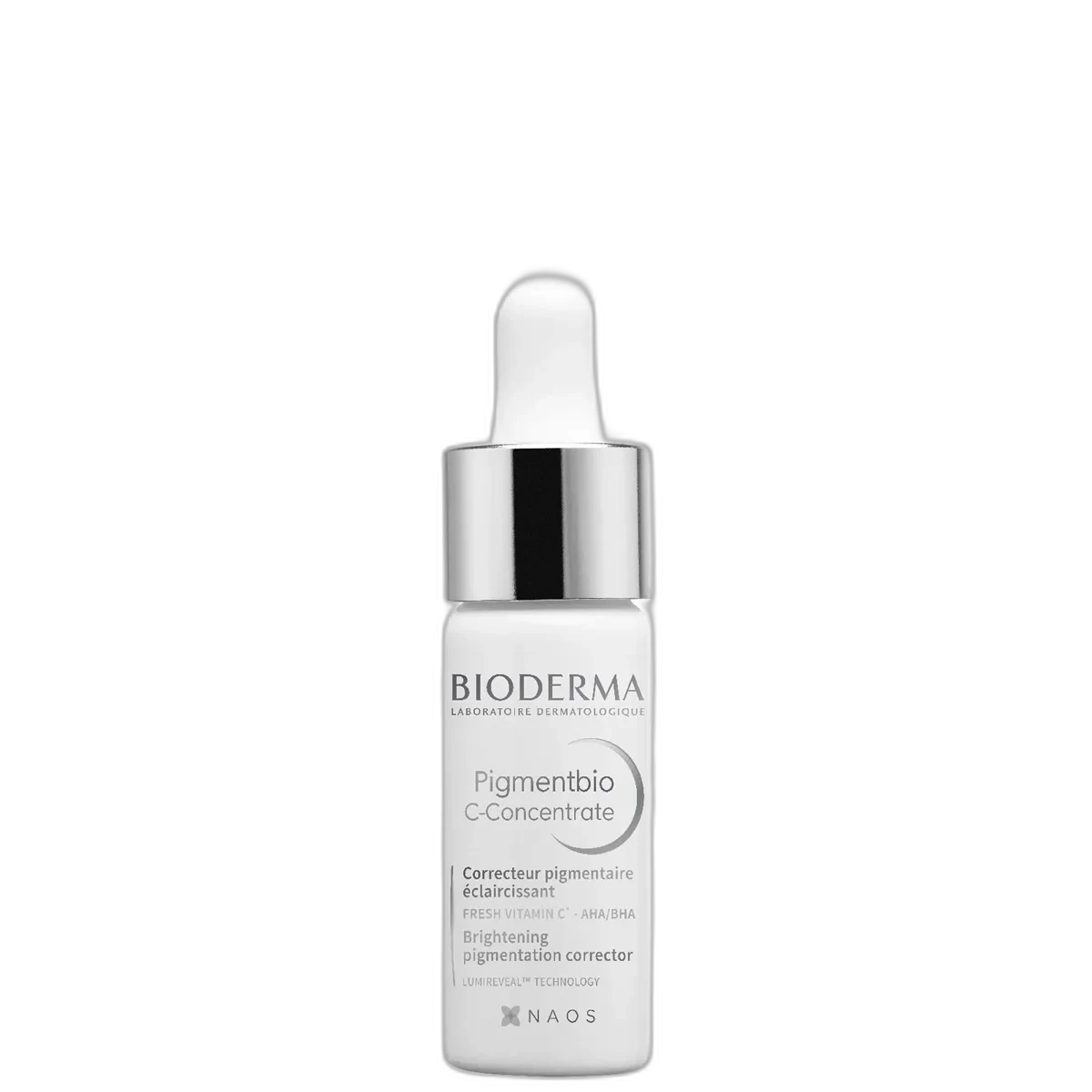
Pigmentbio C-Concentrate Brightening Vitamin C Serum
Multi-Pathway Brightener
 Verified reviewer
Pros & cons.
- +Multi-pathway approach targets pigmentation through five different mechanisms simultaneously
- +Dual-compartment activation system preserves vitamin C potency until first use
- +Patented LumiReveal complex inspired by proven dermatological prescription approaches
- +Lighter and less irritating than pure L-ascorbic acid serums at equivalent concentrations
- +Clinical testing shows measurable dark spot reduction at 8 weeks
- +Combines AHA, BHA, azelaic acid, vitamin C, and niacinamide in one formulation
- −Very expensive at 3.99 for only 15 mL — runs out in 4-6 weeks
- −Contains fragrance in a concentrated treatment product
- −Multi-acid formula can cause tingling and irritation on sensitive skin
- −Activation mechanism is confusing for first-time users
- −Results require 6-8 weeks of consistent nightly use to become visible
- −Not suitable for compromised barrier or very sensitive skin types
The full review.
In the 1970s, dermatologist Albert Kligman created Kligman’s trio: a combination of hydroquinone, tretinoin, and a corticosteroid that attacked hyperpigmentation through three simultaneous mechanisms. It worked—often dramatically. However, it required a prescription and had many side effects. Four decades later, Bioderma’s R&D team asked if they could replicate this multi-pathway approach using ingredients safe for cosmetic use.
The result is Pigmentbio C-Concentrate, a formula based on pigmentation biochemistry. Where Kligman used hydroquinone to inhibit tyrosinase, Bioderma uses azelaic acid and licorice root extract (glabridin)—both established tyrosinase inhibitors with better safety profiles. Where Kligman used tretinoin for cell turnover, Bioderma uses glycolic acid and salicylic acid. Where Kligman used a corticosteroid to manage inflammation, Bioderma uses andrographolide from Andrographis paniculata. They also added ascorbyl glucoside (vitamin C) for antioxidant protection and niacinamide to block melanosome transfer—two pathways Kligman’s original trio did not address.
The ambition is high and the execution is sophisticated. But let’s look at what is inside the bottle—specifically the dual-compartment system used for packaging and marketing.
The activation mechanism is unique. The vitamin C sits as a powder in the cap, separate from the liquid base. Press the cap firmly to release the powder, screw on the included dropper, and shake for ten seconds. This is not a gimmick—ascorbyl glucoside is more stable than L-ascorbic acid, and keeping it as a powder until activation eliminates oxidation risk. This pharmaceutical approach shows Bioderma does not rely on Instagram-style formulation.
Once mixed, the light gel-cream absorbs quickly like a serum. Three to four drops cover the face. It has a light fragrance—an odd choice for a serious treatment and the main complaint in user comments. It also tingles. The glycolic and salicylic acids are noticeable, especially during the first week. It is not painful for most, but sensitive skin should use it cautiously, perhaps starting with every-other-night application.
Bioderma’s clinical data is specific: testing on 21 volunteers over 56 days showed a 41% reduction in dark spot appearance, 87% improvement in skin radiance, and 85% improvement in complexion uniformity. These are brand-sponsored numbers, so take them with a grain of salt, but the multi-mechanism approach provides a scientific basis for these results. You hit melanin production, melanin transfer, cell turnover, and oxidative stress simultaneously rather than relying on one ingredient.
Align your expectations with the clinical timeline. Two weeks brings subtle brightening and improved radiance from the exfoliating acids accelerating cell turnover. Genuine dark spot reduction requires six to eight weeks of consistent use. This product does not deliver dramatic before-and-after photos in a week.
The ingredient list is more complex than most Bioderma products, containing 30 ingredients compared to the brand’s usual minimalist style. Each ingredient fits the formulation logic, but the length increases potential sensitization points, including fragrance and multiple acids. The product is designed for cyclical use: one to three months on, then repeated quarterly. The 15 mL bottle enforces this by running out in four to six weeks.
Finally, consider the value. Forty-four dollars for 15 mL is expensive, especially for a pharmacy brand. You pay for the patented LumiReveal complex, the activation technology, and nearly fifty years of Bioderma’s dermatological R&D. The value depends on your hyperpigmentation severity and previous failed single-ingredient serums. For stubborn melasma or post-inflammatory hyperpigmentation that failed to respond to standalone vitamin C or niacinamide, this multi-pathway approach is different. For mild, occasional dark spots, it is likely overkill in both intensity and cost.
The product sits between gentle cosmetic brighteners and prescription treatments. It is more aggressive than a simple vitamin C serum and more sophisticated than drugstore brightening products, but gentler than the dermatological combinations it mimics. For the right skin concern, it fills a gap few products address. Just note that 15 mL goes fast.
Formula
Ingredient analysis.
Full INCI list
Aqua/Water/Eau, Propanediol, Glycolic Acid, Glycerin, Dipropylene Glycol, Propylheptyl Caprylate, Sodium Hydroxide, Ascorbyl Glucoside, Niacinamide, Salicylic Acid, Ammonium Acryloyldimethyltaurate/VP Copolymer, Sorbitan Sesquioleate, Pentylene Glycol, Tocopheryl Acetate, Xanthan Gum, Sodium Citrate, Lysine, Azelaic Acid, Mannitol, Xylitol, Sodium Metabisulfite, Andrographis Paniculata Leaf Extract, Rhamnose, Saccharide Isomerate, Glycyrrhiza Glabra (Licorice) Root Extract, Tocopherol, Fructooligosaccharides, Caprylic/Capric Triglyceride, Laminaria Ochroleuca Extract, Fragrance (Parfum)
Skin match.
The science.
The Science
Pigmentbio C-Concentrate uses a multi-pathway approach to hyperpigmentation that mirrors dermatological practice.
The LumiReveal complex combines three agents that target different steps in melanogenesis. Azelaic acid inhibits tyrosinase, the rate-limiting enzyme in melanin production. A 1998 study by Kakita and Lowe in Clinical Therapeutics showed that combining azelaic acid and glycolic acid works as well as 4% hydroquinone cream for hyperpigmentation in darker-skinned patients. This study sets the scientific precedent for this formula's acid combination.
Glabridin, from the licorice root extract in this formula, inhibits tyrosinase through a different binding mechanism than azelaic acid. Andrographolide from Andrographis paniculata provides anti-inflammatory properties. This helps prevent the post-inflammatory hyperpigmentation cycle where treatment-induced irritation creates new pigmentation.
Niacinamide adds a third layer. Hakozaki et al. published in the British Journal of Dermatology (2002) showed that niacinamide decreases hyperpigmentation by reducing melanosome transfer from melanocytes to keratinocytes. This targets a different point in the pigmentation cascade than tyrosinase inhibition. The product addresses both melanin production and melanin distribution.
The ascorbyl glucoside (vitamin C derivative) provides antioxidant protection against UV-induced melanogenesis. A 2024 study in PMC showed an ascorbyl glucoside complex significantly improved hyperpigmentation of solar lentigos at 12 and 24 weeks.
Glycolic acid drives exfoliation, removing pigmented keratinocytes from the skin surface and stimulating collagen synthesis in the dermis. Combining it with salicylic acid (a BHA) extends exfoliation into the pore lining to address surface and follicular pigmentation.
References
- Azelaic acid and glycolic acid combination therapy for facial hyperpigmentation in darker-skinned patients: a clinical comparison with hydroquinone — Clinical Therapeutics (1998)
- The effect of niacinamide on reducing cutaneous pigmentation and suppression of melanosome transfer — British Journal of Dermatology (2002)
Dermatologist Perspective
Dermatologists find multi-pathway approaches to hyperpigmentation more effective than single-ingredient strategies because melanin production involves multiple enzymes, cellular processes, and feedback loops. Board-certified dermatologists note the LumiReveal complex combines tyrosinase inhibitors, anti-inflammatory agents, and melanosome transfer blockers to address pigmentation at several points in the cascade. This strategy was previously mostly available through prescription combinations. This product serves as an intermediate step for patients whose hyperpigmentation fails to respond to basic vitamin C or niacinamide serums but who want a sophisticated OTC option before using prescription hydroquinone or tretinoin. The cyclical usage recommendation (1-3 months on, then quarterly) aligns with dermatological guidance on intensive treatment courses.
Where it fits in your routine.
Press the cap firmly before first use to release the vitamin C powder into the liquid base. Screw on the included dropper and shake vigorously for 10 seconds until fully mixed. Apply 3-4 drops to clean, dry skin in the evening, avoiding the eye area. Let it absorb for 1-2 minutes before applying moisturizer. Use every-other-night for the first week, then use nightly if tolerated. Always apply SPF 30+ sunscreen the following morning. Use as a 1-3 month treatment course, then repeat quarterly. Store at room temperature away from direct sunlight after activation.
At 3.99 for 15 mL, this is Bioderma's most expensive product per milliliter and a high cost for a pharmacy-brand serum. The bottle lasts about 4-6 weeks with nightly use, costing roughly 0-44 per month of treatment. The value comes from the multi-ingredient approach replacing several individual serums — a separate vitamin C, a separate acid exfoliant, and a separate niacinamide product likely cost more together. However, for mild pigmentation concerns, the price-to-need ratio is difficult to justify when effective single-ingredient options cost much less. The 15 mL format has no bulk savings option, and the 6-month PAO after activation prevents stockpiling. For persistent hyperpigmentation that hasn't responded to simpler approaches, the investment makes more sense.
This works for people with persistent hyperpigmentation, melasma, or post-inflammatory dark spots who found basic vitamin C or niacinamide serums ineffective. It suits normal to combination skin types wanting a multi-pathway brightening treatment from a trusted pharmacy brand. Use it nightly for 6-8 weeks for best results.
The multi-acid formula is too active for sensitive, reactive, or compromised barrier skin. Salicylic acid content makes it unsuitable during pregnancy. This product is too aggressive and expensive for mild, occasional dark spots. If fragrance in treatment products is a concern, look elsewhere.
Product details.
fall winter
The backstory.
Developed as part of Bioderma's 2019 Pigmentbio range, this serum represents the brand's answer to the growing demand for effective brightening products that don't rely on hydroquinone. The LumiReveal technology was specifically engineered to replicate the multi-pathway efficacy of dermatological prescription combinations using ingredients with better safety profiles for cosmetic use.
About Bioderma
Legacy Brand (20+ years)Pharmacist-biologist Jean-Noël Thorel founded Bioderma in 1977 in Aix-en-Provence, France. The brand has nearly five decades of pharmacy-channel distribution and uses an ecobiology approach to formulation, giving it deep dermatological credibility. The Pigmentbio line uses patented LumiReveal technology to target hyperpigmentation.
FAQ.
How do you activate the Bioderma Pigmentbio C-Concentrate?
Press the cap firmly to release the vitamin C powder into the liquid base. Screw on the included dropper applicator and shake vigorously for 10 seconds until fully mixed. This dual-compartment system keeps the vitamin C in stable powder form until use, preserving maximum potency.
Can you use Bioderma Pigmentbio C-Concentrate with retinol?
Do not use them on the same evening. This serum contains glycolic acid and salicylic acid; adding retinol causes over-exfoliation and skin irritation. Alternate nights — C-Concentrate one evening, retinol the next — or use retinol on nights off during the treatment course.
Is Bioderma Pigmentbio C-Concentrate safe during pregnancy?
No — this product contains salicylic acid. Most doctors advise against using salicylic acid during pregnancy, especially in leave-on formulations. Ask your healthcare provider for pregnancy-safe brightening alternatives.
How long does Bioderma Pigmentbio C-Concentrate take to show results?
Exfoliating acids provide subtle brightening and improved radiance within 1-2 weeks. Consistent nightly use reduces visible dark spots in 6-8 weeks. Bioderma's clinical testing showed a 41% reduction in dark spot appearance at 8 weeks.
Why is the Bioderma Pigmentbio C-Concentrate bottle so small?
The 15 mL size shows this is a concentrated treatment course (1-3 months), not a daily-use serum. Using 3-4 drops per night makes the bottle last about 4-6 weeks. The vitamin C activation system gives the formula a 6-month PAO after mixing; larger volumes risk potency loss before use.
What type of vitamin C is in Bioderma Pigmentbio C-Concentrate?
It uses ascorbyl glucoside, a stable vitamin C derivative. Skin enzymes convert this to pure ascorbic acid after it penetrates. The concentration is lower than many L-ascorbic acid serums. Instead of high-dose vitamin C alone, the product works through a multi-ingredient approach using vitamin C, glycolic acid, niacinamide, azelaic acid, and licorice extract.
What the community says.
"Visibly brightens skin and gives a natural glow"
"Helps reduce dark spots and even skin tone over time"
"Lightweight and fast-absorbing texture"
"Less irritating than pure L-ascorbic acid serums"
"Good for layering under other products"
"Very expensive for only 15 mL of product"
"Activation/mixing mechanism can be confusing on first use"
"Some users report burning sensation on sensitive skin"
"Brightening results require 6+ weeks of patience"
"Contains fragrance in a treatment product"
"Small bottle runs out quickly with daily use"
People also looked at.