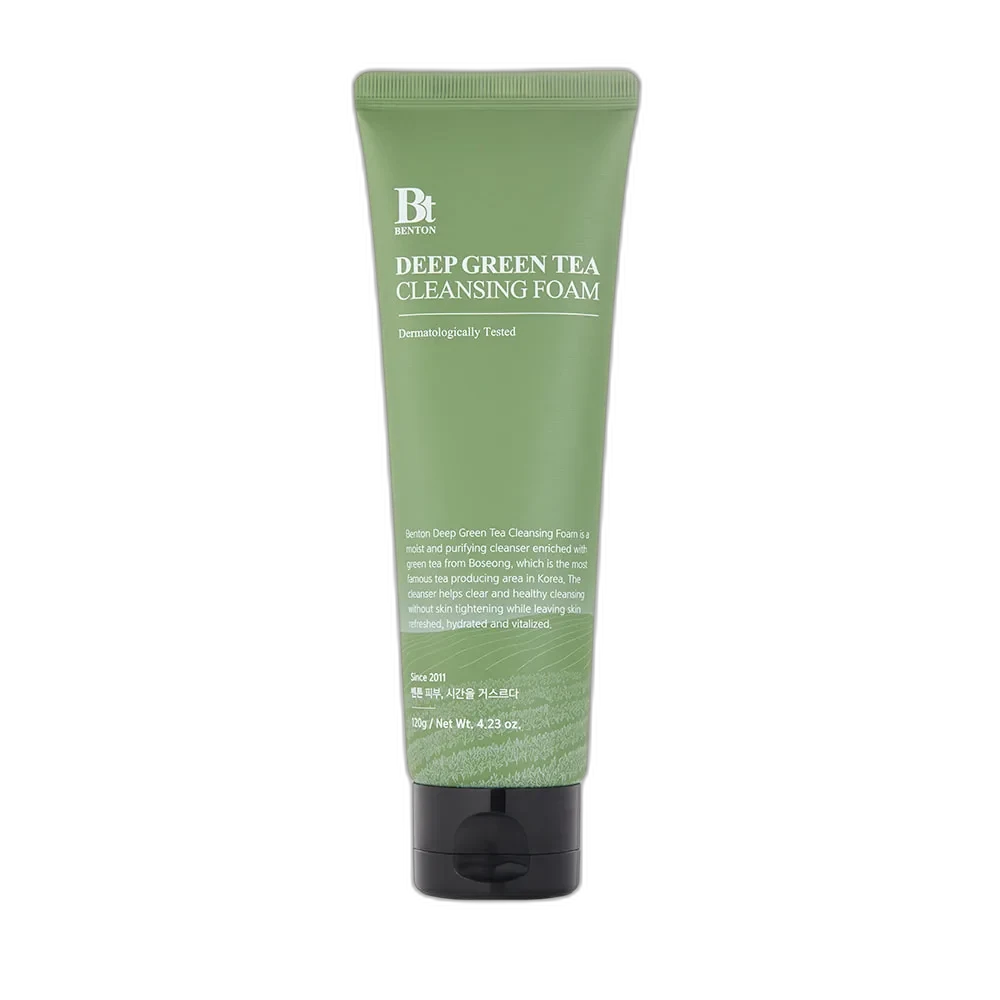
Deep Green Tea Cleansing Foam
Ingredient-Geek Favorite
 Verified reviewer
Pros & cons.
- +10% green tea leaf water replaces part of the water phase
- +Triple-fraction green tea extract bench (leaf, seed, root)
- +Fragrance-free with no added parfum
- +Dense, creamy foam removes residue effectively
- +Includes centella, willow bark, and panthenol soothing bench
- +Affordable at roughly $17 for 120g
- −Alkaline wash-off pH not ideal for reactive or barrier-compromised skin
- −Rosemary leaf oil is a mild potential sensitizer
- −Basic tube packaging with no pump or travel features
- −Not the best choice as a sole cleanser for heavy makeup
- −Benefits of green tea catechins are limited by wash-off format
The full review.
Benton is the K-beauty brand that ingredient-obsessed Reddit users discovered about five minutes before anyone else did. Founded in 2011, the brand built its identity around EWG-style transparency, minimal additives, and a deliberate refusal to chase the hype cycles that most Korean skincare brands ride. The Deep Green Tea Cleansing Foam is a neat test case for whether that philosophy actually changes the product, because ‘green tea cleanser’ is one of the most over-used marketing hooks in the category — most of them contain about as much green tea as a Lipton tea bag that has been briefly waved over the vat. Benton’s version actually contains the plant. Ten percent of the water phase is green tea leaf water, not plain water, and three additional fractions — leaf, seed, and root extracts — sit further down the INCI. Whether that matters at the short contact window of a wash-off product is a fair question, but at least you are paying for what is on the label.
The cleansing base is a traditional Korean saponified-soap system: myristic, lauric, palmitic, and stearic acid combined with potassium hydroxide to generate a dense, creamy foam that removes sebum, sunscreen residue, and the tail end of an oil cleanser without any drama. The pH lands somewhere in the 9-10 range, which is alkaline enough that you should always follow with a low-pH hydrating toner to return skin to its acid mantle quickly — this is standard K-beauty routine practice and not a flaw of the product, but it is worth stating explicitly because people who cross over from amino-acid cleansers sometimes forget. Glycerin, panthenol, and a small centella asiatica soothing bench cushion the wash enough that it never crosses into ‘squeaky-tight’ territory for normal or combination skin, though dry and reactive users will feel the alkalinity more than they would with a cream cleanser.
Using it is about as uneventful as cleanser reviews get, which is actually the highest compliment you can give a face wash. A pearl-sized amount on damp hands whips into a dense, creamy foam — visually satisfying but not performative. Two-fingertip circles around the face for 30-45 seconds, rinse with lukewarm water, pat dry. Skin feels clean without that stripped-plaster sensation, the rosemary oil adds a faint herbal note that most users do not even register, and there is no fragrance-bomb scent to contend with. Makeup removal is competent for light coverage and excellent as a second cleanser — the potassium hydroxide soap dissolves waxes and residual oils more effectively than most amino-acid-based cleansers in the same price tier, which is the main practical reason to choose this over a ‘gentler’ alternative.
Limitations are real but modest. The alkaline pH is a disqualifier for rosacea, eczema, or actively compromised skin — those faces should stick to cream cleansers or micellar water. The rosemary leaf oil is a small but non-zero sensitizer for the subset of users who react to it. The tube packaging is functional but aesthetically plain, which matters mostly for buyers who care about shelf appeal. And the 10% green tea leaf water, impressive as it is for the category, is still delivering polyphenols into a wash-off product where most of the benefit rinses down the drain within a minute. The value proposition is where this cleanser settles into its ‘quiet recommendation’ slot: $17 for 120g of a well-built, fragrance-free, meaningfully active cleanser is genuinely fair, and it slots into nearly any routine that does not specifically require a low-pH formula. For oily, combination, or normal skin looking for a dependable second-cleanse step with actual green tea inside, this is one of the better options in its price tier.
Ingredient analysis.
Full INCI list · pH 9.5
Water, Myristic Acid, Glycerin, Camellia Sinensis (Green Tea) Leaf Water (10%), Lauric Acid, Palmitic Acid, Stearic Acid, Potassium Hydroxide, Butylene Glycol, Pentylene Glycol, Sorbitan Olivate, 1,2-Hexanediol, Polyquaternium-10, Camellia Japonica Seed Oil, Sodium Lauroyl Glutamate, Centella Asiatica Extract, Salix Alba (Willow) Bark Extract, Salix Nigra (Willow) Bark Extract, Panthenol, Caprylic/Capric Triglyceride, Houttuynia Cordata Extract, Punica Granatum (Pomegranate) Fruit Extract, Camellia Sinensis (Green Tea) Leaf Extract, Camellia Sinensis (Green Tea) Seed Extract, Camellia Sinensis (Green Tea) Root Extract, Caprylyl Glycol, Helianthus Annuus (Sunflower) Seed Oil, Capric Acid, Rosmarinus Officinalis (Rosemary) Leaf Oil, Allantoin
Skin match.
The science.
The Science
The core question is whether green tea polyphenols provide measurable benefits in a wash-off format. The catechin family — specifically epigallocatechin gallate, or EGCG — has established literature as a topical antioxidant and mild anti-inflammatory in leave-on formulas at concentrations above roughly 0.5-1%. A 2009 study in Experimental Dermatology by Hsu and colleagues showed that topical EGCG reduced UV-induced inflammatory markers in human skin biopsies. A 2013 Journal of the American Academy of Dermatology review also covered green tea's role in photoprotection and sebum modulation. Wash-off cleansers are harder: contact time is short, and most surfactant-carrying catechins rinse away before they penetrate. Benton's formulation strategy uses a 10% leaf water base rather than a trailing extract, betting that enough residual polyphenol content stays on the skin after rinsing to matter.
The fatty-acid soap science is simpler and better established. Myristic, lauric, palmitic, and stearic acid combined with potassium hydroxide create the dense foam typical of Korean cleansing systems and remove sebum and residue effectively. The tradeoff is a high wash-off pH (typically 9-10) compared to the skin's natural 4.5-6.5 acid mantle; this is why standard K-beauty advice suggests following with a low-pH hydrating toner. Centella asiatica's triterpenoid evidence base is well-documented for leave-on formulas, but like the green tea, its benefit is limited by the short contact window in a cleanser. Panthenol has real but minor benefits in reducing post-wash tightness, with several controlled studies supporting its use in wash-off applications.
Dermatologist Perspective
Dermatologists often see Benton's Deep Green Tea Cleansing Foam as a reasonable middle-ground cleanser for oily or combination skin patients who want a fragrance-free, minimalist K-beauty option. It is not typically recommended for rosacea or eczema patients due to the alkaline wash-off pH and the rosemary oil component. Board-certified dermatologists usually suggest low-pH amino-acid cleansers for those cases. For patients who double-cleanse and follow with a low-pH toner, this cleanser works with most active routines, including those using retinoids, azelaic acid, or benzoyl peroxide.
Where it fits in your routine.
Wet your face with lukewarm water. Squeeze a pea-to-almond-sized amount onto damp palms, add water, and whip it into a dense foam. Apply to the face using gentle circular motions for 30-45 seconds, focusing on oily areas. Rinse thoroughly with lukewarm water and pat dry; do not rub. Always follow with a low-pH hydrating toner to help the skin return to its natural acid mantle. Use once or twice daily. For heavy makeup removal, use an oil or balm cleanser first.
At roughly $17 for 120g, this cleanser offers good value for its category. Cheaper Korean drugstore foams exist but lack meaningful active content; more expensive 'premium' green tea cleansers from Innisfree or Sulwhasoo cost 2-4x more for similar or less impressive INCIs. A 120g tube lasts 3-4 months with twice-daily use, costing about $5 per month. No larger size exists, but the standard tube is travel-friendly and stable, so the lack of a pump is not a disadvantage.
Oily, combination, and normal skin types want a fragrance-free, ingredient-transparent foam cleanser with active content. This works well for users who follow a K-beauty routine using a low-pH toner next.
Skip this if you have rosacea, eczema, or an actively compromised barrier; use a cream or amino-acid cleanser instead. Also skip this if you dislike whipping foam cleansers or want a cleanser that works without a follow-up toner step.
Product details.
Thick, pale-green paste in the tube that whips into a dense, creamy foam.
Rosemary leaf oil and tea extracts add a faint herbal-green note; otherwise, it is essentially unscented.
Standard squeeze tube with a flip-top cap — no frills, no spatula, travels easily.
Foams quickly with water and wet hands. The first wash cleanses without the squeaky tightness common in many K-beauty fatty-acid cleansers, but the alkaline pH makes a subsequent toner step a good idea.
About 3-4 months with twice-daily use for face cleansing.
12 months
All Year
The backstory.
Benton launched in 2011 as one of the first Korean indie brands to lean hard on EWG-style ingredient transparency. The Snail Bee line put them on the map, and the Deep Green Tea collection — introduced in 2018 — was the brand's answer to the sudden wave of premium green-tea K-beauty ranges like Innisfree's Green Tea Seed series, but positioned at the ingredient-geek end of the market rather than the mass-retail one.
About Benton
Established Brand (5–20 years)Benton launched in 2011 as a Korean indie brand. It focuses on EWG-grade ingredient transparency and minimal-additive formulations. The brand built its reputation on the Snail Bee line before adding the Deep Green Tea and Fermentation collections. It has a loyal following among ingredient-conscious K-beauty users.
Common myths.
Fatty-acid soap cleansers always strip the face too harshly.
pH and ingredient support matter more than surfactant class. Glycerin, panthenol, and green tea extracts cushion the wash. A low-pH toner follows. This cleanser works for normal, combination, and oily skin and removes residue better than most amino-acid cleansers.
FAQ.
Is Benton Deep Green Tea Cleansing Foam fragrance-free?
The formula has no added parfum, but rosemary leaf oil appears low on the ingredient list and gives a faint herbal scent. Most users find it unscented; those sensitive to rosemary should patch test.
What pH is the cleanser?
Like most Korean saponified fatty-acid foams, it has an alkaline pH of roughly 9-10. Using a low-pH hydrating toner after helps the skin return to its natural acid mantle quickly after rinsing.
Can I use it as the only cleanser at night?
Use it for light makeup or sunscreen. For heavy makeup, retinoids, or waterproof SPF, use an oil or balm cleanser first. Benton works well as a second cleanser, but it does not emulsify oil-based residues alone.
Is it good for acne-prone skin?
Yes — it cleans without leaving an occlusive residue. It contains centella and willow bark extracts to support breakout-prone skin, and green tea catechins have a solid literature base for sebum-related benefits.
Will it dry out sensitive skin?
Possibly. The alkaline wash-off pH can feel tight on dry or reactive skin, and the rosemary oil is a mild potential irritant. Sensitive-skin users generally do better with Benton's Aloe BHA Skin Toner routine than this foam.
Community
What the community says.
"cleans thoroughly without tightness"
"fragrance-free"
"affordable"
"nice dense foam"
"slight rosemary oil scent"
"can be drying for sensitive skin"
"alkaline pH"
People also looked at.