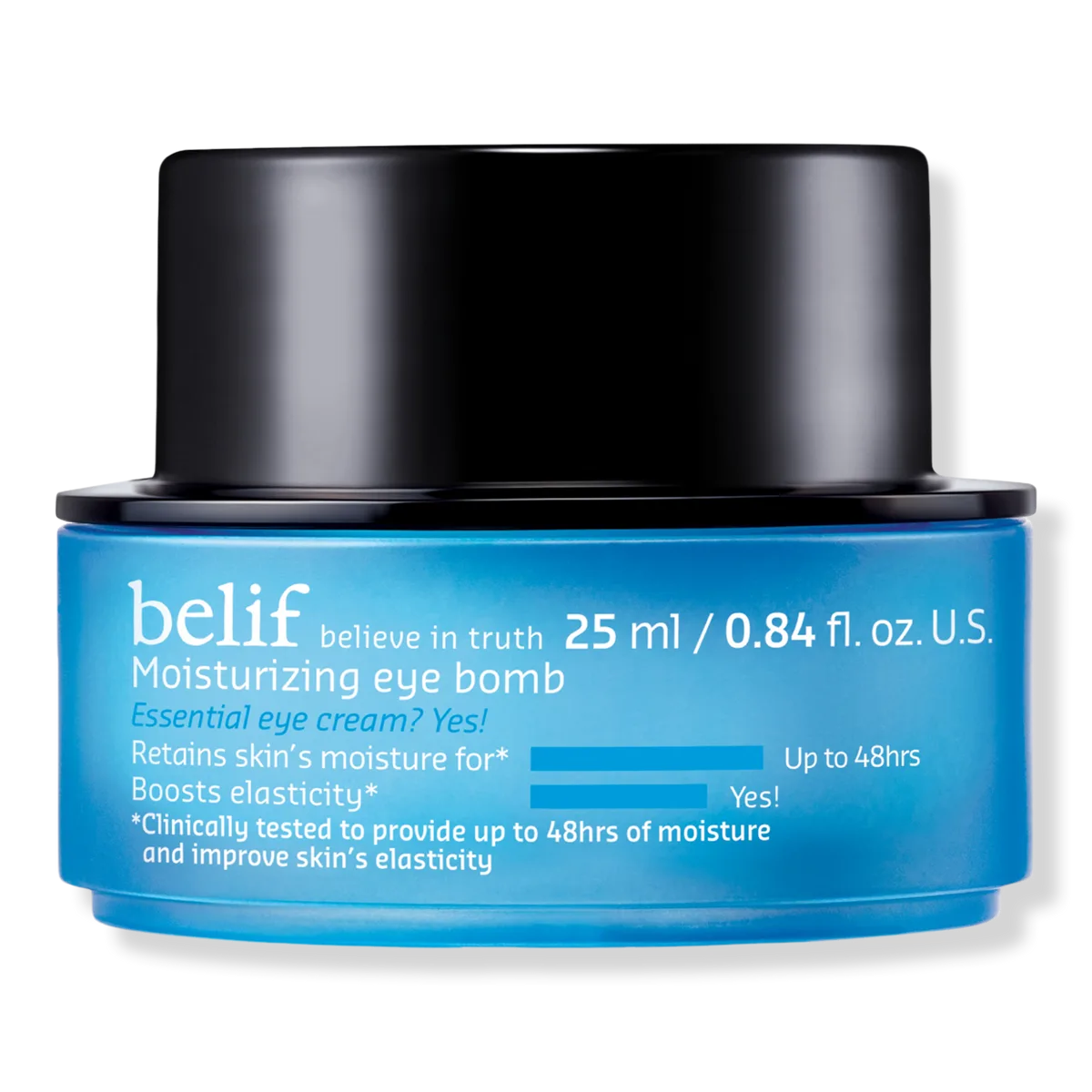
Moisturizing Eye Bomb
K-Beauty Hydration Eye Cream
 Verified reviewer
Pros & cons.
- +Glycerin in the second INCI position delivers the Aqua Bomb hydration baseline
- +Ceramide NP reinforces the delicate under-eye barrier where natural lipids run low
- +Matrixyl peptide pair (palmitoyl tripeptide-1 and tetrapeptide-7) adds real firming actives
- +Six-Herb Complex provides coherent soothing identity from belif's Napiers heritage
- +Centella asiatica adds K-beauty calming credibility
- +Lightweight cushioned texture lays cleanly under concealer
- +Pregnancy-compatible with no flagged anti-aging actives
- −Added fragrance plus limonene and linalool limit use for sensitive eyes
- −$48 for 25 ml is mid-range but not a bargain
- −Jar packaging is less hygienic than a tube would be
- −Doesn't address dark circles or fluid puffiness directly
- −Not appropriate for known fragrance allergies, eczema, or rosacea around the eyes
The full review.
Most hydration-focused eye creams are minimalist. They use glycerin, hyaluronic acid, and an oil or two to provide cushioned hydration. This works, but it leaves a gap for users wanting hydration plus treatment in one product, especially since eye skin is too delicate for the retinol routines used on the rest of the face. belif’s reformulated Moisturizing Eye Bomb fills that gap. The original 2018 product focused on hydration. The reformulated version keeps that hydration backbone and adds palmitoyl tripeptide-1 and palmitoyl tetrapeptide-7 — the Matrixyl peptide pair — to firm skin and target fine lines. It is now a hybrid product.
The glycerin-forward formulation is the main structural choice. Glycerin is second on the INCI list, right after water, which is unusually high for an eye cream. Most eye creams put oils and emulsifiers ahead of the humectant, but belif makes glycerin the lead. This creates a cream that delivers a continuous humectant load to the periorbital skin, drawing water into the upper layers and holding it there after absorption. This structure is why the Aqua Bomb line earned its ‘hydration bomb’ nickname, and it provides the foundation for the more active ingredients.
Ceramide NP sits around the glycerin to reinforce the barrier of the delicate under-eye area; this is critical because eye skin has fewer sebaceous glands than the rest of the face and loses water faster. Squalane provides skin-identical lipid emollience without occlusion. Shea butter adds a thicker emollient layer. Sodium hyaluronate adds another humectant further down the list. Panthenol contributes hydration and soothing. The base supports the eye area’s specific needs rather than acting as a face cream in a smaller jar.
The peptides change the product’s character. Palmitoyl tripeptide-1 and palmitoyl tetrapeptide-7 are part of the Matrixyl family, which has clinical evidence from the last decade for improving fine lines and elasticity. The published work is not as deep as the evidence for retinoids, but it is real, and the side-effect profile is gentler. Peptides do not cause the irritation, dryness, or sun sensitivity that make retinol difficult for the eye area. For users who want anti-aging work but cannot tolerate retinol near their eyes, this peptide combination is a middle path.
belif was launched in 2010 by LG Household & Health Care as a K-beauty brand based on the apothecary traditions of Napiers Herbalists, a Scottish herbal pharmacy founded in 1860. The Six-Herb Complex — wood betony, plantain, yarrow, mallow, nettle, and calendula — runs through the entire product line and gives belif a coherent identity. Centella asiatica, oat kernel extract, and willow bark extract round out the soothing botanicals. These do not do the headline work here, but they create a cohesive context that makes the product feel like a real K-beauty cream rather than a decontextualized peptide carrier.
Texture
The texture is satisfying. The cream is lightweight and cushioned, melts into the eye area in about thirty seconds, and leaves a satin finish that sits cleanly under concealer or eye makeup.
Scent
The herbal-floral fragrance is the dominant impression — a soft, recognizable belif scent. Fans of the line love it, but fragrance-sensitive users should consider this carefully.
Packaging
The compact frosted jar is functional but old-school. Tube packaging would be more hygienic, as dipping a finger into a jar twice daily is a known contamination route.
Common Complaints
There are honest caveats. The product contains added fragrance plus limonene and linalool — common contact allergens that exclude users with eczema, rosacea, or known fragrance sensitivities around the eye area. The price ($48 for 25 ml) is mid-range for K-beauty eye creams and lacks a larger size for frequent buyers. The product does not address dark circles or fluid puffiness directly — it lacks caffeine, vitamin K, and depuffing botanicals — so users with those concerns should look elsewhere. The milk-and-honey-free, mostly plant-based formulation is not certified vegan, so vegan readers should check the latest belif vegan documentation.
Who Should Buy
Buy this if you need hydration and mild fine-line work, want a K-beauty cream with heritage, and do not have known fragrance sensitivities.
Not ideal for
Skip it if your eye area reacts to fragrance, if dark circles or puffiness are your main concern, or if you want a cleaner peptide eye cream without added scent.
Ingredient analysis.
Full INCI list
Water, Glycerin, Caprylic/Capric Triglyceride, Cyclopentasiloxane, Cetearyl Olivate, Sorbitan Olivate, Dimethicone, Pentaerythrityl Tetraethylhexanoate, Cetyl Alcohol, Squalane, Stearyl Alcohol, Glyceryl Stearate, PEG-100 Stearate, Butyrospermum Parkii (Shea) Butter, Panthenol, Ceramide NP, Palmitoyl Tripeptide-1, Palmitoyl Tetrapeptide-7, Centella Asiatica Extract, Avena Sativa (Oat) Kernel Extract, Calendula Officinalis Flower Extract, Salix Alba (Willow) Bark Extract, Stachys Officinalis Extract, Plantago Major Leaf Extract, Achillea Millefolium Extract, Malva Sylvestris (Mallow) Extract, Urtica Dioica (Nettle) Leaf Extract, Acacia Senegal Gum, Tocopheryl Acetate, Sodium Hyaluronate, Carbomer, Tromethamine, 1,2-Hexanediol, Caprylyl Glycol, Disodium EDTA, Phenoxyethanol, Fragrance (Parfum), Limonene, Linalool
Skin match.
The science.
The Science
Eye area structure dictates eye cream formulation. The skin around the eye is thinner than the rest of the face and has fewer sebaceous glands and lower natural lipid output. This causes faster water loss and earlier dehydration crepiness than the cheeks or forehead. Glycerin has a robust evidence base for humectant action: it draws water into the upper epidermal layers, supports barrier function, and improves dry skin comfort and appearance. Placing glycerin in the second INCI position of an eye cream — as belif does here — prioritizes humectant load over emollient richness. Ceramide NP has well-established evidence for barrier reinforcement and trans-epidermal water loss reduction, which matters because natural ceramide content is lower in the eye area than on the cheeks. Squalane also has a robust evidence base for emollience without occlusion. The peptide pair — palmitoyl tripeptide-1 and palmitoyl tetrapeptide-7, sometimes marketed as Matrixyl 3000 — has two decades of clinical evidence for collagen synthesis support and fine line reduction. Published work shows measurable improvements in wrinkle depth and skin elasticity with consistent use over 8-12 weeks at typical cosmetic concentrations. The evidence base is not as deep as retinoids, but it is real and the side-effect profile is much gentler — vital for the delicate eye area where retinol causes significant irritation. Centella asiatica has growing evidence for soothing and barrier support, with multiple controlled trials supporting its use in inflammatory and barrier-compromised conditions. The Six-Herb Complex is an emerging category; individual herbs have varying evidence for topical anti-inflammatory effects, mostly from in vitro and small clinical studies, and mainly contribute to the product's character. The fragrance allergens — limonene and linalool — are established common contact sensitizers, with documented sensitization rates relevant for products applied near the eye where contact dermatitis risk is elevated.
Dermatologist Perspective
Dermatologists frequently recommend ceramide- and peptide-supported eye creams for patients with periorbital dryness or early fine lines. The Matrixyl peptide pair has enough clinical evidence to be a legitimate, gentler alternative to retinoids for the delicate eye area. Board-certified dermatologists generally view glycerin-forward formulations positively because the humectant load addresses the specific dehydration tendency of eye-area skin. The main caveat dermatologists raise is fragrance: the periorbital area is a common site for fragrance-related contact dermatitis. Patients with eczema, rosacea, or known fragrance sensitivity typically choose fragrance-free eye products. Dermatologists also remind patients that no topical eye cream addresses structural under-eye issues like fat pad herniation, true vascular dark circles, or deep hollows from bone resorption — those require in-office procedures.
Where it fits in your routine.
Apply a small amount (about a grain of rice for both eyes) after serums and before face moisturizer. Tap gently with the ring finger from the inner corner outward along the orbital bone — avoid the lash line and waterline. Wait thirty seconds for absorption before applying concealer or other products. Use morning and night. To minimize jar contamination, use a clean fingertip or a small spatula instead of dipping the same finger in repeatedly. Pair with the rest of the Aqua Bomb routine for the full belif system, or use with any moisturizer of your choice.
At $48 for 25 ml, Moisturizing Eye Bomb costs about $10-$12 per month if used twice daily on both eyes. This price is fair for a K-beauty eye cream with the formulation quality belif applies to its core line. The math beats luxury K-beauty eye creams, which often cost $80-$120 for similar peptide-and-ceramide formulations. It costs more than minimalist drugstore or indie eye creams, which run $15-$25 but lack the supporting cast or brand heritage. No larger size exists, which hurts value for regular users who want a lower cost-per-ml. belif's brand status under LG Household & Health Care, the Napiers heritage license, and the peptide-and-ceramide chemistry justify the price better than a typical mid-tier K-beauty brand.
This product suits buyers seeking hydration and mild firming in one step, fans of K-beauty heritage formulations, and users wanting a peptide-supported eye cream gentler than retinol for the delicate eye area.
Skip this if you have known fragrance sensitivities or eczema around the eyes, if dark circles or fluid puffiness are your main concerns, or if you prefer fragrance-free skincare on principle. Also skip if you want a minimalist or higher-active eye cream instead of a hybrid hydration-and-firming product.
Product details.
This lightweight cushioned cream absorbs in about thirty seconds and leaves a satin finish.
Soft herbal-floral aroma typical of the belif Aqua Bomb line
Compact frosted glass jar with screw-top lid
The first use feels cushioned and hydrating. The cream melts into the under-eye area instead of sitting on top of the skin. The herbal-floral fragrance is the most prominent immediate impression. Healthy skin feels no tingling or stinging.
4-5 months at twice-daily use on both eyes
12 months
All Year
The backstory.
belif launched the original Moisturizing Eye Bomb in 2018 as the eye-area extension of the cult-favorite True Cream Aqua Bomb, and reformulated it more recently to add the Matrixyl peptide pair for firming and fine-line work. The reformulation kept the brand's signature glycerin-forward, herb-supported identity while adding more sophisticated treatment actives.
About belif
Established Brand (5–20 years)belif launched in 2010 under LG Household & Health Care. It uses British apothecary traditions from Napiers Herbalists (founded 1860). The brand has a global presence via its True Cream Aqua Bomb hero product and the Aqua Bomb extended line.
Common myths.
Eye creams are just face moisturizers in smaller jars
Sometimes true, but not here. This eye cream targets thin periorbital skin. It is lightweight so it does not migrate into the eye, uses ceramides to offset lower lipid output in the eye area, and uses peptides to work on fine lines specific to the eye area.
Hydrating eye creams don't address aging
The peptide pair in this formula — palmitoyl tripeptide-1 and palmitoyl tetrapeptide-7 — has more clinical evidence showing fine line reduction over 8-12 weeks. It works slower than retinol but suits the delicate eye area where retinol causes irritation.
FAQ.
Is this eye cream for dryness or for fine lines?
Both focus on hydration. The glycerin-ceramide-squalane base treats dryness and dehydration, while the Matrixyl peptide pair (palmitoyl tripeptide-1 and palmitoyl tetrapeptide-7) targets fine lines over 8-12 weeks.
Is it safe for sensitive eyes?
It depends. The base formula is gentle, but it has added fragrance, limonene, and linalool—common fragrance allergens. If you have known fragrance sensitivities or eczema-prone skin around the eyes, use a fragrance-free eye cream instead.
Will it pill under concealer?
No — the lightweight cushioned texture absorbs in about thirty seconds and sits cleanly under concealer or eye makeup. Wait the full thirty seconds before applying additional products to prevent residue.
Does it address dark circles or puffiness?
Not directly. This eye cream hydrates and firms rather than depuffs or brightens. It improves dehydration-induced crepiness and fine lines. For vascular dark circles or fluid puffiness, use a different product, ideally one with caffeine or vitamin K.
Is this safe during pregnancy?
Yes. This formula has no flagged actives—no retinoids, no salicylic acid, and no high-risk botanicals. The added fragrance is the only item a cautious user might flag with their OB.
How is this different from the original Moisturizing Eye Bomb?
The reformulated version adds the Matrixyl peptide pair (palmitoyl tripeptide-1 and palmitoyl tetrapeptide-7) to firm skin and reduce fine lines. The base hydration remains, but the new formula works as a hybrid hydration-and-firming product rather than a pure hydration eye cream.
How long does the jar last?
The 25 ml jar lasts most users four to five months when used twice daily on both eyes. This costs roughly $10-$12 per month, a mid-range price for a K-beauty eye cream.
What the community says.
"Users consistently praise the cushioned hydration"
"Lightweight texture that doesn't pill under makeup"
"Pleasant herbal-floral scent"
"Visible plumping of fine dehydration lines"
"Fragrance irritates some sensitive eyes"
"Pricey for 25 ml"
"Doesn't address dark circles or puffiness directly"
"Not ideal for users seeking a fragrance-free eye cream"
People also looked at.