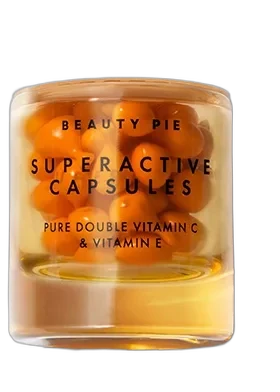
Superactive Capsules Pure Vitamin C Serum
Waterless C Problem-Solver
 Verified reviewer
Pros & cons.
- +Completely solves the vitamin C oxidation problem with single-dose capsules
- +Fresh 10% pure L-ascorbic acid every application, no potency loss
- +Gentle on sensitive skin thanks to the waterless, non-acidic formulation
- +Silky dry-down finish layers invisibly under makeup and sunscreen
- +Excellent member pricing relative to prestige vitamin C serums
- +Fragrance-free, vegan, and suitable for most skin types
- +Travel-friendly individual dose format
- −Single-use plastic capsules are not environmentally ideal
- −Silky silicone finish not for everyone
- −Capsules can feel fiddly to twist open with long nails
- −Does not replicate the ferulic-acid network of prestige vitamin C serums
- −Value advantage narrows at full non-member pricing
The full review.
Every buyer of a pure L-ascorbic acid serum faces the same problem. You spend thirty to a hundred and sixty dollars on a glass dropper bottle, use it for six weeks, and then the clear liquid turns the color of cheap chardonnay. This color change is oxidation—ascorbic acid molecules react with water and air, converting into dehydroascorbic acid and then into breakdown products that do nothing for your skin. The entire premium vitamin C category addresses this flaw by adding ferulic acid buffers, opaque packaging, and low-pH water environments to slow oxidation. Beauty Pie chose a different path: remove the water entirely.
The Superactive Capsules range, launched in 2019, does this. Each single-dose capsule contains roughly half a millilitre of clear anhydrous serum. The formula uses cyclopentasiloxane and dimethicone crosspolymer as the silicone vehicle, 10% pure L-ascorbic acid, vitamin E as an antioxidant, and a small amount of BHT for stability. That is the complete formula. There is no water, no low-pH buffer, and no traditional preservatives because microbes cannot grow without water. The ascorbic acid stays stable in its silicone bath until you twist the capsule open and apply the dose. It is one of the smartest pieces of mainstream skincare engineering from the last decade.
The application feels different from a traditional vitamin C serum. You break off a tiny teardrop-shaped capsule, twist the top, and squeeze out a droplet that looks like baby oil. There is no tingle, acidic sting, fizz, or warmth. Because the format is waterless, the ascorbic acid does not need a low pH to stay active, so the skin does not get irritated. Within thirty seconds, the silicone vehicle dries to a silky, almost powdery finish that layers under sunscreen and makeup without pilling or tackiness. If you avoid vitamin C serums because of sensitive skin, try this.
The formula earns its place through efficacy. At 10%, pure L-ascorbic acid is in the range where clinical studies show benefits: collagen synthesis support, reduced superficial hyperpigmentation, and photoprotection when used under SPF. Peer-reviewed dermatology journals show that topical ascorbic acid needs a 10-20% concentration in an acidic vehicle to penetrate the stratum corneum effectively. Beauty Pie’s format skips the acidity requirement by using a non-aqueous vehicle. This is a different delivery route: the silicones hold the ascorbic acid against the skin surface as they evaporate, letting it diffuse into the upper layers without the pH trick. Most users see visible brightening and smoother tone within two to four weeks of daily AM use, especially on sun-damaged or fatigued skin.
It will not work miracles on deep melasma, set hyperpigmentation, or replace prescription-level treatments for dark spots. Topical vitamin C is an additive tool in a tone-correcting routine, not the primary driver. SPF does most of the work, and you get better results if you use this serum as one ingredient in a regimen rather than a single hero product.
The capsule format has advantages beyond stability. Each dose is exact, there is no wasted product, and the capsules are light and travel-friendly. The disadvantages are environmental and practical. The capsules are single-use plastic, which is not ideal in 2026, and Beauty Pie’s sustainable formats have not yet replaced the originals. The capsules can feel fiddly with long nails or cold fingers, and twisting the tip takes practice. If you prioritize low-waste packaging, a traditional serum in a glass bottle is a better fit.
Texture is a matter of preference. The silicone vehicle makes this formulation work, but it leaves a slightly dry, powdery finish. Some skin types, like combination or oily skin, love this because it stays invisible under makeup, while others find it feels synthetic. If you prefer rich, hydrating water-based serums, this will feel unusual. Layering a hydrating toner underneath helps balance the dry-down.
Value is a strength here. At Beauty Pie member pricing, a 60-capsule box is competitive for a 10% pure L-ascorbic acid serum with a real stability solution. Compared to prestige vitamin C serums that cost three to four times more and oxidize within weeks, the value is clear. At full non-member pricing, the math is less compelling, and a traditional serum can compete. Whether the Beauty Pie membership is worth it depends on how much of your skincare routine you buy from the brand.
Ingredient analysis.
Full INCI list
Cyclopentasiloxane, Ascorbic Acid 10.0%, Dimethicone Crosspolymer, Dimethiconol, Tocopheryl Acetate, C12-15 Alkyl Benzoate, Methyl Methacrylate/Glycol Dimethacrylate Crosspolymer, BHT
Skin match.
The science.
The Science
L-ascorbic acid is the most studied topical vitamin C in dermatology. Decades of evidence show it aids collagen synthesis, antioxidant defence, and inhibition of melanogenesis. Pinnell and colleagues proved that traditional aqueous vehicles need a 10 to 20 percent concentration and a pH below 3.5 for effective delivery, as ascorbic acid only penetrates the stratum corneum in its protonated form. Above pH 4, the molecule becomes charged and cannot diffuse into the skin.
Beauty Pie's capsule format uses a different method. The vehicle is anhydrous — a silicone blend of cyclopentasiloxane and dimethicone crosspolymer — so ascorbic acid does not dissociate and the pH-based penetration model does not apply. As volatile cyclopentasiloxane evaporates, the silicones deposit the vitamin C onto the skin surface. This creates a thin film where ascorbic acid diffuses into the upper layers upon encountering the skin's natural moisture. Published research on non-aqueous vitamin C delivery systems, including lipid-soluble derivatives and silicone carriers, supports this delivery mechanism, though peer-reviewed literature on capsule-dosed formats is thinner than for the traditional aqueous gold standard.
Pairing with tocopheryl acetate uses a well-established antioxidant network strategy. Vitamin C and vitamin E act as regenerative partners in the skin's endogenous antioxidant system; ascorbic acid reduces oxidised tocopherol radicals back to their active form, extending the antioxidant effect. The tocopheryl acetate used here is less active than free tocopherol but much more stable, which suits a long-shelf-life capsule product.
This formulation lacks ferulic acid, which prestige vitamin C serums often add to traditional C+E serums to stabilise ascorbic acid and extend the antioxidant effect. Beauty Pie's capsule format avoids stability issues by staying anhydrous, but it lacks the additional antioxidant synergy from ferulic acid. This is a minor difference in a routine using good SPF, but it matters when comparing directly to C E Ferulic or similar formulations.
Dermatologist Perspective
Dermatologists often recommend topical L-ascorbic acid for morning photoprotection, especially for patients with hyperpigmentation, post-inflammatory dark spots, or photoageing. Conventional advice suggests a 10-20% concentration in a stable vehicle with proper packaging, as oxidation is a known issue and degraded vitamin C serum provides no benefit. Board-certified dermatologists generally view capsule and anhydrous formats favourably because they solve the category's main stability issue. The 10% concentration here falls within the clinically supported range, vitamin E reinforces the antioxidant network, and the lack of water makes it tolerable for patients with sensitive or reactive skin who struggle with traditional low-pH C serums. It is not the most intensively studied vitamin C product on the market, but dermatologists find this formulation approach sensible.
Where it fits in your routine.
After cleansing and applying any hydrating toner each morning, twist open one capsule, squeeze the contents onto clean fingertips, and press it onto the face, neck and décolleté. Avoid aggressive rubbing; the silicone vehicle dries fast and needs even coverage. Wait 30-60 seconds for the serum to set, then apply moisturizer and a broad-spectrum SPF 30 or higher. One capsule provides the full daily dose. Do not stretch the product across multiple applications, as leftover serum oxidizes rapidly once the capsule is open. Use in the AM only; save retinoids for the evening.
At Beauty Pie member pricing, a 60-capsule box delivers two months of daily use at a per-application cost that undercuts nearly every comparable prestige vitamin C serum on the market. The direct comparison against products like SkinCeuticals C E Ferulic, which costs several times as much for a traditional serum that begins oxidising once opened, is lopsided in Beauty Pie's favour on pure economics — though the longer clinical track record and ferulic acid network of the prestige benchmark still matter to some buyers. At full non-member pricing the gap closes, and traditional well-made serums become competitive. For anyone already committed to the Beauty Pie membership, this is one of the easiest products in the catalogue to justify.
Most skin types wanting a serious 10% pure L-ascorbic acid serum with a proper stability solution. It works well for sensitive or reactive skin that cannot tolerate traditional low-pH vitamin C formulations, and for Beauty Pie members seeking one of the range's strongest-value products.
Skip this if you want refillable or low-waste packaging, as the single-use capsule format conflicts with those goals. Also skip if you prefer hydrating water-based serum textures, or if you already own a prestige C E Ferulic formulation and do not need a second vitamin C product.
Product details.
Clear, lightweight silicone suspension dries to a silky, near-powdery finish
Faintly metallic ascorbic note, quickly fades
Single-use twist-open capsules in a resealable box, 60 capsules per package
First use is a surprise — you twist the tiny capsule, squeeze out what looks like a droplet of clear oil, and press it across the face. Unlike traditional vitamin C serums there is no tingle, no acidic sting, and the formula dries down within 30 seconds to a dry silky finish that makeup layers over beautifully. No purging or adjustment period. Visible brightening typically shows up in the two-to-four week window with daily morning use and diligent SPF.
Two months of daily use per 60-capsule box
24 months
All Year
The backstory.
Beauty Pie launched the Superactive Capsules range in 2019 as a way to tackle the oxidation problem that has plagued L-ascorbic acid serums since the category began. The capsule format is manufactured in Italy using pharmaceutical-grade blister packaging adapted for cosmetics, and the line expanded over the following years to include variants at 10%, 20% and 30% ascorbic acid with different supporting ingredients. The original pure C + E capsule is the one most members return to.
About Beauty Pie
Established Brand (5–20 years)Marcia Kilgore (Bliss Spa, Soap & Glory) founded Beauty Pie in 2016 as a members-only 'buyer's club' for prestige-grade skincare. The brand uses European contract manufacturers that also make luxury labels. Beauty Pie does not publish independent clinical trials, but its formulations consistently get positive dermatology and beauty-press coverage.
Common myths.
Vitamin C serums have to sting to work.
Traditional C serums tingle because they use a low pH to keep ascorbic acid stable in water. This capsule format is anhydrous. The ascorbic acid stays active without an acidic environment, so it has no sting but the same efficacy.
Silicone-based serums block active absorption into the skin.
Cyclopentasiloxane is volatile and evaporates on contact. It leaves a thin film that keeps vitamin C on the skin instead of sealing it out. Silicones in well-formulated serums act as a delivery tool, not a barrier.
FAQ.
How is this different from a regular vitamin C serum?
Single-use twist-open capsules sit in an anhydrous silicone base. This prevents the oxidation that turns traditional vitamin C serums yellow and reduces potency. Each capsule provides a fresh, stable 10% dose of pure L-ascorbic acid.
Does the Beauty Pie Vitamin C Capsule serum sting?
No — the waterless formula means the ascorbic acid stays stable without a low pH. Most users, including those with sensitive skin, find it one of the gentlest pure vitamin C serums they have tried.
Can I use it with retinol?
Yes, if you separate them by time of day. Most dermatologists recommend vitamin C in the morning and retinol in the evening. This lets each ingredient work in its optimal environment without compounding irritation.
How long does one box of capsules last?
One box of 60 capsules lasts about two months with daily morning use. Some users stretch this to three months by alternating days or using half a capsule, but splitting a dose causes the unused portion to oxidize.
Is it pregnancy-safe?
Yes — L-ascorbic acid and vitamin E are safe during pregnancy and breastfeeding. They work as alternatives to retinol-based treatments for pregnancy skincare.
Are the capsules recyclable?
The individual capsules are a polymer blend and are not curbside-recyclable in most regions — this is the main environmental criticism of the format. Beauty Pie has explored refills and alternative packaging but the capsules remain single-use plastic.
How does it compare to SkinCeuticals C E Ferulic?
SkinCeuticals uses a 15% ascorbic acid concentration with ferulic acid in a low-pH water-based vehicle. It is the most clinically studied vitamin C serum on the market. Beauty Pie's capsule format is gentler, cheaper at member pricing, and prevents oxidation — but C E Ferulic has the most published clinical data.
Community
What the community says.
"Never oxidizes thanks to single-dose capsules"
"Dry silky finish layers well under makeup"
"Visible brightening within a few weeks"
"No tingle or sting on sensitive skin"
"Waterless formulation ideal for sensitive users"
"Capsule format can feel fiddly"
"Plastic capsules are not environmentally ideal"
"Silicone finish not for everyone"
"Full non-member pricing reduces the value edge"
People also looked at.