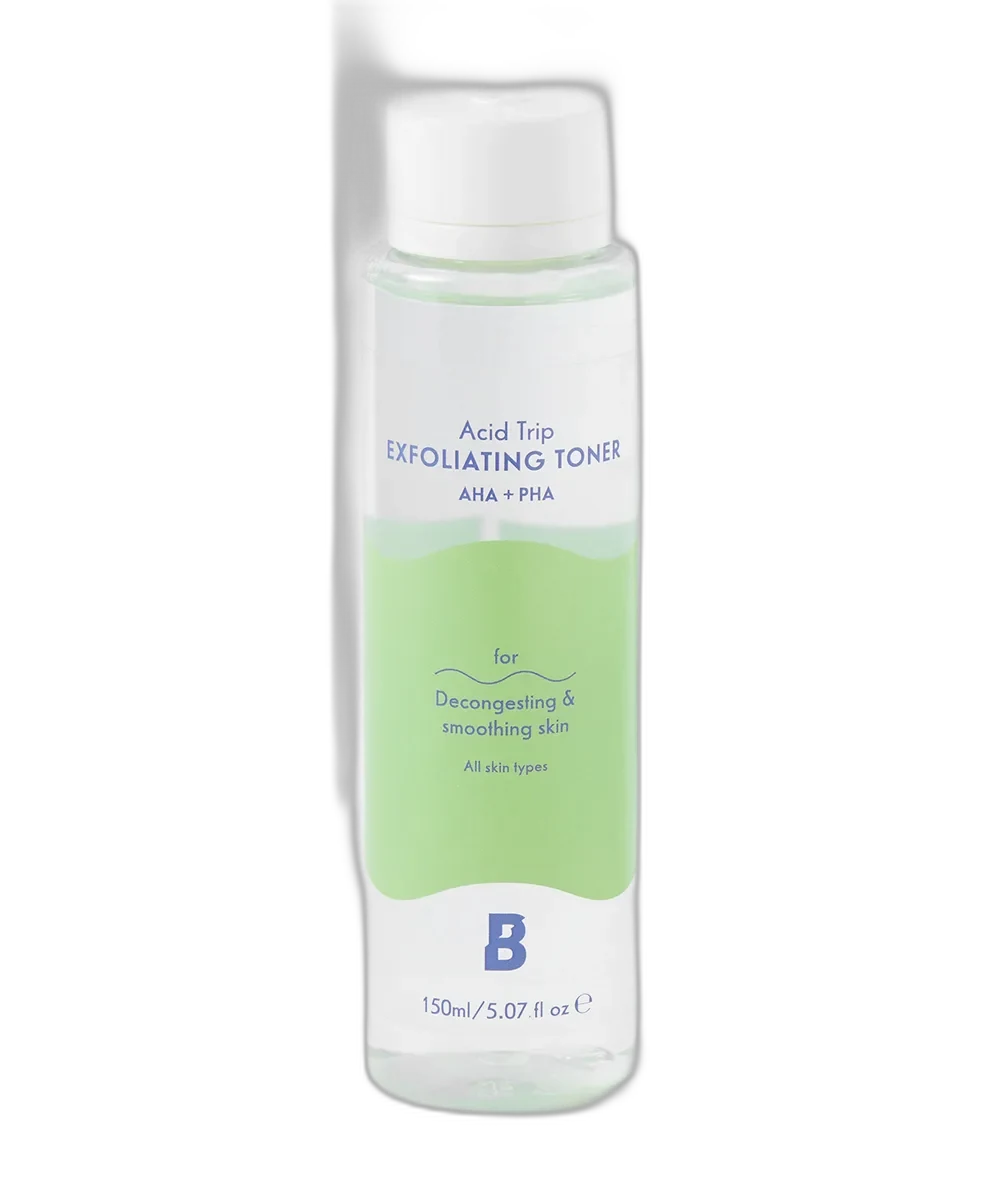
5% Glycolic Acid + 1% PHA Toner (Acid Trip)
Budget AHA-PHA Value Pick
 Verified reviewer
Pros & cons.
- +5% glycolic plus 1% gluconolactone PHA is unusual at this price
- +Gentle enough for 4-5 nights per week of use
- +200ml bottle delivers excellent per-ounce value
- +Water-thin texture absorbs instantly with no residue
- +Allantoin and fruit antioxidants soften post-exfoliation feel
- +Visible brightness and pore refinement within the first month
- −Plastic bottle feels cheap compared to premium competitors
- −Shipping outside the UK raises total cost meaningfully
- −Not suitable for rosacea, eczema or compromised barriers
- −Mild citrus scent is polarizing for fragrance-averse users
- −Lacks the supporting actives (niacinamide, peptides) of mid-tier competitors
The full review.
How to Use
Put a few drops on a cotton pad — or dispense into your palm and press onto your face to save product — and it applies like water, absorbs in 15 seconds, and leaves no sensory trace.
Who Should Buy
This is one of the cleanest value picks for a Western skincare shopper wanting a solid daily glycolic toner without spending $30+.
Texture
It applies like water, absorbs in 15 seconds, and leaves no sensory trace.
Scent
Bitter orange flower water gives a subtle citrus note if you hold the bottle to your nose.
Packaging
The 200ml plastic bottle feels cheap compared to Pixi’s signature teal design or Paula’s Choice’s frosted-glass aesthetic.
Common Praise
By morning, skin looks more reflective, dullness softens, and the tone feels fresher. After 4-5 nights of weekly use for four to six weeks, pore clarity improves, mild bumpy texture smooths, and post-acne marks fade at a reasonable pace.
Common Complaints
The fruit extract cocktail smells pleasant in the bottle but may not suit every fragrance-averse user.
Ingredient analysis.
Full INCI list · pH 3.8
Aqua (Water), Glycolic Acid, Citrus Aurantium Amara (Bitter Orange) Flower Water, Glycerin, Lactic Acid, Heptyl Glucoside, Gluconolactone, Polysorbate 20, Allantoin, Vaccinium Myrtillus (Bilberry) Fruit Extract, Saccharum Officinarum (Sugar Cane) Extract, Citrus Aurantium Dulcis (Orange) Fruit Extract, Citrus Limon (Lemon) Fruit Extract, Acer Saccharum (Sugar Maple) Extract, Ethylhexylglycerin, Sodium Hydroxide, Phenoxyethanol
Skin match.
The science.
The Science
The science behind this toner sits on two well-established pillars — glycolic acid and poly-hydroxy acids — plus a set of supporting ingredients with solid if smaller evidence bases. Glycolic acid has been studied extensively since the 1990s, and its mechanism is among the best-documented in cosmetic chemistry: it loosens corneodesmosome bonds, accelerates desquamation, and reveals newer skin underneath. At 5% and pH around 3.8, the free acid percentage is in the range where regular leave-on use is both effective and reasonably tolerated in non-sensitive skin. Gluconolactone, the PHA here, has been characterized in dermatological research as having similar exfoliating mechanisms to AHAs with a significantly gentler profile due to its larger molecular size and slower penetration. A 2004 review in Cutis compared polyhydroxy acid formulations to traditional glycolic acid and found that PHAs produced comparable photoaging improvements with meaningfully lower rates of stinging and irritation — directly relevant to this toner's layered-acid design. Lactic acid rounds out the AHA phase with better humectant character. The supporting ingredients contribute smaller roles: allantoin has documented barrier-soothing activity, bilberry fruit extract contains anthocyanin antioxidants, and the citrus and sugar extracts add trace natural-source AHAs plus additional polyphenol activity. None of the supporting cast changes the fundamental mechanism, but together they help push the experience away from the strip-and-sting profile of single-acid toners.
References
- Polyhydroxy acids: next generation alpha hydroxy acids — Cutis (2004)
Dermatologist Perspective
Dermatologists commonly recommend AHA/PHA combination toners for patients who want to start or maintain a regular leave-on exfoliation practice without the irritation ceiling of a pure glycolic product. Board-certified dermatologists often describe PHAs as particularly useful for patients with slightly reactive skin or those newly returning to exfoliation after a barrier-repair period, and a 5% glycolic with 1% PHA formulation fits that general profile. Dermatologists typically emphasize that daily SPF use is non-negotiable during any acid routine, that exfoliating toners should not be combined with retinoids or vitamin C in the same evening, and that users should always follow up with a barrier-supportive moisturizer to offset the minor transepidermal water loss that comes with regular acid use.
Where it fits in your routine.
Apply in the evening to clean, dry skin. Sweep a small amount across the face using a cotton pad, or press 4-5 drops into your palm and pat onto the skin to save product. Avoid the immediate eye area and lip line. Let it absorb for 30-60 seconds before applying hydrating serums, niacinamide, or a ceramide moisturizer. Use 3 nights per week initially, then increase to 4-5 as tolerated. Do not use with retinoids, vitamin C acids, or other exfoliants in the same routine. Use a daily broad-spectrum SPF 30+ during use and for one week after stopping.
At $14 for 200ml — about $2 per ounce — this is a top-value daily glycolic toner. Pixi Glow Tonic costs $15 for 100ml, The Ordinary Glycolic Acid 7% costs about $10 for 240ml (but lacks the PHA addition), and Paula's Choice 8% AHA Gel costs $32 for 100ml. Beauty Bay beats Pixi Glow Tonic on per-ounce price with a more layered acid profile and undercuts Paula's Choice 8% AHA Gel significantly. The Ordinary's glycolic toner is the only low-cost competitor, but it swaps the PHA buffer for a simpler formula. For users wanting PHA softening at a budget price, the math on this Beauty Bay toner is unbeatable.
Normal, combination, and oily skin types can use this budget-friendly daily AHA toner for better tolerability than pure glycolic products. It is a strong choice for Pixi Glow Tonic fans seeking a cheaper per-ounce option and PHA users who find most budget toners too harsh.
Sensitive, rosacea-prone, eczema-prone, or compromised skin cannot use even a balanced 5% glycolic. Non-UK shoppers facing high shipping costs may find better value in local equivalents like The Inkey List or The Ordinary glycolic toners.
Product details.
Watery liquid that absorbs almost immediately with no film or tackiness.
Faint citrus from the bitter orange and fruit extracts — not perfumed.
200ml plastic bottle with a screw cap. It feels basic, but the larger size offers value.
The first application causes a mild, brief tingle that most users barely notice — less intense than a pure glycolic toner. Skin looks slightly more luminous by the next morning. Very few users see visible purging at this concentration.
3-4 months with 4-5 nights per week of use.
6 months
fall winter
The backstory.
Beauty Bay launched 'Acid Trip' as one of the anchor products in its first major skincare rollout, explicitly positioning it against Pixi Glow Tonic and The Ordinary Glycolic Acid 7% as a daily-use leave-on exfoliant. The PHA addition was the differentiator the brand used to justify its existence in an already-crowded category, and the toner was later rebranded as part of the core By BEAUTY BAY lineup without any formula change.
About Beauty Bay
Emerging Brand (2–5 years)Beauty Bay launched 'By BEAUTY BAY' and 'SkinHit' skincare around 2019-2020, using 20 years of experience as a UK beauty retailer. The brand's skincare team lacks dermatologist leadership. These affordable indie formulas target the same audience that shops The Ordinary and The Inkey List.
Common myths.
PHAs don't actually exfoliate as well as AHAs.
PHAs exfoliate using the same corneocyte-loosening mechanism as AHAs, but more slowly because their molecules are larger. At 1%, gluconolactone acts as a supporting exfoliant; glycolic acid does the heavy lifting.
Glycolic acid toners can be used every day with no risk.
Daily 5% glycolic use causes barrier compromise without enough moisturization or when used with other actives. Start at 3 nights weekly and increase from there.
FAQ.
How often can I use this toner?
Use 3 nights per week, then increase to 4-5 as tolerated. Sensitive skin stays at 2-3 nights weekly. The PHA addition makes near-daily use easier than with a pure glycolic product.
Can I layer this with niacinamide?
Yes. Apply this toner first and allow it to fully absorb, then follow with niacinamide serum. The old myth that niacinamide and acids can't combine has been debunked — they work fine layered, and niacinamide helps support the barrier during acid exfoliation.
Is this stronger than Pixi Glow Tonic?
Yes. Pixi Glow Tonic has 5% glycolic acid without added PHA and a higher pH, making it functionally gentler. This Beauty Bay toner is more active at a comparable glycolic percentage due to its pH and the extra lactic acid and PHA.
Will it sting?
Most users feel only a brief, mild tingle. Cleansed or compromised skin may sting more. If your skin is in an active barrier-repair phase, stop this toner until your skin returns to baseline.
Does it help with blackheads?
Glycolic acid alone fails to target blackheads effectively; salicylic acid (BHA) penetrates pore lipids better. This toner improves surface smoothness and mild congestion, but a dedicated BHA product works better for blackheads.
Can I use it during pregnancy?
Glycolic, lactic and gluconolactone are pregnancy-compatible at these concentrations. Always confirm with your OB-GYN, as individual pregnancy skincare guidance varies.
How does it compare to The Ordinary Glycolic Acid 7%?
The Ordinary's version uses 7% glycolic at a lower pH, making it stronger and stingier. This Beauty Bay toner feels more tolerable because the PHA buffer and softer pH suit users who want near-daily acid use without the harsh feel of a single-acid product.
What the community says.
"gentle enough for near-daily use"
"visible pore refinement"
"excellent price for 200ml"
"PHA addition reduces stinging"
"plastic bottle feels cheap"
"shipping outside UK is expensive"
"subtle citrus smell polarizing"
People also looked at.