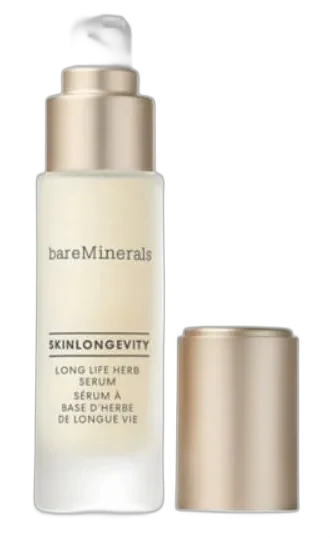
SkinLongevity Long Life Herb Serum
Niacinamide-Forward Serum
 Verified reviewer
Pros & cons.
- +Niacinamide at position three — meaningful concentration with strong evidence
- +Stable ascorbyl glucoside vitamin C compatible with niacinamide in formula
- +Matrixyl 3000 peptide pair adds credible structural support
- +Lightweight, fast-absorbing texture layers cleanly under makeup
- +Pregnancy-safe with no retinoids or salicylates
- +Vegan and cruelty-free with a legacy brand track record
- −Added fragrance plus limonene, linalool, geraniol — three flagged potential allergens
- −Alcohol on the INCI may bother very reactive skin types
- −Premium price doesn't match the actual evidence base of the hero botanical
- −Long Life Herb claims rest on brand-funded research, not independent publication
- −Not fungal acne safe due to fatty components in the formula
The full review.
The marketing for this serum tells a story of Okinawan farmers, the Long Life Herb from the southern Japanese coast, and a tradition linking one plant to long-lived populations. The INCI is simpler: niacinamide is at position three, ascorbyl glucoside is at position four, and a peptide pair sits lower down. The botanical used for the SkinLongevity range provides support; niacinamide and vitamin C are the active ingredients. This is a clarification for anyone deciding between this seventy-four dollar bottle and a thirteen dollar fragrance-free niacinamide serum that offers similar benefits.
Reality
The formula performs specific tasks well. Niacinamide at position three is a meaningful concentration, likely above the threshold for efficacy. In a serum that allows full contact and absorption, niacinamide is a well-evidenced ingredient in topical dermatology. It supports the skin’s natural lipid barrier, regulates sebum, reduces inflammatory cascades that cause redness and post-inflammatory pigmentation, and evens skin tone with consistent use over a few weeks. Ascorbyl glucoside, located right behind it, is a glucose-protected vitamin C derivative. It provides the antioxidant and brightening benefits of vitamin C without the irritation or pH instability of the parent molecule. These two ingredients are compatible; the internet myth about niacinamide and vitamin C incompatibility applies to pure L-ascorbic acid, not stable derivatives like this one.
Matrixyl 3000, the trade name for the palmitoyl tetrapeptide-7 and palmitoyl tripeptide-1 combination, sits further down the formula. It has over a decade of in-vitro and limited clinical work supporting its role as a fibroblast signal peptide. Peptides at low INCI positions are normal because they are expensive and work at small concentrations, but any structural benefit will be subtle and slow. Squalane provides skin-identical lipid smoothness without occlusive heaviness, which works well for a niacinamide-forward serum that must layer easily. Trehalose and glycerin handle hydration. The formula’s structural foundation is sound.
Myth
The Long Life Herb extract sits in the middle of the INCI, well below the niacinamide and ascorbyl glucoside. Peucedanum japonicum is not a sham ingredient; it contains chlorogenic acids and flavonoids that show antioxidant activity in laboratory studies, and the brand ran clinical trials on the SkinLongevity formulations. However, brand-funded clinicals differ from independent peer-reviewed evidence, and the INCI position suggests a modest concentration. The Long Life Herb is an antioxidant adjunct with a good story, while the actives doing the visible work have decades of independent literature behind them.
Scent
This serum contains added fragrance and lists limonene, linalool, and geraniol on the INCI—three EU-disclosed potential allergens common in cosmetic contact dermatitis patch testing. The brand’s clean-beauty positioning would be stronger without fragrance. Because it contains fragrance, anyone with sensitive, rosacea-prone, or compromised-barrier skin should patch test carefully or choose a fragrance-free alternative. Alcohol also appears in the middle of the INCI. It likely functions as a solubilizer, but the combination of fragrance, three flagged allergens, and alcohol increases the irritation risk.
Value
Seventy-four dollars for 50ml places this in mid-luxury territory, competing with brands that have deeper independent clinical research for their hero ingredients. A 30ml size at $50 makes it cheaper to try, but the per-milliliter cost is higher. You are paying for the bareMinerals brand legacy, the Okinawan sourcing story, and the proprietary Long Life Herb extract. Whether this justifies the premium over a fragrance-free niacinamide-and-vitamin-C serum from a clinically focused brand is a personal choice. The formulation is competent. The pricing is aspirational.
Ingredient analysis.
Full INCI list
Water (Aqua/Eau), Propanediol, Niacinamide, Ascorbyl Glucoside, Glycerin, Isodecyl Neopentanoate, Squalane, Trehalose, Peucedanum Japonicum Leaf/Stem Extract, Eschscholtzia Californica Leaf Cell Extract, Saccharomyces Ferment Lysate Filtrate, Citrus Unshiu Peel Extract, Palmitoyl Tetrapeptide-7, Palmitoyl Tripeptide-1, Zingiber Aromaticus Extract, Butylene Glycol, Dimethicone, Potassium Hydroxide, Isostearic Acid, Carbomer, Alcohol, Ethylhexylglycerin, Lauryl Betaine, Behenyl Alcohol, Stearamidopropyl Dimethylamine, Xanthan Gum, Sodium Citrate, Beheneth-20, Acrylates/C10-30 Alkyl Acrylate Crosspolymer, Tocopherol, Batyl Alcohol, Disodium EDTA, Sodium Metaphosphate, Citric Acid, Polysorbate 20, Sodium Metabisulfite, Fragrance (Parfum), Limonene, Linalool, Geraniol, Sodium Lactate, Sodium Benzoate, Phenoxyethanol, Iron Oxides (CI 77491, CI 77492, CI 77499).
Skin match.
The science.
The Science
Niacinamide and ascorbyl glucoside drive the clinical case for this serum. Niacinamide is one of the most studied actives in modern dermatology, with decades of peer-reviewed work on barrier function, sebum regulation, and tone evening. Studies on niacinamide concentrations between 2% and 5% show measurable improvements in transepidermal water loss, hyperpigmentation, and skin texture over 8-12 weeks of consistent use. Because niacinamide is at INCI slot three, this serum likely uses that effective range.
Ascorbyl glucoside is a stable, glucose-shielded vitamin C derivative that converts to active ascorbic acid on skin via enzymatic cleavage. The internet concern about niacinamide and vitamin C interaction only applies to L-ascorbic acid in solution forming nicotinic acid; it does not apply to stable derivatives. These two ingredients coexist comfortably in this serum. Ascorbyl glucoside studies support antioxidant defense and gradual brightening, offering better tolerance than direct vitamin C despite slower results.
The Matrixyl 3000 peptide complex (palmitoyl tetrapeptide-7 and palmitoyl tripeptide-1) has over fifteen years of in-vitro work and human clinical data supporting its role as a signal peptide for fibroblast collagen synthesis. It is a credible peptide combination, though the effect of any topical peptide is modest compared to retinoids.
Peucedanum japonicum is the most novel ingredient and has the thinnest independent evidence. Laboratory studies on the plant's chlorogenic acid and flavonoid constituents support antioxidant capacity, and bareMinerals has conducted in-house clinical studies on the SkinLongevity formulations. These brand-funded studies are not published in peer-reviewed dermatology journals. Long Life Herb is a plausible antioxidant adjunct with promising preliminary data, but it is not a clinically proven anti-aging hero like the niacinamide and peptide actives in this formula.
Dermatologist Perspective
Dermatologists view niacinamide and ascorbyl glucoside as low-risk, well-supported actives for most skin types. The combination at the top of this serum's INCI follows formulation principles board-certified dermatologists recommend for gradual brightening and barrier support. The added fragrance with three flagged allergens is the standard concern dermatologists raise about this product; patients with rosacea, eczema, or reactive skin usually use fragrance-free alternatives. For patients without fragrance sensitivity, this serum fits a standard routine. Dermatologists are generally agnostic about the specific botanical hero and focus discussions on the niacinamide and peptide content.
Where it fits in your routine.
Apply two pumps to clean skin morning and night, after toner and before moisturizer. Press it into the skin and wait 30-60 seconds for absorption before applying the next product. In the morning, use eye cream, moisturizer, and broad-spectrum SPF. In the evening, use eye cream and moisturizer. Use on alternate nights with retinol instead of stacking; this lets the niacinamide buffer retinol nights without overloading the active routine. Patch test before regular use if you have a history of fragrance sensitivity.
At $74 for 50ml, this is mid-luxury. The 30ml size costs $50, offering a lower entry point but worse per-milliliter value. Using it twice daily costs roughly $25-35 per month. This price matches other Sephora-tier serums but costs significantly more than fragrance-free niacinamide-and-vitamin-C serums from clinically focused brands that provide the same headline benefit for less. You pay for the bareMinerals brand legacy and the Okinawan sourcing story. Because bareMinerals has decades of consumer track record on tolerability, the legacy premium is partly defensible. The specific botanical claim is newer and lacks independent validation, making the premium harder to justify on formulation merit alone.
Normal and combination skin types want a niacinamide-and-vitamin-C serum with a pleasant texture and a botanical story. It works for shoppers who value the bareMinerals brand legacy and do not react to fragrance or naturally-derived allergens.
Skip this if you have sensitive, rosacea-prone, or compromised-barrier skin that reacts to fragrance, limonene, linalool, or geraniol. Also skip if you want the most evidence-validated formulation at this price, or if you prefer spending your budget on a fragrance-free serum from a clinically focused brand.
Product details.
This lightweight, slightly milky serum absorbs quickly and leaves no film.
A noticeable herbal-floral fragrance — this is not a fragrance-free serum.
A frosted glass bottle uses a pump dispenser. The pump controls the dose and protects the formula from air.
The first application feels lightweight and slightly cooling. The fragrance is immediate. Most users feel no tingling or visible irritation; results build gradually instead of dramatically.
A 50ml bottle lasts 2-3 months if you use two pumps twice daily.
12 months
All Year
The backstory.
bareMinerals launched the SkinLongevity range to anchor its skincare expansion around a single signature botanical sourced from Okinawan farms. Long Life Herb — chomeiso — has been a regional dietary staple for centuries, and the brand's pitch leans on the longevity associations of the area to build the storytelling around a serum that is, mechanically, a niacinamide-and-peptide product.
About bareMinerals
Legacy Brand (20+ years)bareMinerals is an established mineral makeup brand that launched its skincare line in the late 2010s. The SkinLongevity range uses the brand's proprietary Long Life Herb extract; in-house brand research supports its clinical claims instead of independent peer-reviewed publication.
Common myths.
Niacinamide and vitamin C cannot be used together.
Past concerns focused on pure L-ascorbic acid and niacinamide forming nicotinic acid in solution. The ascorbyl glucoside in this serum is a stable derivative that coexists with niacinamide without this interaction.
All naturally-derived fragrance is gentle.
Limonene, linalool, and geraniol are the three EU-listed allergens on this INCI. These are naturally derived but often cause contact dermatitis in topical products. Sensitive skin types should patch test.
FAQ.
Does the SkinLongevity Long Life Herb Serum actually work?
The niacinamide and ascorbyl glucoside backbone evens tone, brightens, and supports the barrier over 4-8 weeks. The peptide pair adds a subtle structural component over months. The Long Life Herb acts more as an antioxidant adjunct than a dramatic anti-aging hero — the supporting actives provide most visible benefit.
Can I use this serum if I have sensitive skin?
Caution. The formula has added fragrance and three EU-listed potential allergens: limonene, linalool, and geraniol. Sensitive or rosacea-prone skin needs a three-day patch test first. Fragrance-free niacinamide serums are a safer choice for reactive skin.
Is this serum compatible with retinol?
Yes, on alternate nights. Use the SkinLongevity serum and retinol on different evenings to avoid layering active load. Niacinamide also reduces retinoid irritation when used as a buffering layer beneath moisturizer on retinol nights.
What does Long Life Herb actually do?
Peucedanum japonicum is an Okinawan plant with chlorogenic acids and flavonoids. Lab studies show its antioxidant activity. The brand bases its anti-aging clinical claims on in-house research instead of independent peer-reviewed publication. Treat the herb as a plausible antioxidant addition, not a clinically proven hero.
Is this serum pregnancy-safe?
Yes. The formula has no retinoids, salicylic acid, or hormone-disrupting ingredients. It is pregnancy-safe during pregnancy and breastfeeding.
Is it fungal acne safe?
No. Several fatty components in the formula trigger fungal acne. People managing Malassezia folliculitis should use a different serum.
How long does the bottle last?
The 50ml bottle lasts 2-3 months if you use two pumps twice daily. The 30ml size offers a lower entry price for trials.
What the community says.
"lightweight texture"
"subtle glow over time"
"absorbs quickly"
"feels gentle on most skin"
"expensive for the formula"
"added fragrance"
"subtle results"
"not for sensitive skin"
People also looked at.