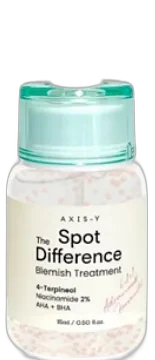
Spot the Difference Blemish Treatment
K-Beauty Spot-Fix Sleeper
 Verified reviewer
Pros & cons.
- +Genuinely fast at reducing surface redness without irritation
- +Buffered formula doesn't dry out surrounding skin
- +Niacinamide addresses post-blemish marks proactively
- +Vegan, fragrance-free, alcohol-free formulation
- +Reasonable price for a 4-6 month supply
- +Invisible finish, layers cleanly under makeup
- +Centella and houttuynia provide real soothing backup
- −Tea tree scent is noticeable and may bother sensitive noses
- −Squeeze tube nozzle dispenses too much on first press
- −Ineffective on deep cystic acne by category limitation
- −Not suitable for use during pregnancy or breastfeeding
- −Tea tree oil is a known allergen for a small subset of users
The full review.
Axis-Y operates on something called the 5-3-1 ingredient philosophy: every formula must contain five functional ingredients, three soothing-and-hydrating ones, and exactly one signature active. That sounds like marketing math until you actually scan the INCI on something like Spot the Difference and realize the brand really does build its products this way — and that the structure prevents the most common spot-treatment failure, which is being so aggressive that you swap a blemish for a flaky red patch.
This little 15ml tube is the brand’s answer to the eternal K-beauty paradox: how do you treat acne in a culture that worships dewy, glassy, completely intact skin? Most Western spot treatments solve the equation by going nuclear — 2% salicylic acid, 10% benzoyl peroxide, sulfur paste that turns your chin into a chalk drawing. Effective, often. Pleasant, never. Axis-Y’s answer is quieter. The salicylic acid sits at 0.5%, low enough that the surrounding skin isn’t collateral damage but high enough that, applied directly to a fresh papule, it dissolves the keratin plug responsible for the inflammation in the first place.
The rest of the formula is the clever part. Niacinamide is the third ingredient, doing the dual job of calming the inflammatory cascade and starting the long process of preventing the post-blemish dark mark that any acne-prone person knows is the real villain. Centella asiatica and houttuynia cordata, two pillars of Korean botanical skincare, add the soothing layer that keeps the BHA from feeling like punishment. Tea tree oil is in there too, contributing some antimicrobial backup against C. acnes without dominating the formula the way it does in straight-up tea tree spot gels.
Texture
The texture is a clear, lightweight gel that absorbs into a thin invisible film within about thirty seconds. There’s no white cast, no chalky residue, nothing that announces itself under makeup.
Packaging
The packaging is a soft squeeze tube with a narrow nozzle, which is either a feature or a frustration depending on whether you prefer dotting with a fingertip or with a precision applicator. After a few weeks of use you get the hang of dispensing exactly enough, but the first few squeezes tend to overshoot.
Best for
Where it shines: surface-level inflammatory pimples, those red bumps that pop up overnight after a stressful week or a humidity spike. Apply a thin layer at bedtime and most users report visibly reduced redness by morning. A second night usually finishes the job. It’s fast, but not aggressive-fast — there’s no scab, no peeling, no marker of where the blemish was. It just quietly disappears.
Not ideal for
Where it struggles: deep cystic acne, the kind that lives a centimeter below the surface and throbs for a week. No topical BHA at any concentration can reach those, and Spot the Difference is no exception. It can take some surface heat off a cyst, but you’re not curing it with this product. Same goes for blackheads — for those you want a leave-on BHA across the whole T-zone, not a targeted gel.
Scent
The tea tree note is the one thing that genuinely splits opinion. It’s faint, herbal, not overpowering, but it’s noticeable on application and lingers for a minute or two. People who love K-beauty’s botanical lineage will find it pleasant; people sensitized to tea tree should patch test first. Outside of that scent, there’s no added fragrance and no alcohol, which is more than most spot treatments at this price point can claim.
Value-wise, $22 for 15ml of a treatment you only apply to active spots is reasonable. The tube lasts most people four to six months unless you’re treating multiple breakouts daily — in which case you’d be better served by an all-over BHA toner anyway. Within the K-beauty spot-treatment category, it’s positioned cleverly: cheaper than COSRX’s pimple patches by per-use cost, gentler than Some By Mi’s AHA-BHA-PHA toner, more targeted than any face-wide treatment. It fills a specific niche, and it fills it well.
The verdict for blemish-prone skin that’s been burned by harsh treatments: this is worth keeping in the medicine cabinet. It won’t replace your routine, but as the thing you reach for when a single red bump shows up at 11pm before a meeting, it does the job and lets you wake up with skin that looks like nothing happened.
Ingredient analysis.
Full INCI list · pH 4
Aloe Barbadensis Leaf Water, Propanediol, Niacinamide, Glycerin, 1,2-Hexanediol, Salicylic Acid, Centella Asiatica Extract, Melaleuca Alternifolia (Tea Tree) Leaf Oil, Houttuynia Cordata Extract, Allantoin, Panthenol, Sodium Hyaluronate, Adenosine, Sodium Polyacrylate, Polyglyceryl-10 Laurate, Polyglyceryl-10 Myristate, Caprylyl Glycol, Ethylhexylglycerin, Disodium EDTA
Skin match.
The science.
The Science
The salicylic acid in Spot the Difference works through a known mechanism: as a beta hydroxy acid, it is lipophilic enough to enter sebum-filled follicles and dissolve the desmosomal connections between dead corneocytes. The 0.5% concentration is at the low end of efficacy — the FDA monograph for over-the-counter acne treatments allows 0.5-2% — which is intentional for a buffered, leave-on spot treatment. Higher concentrations do not always yield better results in spot applications and increase irritation risk, especially when mixed with other actives.
The niacinamide combination defines this product's formulation logic. Niacinamide has several documented effects on acne: it reduces sebum production, downregulates inflammatory cytokines, and inhibits melanosome transfer to keratinocytes (helping with post-inflammatory hyperpigmentation). This pairing treats both the active blemish and the resulting marks.
Tea tree oil has moderate, real evidence — comparative studies show 5% tea tree gel produces results comparable to 5% benzoyl peroxide for mild-to-moderate acne, with slower onset but fewer side effects. The concentration here is much lower, making it a contributing ingredient rather than the main driver, but it belongs in the formula.
Centella asiatica's wound-healing properties are well-supported in dermatological literature, specifically its triterpenoid compounds (asiaticoside, madecassoside) which accelerate healing and reduce inflammation. Including it in a BHA spot treatment is an evidence-based choice, not just a K-beauty trend.
Dermatologist Perspective
Dermatologists often recommend low-percentage BHA spot treatments for patients who find higher-concentration products or benzoyl peroxide too irritating. The buffered approach here — pairing salicylic acid with niacinamide and centella — aligns with dermatological strategies to treat acne without damaging the skin barrier, a known driver of long-term skin health. Board-certified dermatologists note that using niacinamide during acne treatment helps mitigate post-inflammatory hyperpigmentation, especially in skin of color where dark marks often last months longer than the blemish. This formulation is a reasonable starter spot treatment for adults who cannot tolerate prescription-strength acne products.
Where it fits in your routine.
Apply a thin layer to active blemishes after cleansing and water-based serums, but before moisturizer. Use at most twice daily. This product is for spot use only; do not apply it across the entire face. If you use retinol or other BHA/AHA products, apply them at a different time or skip that active step on nights you use this. Stop use if persistent stinging or peeling occurs, and patch test first if you have known sensitivities to tea tree oil. Pair with a niacinamide serum elsewhere in your routine to compound anti-mark benefits.
At $22 for 15ml, Spot the Difference is a mid-range K-beauty spot treatment. When used only on active blemishes, the tube lasts four to six months, making the cost-per-use under a dollar. The formulation justifies the price; you pay for a transparent, well-buffered active stack without added fragrance or alcohol, not branding or packaging. Axis-Y is gentler and has more niacinamide than drugstore alternatives at half the price. Compared to luxury spot treatments at 3-4x the price, you get most of the benefit for much less.
This works for combination-to-oily skin prone to occasional inflammatory breakouts. It suits users who want gentler alternatives to harsh, drying spot treatments. It also fits K-beauty formulation fans and anyone managing active acne and post-blemish marks.
People with severe cystic acne (requiring systemic treatment), tea tree oil sensitivities, pregnant or breastfeeding individuals advised to avoid BHAs, and anyone with widespread acne where face-wide BHA treatment makes more sense than spot-by-spot application.
Product details.
Lightweight clear gel that absorbs quickly without tackiness
The essential oil component gives a faint herbal tea tree aroma; there is no added fragrance.
15ml soft squeeze tube with narrow nozzle for targeted application
The application feels slightly cool and reduces redness by the next morning. This targeted treatment causes no purging, but tea tree-sensitive skin may feel slight tingling — stop use if it stings persistently.
4-6 months with targeted use on emerging blemishes only
12 months
All Year
The backstory.
Axis-Y was built around a transparent ingredient philosophy by a Korean-American team frustrated with K-beauty's mystery-essence reputation. Spot the Difference launched as part of the brand's blemish range and quickly became a quiet favorite among reviewers who wanted a spot treatment that didn't double as a barrier wrecker.
About Axis-Y
Emerging Brand (2–5 years)Axis-Y launched in 2018 as a Korean-American collaboration. It uses a 5-3-1 ingredient philosophy (5 functional, 3 hydrating, 1 essential active) to create transparent, vegan formulations. The brand builds credibility through ingredient honesty instead of clinical trials. Its formulas have high regard in the K-beauty community, though independent third-party validation is limited.
Common myths.
Apply spot treatments thickly and let them crust over to work.
This gel absorbs into a thin layer. Using more doesn't speed up results — the salicylic acid penetrates within minutes, and excess product just delays the moisturizer step.
Tea tree oil is too harsh for sensitive skin in any concentration.
The tea tree oil level stays below most patch test thresholds, while niacinamide and centella buffer it. If you have a documented tea tree allergy, this isn't the spot treatment for you.
FAQ.
How is this different from a regular salicylic acid serum?
This targeted spot treatment uses 0.5% salicylic acid in a buffered base to treat individual blemishes. A face-wide BHA serum delivers acid across the entire complexion at different concentrations and over a longer routine. They have different purposes, and you can use both.
Can I use this with retinol at night?
Apply them at different times or on different days. Retinol and BHAs both increase irritation, and stacking them on the same spot disrupts the skin barrier. The Axis-Y team recommends rotating active nights or applying retinol everywhere except the treated spot.
Will it help with cystic acne?
It reduces redness and surface inflammation on cystic spots within days. However, cystic acne forms below the BHA's reach and often requires oral or prescription support. For deep, painful cysts, this works as a helpful adjunct instead of a standalone fix.
Is this safe during pregnancy?
Topical salicylic acid in spot-treatment doses is low-risk, but most OB-GYNs recommend avoiding BHAs during pregnancy. Use a centella-based alternative while this product is discontinued.
How long does the 15ml tube actually last?
The tube lasts most users 4-6 months when used only as a spot treatment. If you use it daily on multiple spots, a leave-on BHA serum costs less.
Does it work on hormonal acne along the jawline?
It treats surface inflammation from hormonal breakouts but does not change the hormonal trigger. To manage jawline cycling, use this with a niacinamide serum and ask a dermatologist about systemic options.
What the community says.
"Fast visible reduction in redness"
"Doesn't dry out surrounding skin"
"Affordable for the size"
"Pleasant gel texture"
"Tea tree scent is noticeable"
"Tube packaging makes precise dosing harder"
"Less effective on cystic acne"
People also looked at.