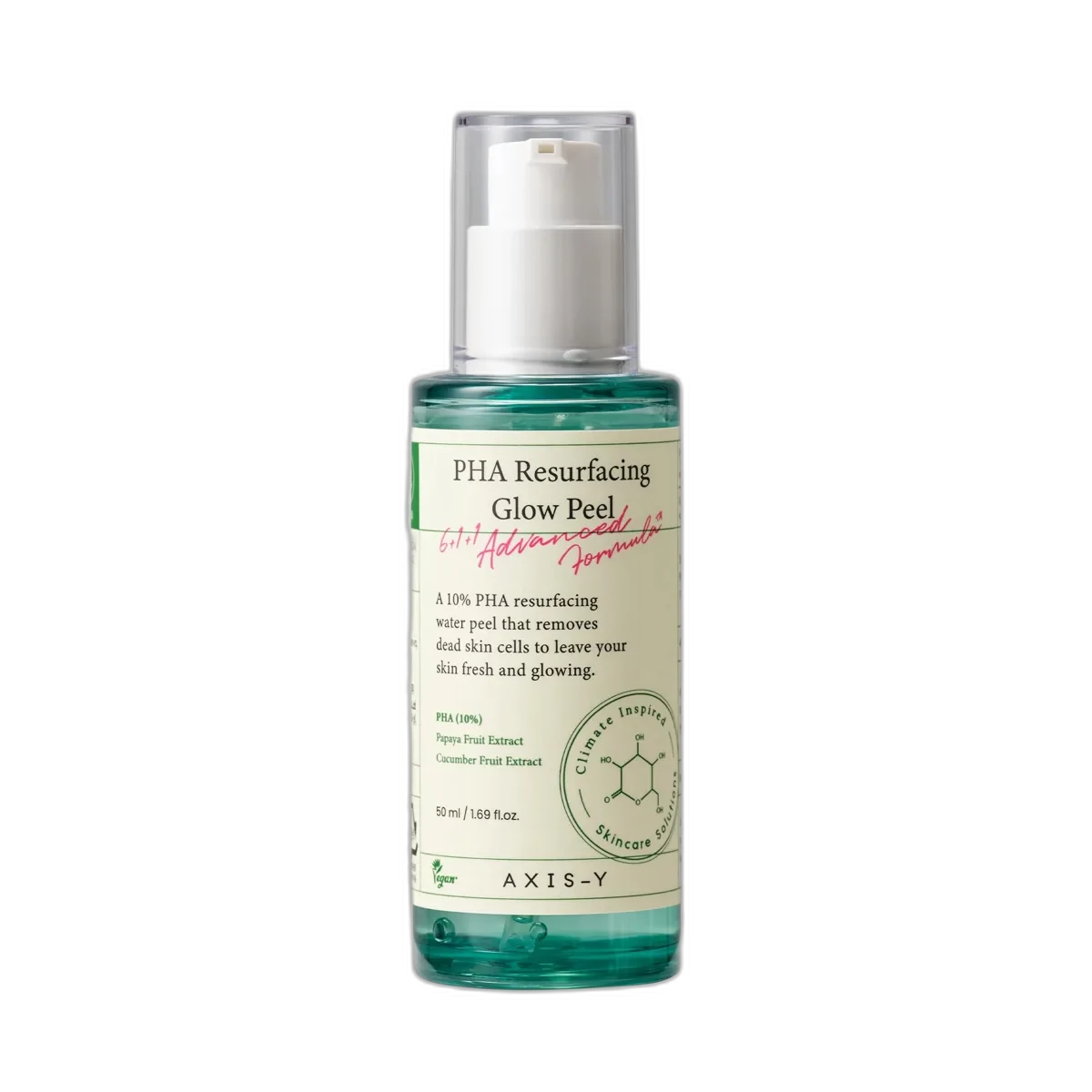
PHA Resurfacing Glow Peel
Sensitive-Friendly PHA Peel
 Verified reviewer
Pros & cons.
- +Dual PHA approach reduces irritation vs AHA peels
- +Dense calming cast of centella, madecassoside, panthenol, and allantoin
- +Fragrance-free and alcohol-free
- +Tolerable on mildly sensitive skin
- +Immediate glow and cumulative texture improvement
- +Lactobionic acid adds humectant contribution
- −30ml size is small for the price
- −Subtle effect compared to strong AHAs
- −Not a match for users who want aggressive exfoliation
- −Rosacea flares still require caution with any acid
The full review.
This peel is intentionally less dramatic than typical AHA treatments. Glycolic and lactic acids are the loud actives of exfoliation; they penetrate fast, tingle aggressively, and show quick results. This sells products but often irritates reactive skin within a few uses. Axis-Y chose differently. Gluconolactone and lactobionic acid, the two polyhydroxy acids high in this formula, have larger molecular structures. They penetrate slower and exfoliate more gradually. At equivalent concentrations, they sting less and provide less immediate morning-after glow, but they do not bully reactive skin. This makes the user base for a PHA peel much broader than for a strong AHA peel.
The formulation logic is careful. Gluconolactone is the smaller PHA, sitting in the third INCI slot at a concentration that likely provides meaningful exfoliating activity. Lactobionic acid follows in the fourth slot. It is a larger molecule, penetrates even slower, and acts as a genuine humectant. Stacking these two PHAs at different molecular sizes spreads exfoliation across the upper stratum corneum instead of one narrow penetration window. Niacinamide appears mid-INCI to target melanocytes, which compounds with the PHA surface brightening over weeks of regular use. Centella asiatica extract, isolated madecassoside, panthenol, and allantoin form a dense calming layer. These four soothing actives work alongside the exfoliation, allowing this product to stay tolerable on mildly sensitive skin where a similar-concentration AHA would flare.
The texture and experience match a gentle peel. The liquid is thin and watery with a slight slip. Apply it with a dropper to clean, dry skin after an evening toner. On first use, the PHAs cause a mild tingle that fades within a minute, leaving a soft glow and mild surface softening. After two to three weeks of consistent use, most users see cumulative improvements in baseline dullness and fine texture. Deeper results—real tonal evening and long-term texture refinement—accumulate over four to eight weeks. These results depend on daily sunscreen use, as UV exposure undoes the gains from any acid treatment.
This peel earns its position through tolerability. Sensitive skin that struggles with glycolic or lactic acid peels generally handles this one without the flushing, stinging, or post-peel tightness that forces users back to acid-free routines. Rosacea-prone skin should still use caution, as any acid risks active rosacea flares, but the centella cast makes this more plausible than most alternatives. Normal and combination skin find it comfortable. Dry skin gets humectant benefits from the lactobionic acid. Very oily skin with high exfoliation tolerance may find it underwhelming compared to a strong BHA routine, but that is a mismatch of intent, not a formulation failure.
Value is acceptable but not exceptional. Twenty-eight dollars for a 30ml bottle is high for an entry-level acid, and the size may disappoint those wanting a full season of use. At twice-weekly use, the bottle lasts about two to three months. This costs around twelve dollars a month—fair for a gentle peel with this supporting cast, but not a bargain. No larger size exists, so you cannot improve the per-unit economics. For sensitive skin users seeking a tolerable entry point into exfoliation, this peel is a useful tool. For readers already using a strong AHA or BHA routine, it is redundant. As always, daily sunscreen is required for this to work.
Ingredient analysis.
Full INCI list · pH 4
Water, Butylene Glycol, Gluconolactone, Lactobionic Acid, Propanediol, Niacinamide, 1,2-Hexanediol, Glycerin, Betaine, Panthenol, Allantoin, Centella Asiatica Extract, Madecassoside, Sodium Hyaluronate, Tromethamine, Hydrogenated Lecithin, Carbomer, Xanthan Gum, Disodium EDTA, Ethylhexylglycerin, Tocopherol
Skin match.
The science.
The Science
Polyhydroxy acids are hydroxy acids with larger molecular sizes than traditional AHAs like glycolic acid and lactic acid. Green and colleagues published work in Cutis reviewing gluconolactone and lactobionic acid use in sensitive skin. They concluded PHAs provide exfoliation comparable to AHAs at equivalent concentrations but with less irritation. This makes them useful for patients who cannot tolerate glycolic acid or lactic acid products. The slower penetration rate causes this reduced irritation; a larger molecule takes longer to cross the stratum corneum and creates a smaller concentration spike in the upper layers than a small AHA molecule. Lactobionic acid also acts as a humectant due to its polyhydroxy structure, adding a water-binding function that pure AHAs lack. Hakozaki and colleagues in the British Journal of Dermatology provide foundational work on niacinamide's melanocyte-transfer inhibition. Reviews in Postepy Dermatologii i Alergologii and related literature support the calming effect of centella asiatica. Using two PHAs with a dense calming cast aligns with PHA literature supporting these actives for sensitive and reactive skin, though no independent clinical tests exist for this specific formulation at the finished-product level.
References
Dermatologist Perspective
Dermatologists often recommend polyhydroxy acid products as a gentler AHA alternative for patients with sensitive, rosacea-prone, or reactive skin who need mild chemical exfoliation. Board-certified dermatologists note that gluconolactone and lactobionic acid are well-tolerated at concentrations matching clinical evidence. Combining them with fragrance-free vehicles and calming botanicals like centella asiatica creates a product profile suitable for patients who struggle with other acid treatments. Clinicians emphasize that all chemical exfoliants require daily broad-spectrum sunscreen to maintain benefits. Acid products should not be stacked with retinoids or additional exfoliants on the same night without checking the tolerance profile.
Guidance
Where it fits in your routine.
Apply to clean, dry skin at night. Use one to three times a week for sensitive skin or every other night for resilient skin. Use the dropper to apply two or three drops; press it into the face and avoid the eye area. Wait one minute for the tingle to settle, then use a calming or barrier cream. Use broad-spectrum sunscreen every morning because PHAs increase UV sensitivity. Do not use on the same night as AHA, BHA, or retinol products.
At twenty-eight dollars for 30ml, this peel costs as much as mid-tier K-beauty acid products but isn't a budget option. Established brands often charge thirty to sixty dollars for similar PHA treatments, making this price competitive. Using it twice weekly makes the bottle last two to three months, costing about twelve dollars per month. The 30ml bottle size limits value; readers wanting a multi-month supply in one purchase will find it small. No larger size exists, so retail sales are the only way to lower the per-unit cost.
Sensitive, normal, and combination skin types seeking gentle, entry-level chemical exfoliation. This works well for readers who find glycolic or lactic acid products too irritating and want a tolerable alternative that still exfoliates over time.
If you already use a strong AHA or BHA routine, this peel is redundant and underwhelming. People with active rosacea flares should use acid products cautiously and consult a dermatologist.
Product details.
A thin watery liquid with a slight slip, applied with a dropper to clean skin.
Fragrance-free; essentially scentless with a very faint acidic base note.
30ml glass dropper bottle. The dropper allows controlled application, but some users want a larger bottle.
The PHA duo causes mild tingling on first application that fades within a minute. Visible early effects include immediate softening and glow; deeper texture improvement accumulates over weeks.
About 2-3 months with twice-weekly to every-other-night application.
12 months
All Year
The backstory.
Axis-Y launched this peel in 2023 as the brand's first dedicated acid treatment, explicitly positioned for users who had found traditional AHA and BHA products too irritating. The choice of PHAs over AHAs was deliberate — the formulators wanted a product that could be used by reactive and mildly sensitive skin without requiring a long build-up period or elaborate buffering routine.
About Axis-Y
Emerging Brand (2–5 years)Axis-Y is a Korean-Singaporean indie brand founded in 2018 that prioritizes transparency. K-beauty enthusiasts trust the brand, though specific product clinical validation is still developing.
Common myths.
PHA is just a weaker AHA.
PHAs are a distinct acid category. Their larger molecular sizes slow penetration and reduce irritation. At matched usage, they produce less immediate exfoliation but better tolerability. For sensitive skin, the practical result is equivalent or better over time.
You can use acid peels every night.
Even PHA peels should generally be used no more than every other night on most skin, and one to three times weekly on sensitive skin. Daily acid use pushes toward over-exfoliation regardless of the acid type.
FAQ.
What's the difference between PHA and AHA?
PHAs are hydroxy acids with larger molecular sizes than AHAs like glycolic acid. This slows penetration and reduces irritation. At equivalent concentrations, they produce less immediate exfoliation but tolerate better on sensitive skin.
How often should I use this peel?
Use one to three times a week for sensitive skin, or up to every other night for more resilient skin. The formula is relatively gentle, but do not use it daily.
Can I use this with retinol?
Do not use them on the same night. Use them on alternate nights, or use this peel two nights a week and retinol on separate nights. Using a PHA peel with retinol causes over-exfoliation.
Does it work on keratosis pilaris?
PHAs often treat keratosis pilaris on the upper arms and thighs. This peel works for body KP, but urea-based body lotions may work better for stubborn cases.
Is it safe for sensitive skin?
It is more tolerable than most acid peels. The PHA-based actives and centella-panthenol calming cast make it a better option for tolerance, though any acid product causes irritation if overused or used by the wrong person.
Do I need to wear sunscreen?
Yes, always — any acid exfoliant increases UV sensitivity. Use daily broad-spectrum SPF 30 or higher when using this peel.
What the community says.
"Gentler than AHA peels"
"Immediate glow effect"
"Fragrance-free"
"Can be used by sensitive skin"
"Small 30ml bottle"
"Pricier than entry-level acid toners"
"Needs a calming cream after"
"Subtle effect compared to strong AHAs"
People also looked at.