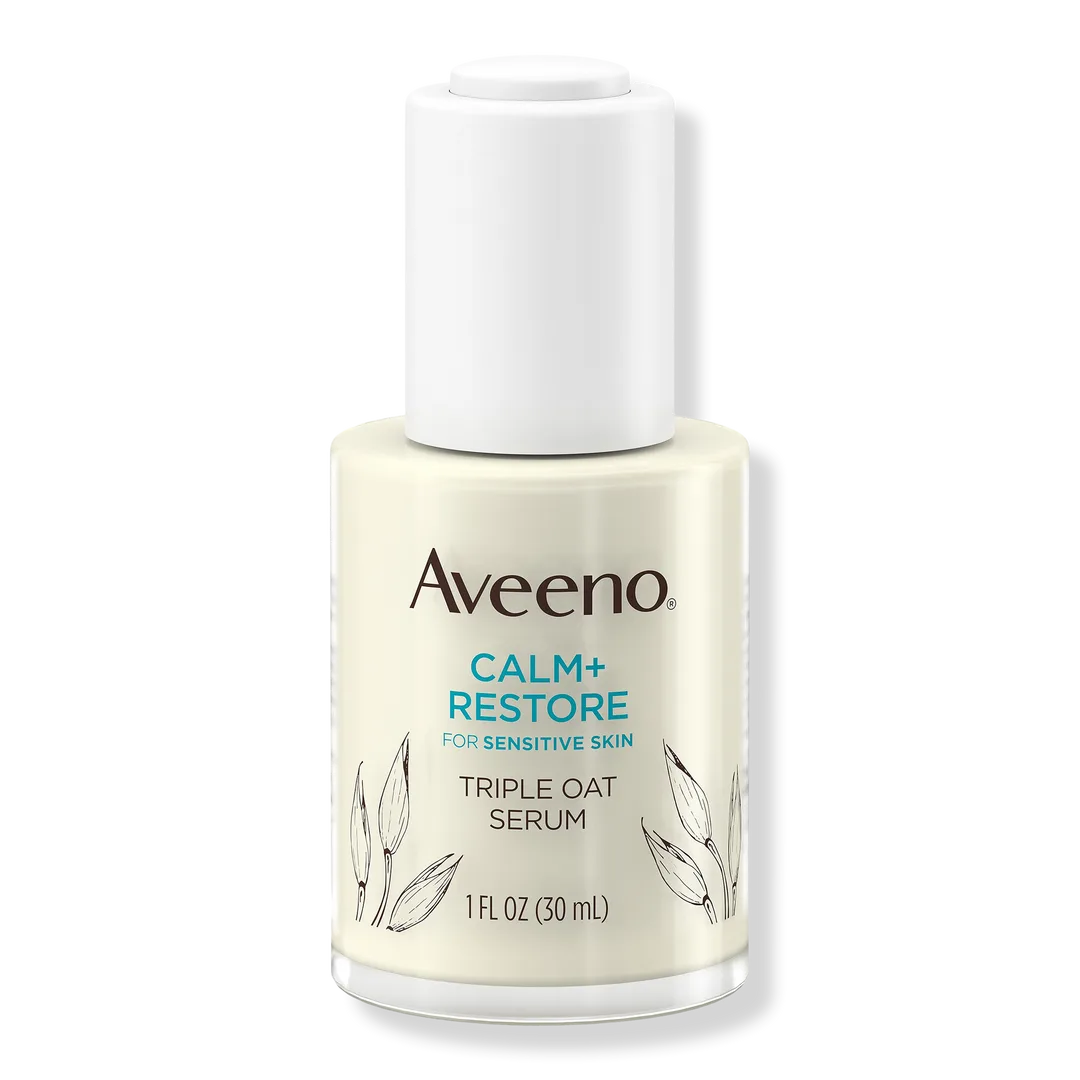
Calm + Restore Triple Oat Serum
Sensitive Skin Sanctuary
 Verified reviewer
Pros & cons.
- +Triple oat complex provides genuine multi-pathway soothing and barrier repair
- +Minimal 19-ingredient formula reduces sensitization risk significantly
- +Fragrance-free with no common allergens beyond the feverfew caveat
- +Lightweight texture absorbs in 15 seconds and layers beautifully
- +Backed by 80 years of Aveeno oat research and published clinical studies
- +Pregnancy safe with no contraindicated ingredients
- +4.5 star average across approximately 5,000 consumer reviews
- −Small 1 oz bottle lasts only 5-6 weeks with recommended twice-daily use
- −Price-to-volume ratio is less competitive than other drugstore serums
- −Feverfew extract may cause reactions in those allergic to Asteraceae plants
- −Does not target specific concerns like aging, brightening, or acne
- −Pump dispenser requires multiple pumps for adequate coverage
The full review.
There is a trend in skincare right now toward maximalism — serums with twelve actives, layering routines with seven steps, ingredient lists that read like a chemistry final. And then there is this serum, which looked at that entire movement and politely declined. Nineteen ingredients. Three forms of oat. One clear mission: make your skin stop panicking.
The Calm + Restore Triple Oat Serum launched in 2021, but its intellectual roots trace back to 1945, when Aveeno was founded in partnership with the Mayo Clinic around the therapeutic potential of oat. Eighty years of research distilled into a one-ounce bottle — there is something appealingly stubborn about that kind of commitment to a single botanical family.
The triple oat concept is not just clever naming. Each form of Avena Sativa contributes distinct bioactive compounds. The oat kernel flour delivers avenanthramides, a class of polyphenols unique to oats that have demonstrated anti-inflammatory potency comparable to one percent hydrocortisone in published studies. The oat kernel oil provides lipids — including ceramide precursors — that support barrier repair at the structural level. And the oat kernel extract contributes concentrated beta-glucan, a polysaccharide that forms a moisture-binding film on the skin surface. Soothing, repairing, hydrating — three functions from three preparations of the same plant, each addressing a different aspect of what goes wrong when sensitive skin is under siege.
Feverfew rounds out the anti-inflammatory strategy. Aveeno uses a parthenolide-depleted extract, which is a meaningful distinction. Raw feverfew contains parthenolide, a compound that can cause allergic contact dermatitis — not ideal for a product targeting sensitive skin. Aveeno’s extraction process removes this sensitizer while preserving the plant’s inhibition of 5-lipoxygenase and phosphodiesterase enzymes. The result is an anti-inflammatory agent that works through different pathways than the oat avenanthramides, broadening the formula’s ability to quell diverse inflammatory cascades.
What is conspicuously absent is just as important as what is present. No retinol. No niacinamide. No vitamin C. No hyaluronic acid. No peptides. No exfoliating acids. In a market where every serum tries to address five concerns, this one addresses exactly one — calming reactive skin — and refuses to dilute its focus. That restraint is either frustrating or liberating depending on what you need. If you want anti-aging or brightening, look elsewhere. If your skin barrier is compromised and everything stings, this is the serum that understands your situation.
The texture reflects the formula’s simplicity. It is slightly more viscous than a water-weight serum, with a faint oat-hued tint that feels like a nod to its botanical DNA. Application requires two to three pumps from a dispenser that doles out modest amounts — a minor annoyance when the bottle is only one ounce. Absorption takes roughly fifteen seconds, leaving behind a satin smoothness with no greasiness, stickiness, or residue. It layers beautifully under moisturizer and sunscreen, and its fragrance-free neutrality means it plays well with everything in your routine.
Clinical and consumer feedback align unusually well here. Ninety-two percent of testers in Aveeno’s assessment reported immediate smoothing, and the approximately five thousand reviews across major retailers average 4.5 out of 5 stars — high for a product whose primary benefit is the absence of irritation rather than the presence of dramatic visible change. Users consistently describe skin that feels calmer, less reactive, and more resilient over two to four weeks of use. The improvements are real but subtle — this is not a before-and-after Instagram product.
The stinging reports from a minority of users almost certainly trace to the feverfew. If you have known allergies to the Asteraceae family — daisies, ragweed, chrysanthemums — patch test this product first. It is ironic that a serum designed for sensitive skin contains an ingredient that some sensitive individuals cannot tolerate, but the parthenolide depletion does mitigate the most common sensitization pathway.
Value is the area where this serum faces its sharpest criticism. At roughly twenty dollars for one ounce, it lasts only five to six weeks with twice-daily use. The ingredients justify the quality, but the quantity feels stingy. A two-ounce option or a more generous pump mechanism would address the most common complaint without changing anything about the formula itself.
There is a particular kind of skincare product that does not photograph well, does not go viral, and does not produce the kind of dramatic results that generate breathless reviews. It just quietly, reliably makes your skin feel better. The Triple Oat Serum is that product. For the millions of people with rosacea, eczema, post-procedure sensitivity, or retinoid-irritated skin who have learned to approach new products with the wariness of someone who has been burned too many times, this serum is a safe harbor. And Aveeno, with its eight decades of oat research, might be the only brand at the drugstore with the credibility to promise that and deliver.
Formula
Texture
The texture reflects the formula’s simplicity. It is slightly more viscous than a water-weight serum, with a faint oat-hued tint that feels like a nod to its botanical DNA. Application requires two to three pumps from a dispenser that doles out modest amounts — a minor annoyance when the bottle is only one ounce. Absorption takes roughly fifteen seconds, leaving behind a satin smoothness with no greasiness, stickiness, or residue. It layers beautifully under moisturizer and sunscreen, and its fragrance-free neutrality means it plays well with everything in your routine.
Scent
Fragrance-free neutrality
Common Praise
Clinical and consumer feedback align unusually well here. Ninety-two percent of testers in Aveeno’s assessment reported immediate smoothing, and the approximately five thousand reviews across major retailers average 4.5 out of 5 stars — high for a product whose primary benefit is the absence of irritation rather than the presence of dramatic visible change. Users consistently describe skin that feels calmer, less reactive, and more resilient over two to four weeks of use. The improvements are real but subtle — this is not a before-and-after Instagram product.
Common Complaints
Value is the area where this serum faces its sharpest criticism. At roughly twenty dollars for one ounce, it lasts only five to six weeks with twice-daily use. The ingredients justify the quality, but the quantity feels stingy. A two-ounce option or a more generous pump mechanism would address the most common complaint without changing anything about the formula itself.
Works for
For the millions of people with rosacea, eczema, post-procedure sensitivity, or retinoid-irritated skin who have learned to approach new products with the wariness of someone who has been burned too many times, this serum is a safe harbor.
Not ideal for
If you want anti-aging or brightening, look elsewhere.
Ingredient analysis.
Full INCI list
Water, Glycerin, Butylene Glycol, Bis-PEG-18 Methyl Ether Dimethyl Silane, Isodecyl Neopentanoate, Pentaerythrityl Tetraethylhexanoate, Ethylhexylglycerin, Phenoxyethanol, Ammonium Acryloyldimethyltaurate/VP Copolymer, Chlorphenesin, Dimethicone, Succinoglycan, Chrysanthemum Parthenium (Feverfew) Flower/Leaf/Stem Juice, Avena Sativa (Oat) Kernel Flour, Avena Sativa (Oat) Kernel Oil, Acrylates/C10-30 Alkyl Acrylate Crosspolymer, Dimethiconol, Sodium Hydroxide, Avena Sativa (Oat) Kernel Extract
Skin match.
The science.
The Science
The triple oat complex forms the base of this formula. It uses three Avena Sativa preparations to treat sensitive skin via different mechanisms. Oat kernel flour contains avenanthramides, which are unique oat polyphenols with documented anti-inflammatory properties. A 2015 study by Reynertson et al. in the Journal of Drugs in Dermatology shows that colloidal oat extracts have anti-inflammatory activity similar to one percent hydrocortisone by inhibiting NF-kappaB and suppressing pro-inflammatory cytokines.
A 2016 study by Ilnytska et al. in the Journal of Drugs in Dermatology examined the mechanism further. It shows that colloidal oatmeal extracts induce genes for epidermal differentiation, tight junction formation, and lipid regulation. A clinical trial with 50 subjects showed significant improvements in skin dryness, moisturization, and barrier function, which supports the product's barrier-repair claims.
The oat kernel oil provides lipids like linoleic acid, oleic acid, and ceramide precursors. These integrate into the intercellular lipid lamellae to strengthen the barrier structure. The oat kernel extract provides concentrated beta-glucan, a polysaccharide that acts as a humectant and film-former to help retain moisture.
Parthenolide-depleted feverfew adds a second anti-inflammatory axis. Martin et al. published in Inflammopharmacology in 2008 showed this modified extract inhibits 5-lipoxygenase, PDE-3, and PDE-4, and reduces pro-inflammatory mediators like nitric oxide, prostaglandin E2, and TNF-alpha. Joen et al. in Archives of Dermatological Research showed free radical scavenging activity higher than vitamin C and reduced UV-induced oxidative stress. Removing parthenolide eliminates the main sensitizing compound while keeping these benefits—a key engineering choice for reactive skin.
References
- Anti-inflammatory activities of colloidal oatmeal contribute to the effectiveness of oats in treatment of itch associated with dry, irritated skin — Journal of Drugs in Dermatology (2015)
- Colloidal Oatmeal (Avena Sativa) Improves Skin Barrier Through Multi-Therapy Activity — Journal of Drugs in Dermatology (2016)
- Anti-inflammatory activity of parthenolide-depleted feverfew (Tanacetum parthenium) — Inflammopharmacology (2008)
- Parthenolide-depleted Feverfew protects skin from UV irradiation and external aggression — Archives of Dermatological Research (2007)
Dermatologist Perspective
Board-certified dermatologists know that patients with compromised skin barriers—from eczema, rosacea, or retinoid use—often need less inflammation and more barrier support rather than more active ingredients. Dermatologists note the triple oat approach in this serum provides clinically validated anti-inflammatory activity via avenanthramides and delivers barrier-repairing lipids, matching dermatological best practices for sensitive skin. Dermatologists view the addition of parthenolide-depleted feverfew favorably because it expands the anti-inflammatory spectrum without the sensitization risk of raw feverfew. Dermatologists often recommend this serum to soothe routines using prescription retinoids or to recover after chemical peels and laser treatments.
Where it fits in your routine.
Press 2-3 drops onto fingertips and press into clean, slightly damp skin. Apply to face and neck, but avoid eyes. Use morning and evening before moisturizer. If using retinoids or active treatments, apply this serum first as a calming base layer. Wait one to two minutes for absorption, then apply the treatment product. Follow with moisturizer and sunscreen in the morning.
At approximately $20 for 1 fluid ounce, this serum sits at the upper end of drugstore pricing. The cost per ounce is significantly higher than Aveeno's cleansers and moisturizers, and the small bottle lasts only five to six weeks with twice-daily use. However, the ingredient quality justifies the price — the triple oat complex and patented feverfew extract represent genuine research investment, and the minimal 19-ingredient formula reflects deliberate curation rather than cost-cutting. Given Aveeno's 80-year legacy of oat science and the broad clinical evidence supporting its core ingredients, the price reflects legitimate formulation quality. A larger size option would significantly improve the value equation.
This serum works for sensitive, reactive, or barrier-compromised skin that needs calming without multi-active complexity. It is excellent for rosacea-prone skin, people recovering from cosmetic procedures, or anyone using prescription retinoids who needs a soothing buffer step.
This is not the right choice for a serum targeting wrinkles, dark spots, or acne. Skip this if you have allergies to the Asteraceae (daisy) plant family, because feverfew extract may trigger reactions. The 1 oz size lacks value per ounce for drugstore shoppers.
Product details.
This slightly viscous serum has a subtle oat-hued tint. It is thicker than water-weight serums but absorbs in approximately 15 seconds. It leaves a satin smoothness without greasiness.
Completely fragrance-free. Faint natural oat aroma only, barely perceptible.
Glass bottle with pump dispenser. Minimal aesthetic with oat branch illustrations. The pump dispenses small amounts; use 2-3 pumps for full-face coverage.
The first application feels smoothing and calming. The serum has a lightweight slip and absorbs fast. Most users experience no tingling, stinging, or adjustment period. Skin feels softer and more settled immediately.
5-6 weeks with twice-daily use of 2-3 drops
6 months
All Year
The backstory.
Launched in 2021 as the flagship serum of the Calm + Restore line, this product represents Aveeno's deepest expression of its 80-year oat science heritage. Rather than chasing active ingredient trends, Aveeno essentially asked: what if we triple down on the one ingredient we know better than anyone? The result is a serum that does not try to be everything — it just tries to make sensitive skin feel safe.
About Aveeno
Legacy Brand (20+ years)Aveeno launched in 1945 with the Mayo Clinic and has dermatologist-recommended status for over 80 years. Now owned by Kenvue, the brand pioneered colloidal oat skincare and owns patents on parthenolide-depleted feverfew extract. In 2025, Aveeno announced a new research collaboration with the Mayo Clinic to advance skin health science.
Common myths.
Using three forms of oat is just marketing — oat is oat.
Each form of Avena Sativa delivers different bioactive compounds. Oat kernel flour provides avenanthramides (anti-inflammatory polyphenols), oat kernel oil provides ceramide-like lipids for barrier repair, and oat kernel extract provides concentrated beta-glucan for moisture binding. These mechanisms complement each other instead of being redundant.
A soothing serum without active ingredients does not improve skin.
For compromised or reactive skin, reducing inflammation is the active treatment. The oat avenanthramides in this formula show anti-inflammatory activity comparable to 1% hydrocortisone. Often, the best intervention is removing the insult and letting the skin recover, which a well-formulated calming serum does.
FAQ.
What does the triple oat complex in this serum actually do?
The triple oat complex uses three Avena Sativa forms with different functions: oat kernel flour delivers anti-inflammatory avenanthramides to calm redness and irritation, oat kernel oil provides ceramide-like lipids to repair the skin barrier, and oat kernel extract adds beta-glucan for moisture retention. Together, they meet the three core needs of sensitive skin: calming, repairing, and hydrating.
Can I use the Aveeno Triple Oat Serum with retinol?
Yes, this serum pairs well with retinol. Its anti-inflammatory oat and feverfew ingredients buffer common retinoid irritation. Apply this serum to clean skin first, let it absorb, then apply your retinol product. These calming properties reduce redness, peeling, and sensitivity from retinoid use.
Is this serum good for rosacea?
This serum works for rosacea-prone skin. The fragrance-free, minimal formula avoids common rosacea triggers. Oat avenanthramides and feverfew extract provide anti-inflammatory activity to manage redness. However, people with rosacea who are allergic to Asteraceae (daisy) family plants should patch test first, because feverfew extract may cause reactions.
How long does the 1 oz bottle of Aveeno Triple Oat Serum last?
Using 2-3 drops twice daily makes the 1 fl oz bottle last 5-6 weeks. This duration is shorter than many users expect, and the small size relative to the price is a common complaint. Using the serum once daily or applying less extends its life to 8-10 weeks.
Is the Aveeno Calm + Restore Triple Oat Serum safe during pregnancy?
Yes, this serum is pregnancy safe. It lacks retinoids, salicylic acid, hydroquinone, or other pregnancy-contraindicated ingredients. This fragrance-free, oat-based formula is one of the safest serum options for expectant mothers and appears on multiple pregnancy-safe skincare recommendation lists.
Why does this serum sting on my skin?
Feverfew (Chrysanthemum Parthenium) extract from the Asteraceae/Compositae plant family is the most likely cause. Cross-reactivity occurs if you have allergies to daisies, ragweed, chrysanthemums, or marigolds. Stop use if stinging persists. Less often, very compromised skin barriers react to preservatives like phenoxyethanol or chlorphenesin.
Community
What the community says.
"Lightweight texture absorbs quickly without residue or stickiness"
"Effectively calms and soothes sensitive, irritated skin"
"Works beautifully under makeup and layers well with other products"
"Fragrance-free with only a subtle natural oat scent"
"Immediate smoothing sensation upon application"
"Dispenser requires multiple pumps for adequate coverage"
"Results are subtle and gradual rather than dramatic"
"Small 1 oz bottle runs out quickly for twice-daily use"
"Some users with Asteraceae family allergies experienced stinging"
"Does not address specific concerns like wrinkles or dark spots"
Featured in.
People also looked at.