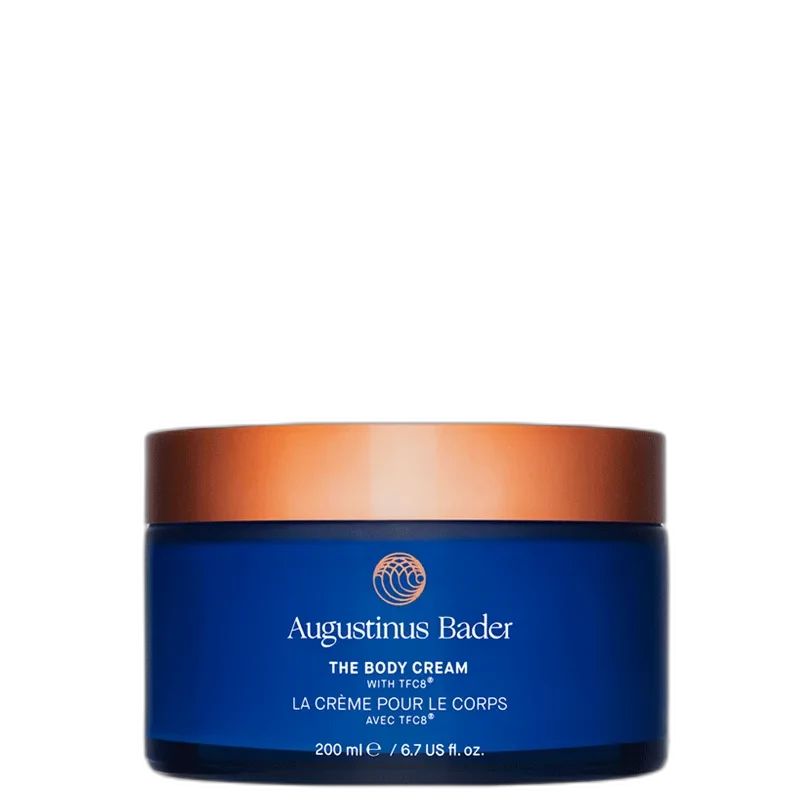
The Body Cream
Luxury Body Cream Statement
 Verified reviewer
Pros & cons.
- +Genuinely fragrance-free — rare in the luxury body category
- +Two real ceramides plus amino acid and peptide complex
- +Velvety, fast-absorbing texture without greasiness
- +Bisabolol and shea base suit sensitive body skin
- +Substantial brand research pedigree from University of Leipzig
- +Pregnancy-safe and well-tolerated
- +Recyclable minimalist tube packaging
- −Price is impossible to justify on ingredients alone
- −Marketing claims around firming and stretch marks unproven
- −200ml empties faster than expected at body application amounts
- −Plant oils make it not reliably fungal-acne safe
- −TFC8 complex is proprietary and harder to independently verify
The full review.
About Augustinus Bader
The body care category is, with very few exceptions, a backwater of skincare. Walk into any pharmacy or beauty store and you’ll find walls of body lotion built around generic emollients, drugstore-grade fragrance, and ingredient lists that look like they were written in 1995. The reason is simple: most consumers don’t want to pay face-care prices for body care, so brands stop trying. There are a few legitimate exceptions — Necessaire, Eucerin’s medicated ranges, Nécessaire’s barrier creams — but the upper end of the body category has historically been dominated by lotions whose appeal is the smell rather than the science. Augustinus Bader’s Body Cream landed in 2021 as a deliberate provocation against this status quo, asking what a body cream would look like if you formulated it like a face cream and priced it accordingly. The answer turns out to be more interesting than the predictable cynicism about $165 body lotions would suggest.
Formula
The first thing to understand about the formula is that it is built on top of TFC8 — Trigger Factor Complex 8 — which is the brand’s proprietary stack of amino acids, peptides, ceramides, and supporting nutrients. The complex isn’t a single ingredient on the INCI; it’s a system of components scattered throughout the formula. You can find them by reading the list: alanyl glutamine, arginine, glycine, lysine, phenylalanine, proline (the amino acids), ceramide NG and ceramide NP (the lipid stabilizers), oligopeptide-177 and various supporting molecules. The complex grew out of Professor Augustinus Bader’s research at the University of Leipzig on cell signaling and wound healing — work that was originally aimed at improving outcomes for severe burn patients before being commercialized into skincare. The medical pedigree is real and is one of the few cases where a luxury skincare brand can actually point to peer-reviewed academic research rather than just a chemist with a marketing budget. The structural backbone of the cream is more conventional and equally well-built. Shea butter sits in the second slot as the dominant emollient, providing the rich, cushioning texture. Glycerin in the fifth slot provides the water-side humectancy. Behenyl alcohol, dicaprylyl ether, and a stack of esters and emulsifiers handle the formulation chemistry that gives the cream its characteristically silky-but-not-greasy feel. Sunflower seed oil, cholesterol-hydrogenated lecithin, and tocopherol round out the antioxidant and lipid layer. Bisabolol — the chamomile-derived anti-inflammatory — sits midway through the list and is the calming addition that lets the cream work on sensitive body skin without any added fragrance. Verbena and brassica oil are present in trace amounts but don’t drive the scent profile, which is genuinely fragrance-free.
Texture
The texture, when you actually use it, is the part that tells you the brand was serious about formulating this as a face cream applied at body scale. The cream is rich without being heavy, softens on contact, spreads thin and absorbs to a velvety, cushioned finish in under a minute. There is no greasy slick, no waxy residue, no need to wait fifteen minutes before getting dressed — all of which are common compromises in luxury body creams that lead with shea butter.
Scent
The fragrance-free profile is striking if you’re used to scented body lotions; the only scent is the faint shea-and-clean-lipid character of the formula itself.
Best for
For sensitive body skin, for users with rosacea or eczema on the body, or for anyone who simply doesn’t want their body care to compete with their perfume, this is one of the few luxury options that delivers a fragrance-free experience without feeling clinical.
Common Complaints
The honest conversation about this cream has to be about value. At around $165 for the 200ml tube ($95 for the 100ml), there is no body cream in the world that delivers $165 worth of unique benefit over a well-formulated $30 ceramide cream. CeraVe’s body cream contains three real ceramides, hyaluronic acid, and the same MVE delivery system used in their face creams, and costs about $20 for nearly three times the volume. La Roche-Posay’s Lipikar body creams contain niacinamide and shea butter at a fraction of the price. Necessaire’s body lotion contains niacinamide, ceramides, and peptides and runs around $25. The structural ingredient chemistry that drives barrier health on body skin is not proprietary to luxury brands. What Augustinus Bader’s cream offers in addition to that ingredient chemistry is the TFC8 complex (which is genuinely interesting but whose body-skin clinical data is limited and proprietary), a fragrance-free formulation that’s rare at the luxury tier, a sensorial experience that does feel meaningfully more refined than a drugstore body cream, and the brand experience itself. Whether those four things are worth the additional $135 over a CeraVe is a personal question, not an objective one. For a user who specifically wants the combination of fragrance-free luxury body care, ceramides, and the clinical-research brand story — and who can comfortably afford to spend on body care at this level — the cream is one of the more defensible options in the luxury body category. For a user who’d be stretching to buy it, who expects the price to translate into dramatically better visible results than a drugstore alternative, or who is hoping the cream will measurably improve cellulite or stretch marks (the marketing claims here are not supported by independent clinical evidence specific to this product), the value math doesn’t work. The product is genuinely good. It is also genuinely overpriced relative to its ingredient cost, in the way all luxury skincare is. Augustinus Bader’s broader pitch — that body skin deserves the same molecular attention as face skin — is a legitimate one, and the formula is one of the cleaner attempts to live up to it. The question every user has to answer for themselves is whether the experience and the brand are worth the math. There’s no right answer. There is only the cream itself, which is well-built, well-tolerated, sensorially excellent, and astronomically priced — exactly what a luxury body cream is supposed to be.
Ingredient analysis.
Full INCI list
Water, Butyrospermum Parkii (Shea) Butter, Behenyl Alcohol, Dicaprylyl Ether, Glycerin, Lauryl Laurate, Myristyl Myristate, Glyceryl Stearate, Polyglyceryl-3 Methylglucose Distearate, Sodium Stearoyl Glutamate, Xylitylglucoside, Anhydroxylitol, Xylitol, Chlorphenesin, Sodium Benzoate, Citric Acid, Bisabolol, Xanthan Gum, Tocopherol, Helianthus Annuus (Sunflower) Seed Oil, Alcohol, Glucose, Tocopheryl Acetate, Cholesterol Hydrogenated Lecithin, Sodium Hydroxide, Verbena Officinalis Flower/Leaf Extract, Alanyl Glutamine, Arginine, Ceramide NG, Ceramide NP, Glycine, Lysine, Oleic Acid, Palmitic Acid, Phenylalanine, Proline, Scenedesmus Rubescens Extract, Phenoxyethanol, Brassica Alba Oil, Disodium EDTA, Oligopeptide-177, Sodium Ascorbate
Skin match.
The science.
The Science
The science behind this cream stems from Professor Augustinus Bader's published research on cell signaling and wound healing at the University of Leipzig. Bader and colleagues used amino acid and peptide combinations to support regenerating tissue's molecular environment, work published in peer-reviewed journals over many years. The TFC8 complex in this cream uses that research, but note: the original studies focused on wound healing and tissue regeneration, not cosmetic body cream applications, and the proprietary composition makes independent replication difficult. The cream's barrier-supporting chemistry is more certain. Ceramide NG and ceramide NP are well-characterized skin-identical ceramides; a 2002 British Journal of Dermatology paper by Coderch and colleagues reviewed how ceramides affect stratum corneum barrier function. Cholesterol-hydrogenated lecithin adds more barrier-supporting lipids. A 2008 British Journal of Dermatology paper by Fluhr and colleagues extensively reviewed Glycerin as a humectant for skin hydration. Cosmetic chemistry literature from decades ago characterizes Bisabolol's anti-inflammatory effects at cosmetic concentrations. The structural ingredients—the ceramides, glycerin, shea butter, and bisabolol—have established cosmetic chemistry support. These well-understood ingredients drive the cream's effects on body skin smoothness and barrier health. The TFC8 complex is the formula's distinctive, harder-to-independently-verify hero and differentiates the brand from a drugstore ceramide cream.
References
- Ceramides and skin function — American Journal of Clinical Dermatology (2003)
- Glycerol and the skin: holistic approach to its origin and functions — British Journal of Dermatology (2008)
Dermatologist Perspective
Dermatologists generally see luxury body creams like this one as well-formulated but not pharmacologically different from cheaper barrier-supporting alternatives. Board-certified dermatologists note the ceramide and amino acid system in TFC8 shows thoughtful formulation chemistry, but they emphasize that for body skin, the structural ingredients for barrier health—ceramides, glycerin, fatty acids, shea butter—exist in many cheaper products. The fragrance-free profile benefits sensitive skin, rosacea-prone body skin, and patients with body eczema or chronic dryness. For stretch marks or cellulite, dermatologists caution that cosmetic body creams have limited evidence for visible improvement; prescription topicals or in-office treatments offer more evidence-backed options for clinically significant concerns.
Where it fits in your routine.
Apply to clean, damp skin after showering; moisture helps The CeraVe Moisturizing Cream emulsify and absorb evenly. Use a small amount—the cream is thick—on dry or rough areas like elbows, knees, decolletage, the backs of hands, and the lower legs. Massage until absorbed. Use morning, night, or both. For maximum effect, layer over Augustinus Bader's Body Oil or under Augustinus Bader's Rich Cream on the chest and decolletage.
At $165 for 200ml or $95 for 100ml, this is one of the most expensive body creams on the market. Ingredient costs alone do not justify these prices. You can find the structural ingredients in CeraVe Body Cream ($20 for nearly 3x the volume), Necessaire Body Lotion ($25), or La Roche-Posay Lipikar Baume AP+M ($30) for much less. The price premium covers the TFC8 complex, the fragrance-free luxury formulation, the sensorial experience, the recyclable packaging, the brand story, and the academic research pedigree. This cream is a defensible luxury option for buyers who want that specific combination. For value-driven buyers, almost any quality drugstore ceramide body cream provides most structural benefits for less money. Decide which buyer you are.
This fragrance-free body cream suits users who want ceramides, can afford the price, and value the brand's clinical research. It works for sensitive body skin, rosacea-prone body areas, and pregnancy moisturizing when fragrance-free is a priority.
Avoid this if you are on a tight budget, expect dramatic firming or stretch mark improvement (not supported by independent evidence), have confirmed fungal acne, or want a CeraVe or Necessaire ceramide body cream — which covers most people.
Product details.
Thick, soft white cream that softens on contact and absorbs to a velvety, cushioned finish without a sticky film
It is fragrance-free, with a faint scent from shea butter and clean lipids.
Thick white tube with minimalist branding. It is premium, recyclable, and travel-friendly.
The first application feels like a high-end face cream used on the body — substantial but not heavy. It absorbs within a minute and leaves skin softer. The fragrance-free profile is striking compared to scented body lotions; it only smells of shea and amino acids. Users have debated since launch whether this experience justifies the price.
Use daily on the full body for about 2 months, or longer for spot application on dry areas
12 months
All Year
The backstory.
Augustinus Bader the brand launched in 2018, but Professor Augustinus Bader the scientist had been researching cell signaling and wound healing at the University of Leipzig for decades. The original work was aimed at improving outcomes for severe burn patients, and the amino-acid-and-peptide complex that became TFC8 was developed in that medical context. The Body Cream launched in 2021 as the brand's expansion from face into body — the same complex, applied to skin that the brand argued deserved the same molecular attention as the face but rarely got it from the body-care category.
About Augustinus Bader
Emerging Brand (2–5 years)Augustinus Bader launched in 2018, based on Professor Augustinus Bader's stem cell and wound-healing research at the University of Leipzig. He created an amino acid and peptide complex to treat burns. The brand uses this research as 'TFC8' in its skincare line. The science works, but the proprietary complex is harder to verify independently than openly published actives.
Common myths.
Stem cells in skincare can regrow your skin.
Augustinus Bader's TFC8 complex lacks stem cells. This amino acid and peptide complex supports the cellular environment and comes from stem cell research. The "cell signaling" marketing is technically accurate, but users often misread it as "stem cell skincare," which the formula is not.
A $165 body cream must outperform a $20 body cream by eight times.
It isn't. The Augustinus Bader body cream has a good formulation, but the value gap between a luxury and a drugstore ceramide cream is much smaller than the price gap. Users buy this for the experience, the brand, and the formulation quality — not because it outperforms CeraVe by 8x.
FAQ.
Is it worth the price?
By formulation quality alone, no—no body cream provides $165 of unique benefit over a well-formulated $30 ceramide cream. For users who want the specific combination of fragrance-free, luxury texture, and ceramides, the brand and experience make it worth the cost. It is not a value purchase. As a luxury indulgence with thoughtful formulation, it is one of the more defensible options in the luxury body category.
What is TFC8?
TFC8 is Augustinus Bader's proprietary 'Trigger Factor Complex 8'. This layered combination of amino acids, ceramides, peptides like oligopeptide-177, and supporting nutrients mimics the molecular environment that supports cell repair. Professor Bader developed the complex during burn-treatment research at the University of Leipzig. TFC8 is not one ingredient; it is a system of components dispersed throughout the formula.
Is it fragrance-free?
Yes. The cream has no added fragrance. The only scent comes from the faint inherent character of shea butter and clean lipids. This is one of the few luxury body creams that is genuinely fragrance-free, making it suitable for sensitive skin types.
Is it safe during pregnancy?
Yes — the formula contains no ingredients flagged for pregnancy avoidance. Its fragrance-free, retinoid-free profile makes it safer than most luxury body creams during pregnancy. The brand markets it for stretch mark moisturizing, though clinical evidence for stretch mark improvement specifically is limited.
Can I use it on my face?
Technically yes, but it costs too much for face use. The brand makes dedicated face products (The Cream and The Rich Cream) with formulations better for facial skin. The Body Cream is thick enough that some users find it too occlusive for the face.
How long does the 200ml tube last?
Apply daily to the full body for about two months, or longer if you only use it on dry areas like elbows, knees, decolletage and hands. Most users find The CeraVe Moisturizing Cream is thick enough that a small amount lasts longer than a typical body lotion.
Does it actually firm skin or reduce stretch marks?
The brand claims this product firms skin and improves stretch marks, but independent clinical evidence for these specific claims is limited. The formula ingredients support general barrier health and skin smoothness to improve body skin appearance, but available data does not support expectations of dramatic stretch mark reduction.
Community
What the community says.
"luxurious texture without greasiness"
"fragrance-free and sensitive-skin friendly"
"noticeable softness improvement on dry areas"
"feels like a face cream applied to the body"
"price is genuinely difficult to justify"
"200ml empties faster than expected at body application amounts"
"marketing claims around firming and stretch marks unproven"