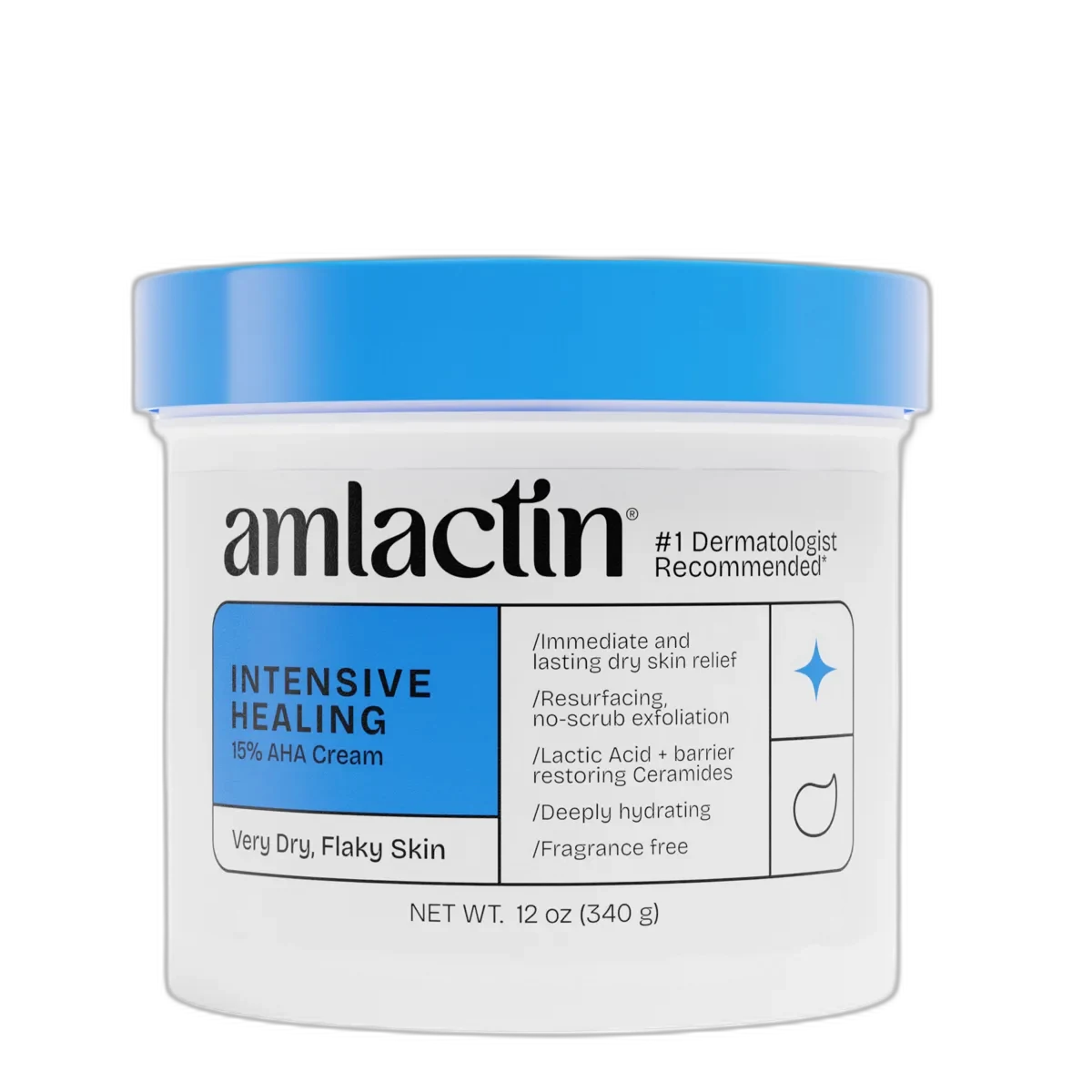
Intensive Healing Body Cream
Drugstore KP and Dry Skin MVP
 Verified reviewer
Pros & cons.
- +15% lactic acid at prescription-grade concentration paired with triple ceramide barrier repair
- +Phytosphingosine and cholesterol create a biomimetic lipid complex for comprehensive barrier restoration
- +Exceptional value at ~$18 for 12 oz — outperforms body products costing five times more
- +Highly effective for keratosis pilaris, extremely dry skin, and rough body texture
- +1000+ reviews with 4.6-star average and #1 dermatologist-recommended status
- +Fragrance-free and paraben-free with a clean, functional ingredient list
- −15% lactic acid stings on compromised, broken, or very dry skin during initial use
- −Ammonium lactate has a characteristic tart smell that some users find noticeable
- −Too strong for facial use — body only
- −Results require consistent ongoing use — roughness and KP return if discontinued
- −Tub packaging is less hygienic than pump bottles for a product used with potentially damp hands
- −Not suitable for acutely inflamed eczema patches despite the ceramide content
The full review.
There is a long-running joke in skincare circles that the most effective products are the least glamorous. No one photographs their AmLactin tub for Instagram. No one unboxes it on TikTok with dramatic lighting and a reaction shot. It sits on drugstore shelves in utilitarian packaging that practically dares you to walk past it. And yet, ask any dermatologist what they recommend for dry, rough, bumpy body skin, and this is one of the first names out of their mouths.
AmLactin has been the lactic acid brand since the 1990s, and the Intensive Healing Body Cream represents the most evolved version of their core formula. The original AmLactin was straightforward — ammonium lactate in a basic moisturizer vehicle. Effective, but incomplete. The Intensive Healing upgrade adds what the original lacked: barrier repair. Three ceramides (NP, AP, EOP), phytosphingosine, and cholesterol create a lipid complex that mirrors the skin’s natural barrier composition, turning a simple exfoliating moisturizer into a genuine treatment product.
The logic is elegant. Fifteen percent lactic acid dissolves the protein bonds between dead skin cells in the stratum corneum — a process called corneodesmolysis. This is the same mechanism used by fancy AHA peels and exfoliating treatments, just applied to body skin at a concentration that matches prescription strength. The rough, flaky, bumpy texture that characterizes extremely dry skin, keratosis pilaris, and ichthyosis is literally being dissolved away with each application.
But here is where older ammonium lactate formulas ran into trouble: aggressive chemical exfoliation without barrier support can create a cycle of exfoliation and re-drying. You remove the dead skin, the barrier is compromised, moisture escapes, and the skin dries out again — sometimes worse than before. The triple ceramide complex breaks this cycle. As the lactic acid clears dead cells from the surface, the ceramides NP, AP, and EOP integrate into the lipid matrix between the viable cells underneath, restoring the barrier that prevents moisture loss. Phytosphingosine stimulates the skin’s own ceramide production. Cholesterol completes the biomimetic lipid ratio.
The result is body skin that is both smoother (from the exfoliation) and better hydrated (from the barrier repair). The two effects compound with consistent use — each application builds on the last, creating progressively smoother, more resilient skin over weeks.
For keratosis pilaris — the ubiquitous chicken-skin bumps on upper arms and thighs that affect roughly 40% of adults — this formula is one of the most consistently effective OTC treatments available. The keratin plugs that create KP bumps are essentially micro-calluses, and the 15% lactic acid dissolves them with the same mechanism it uses on larger-scale rough patches. Most users see flattening of bumps within two to three weeks, with significant improvement by the six-week mark.
The texture is a proper cream — thick and rich, denser than the AmLactin lotion versions but not oppressively heavy. It absorbs reasonably well considering its density, leaving a slight dimethicone-smoothed finish rather than a greasy sheen. For a body product that you apply to arms, legs, and torso, the absorption speed is acceptable though not instant. Winter skin, arms after shaving, post-shower dry patches — it handles all of these with the same efficient competence.
The stinging is real and worth addressing directly. Fifteen percent ammonium lactate on dry, rough skin will tingle. On very dry, cracked, or compromised areas, it can sting with enough intensity to make you pause. This is the acid working — dissolving dead cell bonds is not a comfort-forward process. The stinging subsides within minutes and decreases with each application as the skin becomes smoother and less compromised. Starting with once-daily application and building to twice daily helps manage the acclimation period.
The smell is the other perennial talking point. Ammonium lactate has a natural tart, slightly chemical odor that is detectable during application. It is not the pleasant scent of a luxury body cream, nor is it offensive — it is simply noticeable. It fades within minutes, and the fragrance-free formulation means there is no artificial scent layered on top. Some users are unbothered; others apply it only at night when the smell matters less.
At approximately eighteen dollars for twelve ounces of product, the value calculation is almost embarrassing for the luxury body care market. The same triple ceramide technology used in $50 CeraVe creams, the same 15% ammonium lactate concentration found in prescription Lac-Hydrin, and the same type of phytosphingosine and cholesterol barrier repair found in $100+ clinical serums — all in a single drugstore tub that costs less than a cocktail. The math works even better when you consider that the tub lasts four to eight weeks of daily full-body application.
The 2023 Oprah Daily Editor’s Choice recognition — awarded in the context of skin cycling, the routine trend that alternates exfoliation and recovery — was a well-deserved spotlight moment. This cream is essentially a skin cycling routine in a single product: exfoliating and repairing simultaneously, eliminating the need to alternate between an exfoliant night and a barrier cream night.
AmLactin Intensive Healing is not exciting. It is not aesthetically pleasing. It will never be the product you display on your bathroom shelf. But it is one of the most effective, well-formulated, and fairly priced body treatments available anywhere, and the 1000+ reviews and dermatologist recommendations reflect a product that has earned its reputation over decades of quiet, consistent performance.
Formula
Texture
The texture is a proper cream — thick and rich, denser than the AmLactin lotion versions but not oppressively heavy. It absorbs reasonably well considering its density, leaving a slight dimethicone-smoothed finish rather than a greasy sheen. For a body product that you apply to arms, legs, and torso, the absorption speed is acceptable though not instant. Winter skin, arms after shaving, post-shower dry patches — it handles all of these with the same efficient competence.
Scent
The smell is the other perennial talking point. Ammonium lactate has a natural tart, slightly chemical odor that is detectable during application. It is not the pleasant scent of a luxury body cream, nor is it offensive — it is simply noticeable. It fades within minutes, and the fragrance-free formulation means there is no artificial scent layered on top. Some users are unbothered; others apply it only at night when the smell matters less.
Common Praise
For keratosis pilaris — the ubiquitous chicken-skin bumps on upper arms and thighs that affect roughly 40% of adults — this formula is one of the most consistently effective OTC treatments available. The keratin plugs that create KP bumps are essentially micro-calluses, and the 15% lactic acid dissolves them with the same mechanism it uses on larger-scale rough patches. Most users see flattening of bumps within two to three weeks, with significant improvement by the six-week mark.
Common Complaints
The stinging is real and worth addressing directly. Fifteen percent ammonium lactate on dry, rough skin will tingle. On very dry, cracked, or compromised areas, it can sting with enough intensity to make you pause. This is the acid working — dissolving dead cell bonds is not a comfort-forward process. The stinging subsides within minutes and decreases with each application as the skin becomes smoother and less compromised. Starting with once-daily application and building to twice daily helps manage the acclimation period.
Best for
For keratosis pilaris — the ubiquitous chicken-skin bumps on upper arms and thighs that affect roughly 40% of adults — this formula is one of the most consistently effective OTC treatments available. The keratin plugs that create KP bumps are essentially micro-calluses, and the 15% lactic acid dissolves them with the same mechanism it uses on larger-scale rough patches. Most users see flattening of bumps within two to three weeks, with significant improvement by the six-week mark.
Works for
Winter skin, arms after shaving, post-shower dry patches — it handles all of these with the same efficient competence.
Ingredient analysis.
Full INCI list
Water, Ammonium Lactate, Cetearyl Alcohol, Cetyl Alcohol, Glyceryl Stearate, Dimethicone, Propanediol, Glycerin, Isostearyl Isostearate, Polysorbate 60, Hydroxyethyl Acrylate/Sodium Acryloyldimethyl Taurate Copolymer, Mineral Oil, PEG-75 Stearate, Ceramide NP, Ceramide AP, Ceramide EOP, Petrolatum, Caprylyl Glycol, 1,2-Hexanediol, Polyisobutene, Ceteth-20, Steareth-20, Tocopheryl Acetate, PEG-7 Trimethylolpropane Coconut Ether, Sodium Lauroyl Lactylate, Phytosphingosine, Cholesterol, Xanthan Gum, Carbomer
Skin match.
The science.
The Science
Combining ammonium lactate with ceramides is a scientifically rational way to treat xerotic and hyperkeratotic skin conditions. Research in the Journal of the American Academy of Dermatology (Wehr et al., 1991) shows that 12-15% ammonium lactate significantly improves xerosis severity scores after 4 weeks of twice-daily application. The mechanism is clear: lactic acid disrupts corneodesmosomes (the protein rivets holding dead cells together) and acts as a humectant.
The triple ceramide complex fixes the barrier disruption that chemical exfoliation causes. Research in the Journal of Clinical Investigation (Holleran et al., 1991) shows topical ceramide application restores barrier function in lipid-depleted skin. Ceramides NP, AP, and EOP cover the three major ceramide classes in the stratum corneum's lamellar lipid structure. Phytosphingosine, a sphingoid base, stimulates endogenous ceramide synthesis via serine palmitoyltransferase activation—a mechanism confirmed by research in Experimental Dermatology.
Cholesterol in the formulation reflects the fact that the stratum corneum's barrier function depends on a roughly equimolar ratio of ceramides, cholesterol, and free fatty acids. Research in the Journal of Lipid Research shows that disrupting this ratio impairs barrier function, while restoring it accelerates repair.
Lactic acid works well for keratosis pilaris specifically. KP comes from keratin hyperproduction in hair follicles, which forms plugs and creates rough bumps. Lactic acid's keratolytic activity dissolves these plugs while its humectant properties hydrate the surrounding skin—a dual mechanism physical exfoliation cannot replicate.
Dermatologist Perspective
Dermatologists rank ammonium lactate-based products among the most effective OTC treatments for xerosis, keratosis pilaris, and ichthyosis. Board-certified dermatologists say adding ceramides to the traditional ammonium lactate vehicle improves the formula by addressing the barrier compromise from long-term acid exfoliation. The 15% concentration exceeds the 12% in prescription Lac-Hydrin, and the ceramide complex provides barrier support that the prescription product lacks. Dermatologists typically recommend this as a first-line treatment before prescription options; its drugstore pricing makes long-term use practical for conditions requiring ongoing maintenance.
Where it fits in your routine.
Apply to clean, dry body skin 1-2 times daily. Focus on dry, rough, or KP-affected areas. If stinging is a concern, use once daily (evening) for the first week, then increase to twice daily as tolerated. Do not apply to freshly shaved skin, open cuts, or wounds. For keratosis pilaris: apply to upper arms, thighs, and affected areas consistently for 4-6 weeks to see improvement. Apply SPF to sun-exposed areas because lactic acid increases photosensitivity.
At approximately $18 for 12 oz, this is one of the best values in medicated body care. The 15% ammonium lactate concentration matches or exceeds prescription-grade formulations, and the triple ceramide complex adds barrier technology found in products costing three to five times more. The tub lasts 4-8 weeks of daily use, putting the annual cost at approximately $115-230 — extraordinarily affordable for a product with this ingredient quality. A 7.9 oz lotion version and 14.1 oz pump version are also available, offering size options for different preferences and usage rates.
Use this for dry body skin, keratosis pilaris, rough or flaky arms and legs, or ichthyosis-related conditions. It works for budget-conscious shoppers seeking prescription-grade exfoliation and ceramide barrier repair at a drugstore price. It is the gold-standard OTC treatment for KP.
Use this if 15% lactic acid stings your sensitive body skin. Do not use on the face. Wait for eczema flares to resolve before applying this product. The utilitarian formula and lactic acid smell lack a spa-like feel or scent; this is a treatment product, not a sensory experience.
Product details.
This is fragrance-free but has the mild tartness of ammonium lactate. It lacks a perfumed smell; the chemical note fades within minutes of application.
12 oz tub with screw-on lid. The lotion version also comes in 7.9 oz and 14.1 oz pump bottles. Practical, no-nonsense drugstore packaging.
Application causes mild tingling or stinging. This sensation is stronger on rough, dry areas and less noticeable on intact skin. The cream spreads easily and absorbs faster than its density suggests. Skin feels smoother within days, and the ceramide complex prevents the tightness that follows acid-only exfoliation.
4-8 weeks with once or twice daily full-body application
24 months
All Year
The backstory.
AmLactin's Intensive Healing represents the evolution of the brand's original formula from simple ammonium lactate in a basic vehicle to a more sophisticated ceramide-enriched formulation. The addition of three ceramides, phytosphingosine, and cholesterol reflects the brand's response to the skin barrier repair movement — recognizing that aggressive exfoliation without barrier support can create a cycle of dryness. The 2023 Oprah Daily Editor's Choice recognition brought the product to a broader audience beyond its traditional dermatologist-recommendation channel.
About Amlactin
Legacy Brand (20+ years)AmLactin has led the lactic acid moisturizer market since the early 1990s and is the #1 dermatologist-recommended brand in the lactic acid moisturizer category. AmLactin ammonium lactate formulations use the same active ingredient found in prescription-strength products.
Common myths.
15% lactic acid is too strong for regular body use.
Body skin — especially on arms, legs, and torso — has a thicker stratum corneum than facial skin. What works aggressively on the face is appropriate for the body. The 15% concentration matches prescription-strength ammonium lactate (Lac-Hydrin), and the ceramide complex in this formula mitigates the barrier disruption from acid exfoliation. Most users tolerate twice-daily application after a brief acclimation period.
Ceramides in a lactic acid cream negate the exfoliation.
Ceramides and lactic acid work at different skin levels. Lactic acid dissolves dead cell bonds in the outermost layers (corneodesmolysis), but ceramides integrate into the lipid matrix between viable cells deeper in the stratum corneum. They do not interfere. Instead, ceramides repair the barrier that lactic acid temporarily disrupts, creating a more complete treatment cycle.
FAQ.
What's the difference between AmLactin Intensive Healing Cream and Lotion?
Both contain 15% lactic acid and the triple ceramide complex. The cream (12 oz tub) is thick and emollient—best for dry skin, winter use, and rough patches. The lotion (7.9 oz and 14.1 oz pump) is light and spreads easily over large body areas. The active ingredients and efficacy are comparable.
Can I use AmLactin Intensive Healing on my face?
This product targets body skin. The 15% lactic acid concentration is too strong for most facial skin. Applying it to the face causes stinging, redness, and irritation. For facial exfoliation, use products with 5-10% AHA at appropriate pH levels formulated for the face.
Why does AmLactin sting when I apply it?
Tingling or stinging is a normal response to 15% ammonium lactate dissolving keratin bonds in dead skin cells. This sensation is stronger on dry, rough, or compromised areas. The stinging usually stops within minutes and decreases as skin acclimates and becomes smoother. If stinging is severe or persistent, use it once daily.
How does AmLactin compare to prescription Lac-Hydrin?
AmLactin Intensive Healing has 15% ammonium lactate, which is a higher concentration than prescription Lac-Hydrin (12% ammonium lactate). This formula adds three ceramides, phytosphingosine, and cholesterol to repair the barrier, which Lac-Hydrin does not do. For most people with dry, rough body skin, this OTC product is as effective or more comprehensive than the prescription alternative.
Is AmLactin safe for eczema?
The ceramide complex repairs the barrier, which helps eczema-prone skin. But the 15% lactic acid stings on broken or actively inflamed eczema patches. Many dermatologists recommend using it on eczema-prone areas during remission to keep skin smooth and hydrated, but suggest a gentler moisturizer during active flares. Consult your dermatologist for eczema-specific guidance.
Does AmLactin Intensive Healing Cream smell bad?
The product is fragrance-free, but ammonium lactate has a mild, natural tart smell. This scent is not strong or perfumed and fades minutes after application. Most users find it inoffensive, though some notice it during application. Because it has no added fragrance, it will not irritate fragrance-sensitive skin.
What the community says.
"Dramatically transforms rough, dry, flaky body skin"
"The ceramides prevent the over-drying that plain lactic acid can cause"
"Excellent value for a medicated body cream"
"Effective for keratosis pilaris on arms and legs"
"Stings on compromised or broken skin — can be uncomfortable initially"
"Characteristic lactic acid smell that some find unpleasant"
"Too strong for very sensitive skin or facial use"
"Requires consistent use — dryness returns if discontinued"