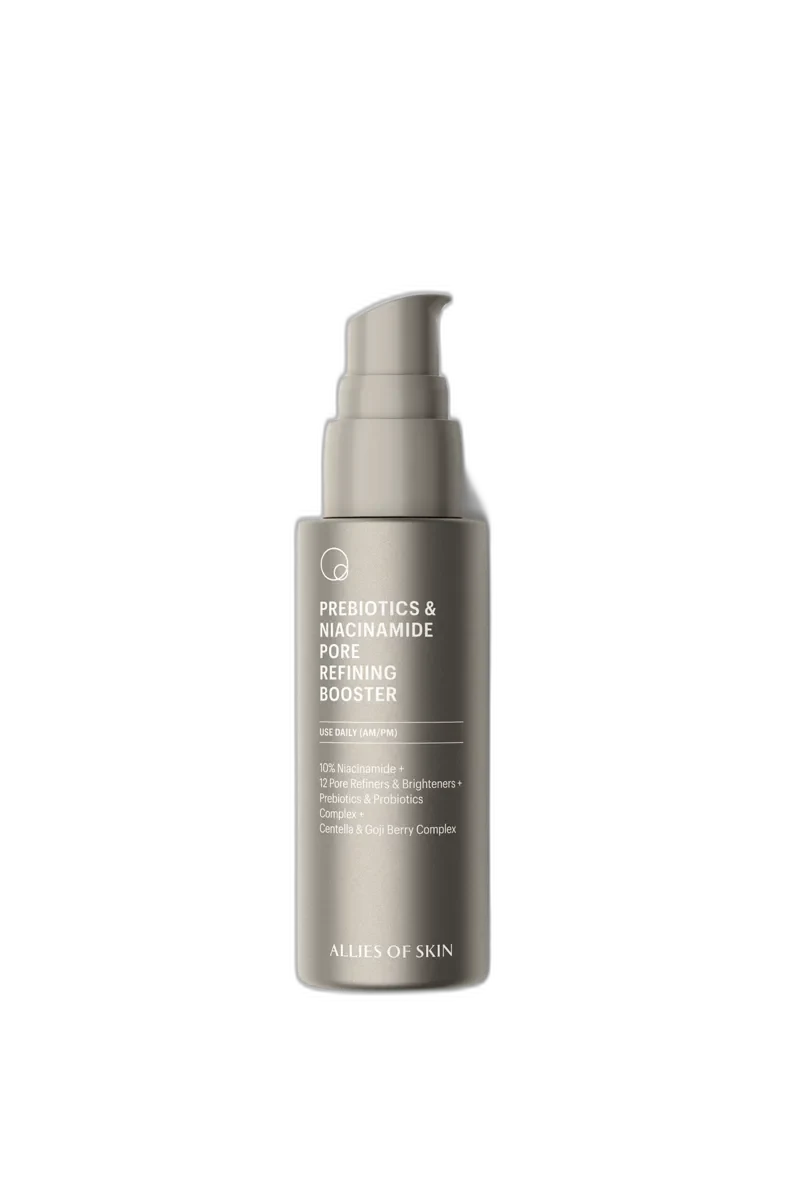
Prebiotics & Niacinamide Pore Refining Booster
Microbiome-Aware Pore Serum
 Verified reviewer
Pros & cons.
- +10% niacinamide at the clinically well-studied concentration
- +Genuine prebiotic and postbiotic microbiome support
- +Low-dose 0.5% BHA for daily pore clarity without irritation
- +Fragrance-free airless pump packaging
- +Comfortable and non-pilling under makeup and sunscreen
- +Includes zinc PCA for sebum regulation cofactor
- −$89 is very expensive for a niacinamide serum
- −The Ordinary delivers the core actives for a fraction of the price
- −Can be drying for dehydrated or dry skin
- −Microbiome ferments may not suit fungal-acne-prone users
- −Pore refinement is slow and requires weeks of consistency
The full review.
A gap exists in the 10% niacinamide serum market. The category splits between The Ordinary’s Niacinamide 10% + Zinc 1% — a five-dollar formula that works — and prestige serums that use the same niacinamide dose in better packaging for thirty times the price. Few brands innovate on the niacinamide concept. Allies of Skin’s Prebiotics & Niacinamide Pore Refining Booster is an exception. Its difference isn’t the niacinamide, zinc, or gentle BHA — those are standard. It is the three-part prebiotic matrix and postbiotic ferments in the base.
This matters because pore visibility and congestion stem from sebum composition, cellular turnover, and the bacterial ecology inside the follicle. Niacinamide manages sebum and cellular turnover. But if the microbiome inside and around pores is unbalanced — with too many wrong strains and not enough right ones — sebum production and inflammation persist regardless of niacinamide levels. The prebiotic matrix here — alpha-glucan oligosaccharide, inulin, and fructooligosaccharides — targets commensal bacteria like S. epidermidis while starving less-beneficial strains. Lactobacillus and Bifida ferment lysates add postbiotic metabolites to support the microbiome. Microbiome skincare evidence is still emerging, but this booster treats the concept more seriously than most pore-refining competitors.
The rest of the formula centers on that microbiome core. Ten percent niacinamide hits the clinically studied dose for sebum reduction and pore appearance. Zinc PCA acts as a sebum-regulating cofactor. Salicylic acid is at 0.5% — low enough to avoid exfoliation-level irritation but high enough to keep pore openings clear daily. Bakuchiol provides a retinol-adjacent signal for textural refinement without retinoid irritation. Ectoin and centella smooth the formula, which sits in a fragrance-free, alcohol-free, essential-oil-free base that feels comfortable for a serum with this many actives.
The texture is a clear, water-light serum that absorbs in twenty seconds and leaves a slight matte finish. It has no tack, residue, or pilling under sunscreen or foundation. The 0.5% BHA stays below the threshold where most users feel tingling. If you use The Ordinary’s niacinamide formula — which can flake or pill for some — this applies more smoothly, and the airless pump protects the ferment and prebiotic payload better than The Ordinary’s dropper.
Results are realistic. Oil control shows by the end of week one — most users report less mid-day shine and a cleaner T-zone. Textural smoothness improves over three to four weeks as the BHA and niacinamide work. Actual pore-appearance refinement is slow and requires eight to twelve weeks of consistent use, matching published niacinamide research. The prebiotic effect is harder to quantify — users tracking skin closely sometimes report fewer congestion episodes and less inflammation, but the effect is subtle and cumulative.
The tension here is value. At $89 for 30ml, you could buy The Ordinary’s Niacinamide 10% + Zinc 1% for about five dollars and get the same core active concentrations. The argument for paying seventeen times more is the microbiome matrix, the airless packaging, the fragrance-free luxury base, and the BHA inclusion — these are real, but none are transformative alone. For enthusiasts wanting the microbiome angle, the math works. For those chasing only niacinamide, The Ordinary remains the value pick.
This formula is not for everyone. Dry skin may find the serum too drying over time — the sebum reduction is real, and 10% niacinamide plus BHA can cause tightness in dehydrated skin. Sensitive and reactive skin should start cautiously; the actives density is high despite the soothing base. Users with fungal acne (malassezia folliculitis) should note that ferments could theoretically exacerbate yeast-driven breakouts, even if the booster is otherwise well-tolerated.
Brand context matters. Allies of Skin is an emerging brand — founded 2016, with no long-form clinical trials on this specific formula — which is fine for a pore serum, as niacinamide evidence is robust and the prebiotic work follows academic microbiome research. You aren’t paying for decades of branded clinical data. You are paying for sophisticated ingredient selection and fragrance-free multitasking.
If you like The Ordinary’s niacinamide work but want a more considered formula with a microbiome angle, try this serum. If you have never tried 10% niacinamide, start with a cheaper option first.
Ingredient analysis.
Full INCI list · pH 5.5
Water/Aqua/Eau, Niacinamide, Glycerin, Propanediol, Pentylene Glycol, Dimethyl Isosorbide, Alpha-Glucan Oligosaccharide, Inulin, Fructooligosaccharides, Lactobacillus Ferment, Bifida Ferment Lysate, Zinc PCA, Salicylic Acid, Hydrolyzed Sodium Hyaluronate, Sodium Hyaluronate, Bakuchiol, Ectoin, Panthenol, Allantoin, Centella Asiatica Extract, Camellia Sinensis Leaf Extract, Portulaca Oleracea Extract, Glycyrrhiza Glabra Root Extract, Tocopherol, Sodium PCA, Trehalose, Xanthan Gum, Carbomer, Ethylhexylglycerin, Disodium EDTA, Phenoxyethanol
Skin match.
The science.
The Science
The niacinamide case is rock-solid. Published studies show topical niacinamide at 2-10% reduces sebum excretion rate, improves enlarged pore appearance, and evens skin tone by interfering with melanosome transfer to keratinocytes. The 10% dose is at the upper end of the studied range and contains most of the pore-refining and sebum-reducing data. Zinc PCA also has supporting evidence as a sebum cofactor, and the niacinamide-zinc pairing is a well-validated combination for oily skin. Salicylic acid at 0.5% is below the typical exfoliating threshold, but it still works to keep pore linings clear and has an established evidence base for comedolysis at higher doses. The microbiome work is less settled. Emerging research shows the prebiotic oligosaccharides — alpha-glucan oligosaccharide, inulin, and FOS — selectively support commensal skin bacteria like S. epidermidis, which may affect barrier function and inflammation. The Lactobacillus and Bifida postbiotic ferments are lysed bacterial preparations that deliver peptides and metabolites; their evidence base is early-stage but growing. The logic — niacinamide for sebum and tone, BHA for pore clarity, prebiotics and postbiotics for microbiome rebalancing — is coherent and follows current academic microbiome research. It is less clear how much extra benefit the microbiome matrix delivers compared to niacinamide and BHA alone. The evidence supports the approach but does not quantify the added benefit, so users should treat the prebiotic work as a promising complement.
Dermatologist Perspective
Dermatologists frequently recommend 10% niacinamide as a first-line topical for patients with oily skin, enlarged pores, and mild hyperpigmentation. Board-certified dermatologists note that niacinamide is one of the best-tolerated cosmetic actives and works alongside prescription treatments without significant interaction concerns. The low-dose salicylic acid and zinc make this booster a sensible daily pore-refining option. Microbiome-aware formulations are a newer frontier; dermatologists view the prebiotic-postbiotic approach as promising but not a substitute for evidence-based actives. For patients seeking the same niacinamide benefit at a lower price, dermatologists often recommend simpler formulations as a starting point.
Where it fits in your routine.
Apply three to four drops to clean skin after toning or essence, morning and evening. Press it into the face, focusing on the T-zone, cheeks, and congested areas. Wait thirty to sixty seconds before applying more serums or moisturizer. In the AM, always use a broad-spectrum SPF 30 or higher — niacinamide is photostable, but the skin still needs protection. Do not layer directly with other BHA products or pure ascorbic acid in one application to avoid redundant exposure. If you are new to 10% niacinamide, use it once daily for the first week, then increase to twice daily.
At $89 for 30ml, this booster costs as much as prestige indie niacinamide serums. The prebiotic-postbiotic matrix, airless packaging, fragrance-free base, and low-dose BHA add formulation value, but they must justify a price roughly seventeen times higher than The Ordinary's equivalent. The math works for skincare enthusiasts interested in microbiome support or users who find budget niacinamide serums irritating or poorly formulated. For users focused purely on the niacinamide work, cheaper options deliver the same core benefit. Only the 30ml size is available, so there is no per-unit savings opportunity.
Oily and combination skin users want a 10% niacinamide formula with a microbiome angle. It works for users who find budget niacinamide serums irritating or prone to pilling. It also suits skincare enthusiasts who want prebiotic and postbiotic support in their pore routine.
The Ordinary's Niacinamide 10% + Zinc 1% works for dry and dehydrated skin, sensitive or reactive skin, fungal-acne-prone skin, and budget-conscious users. It is not the right pick for active acne or significant hyperpigmentation needing stronger treatment.
Product details.
Clear watery serum with a slight slip
Fragrance-free with a very faint neutral scent
An airless pump in a frosted glass bottle protects the ferment and prebiotic payload
This clear, water-light serum absorbs almost instantly. It causes no tingling, stinging, or tightness. The 0.5% salicylic acid stays below the typical sensation threshold. Most users see visible oil reduction by mid-day during the first week; pore appearance changes take longer and require patience.
2.5 to 3 months with twice-daily face application
12 months
All Year
The backstory.
Allies of Skin released the booster as part of a wave of microbiome-focused skincare that emerged around 2019-2020, but with the brand's characteristic maximalist approach — layering prebiotics, postbiotics, niacinamide, zinc, and a low-dose BHA into a single step. It's become a quiet cult favorite among oily-skin enthusiasts.
About Allies of Skin
Emerging Brand (2–5 years)Allies of Skin is an indie brand founded in Singapore in 2016. The Prebiotics & Niacinamide Booster launched in 2020 as the brand expands into microbiome-aware formulas; ingredient transparency, not decades of clinical trials, builds its credibility.
Common myths.
Niacinamide can shrink your pores.
Pore size is genetically fixed, but niacinamide reduces the visual appearance of pores by regulating sebum output and improving skin texture. This booster's prebiotic matrix supports that effect by stabilizing the microbiome.
Prebiotics in skincare are just marketing.
The specific prebiotics used here — alpha-glucan oligosaccharide, inulin, and FOS — have emerging but real research showing they selectively feed beneficial skin bacteria. The evidence base is not as robust as for niacinamide but it's more than decorative.
FAQ.
How does this compare to The Ordinary Niacinamide 10% + Zinc 1%?
Both deliver 10% niacinamide and zinc at the evidence-based concentration. This booster adds a prebiotic-postbiotic matrix and 0.5% salicylic acid, uses airless packaging, and costs more. The Ordinary leads on value for pure niacinamide; this booster targets users wanting the microbiome angle.
Can I use this with other acids or vitamin C?
Do not apply this directly with other BHAs or pure ascorbic acid during the same application. Alternate them between AM and PM or use them on different days to avoid redundant acid exposure.
How long until I see pore improvement?
Oil control shows within days. Textural smoothness improves over 3-4 weeks. Pore-appearance refinement requires 8-12 weeks of consistent daily use.
Is this safe for sensitive skin?
The formula is fragrance-free and contains soothing centella, licorice root, and panthenol. However, the 10% niacinamide and 0.5% salicylic acid can irritate very reactive skin. Patch test first and use it once daily to start.
Will this help with blackheads?
Yes — the niacinamide-zinc-BHA combination and prebiotic microbiome support target the sebum and congestion patterns that cause blackheads. Expect gradual improvement, not overnight results.
Can I use this during pregnancy?
The 0.5% salicylic acid makes this a grey zone. Many dermatologists say low-concentration topical BHA is acceptable during pregnancy, but ask your OB or dermatologist before use.
What the community says.
"visible oil control"
"smoother texture within weeks"
"comfortable under makeup"
"expensive for a niacinamide serum"
"slow pore improvement"
"small bottle"
People also looked at.