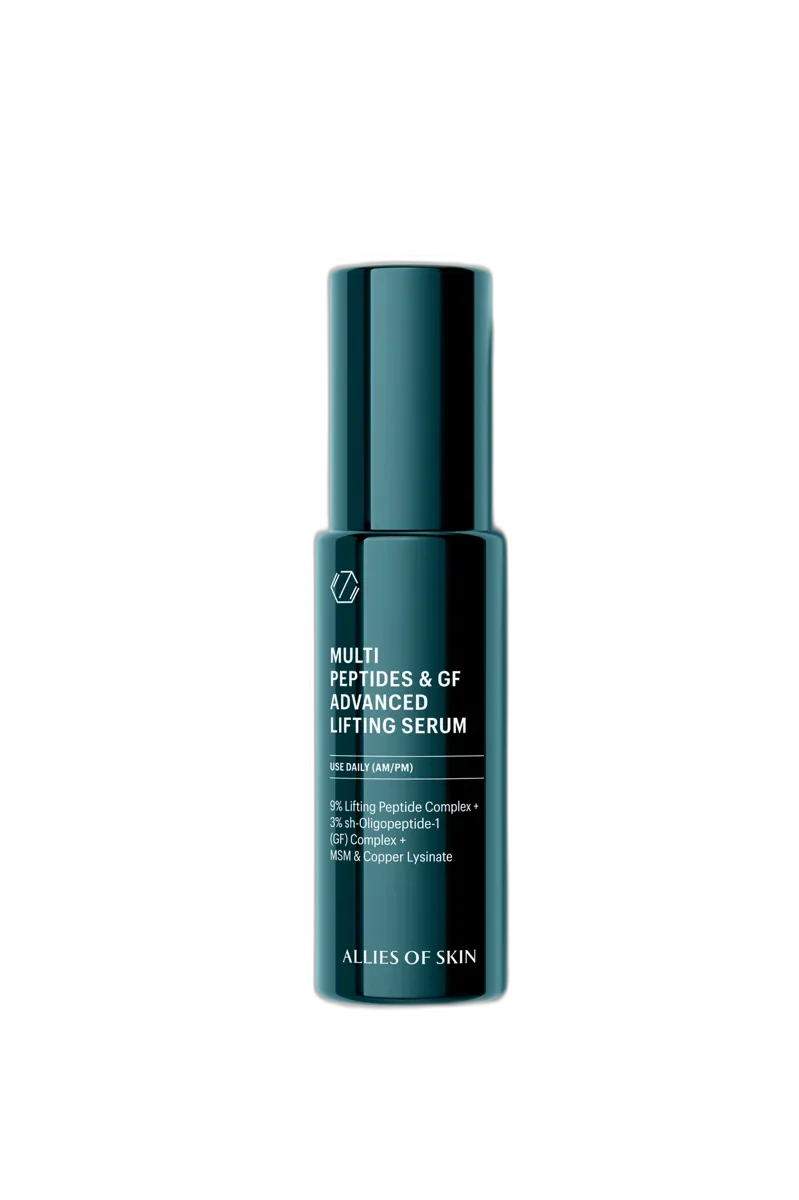
Multi Peptides & GF Advanced Lifting Serum
Peptide Powerhouse
 Verified reviewer
Pros & cons.
- +Over ten peptides stacked in a single fragrance-free serum
- +Includes lab-synthesized growth factor peptides for added signaling
- +Soothing base with centella, panthenol, and allantoin
- +Antioxidant protection from ectoin, ergothioneine, and glutathione
- +Suitable for sensitive and barrier-compromised skin types
- +Pairs cleanly with retinoids and layers under makeup without pilling
- +Fragrance-free, alcohol-free, and fungal-acne-safe
- −$152 for 30ml puts it firmly in prestige pricing territory
- −Results are subtle and cumulative, not dramatic or fast
- −Small size runs out relatively quickly with twice-daily use
- −Limited independent clinical studies on this specific formulation
- −Not a replacement for prescription retinoids or in-office procedures
The full review.
Nicolas Travis built Allies of Skin out of a very specific frustration: he found most serums too polite, too narrow, too willing to hero a single ingredient and call it a day. The Multi Peptides & GF Advanced Lifting Serum is the clearest expression of the opposite philosophy. Crack open the INCI list and you count more than ten distinct peptides — palmitoyl tripeptide-1 and tetrapeptide-7 (the Matrixyl 3000 pair), acetyl hexapeptide-8 (Argireline), palmitoyl tripeptide-38, copper tripeptide-1, nicotinoyl tripeptide-1, acetyl tetrapeptide-2 — layered with five lab-synthesized sh-oligopeptides and sh-polypeptides mimicking EGF, VEGF, and FGF signaling. This is not a serum designed by someone who thinks restraint is a virtue.
The texture is where the formulation starts to feel genuinely considered. For all the density of the actives list, what comes out of the airless pump is a pale, milky serum that flashes to a weightless finish in about forty seconds. There’s no tack, no slip, no fragrance — just a clean hydrated base that disappears under moisturizer and sits calmly beneath foundation without pilling. If you were hoping for dramatic tingling or a sensory signal that something powerful is happening, you won’t get it. That’s the trade-off with peptides and growth factors: they work through slow cellular signaling, not topical sensation.
What the formula does well is obvious within the first few days. The glycerin, sodium hyaluronate, and betaine base delivers immediate plumping, and the 5% niacinamide starts evening out tone within a week or two. The actual firming work is much slower — most users report meaningful softening of fine lines and a subtle lifted quality around the jawline and under-eye area somewhere between weeks six and eight. Peptide research consistently shows that gains continue accumulating through the twelve-week mark, so the reviews complaining about week-two results are missing the point. This is a cumulative treatment, not a flash-in-the-pan glow serum.
Where the formula earns additional respect is in its supporting cast. Bakuchiol slips in as a gentle retinol-alternative signal for users who want retinoid-like remodeling without the irritation. Ectoin and ergothioneine — two of the more sophisticated antioxidants in commercial skincare — protect the peptide cargo from oxidative degradation and shield skin proteins from environmental stress. Glutathione and carnosine add further antioxidant and glycation-protection layers. Centella asiatica, panthenol, and allantoin keep everything soothing. The pH sits in a comfortable 5.5 range, and the formula is completely free of fragrance, alcohol, essential oils, and exfoliating acids. Reactive and barrier-compromised users, who usually have to pick between aggressive anti-aging serums and tolerable ones, get both in a single bottle.
The honest limitations are worth naming. At $152 for 30ml, this sits in the prestige clinical tier — not quite Augustinus Bader or SkinMedica territory, but well above the indie mass-market. A dedicated Matrixyl 3000 serum from a more modest brand will deliver most of the peptide work for a third of the price. What you’re paying for here is the density and the synergy: the fact that you’re hitting collagen synthesis, expression lines, wound-healing pathways, antioxidant protection, and barrier support in a single step rather than stacking three or four serums. For routine minimalists or users who actively want that kind of consolidation, the math can make sense. For anyone who enjoys layering and experimenting, it probably doesn’t.
The other limitation is the expectations gap. Peptide serums are genuinely real in their effects but they are never going to match a prescription retinoid or an in-office procedure. If your goal is erasing deep static wrinkles or significantly resurfacing photo-damaged skin, this serum is a supporting player, not a lead. It shines in the prevention lane and as a soft-remodeling treatment for users in their thirties and forties who want to maintain firmness without pushing their barrier through acid and retinoid cycling.
On brand heritage — Allies of Skin has been around since 2016, which puts it in the emerging tier rather than the established clinical bracket. Independent long-term efficacy studies on its specific formulations are not published, and what you have instead is ingredient transparency, peer-reviewed research on individual peptides and growth factor fragments, and a dedicated niche following. For a peptide serum, that’s a reasonable substitute because the peptide literature is well-developed even if this specific stack hasn’t been clinically trialed. Just go in clear-eyed: you are buying a sophisticated formulation from a thoughtful indie, not a clinically validated drug-grade product.
For the right user, this is one of the more interesting peptide flagships on the market. For everyone else, a focused Matrixyl 3000 or niacinamide serum at a fraction of the price will do eighty percent of the work. Both readings are fair.
Formula
Ingredient analysis.
Full INCI list · pH 5.5
Water/Aqua/Eau, Glycerin, Niacinamide, Propanediol, Dimethyl Isosorbide, Pentylene Glycol, Bis-PEG-18 Methyl Ether Dimethyl Silane, 1,2-Hexanediol, Betaine, Acetyl Hexapeptide-8, Palmitoyl Tripeptide-38, Palmitoyl Tetrapeptide-7, Palmitoyl Tripeptide-1, Copper Tripeptide-1, sh-Oligopeptide-1, sh-Oligopeptide-2, sh-Polypeptide-1, sh-Polypeptide-9, sh-Polypeptide-11, Acetyl Tetrapeptide-2, Nicotinoyl Tripeptide-1, Sodium Hyaluronate, Hydrolyzed Sodium Hyaluronate, Hyaluronic Acid, Bakuchiol, Ectoin, Glutathione, Ergothioneine, Tocopherol, Ubiquinone, Panthenol, Allantoin, Centella Asiatica Extract, Camellia Sinensis Leaf Extract, Adenosine, Carnosine, Sodium PCA, Trehalose, Xanthan Gum, Carbomer, Ethylhexylglycerin, Disodium EDTA, Phenoxyethanol
Skin match.
The science.
The Science
Peptide research is a reliable area of cosmetic science, and this serum uses actives from that literature. Multiple published studies show Palmitoyl pentapeptide-4 and the palmitoyl tripeptide-1/tetrapeptide-7 combination (Matrixyl 3000) upregulate collagen and glycosaminoglycan synthesis in fibroblast cultures and reduce wrinkle depth in human trials at concentrations used in commercial serums. Acetyl hexapeptide-8 (Argireline) targets the SNARE protein complex involved in muscle contraction; placebo-controlled studies show it softens expression lines, though the effect size is smaller than topical or injected neuromodulators. Copper tripeptide-1 is a well-studied peptide; research from the 1990s shows wound-healing and collagen-stimulating effects. This formulation uses a stacking strategy. Instead of one peptide, it combines peptides that target different cellular pathways (collagen signaling, contraction inhibition, wound healing, melanogenesis modulation) with antioxidant extremolytes like ectoin and ergothioneine to protect the peptide cargo from oxidative degradation. The sh-oligopeptides and sh-polypeptides are lab-synthesized peptide fragments modeled on growth factor proteins. Evidence for topical growth factor mimics is promising but less robust than for Matrixyl, and efficacy depends on delivery and stability. The airless pump packaging helps with stability. Note: peptide serums show cumulative effects in 8-12 week studies, so short-term reviews rarely capture their benefit.
Dermatologist Perspective
Dermatologists view multi-peptide serums as a reasonable adjunct to—not a replacement for—prescription retinoids and in-office procedures for anti-aging. Board-certified dermatologists note peptide serums suit patients who cannot tolerate retinoids, are building tolerance, or want to layer complementary mechanisms. The Matrixyl 3000 and Argireline combinations used here have the most published data. The fragrance-free, low-irritant base makes this serum a practical choice for patients with rosacea, sensitive skin, or compromised barriers who want to address firmness and fine lines. The price point is appropriate only for patients seeking a density advantage; for cost-conscious patients, simpler Matrixyl or niacinamide serums are often recommended as a starting point.
Where it fits in your routine.
Apply three to four drops to clean, damp skin after toning or essence, morning and evening. Press gently into the face and neck and allow thirty to sixty seconds for absorption before layering moisturizer. In the AM, always follow with a broad-spectrum SPF 30 or higher. In the PM, layer under a richer moisturizer, and if you use a retinoid, apply the serum first so it acts as a buffering hydrator beneath the retinoid. The airless pump is there for stability reasons — do not decant into another container, as this will expose the peptides and growth factor mimics to oxidation. Consistent twice-daily use for at least eight weeks is necessary before judging the results.
At $152 for 30ml, this serum costs more than most users pay for a peptide product. The math works if you want the density — ten-plus peptides, growth factor mimics, and stabilizing antioxidants in one bottle — instead of buying cheaper single-ingredient serums. Allies of Skin has enough indie credibility and ingredient transparency to avoid the hype premiums of celebrity or influencer brands, but you still pay for brand positioning and formulation. Only one size exists, so there are no per-unit savings. For users on a budget, a $30 Matrixyl serum used consistently outperforms a $152 multi-peptide serum used sporadically — consistency beats sophistication.
Users in their thirties, forties, and fifties seeking a high-density peptide and growth factor serum can use this to consolidate multiple firming actives into one step. It also works for sensitive, rosacea-prone, or barrier-compromised skin that cannot tolerate aggressive retinoids or acids but wants anti-aging support.
This is not for budget-conscious users, beginners who need a focused Matrixyl or niacinamide serum at a lower price, or anyone expecting fast, dramatic results. It also does not suit users targeting active acne, hyperpigmentation, or deep static wrinkles that require prescription retinoids or in-office procedures.
Product details.
Lightweight milky serum that flashes to a soft finish
Fragrance-free with a faint natural scent from plant extracts
An airless pump in a frosted glass bottle protects the peptide and growth factor payload
The application has a silky, watery glide and hyaluronic acid and glycerin provide immediate plumping. It causes no tingling, stinging, or purging. During the first week, it feels like a hydrator rather than a firming treatment. Patience is mandatory; the peptide work is slow and cumulative.
3 months with twice-daily face and neck use
12 months
All Year
The backstory.
Nicolas Travis built Allies of Skin after struggling with adult acne and finding most serums too single-minded. The Multi Peptides & GF launched as the brand's firming flagship, intended to rival prestige clinical peptide serums at a slightly more accessible indie price.
About Allies of Skin
Emerging Brand (2–5 years)Nicolas Travis founded Allies of Skin in 2016 in Singapore. He built the brand using high-concentration multitasking formulas. Allies of Skin has credibility from ingredient transparency and endorsements from derms and estheticians, but as a young indie, it lacks decades of independent clinical research.
FAQ.
Can I use this serum with retinol?
Yes. The fragrance-free, acid-free base and 5% niacinamide make this an ideal layering partner for retinoids — apply the serum first, let it absorb, then follow with your retinoid on dry skin.
Is this suitable for sensitive skin?
Yes. The formula lacks fragrance, alcohol, essential oils, or exfoliating acids despite its dense actives list. It combines peptides with soothing centella and panthenol. Most sensitive users tolerate it well.
How long until I see results?
Hydration starts immediately and skin feels smoother within days. Consistent twice-daily application shows improvements in firmness and fine lines around the 6-8 week mark.
Is the price justified?
If you want a high-density peptide and growth factor serum, yes — this ingredient list combines what several mid-price serums provide separately. If you want hydration or tone, cheaper niacinamide or HA serums work better.
Can I use this during pregnancy?
Most ingredients are safe, but the formula contains bakuchiol and multiple bioactive peptides without specific pregnancy studies. Ask your OB or dermatologist before use.
Does it work well under makeup?
Yes. The fast-absorbing, non-greasy finish leaves a silky base. Primers and foundations sit cleanly on top without pilling.
What the community says.
"visible firming over 2-3 months"
"comfortable under makeup"
"absorbs quickly without residue"
"expensive for the size"
"subtle rather than dramatic results"
"requires patience"
People also looked at.