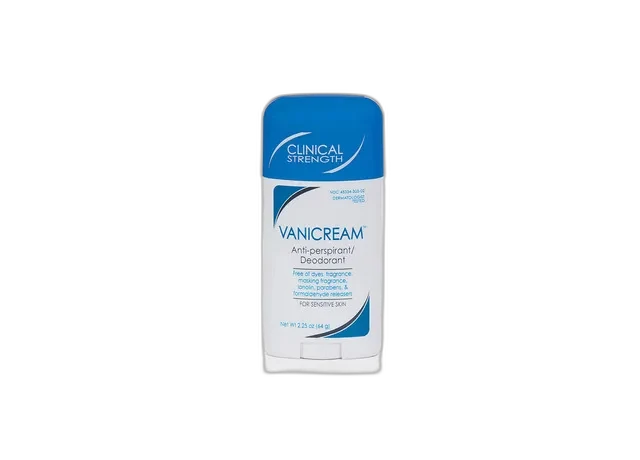
Anti-Perspirant Deodorant
Sensitive Skin Deodorant Standard
 Verified reviewer
Pros & cons.
- +Eliminates all major contact dermatitis triggers — fragrance, dyes, parabens, lanolin, botanicals, baking soda
- +Clinical-strength 20% aluminum zirconium provides effective 24-hour antiperspirant protection
- +Minimal white marks or residue on clothing despite aluminum-based formula
- +Developed by pharmacists with 50+ years of sensitive-skin formulation expertise
- +Only seven inactive ingredients — among the shortest ingredient lists in the category
- +Cruelty-free, vegan, and dermatologist-tested
- −Firm, waxy texture requires warming before smooth application
- −May not provide sufficient sweat control for heavy perspiration or hyperhidrosis
- −Premium price at $9-12 compared to mainstream drugstore deodorants at $4-6
- −Limited retail availability — not always stocked at local pharmacies or grocery stores
- −No moisturizing ingredients for underarms prone to dryness or post-shave irritation
The full review.
Nobody writes love letters about deodorant. It is the most utilitarian product in anyone’s routine — you apply it, you hope it works, and you move on with your day. The only time people think about their deodorant is when it fails, either by letting sweat or odor through or, more insidiously, by irritating the thin, sensitive skin of the underarm until it becomes red, itchy, and raw.
Vanicream’s Anti-Perspirant Deodorant exists specifically for the second failure mode. It was developed by Pharmaceutical Specialties, Inc., a company founded in 1975 by two hospital pharmacists in Rochester, Minnesota, who kept getting the same request from dermatologists: make products that my patients can actually use without reacting. For over fifty years, that mission has produced a line of deliberately boring, aggressively minimal products — and this deodorant is perhaps the most boring and most necessary of them all.
The ingredient list reads like a study in omission. No fragrance. No dyes. No parabens. No formaldehyde releasers. No lanolin. No botanical extracts. No essential oils. No baking soda. No talc. These are not trendy clean-beauty exclusions — they are the specific ingredients that dermatologists identify as the most common causes of contact dermatitis in the underarm area. Vanicream removed them all, and what remains is an aluminum antiperspirant active in a simple silicone-and-wax base. Seven inactive ingredients total.
The active ingredient is aluminum zirconium trichlorohydrex gly at 20%, which is clinical-strength antiperspirant territory. It works the way all aluminum antiperspirants work — by temporarily forming a gel plug in the sweat duct openings, reducing the amount of perspiration that reaches the skin surface. This is well-established FDA-regulated drug mechanism, not cosmetic marketing. It provides 24-hour protection for most people, though those with genuine hyperhidrosis may need prescription-strength options.
The texture is where Vanicream’s philosophy of function-over-form becomes most apparent. This is a firm, waxy stick that requires some pressure to deposit product onto skin. It does not glide with the effortless slip of a gel deodorant or the soft cushion of a cream formula. The minimal ingredient list means there are no softening agents smoothing the application experience. The workaround — running the stick under warm water for a few seconds before use — is effective but represents the kind of minor inconvenience that would never survive a focus group at a mainstream personal care company.
Once applied, the product does what it promises with quiet efficiency. The cyclopentasiloxane base evaporates within a minute, leaving a thin, invisible layer that keeps underarms dry without the chalky residue that aluminum antiperspirants are notorious for. Users consistently report minimal white marks on clothing, which is a genuine achievement for a 20% aluminum formula. The absence of fragrance means there is no scent — not a ‘clean’ scent, not a ‘fresh’ scent, nothing. Your underarm smells like nothing, which is the entire point.
Vanicream has been making products since 1975, giving it over fifty years of credibility in the sensitive-skin space. The brand is not flashy. It has no celebrity partnerships, no social media virality, no aesthetically designed packaging meant for shelfies. What it has is a half-century of dermatologist trust built one functional, minimal product at a time. When a dermatologist tells a patient with contact dermatitis to switch deodorants, Vanicream is frequently the brand they name.
The limitations are straightforward. This is a solid performer for average to moderate perspiration, but heavy sweaters may find it insufficient. The 20% aluminum concentration, while clinical-strength by OTC standards, is not the maximum available — prescription antiperspirants can go significantly higher. The price, typically $9-12 per stick, is notably more than mainstream drugstore deodorants, though comparable to other specialty sensitive-skin formulations.
For the majority of users, the product works exactly as intended. It keeps underarms dry, prevents odor at the source by reducing the sweat bacteria feed on, and does so without triggering the rashes, itching, and burning that conventional deodorants inflict on sensitive skin. This is not a product that inspires excitement. It is a product that inspires relief — the particular relief of finding something that solves a problem so basic you felt embarrassed even having it.
There is a version of this review that would try to make a deodorant sound exciting. But Vanicream’s entire brand identity is built on the idea that personal care products should not be exciting — they should be effective, safe, and boring enough that you never have to think about them. By that standard, this deodorant is a complete success.
About BrandName
Vanicream has been making products since 1975, giving it over fifty years of credibility in the sensitive-skin space. The brand is not flashy. It has no celebrity partnerships, no social media virality, no aesthetically designed packaging meant for shelfies. What it has is a half-century of dermatologist trust built one functional, minimal product at a time. When a dermatologist tells a patient with contact dermatitis to switch deodorants, Vanicream is frequently the brand they name.
Texture
This is a firm, waxy stick that requires some pressure to deposit product onto skin. It does not glide with the effortless slip of a gel deodorant or the soft cushion of a cream formula. The minimal ingredient list means there are no softening agents smoothing the application experience. The workaround — running the stick under warm water for a few seconds before use — is effective but represents the kind of minor inconvenience that would never survive a focus group at a mainstream personal care company.
Scent
The absence of fragrance means there is no scent — not a ‘clean’ scent, not a ‘fresh’ scent, nothing. Your underarm smells like nothing, which is the entire point.
Common Praise
Users consistently report minimal white marks on clothing, which is a genuine achievement for a 20% aluminum formula.
Common Complaints
The limitations are straightforward. This is a solid performer for average to moderate perspiration, but heavy sweaters may find it insufficient. The 20% aluminum concentration, while clinical-strength by OTC standards, is not the maximum available — prescription antiperspirants can go significantly higher. The price, typically $9-12 per stick, is notably more than mainstream drugstore deodorants, though comparable to other specialty sensitive-skin formulations.
Best for
For the majority of users, the product works exactly as intended. It keeps underarms dry, prevents odor at the source by reducing the sweat bacteria feed on, and does so without triggering the rashes, itching, and burning that conventional deodorants inflict on sensitive skin. This is not a product that inspires excitement. It is a product that inspires relief — the particular relief of finding something that solves a problem so basic you felt embarrassed even having it.
Ingredient analysis.
Full INCI list
Active: Aluminum Zirconium Trichlorohydrex Gly 20% (Anhydrous). Inactive: Cyclopentasiloxane, Hydrogenated Poly(C6-14 Olefin), Stearyl Alcohol, Phenyl Trimethicone, Hydrogenated Castor Oil, Cetyl Alcohol, Silica
Skin match.
The science.
The Science
Aluminum zirconium trichlorohydrex gly is an FDA-approved antiperspirant active that works by forming a temporary gel-like plug within the eccrine sweat gland ducts. The mechanism is well-established: aluminum salts react with electrolytes in sweat to form a precipitate that physically obstructs the duct, reducing sweat flow to the skin surface. This effect is reversible — normal sweat function resumes within 24-48 hours of discontinuation as the plugs are cleared through natural skin turnover.
The safety profile of aluminum-based antiperspirants has been extensively reviewed. A 2014 critical review published in Critical Reviews in Toxicology examined the evidence for links between aluminum antiperspirant use and breast cancer, concluding that the available evidence does not support a causal relationship. The Alzheimer's Association similarly states that studies have failed to confirm a role for aluminum in Alzheimer's disease development. The FDA classifies aluminum antiperspirant actives as Category I (generally recognized as safe and effective) when used as directed.
The choice of cyclopentasiloxane as the primary vehicle is dermatologically relevant. Volatile silicones evaporate after application without leaving lipid residue, which makes them ideal carriers for sensitive underarm skin that is already prone to irritation from shaving, friction, and occlusion. Published research in Contact Dermatitis and the Journal of the American Academy of Dermatology has identified fragrance, preservatives, and botanical extracts as the leading causes of allergic contact dermatitis in the axillary area — all of which are excluded from this formula.
References
- Aluminum antiperspirants and breast cancer risk: a critical review — Critical Reviews in Toxicology (2014)
Dermatologist Perspective
Dermatologists frequently recommend Vanicream's antiperspirant for patients presenting with axillary contact dermatitis, particularly when patch testing reveals sensitivities to fragrances, preservatives, or botanical ingredients common in mainstream deodorants. Board-certified dermatologists note that the underarm area is uniquely vulnerable to contact irritation due to thin skin, frequent shaving, and constant friction from clothing. The minimal ingredient list makes it easy to rule out as a sensitization source, and the clinical-strength aluminum active provides practical efficacy alongside the hypoallergenic formulation. For post-procedure patients or those recovering from axillary skin conditions, dermatologists often suggest this as a re-introduction antiperspirant due to its low irritation potential.
Where it fits in your routine.
Apply to clean, dry underarm skin. For best results, apply at night before bed. Aluminum antiperspirants work best when sweat glands are less active, so the aluminum forms a better seal. Reapply in the morning if desired. If the stick feels too firm, run the tip under warm water or press it against your skin for 2-3 seconds to soften it. Two to three even strokes per underarm is sufficient.
At $9-12 per 2.25 oz stick, this is 2-3 times the price of mainstream drugstore antiperspirants. However, for individuals with sensitive skin who have cycled through multiple products that caused irritation, the cost comparison is misleading — the true cost of a cheaper deodorant that causes dermatitis includes the discomfort, the dermatologist visit, and the next product trial. Multi-packs on Amazon and Walmart bring the per-unit cost down to approximately $9, and the stick lasts 3-4 months with daily use, making the annual cost approximately $30-40. For a product backed by over 50 years of dermatologist-trusted formulation, the premium is modest.
People with sensitive, eczema-prone, or allergy-prone skin who react to conventional deodorants. It works well for those with diagnosed contact dermatitis to fragrance, preservatives, or botanical ingredients, and for post-shave sensitivity in the underarm area.
People with heavy perspiration or hyperhidrosis needing maximum-strength sweat control may find this insufficient and should consult a dermatologist about prescription options. Budget-conscious shoppers without sensitive skin concerns can find effective fragrance-free antiperspirants at lower price points.
Product details.
A firm, solid stick with a waxy consistency. It takes a few swipes to warm up and spread evenly. It dries to a smooth, non-tacky finish within one minute.
Fragrance-free. It has no added fragrance, no masking scent, no botanical extracts, and no essential oils. The odor is virtually undetectable.
A standard twist-up deodorant stick in a white cylindrical Vanicream container. The simple, clinical packaging matches the brand's no-frills approach. Multi-packs are also available for value.
The first application feels slightly waxy compared to gel or soft-solid deodorants. Run the stick under warm water briefly to soften the tip for smoother gliding. The product deposits a thin, invisible layer that dries fast. There is no tingling, burning, or sensation — you notice only the absence of any sensation.
3-4 months with daily use
36 months
All Year
The backstory.
Vanicream's entire product line exists because two hospital pharmacists in Rochester, Minnesota were repeatedly asked by dermatologists to create products their sensitive-skin patients could actually tolerate. This deodorant extends that founding mission into one of the most irritant-prone product categories in personal care — where fragrances, dyes, and botanical extracts are the norm rather than the exception.
About Vanicream
Legacy Brand (20+ years)Vanicream was founded in 1975 by pharmacists Conrad Thompson and Edward Mansfield at the request of dermatologists who needed better products for patients with sensitive skin. Pharmaceutical Specialties, Inc. has been developing minimal-irritant formulations for over 50 years and is widely recommended by dermatologists for eczema, allergy-prone, and sensitive skin.
Common myths.
Aluminum in deodorant causes cancer or Alzheimer's disease
Extensive research from the FDA, the National Cancer Institute, and the Alzheimer's Association shows no conclusive scientific evidence linking aluminum-based antiperspirants to cancer or Alzheimer's disease. The American Cancer Society notes that epidemiological studies show no clear link.
Fragrance-free deodorants don't control odor as well
Fragrance in deodorants masks odor instead of preventing it. This product controls odor at the source. The aluminum active reduces sweat, which leaves bacteria with less to feed on. Removing fragrance does not change odor prevention efficacy.
FAQ.
Is Vanicream deodorant safe for eczema-prone skin?
Yes — Vanicream formulates for sensitive and eczema-prone skin. It excludes common irritants like fragrance, dyes, parabens, formaldehyde releasers, lanolin, botanical extracts, and baking soda. Many users with eczema and contact dermatitis say this is the only antiperspirant they tolerate without flare-ups.
Does Vanicream deodorant actually stop sweating?
Yes — the 20% aluminum zirconium trichlorohydrex gly is a clinical-strength antiperspirant active. It temporarily plugs sweat gland ducts to reduce perspiration. It provides 24-hour protection for most users, but those with hyperhidrosis (excessive sweating) may need more for heavy perspiration.
Why is Vanicream deodorant so hard to apply?
The firm, waxy texture comes from the minimal ingredient list. Without the softening agents and slip enhancers in mainstream deodorants, the stick feels stiff at first. Run the tip under warm water for a few seconds or press it against your skin before swiping to soften it for smoother application.
Does Vanicream deodorant leave white marks?
Users report little to no white marks on clothing, even for an aluminum-based antiperspirant. The cyclopentasiloxane base evaporates cleanly. The formula lacks the talc or heavy waxes that cause white residue on dark fabrics.
Is Vanicream deodorant aluminum-free?
No — this specific product uses 20% aluminum zirconium trichlorohydrex gly as its active antiperspirant ingredient. Vanicream also makes an aluminum-free deodorant gel if you want to avoid aluminum entirely. The aluminum-free version controls odor but does not reduce perspiration.
What the community says.
"Highly effective for sensitive skin — no irritation, itching, or rashes"
"Keeps underarms dry and odor-free for a full day"
"Does not leave white marks or residue on clothing"
"Frequently recommended by dermatologists for patients with eczema or allergies"
"Fragrance-free without any masking scent"
"Waxy, dry texture can make initial application slightly difficult"
"May not provide enough sweat control for heavy perspiration"
"Premium price compared to mainstream drugstore deodorants"
"Limited availability — not always stocked in local pharmacies"
"Some users report a dry feeling that lingers on the skin"